Articles | Volume 9, issue 2
https://doi.org/10.5194/gc-9-139-2026
© Author(s) 2026. This work is distributed under
the Creative Commons Attribution 4.0 License.
Special issue:
https://doi.org/10.5194/gc-9-139-2026
© Author(s) 2026. This work is distributed under
the Creative Commons Attribution 4.0 License.
GC Insights: Designing for inquiry in virtual fieldwork

Rie Hjørnegaard Malm
CORRESPONDING AUTHOR
Department of Design, Media and Educational Science, University of Southern Denmark, Odense, 5230, Denmark
Kristen Rune Skalborg Hansen
KVUC – Copenhagen Adult Education Centre, Copenhagen, 1120, Denmark
Robert Evans
Department Science Education, University of Copenhagen, Copenhagen, 2200, Denmark
Lene Møller Madsen
Department Science Education, University of Copenhagen, Copenhagen, 2200, Denmark
Jesper Milán
KALK – Museums of East Zealand, Faxe, 4640, Denmark
Nicolas Thibaut
Department Department of Geosciences and Natural Resource Management, University of Copenhagen, Copenhagen, 1958, Denmark
Ben Kennedy
School of Earth and Environment, University of Canterbury, Christchurch, 8140, Aotearoa New Zealand
Related authors
No articles found.
Sriparna Saha, Ben Kennedy, Alexander R. L. Nichols, Erik Brogt, Nikita Harris, and Simon Hoermann
Geosci. Commun., 9, 127–138, https://doi.org/10.5194/gc-9-127-2026, https://doi.org/10.5194/gc-9-127-2026, 2026
Short summary
Short summary
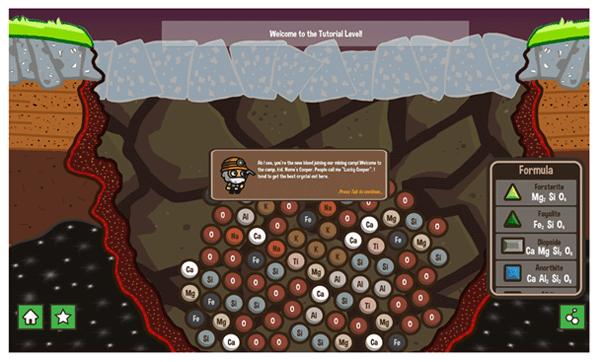
Teaching topics like fractional crystallization and mineralogy can be challenging in university geology classes, because students often focus more on following steps than truly understanding the underlying concepts. To make learning more engaging, a serious educational game called Magma Pop was developed to illustrate fractional crystallization. Magma Pop demonstrates how the magma composition changes as minerals crystallize out in a gamified environment.
Iris Fernandes, Klaus Mosegaard, Aske L. Sørensen, Mohammad Youssof, Nicolas Thibault, and Tais W. Dahl
EGUsphere, https://doi.org/10.5194/egusphere-2025-6145, https://doi.org/10.5194/egusphere-2025-6145, 2026
This preprint is open for discussion and under review for Geoscientific Model Development (GMD).
Short summary
Short summary
We introduce a new method to more precisely date ancient sediment layers using astronomical time cycles recorded in the rock. Unlike previous tools, it handles complex, multi-channel data without oversimplifying and gives clear estimates of dating uncertainty. This helps future research in better understand Earth’s past climate, biological changes, and geologic events with greater confidence and accuracy.
Ben Kennedy, Kamen Engel, Jonathan Davidson, Sylvia Tapuke, Dan Hikuroa, Tim Martin, and Pinelopi Zaka
Geosci. Commun., 8, 107–124, https://doi.org/10.5194/gc-8-107-2025, https://doi.org/10.5194/gc-8-107-2025, 2025
Short summary
Short summary
We added more science communication activities and cultural content from Māori cultural experts in a course that combines online interactive virtual fieldtrip content with reflective workshops, laboratory sessions, and fieldwork, to reflect a need for these skills in the Aotearoa NZ workforce. Students mentioned science communication and cultural competence more when responding to a survey question regarding
What they learnt?, and they highlighted the importance that these skills might have for themselves.
Pedro Doll, Shaun Robert Eaves, Ben Matthew Kennedy, Pierre-Henri Blard, Alexander Robert Lee Nichols, Graham Sloan Leonard, Dougal Bruce Townsend, Jim William Cole, Chris Edward Conway, Sacha Baldwin, Gabriel Fénisse, Laurent Zimmermann, and Bouchaïb Tibari
Geochronology, 6, 365–395, https://doi.org/10.5194/gchron-6-365-2024, https://doi.org/10.5194/gchron-6-365-2024, 2024
Short summary
Short summary
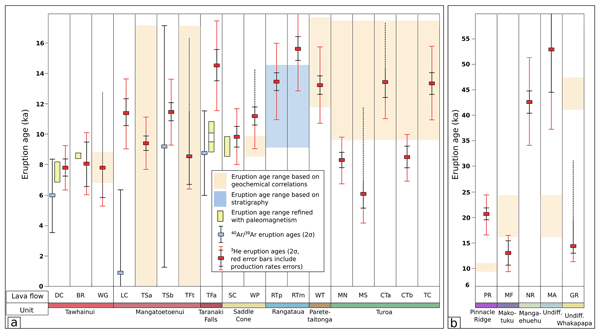
In this study, we use cosmogenic-sourced 3He to determine the eruption ages of 23 lava flows at Mt Ruapehu, Aotearoa New Zealand, and we show how this method can help overcome challenges associated with traditional dating methods in young lavas. Comparison with other methods demonstrates the accuracy of our data and the method's reliability. The new eruption ages allowed us to identify periods of quasi-simultaneous activity from different volcanic vents during the last 20 000 years.
Stephen P. Hesselbo, Aisha Al-Suwaidi, Sarah J. Baker, Giorgia Ballabio, Claire M. Belcher, Andrew Bond, Ian Boomer, Remco Bos, Christian J. Bjerrum, Kara Bogus, Richard Boyle, James V. Browning, Alan R. Butcher, Daniel J. Condon, Philip Copestake, Stuart Daines, Christopher Dalby, Magret Damaschke, Susana E. Damborenea, Jean-Francois Deconinck, Alexander J. Dickson, Isabel M. Fendley, Calum P. Fox, Angela Fraguas, Joost Frieling, Thomas A. Gibson, Tianchen He, Kat Hickey, Linda A. Hinnov, Teuntje P. Hollaar, Chunju Huang, Alexander J. L. Hudson, Hugh C. Jenkyns, Erdem Idiz, Mengjie Jiang, Wout Krijgsman, Christoph Korte, Melanie J. Leng, Timothy M. Lenton, Katharina Leu, Crispin T. S. Little, Conall MacNiocaill, Miguel O. Manceñido, Tamsin A. Mather, Emanuela Mattioli, Kenneth G. Miller, Robert J. Newton, Kevin N. Page, József Pálfy, Gregory Pieńkowski, Richard J. Porter, Simon W. Poulton, Alberto C. Riccardi, James B. Riding, Ailsa Roper, Micha Ruhl, Ricardo L. Silva, Marisa S. Storm, Guillaume Suan, Dominika Szűcs, Nicolas Thibault, Alfred Uchman, James N. Stanley, Clemens V. Ullmann, Bas van de Schootbrugge, Madeleine L. Vickers, Sonja Wadas, Jessica H. Whiteside, Paul B. Wignall, Thomas Wonik, Weimu Xu, Christian Zeeden, and Ke Zhao
Sci. Dril., 32, 1–25, https://doi.org/10.5194/sd-32-1-2023, https://doi.org/10.5194/sd-32-1-2023, 2023
Short summary
Short summary
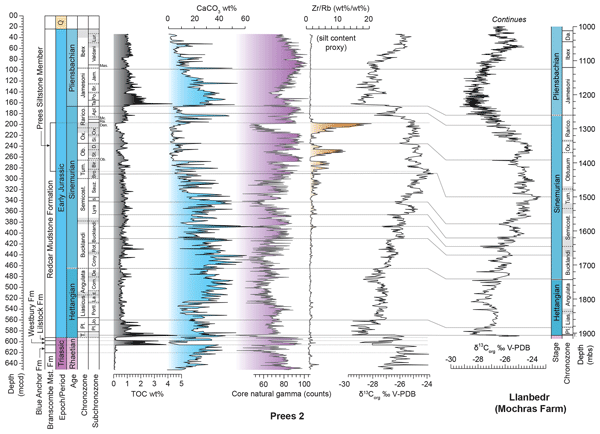
We present initial results from a 650 m long core of Late Triasssic to Early Jurassic (190–202 Myr) sedimentary strata from the Cheshire Basin, UK, which is shown to be an exceptional record of Earth evolution for the time of break-up of the supercontinent Pangaea. Further work will determine periodic changes in depositional environments caused by solar system dynamics and used to reconstruct orbital history.
Morgan T. Jones, Ella W. Stokke, Alan D. Rooney, Joost Frieling, Philip A. E. Pogge von Strandmann, David J. Wilson, Henrik H. Svensen, Sverre Planke, Thierry Adatte, Nicolas Thibault, Madeleine L. Vickers, Tamsin A. Mather, Christian Tegner, Valentin Zuchuat, and Bo P. Schultz
Clim. Past, 19, 1623–1652, https://doi.org/10.5194/cp-19-1623-2023, https://doi.org/10.5194/cp-19-1623-2023, 2023
Short summary
Short summary
There are periods in Earth’s history when huge volumes of magma are erupted at the Earth’s surface. The gases released from volcanic eruptions and from sediments heated by the magma are believed to have caused severe climate changes in the geological past. We use a variety of volcanic and climatic tracers to assess how the North Atlantic Igneous Province (56–54 Ma) affected the oceans and atmosphere during a period of extreme global warming.
Richard N. Holdaway, Ben Kennedy, Brendan M Duffy, Jiandong Xu, and Clive Oppenheimer
Geochronology Discuss., https://doi.org/10.5194/gchron-2021-13, https://doi.org/10.5194/gchron-2021-13, 2021
Revised manuscript not accepted
Short summary
Short summary
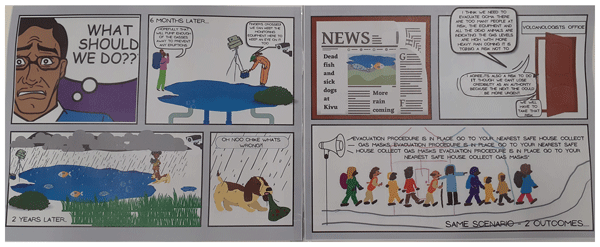
Prehistoric volcanic eruptions are often dated by wiggle matching series of radiocarbon ages on tree rings to standard calibration curves, ignoring potential contamination by 'old' carbon given off by the volcano. We modeled the effects of low amounts of contamination on wiggle match dates for the 10th century Changbaishan eruption and found evidence of contamination in all. We propose a new protocol to identify the presence of contamination, and provide more secure dates for major eruptions.
Cited articles
Anderson, L. W. and Krathwohl, D. R. (Eds.): A taxonomy for learning, teaching, and assessing: A revision of Bloom's taxonomy of educational objectives, Abridged, New York, Longman, ISBN 0-321-08405-5, 2001.
Anderson, R. D.: Reforming Science Teaching: What Research Says About Inquiry, Journal of Science Teacher Education, 13, 1–12, https://doi.org/10.1023/A:1015171124982, 2002.
Bonali, F. L., Russo, E., Vitello, F., Antoniou, V., Marchese, F., Fallati, L., Bracchi, V., Corti, N., Savini, A., Whitworth, M., Drymoni, K., Mariotto, F. P., Nomikou, P., Sciacca, E., Bressan, S., Falsaperla, S., Reitano, D., van Wyk de Vries, B., Krokos, M., Panieri, G., Stiller-Reeve, M. A., Vizzari, G., Becciani, U., and Tibaldi, A.: How academics and the public experienced immersive virtual reality for geo-education, Geosciences, 12, 9, https://doi.org/10.3390/geosciences12010009, 2021.
Bond, C. E. and Cawood, A. J.: A role for virtual outcrop models in blended learning – improved 3D thinking and positive perceptions of learning, Geosci. Commun., 4, 233–244, https://doi.org/10.5194/gc-4-233-2021, 2021.
Bond, C. E., Pugsley, J. H., Kedar, L., Ledingham, S. R., Skupinska, M. Z., Gluzinski, T. K., and Boath, M. L.: Learning outcomes, learning support, and cohort cohesion on a virtual field trip: an analysis of student and staff perceptions, Geosci. Commun., 5, 307–323, https://doi.org/10.5194/gc-5-307-2022, 2022.
Bybee, R. W.: The BSCS 5E instructional model and 21st century skills, Workshop on Exploring the Intersection of Science Education and the Development of 21st Century Skills, National Academies Board on Science Education, https://citeseerx.ist.psu.edu/viewdoc/download?doi=10.1.1.674.6559&rep=rep1&type=pdf (last access: 31 March 2026), 2009.
Bybee, R. W., Taylor, J. A., Gardner, A., Van Scotter, P., Powell, J. C., Westbrook, A., and Landes, N.: The BSCS 5E instructional model: Origins and effectiveness, Colorado Springs, Co: BSCS, 88–98, https://fremonths.org/ourpages/auto/2008/5/11/1210522036057/bscs5efullreport2006.pdf (last access: 31 March 2026), 2006.
Cawood, A. and Bond, C.: eRock: An open-access repository of virtual outcrops for geoscience education, GSA Today, 29, 36–37, https://doi.org/10.1130/GSATG373GW.1, 2019.
Cliffe, A. D.: A review of the benefits and drawbacks to virtual field guides in today's Geoscience higher education environment, International Journal of Educational Technology in Higher Education, 14, 28, https://doi.org/10.1186/s41239-017-0066-x, 2017.
Dewey, J.: How we think, Heath, Boston, 1933.
Dolphin, G., Dutchak, A., Karchewski, B., and Cooper, J.: Virtual field experiences in introductory geology: Addressing a capacity problem, but finding a pedagogical one, Journal of Geoscience Education, 67, 114–130, https://doi.org/10.1080/10899995.2018.1547034, 2019.
El-Mowafy, A.: Using peer assessment of fieldwork to enhance students' practical training, Assess. Eval. High. Edu., 39, 223–241, https://doi.org/10.1080/02602938.2013.820823, 2014.
Eisenkraft, A.: Expanding the 5E model, The Science Teacher, 70, 56–59, 2003.
Elkins, J. T. and Elkins, N. M.: Teaching geology in the field: Significant geoscience concept gains in entirely field-based introductory geology courses, Journal of Geoscience Education, 55, 126–132, https://doi.org/10.5408/1089-9995-55.2.126, 2007.
Engel, K. T., Davidson, J., Jolley, A., Kennedy, B., and Nichols, A. R. L.: Development of a virtual microscope with integrated feedback for blended geology labs, Journal of Geoscience Education, 72, 367–381, https://doi.org/10.1080/10899995.2023.2202285, 2023.
Evelpidou, N., Karkani, A., Komi, A., Giannikopoulou, A., Tzouxanioti, M., Saitis, G., Spyrou, E., and Gatou, M.-A.: GIS-Based Virtual Field Trip as a Tool for Remote Education, Geosciences, 12, 327, https://doi.org/10.3390/geosciences12090327, 2022.
Foley, K., Petcovic, H. L., and Semken, S.: How college geoscience instructors report finding and implementing virtual field experiences for their courses, Journal of Geoscience Education, 72, 450–462, https://doi.org/10.1080/10899995.2024.2334179, 2024.
Furtak, E. M., Seidel, T., Iverson, H., and Briggs, D. C.: Experimental and quasi-experimental studies of inquiry-based science teaching: A meta-analysis, Rev. Educ. Res., 82, 300–329, https://doi.org/10.3102/0034654312457206, 2012.
Granshaw, F. and Duggan-Haas, D.: Virtual fieldwork in geoscience teacher education: Issues, techniques and models, in: Google earth and virtual visualizations in geoscience education and research, edited by: Whitmeyer, S, Bailey, J. E., De Paor, D. G., and Ornduff, T., Geological Society of America, 285–303, https://doi.org/10.1130/2012.2492(20), 2012.
Guillaume, L., Laurent, V., and Genge, M. J.: Immersive and interactive three-dimensional virtual fieldwork: Assessing the student learning experience and value to improve inclusivity of geosciences degrees, Journal of Geoscience Education, 71, 462–475, https://doi.org/10.1080/10899995.2023.2200361, 2023.
Herodotou, C., Muirhead, D. K., Aristeidou, M., Hole, M. J., Kelley, S., Scanlon, E., and Duffy, M.: Blended and online learning: a comparative study of virtual microscopy in Higher Education, Interact. Learn. Envir., 28, 713–728, https://doi.org/10.1080/10494820.2018.1552874, 2020.
Heiss, E. D., Obourn, E. S., and Hoffman, C. W.: Modern Science Teaching, New York: Macmillan, 1950.
Houghton, J. J., Lloyd, G. E., Robinson, A., Gordon, C. E., and Morgan, D. J.: The Virtual Worlds Project: geological mapping and field skills, Geology Today, 31, 227–231, https://doi.org/10.1111/gto.12117, 2015.
Hurrell, E. R., Hutchinson, S. M., Yorke, L., Batty, L. C., Bunting, M. J., Swanton, D., McDougall, D. A., and Parsons, D. R.: The role of virtual field trips in Geography higher education: A perspective paper, Area, e70011, https://doi.org/10.1111/area.70011, 2025.
Hurst, S.: Use of virtual field trips in teaching introductory geology, Comput. Geosci., 24, 653–658, https://doi.org/10.1016/S0098-3004(98)00043-0, 1998.
Jeffery, A. J., Rogers, S. L., Jeffery, K. L. A., and Hobson, L.: A flexible, open, and interactive digital platform to support online and blended experiential learning environments: Thinglink and thin sections, Geosci. Commun., 4, 95–110, https://doi.org/10.5194/gc-4-95-2021, 2021.
Jolley, A., Kennedy, B. M., Brogt, E., Hampton, S. J., and Fraser, L.: Are we there yet? Sense of place and the student experience on roadside and situated geology field trips, Geosphere, 14, 651–667, https://doi.org/10.1130/GES01484.1, 2018.
Karplus, R. and Their, H. D.: A new look at elementary school science, new trends in curriculum and instruction series, Chicago: Rand McNally and Co., 1967.
Kennedy, B., Engel, K., Davidson, J., Tapuke, S., Hikuroa, D., Martin, T., and Zaka, P.: Incorporating science communication and bicultural knowledge in teaching a blended volcanology course, Geosci. Commun., 8, 107–124, https://doi.org/10.5194/gc-8-107-2025, 2025.
Klippel, A., Zhao, J., Oprean, D., Wallgrün, J. O., Stubbs, C., La Femina, P., and Jackson, K. L.: The value of being there: Toward a science of immersive virtual field trips, Virtual Real., 24, 753–770, https://doi.org/10.1007/s10055-019-00418-5, 2020.
Kolb, D.: Experiential learning: Experience as the source of learning and development, New Jersey: Prentice-Hall, 1984.
Kolbert, E.: The sixth extinction: An unnatural history, New York: Henry Holt and Company, ISBN 9781408851210, 2014.
Madsen, L. M., Evans, R., and Bruun, J.: Inquiry-based teaching: The 6F model – its origin and development in Denmark [Undersøgelsesbaseret undervisning: 6F-modellen – dens tilblivelse og udvikling i Danmark], MONA, 1, 26–45, 2020.
Madsen, L. M., Evans, R., and Malm, R. H.: Using a Wicked Problem for Inquiry-Based Fieldwork in High School Geology: Addressing Climate Change and Mass Extinction Events, in: Addressing Wicked Problems through Science Education: The Role of Out-of-School Experiences, edited by: Dillon, J., Achiam, M., and Glackin, M. Springer, 167–188, https://doi.org/10.1007/978-3-030-74266-9_9, 2021.
Malm, R. H.: Designing for inquiry in virtual fieldwork: using explorations of extinction event to teach climate change, Zenodo [data set], https://doi.org/10.5281/zenodo.18596104, 2026.
Malm, R. H., Madsen, L. M., and Lundmark, A. M.: Students' negotiations of belonging in geoscience: Experiences of faculty–student interactions when entering university, J. Geogr. Higher Educ., 44, 532–549, https://doi.org/10.1080/03098265.2020.1771683, 2020.
Minner, D. D., Levy, A. J., and Century, J.: Inquiry-based science instruction – what is it and does it matter? Results from a research synthesis years 1984 to 2002, J. Res. Sci. Teach., 47, 474–496, 2010.
Mogk, D. W. and Goodwin, C.: Learning in the field: Synthesis of research on thinking and learning in the geosciences, in: Earth and mind II: A synthesis of research on thinking and learning in the geosciences, edited by: Kastens, K. A. and Manduca, C. A., Special Paper 486, The Geological Society of America, https://doi.org/10.1130/2012.2486(24), 2012.
Nyarko, S. C. and Petcovic, H. L.: Do students develop teamwork skills during geoscience fieldwork? A case study of a hydrogeology field course, Journal of Geoscience Education, 71, 145–157, https://doi.org/10.1080/10899995.2022.2107368, 2023.
Posselt, J. R. and Nuñez, A. M.: Learning in the wild: Fieldwork, gender, and the social construction of disciplinary culture, J. High. Educ., 93, 163–194, https://doi.org/10.1080/00221546.2021.1971505, 2022.
Pugsley, J. H., Howell, J. A., Hartley, A., Buckley, S. J., Brackenridge, R., Schofield, N., Maxwell, G., Chmielewska, M., Ringdal, K., Naumann, N., and Vanbiervliet, J.: Virtual field trips utilizing virtual outcrop: construction, delivery and implications for the future, Geosci. Commun., 5, 227–249, https://doi.org/10.5194/gc-5-227-2022, 2022.
Rojas-Sánchez, M. A., Palos-Sánchez, P. R., and Folgado-Fernández, J. A.: Systematic literature review and bibliometric analysis on virtual reality and education, Education and Information Technologies, 28, 155–192, https://doi.org/10.1007/s10639-022-11167-5, 2023.
Rönnebeck, S., Bernholt, S., and Ropohl, M.: Searching for a common ground – A literature review of empirical research on scientific inquiry activities, Stud. Sci. Educ., 52, 161–197, https://doi.org/10.1080/03057267.2016.1206351, 2016.
Saha, S., Tapuke, S., Kennedy, B., Tolbert, S., Tapuke, K., Macfarlane, A., Hersey, S., Leonard, G., Tupe, R., Ngaropo, P., Milroy, K., and Smith, B.: A place-based virtual field trip resource that reflects understandings from multiple knowledge systems for volcano hazard education in Aotearoa NZ: Lessons from collaborations between Māori and non-Māori, Journal of Geoscience Education, 71, 388–402, https://doi.org/10.1080/10899995.2022.2109397, 2023.
Senger, K., Betlem, P., Birchall, T., Buckley, S. J., Coakley, B., Eide, C. H., Flaig, P. P., Forien, M., Galland, O., Gonzaga, L., Jensen, M., Kurz, T., Lecomte, I., Mair, K., Malm, R. H., Mulrooney, M., Naumann, N., Nordmo, I., Nolde, N., Ogata, K., Rabbel, O., Schaaf, N. W., and Smyrak-Sikora, A.: Using digital outcrops to make the high Arctic more accessible through the Svalbox database, Journal of Geoscience Education, 69, 123–137, https://doi.org/10.1080/10899995.2020.1813865, 2021.
Stokes, A. and Boyle, A. P.: The undergraduate geoscience fieldwork experience: Influencing factors and implications for learning, in: Field geology education: Historical perspectives and modern approaches, edited by: Whitmeyer, S. J., Mogk, D. W., and Pyle, E. J., Special Paper 461, The Geological Society of America, https://doi.org/10.1130/2009.2461(23), 2009.
Watson, A., Kennedy, B. M., Jolley, A., Davidson, J., and Brogt, E.: Design, implementation, and insights from a volcanology Virtual Field Trip to Iceland, Volcanica, 5, 451–467, https://doi.org/10.30909/vol.05.02.451467, 2022.
Whitmeyer, S. J. and Dordevic, M.: Creating virtual geologic mapping exercises in a changing world, Geosphere, 17, 226–243, https://doi.org/10.1130/GES02308.1, 2021.
Short summary
This GC Insights presents a virtual fieldwork module integrating 360 videos and inquiry-based learning to support geoscience education at the upper secondary level. The design enables students to engage in scientific practices, including data collection, interpretation, and hypothesis formation. The paper discusses how virtual environments can facilitate an exploratory learning and foster deeper conceptual understanding, when designed carefully as an inquiry lesson.
This GC Insights presents a virtual fieldwork module integrating 360 videos and inquiry-based...
Special issue
Altmetrics
Final-revised paper
Preprint