the Creative Commons Attribution 4.0 License.
the Creative Commons Attribution 4.0 License.
 | 02 Apr 2026
GC Insights: Designing for inquiry in virtual fieldwork
Rie Hjørnegaard Malm
Kristen Rune Skalborg Hansen
Robert Evans
Lene Møller Madsen
Jesper Milán
Nicolas Thibaut
Ben Kennedy
In virtual field courses, it is challenging to design a truly explorative course element. In relation to theories of student learning, more inquiry and student-centred virtual fieldwork have been proposed to facilitate student exploration and engagement. Here, we outline the development of an inquiry virtual fieldwork activity using 360° videos, along with additional classroom tools that allow students to collect data, develop hypotheses independently, and combine them with known science to draw geologically viable conclusions.
- Article
(1137 KB) - Full-text XML
- BibTeX
- EndNote


Technological advancement has enabled the production of low-cost virtual field experiences with a variety of aims (Cliffe, 2017; Dolphin et al., 2019; Klippel et al., 2020; Foley et al., 2024; Rojas-Sánchez et al., 2023). The use of virtual fieldwork in learning situations was favoured during the COVID-19 pandemic, when field-based teaching became impossible in many locations (e.g., Whitmeyer and Dordevic, 2021; Bond and Cawood, 2021; Jeffery et al., 2021). In addition, a growing recognition of the inequities associated with physical fieldwork has led to an increased interest in developing virtual field trips (Malm et al., 2020; Posselt and Nuñez, 2022; Guillaume et al., 2023; Hurrell et al., 2025). Despite these developments, the research field, especially at the upper secondary level, is still grappling with integrating virtual fieldwork with the inquiry-based learning approach. However, inquiry as a pedagogical method has long been a focus in science teaching and learning (Anderson, 2002). Here, we present a virtual fieldwork inquiry lesson, specify the pedagogical intentions behind the design, and make the lesson available in Malm (2026).
Teaching in the field is a central pedagogical practice in Earth science, where materials and processes are connected, theoretical knowledge is made relevant, and, through this, students' understanding of key scientific principles is enhanced (Elkins and Elkins, 2007; Stokes and Boyle, 2009; Mogk and Goodwin, 2012). While the close connection between exploratory fieldwork and scientific advancements is well established, the link between exploration and teaching in the field is less prominent. The open exploration of scientific fieldwork is replaced by designed field trips or excursions to selected locations or outcrops. According to Granshaw and Duggan-Haas (2012), this linear design lacks the fundamental exploratory nature of fieldwork, and they make a distinction between a field trip designed with a predetermined, linear structure and a fieldwork design that includes exploration. In a linear design, active movement through different geologic times can foster appreciation for situated fieldwork settings (Jolley et al., 2018), but the pre-design often does not allow for student inquiry. Creating opportunities for exploration is also a challenge in a virtual fieldwork design, where the developer pre-selects content (Hurst, 1998). Here, we create a virtual field environment in which the student's task is to explore and collect data as they enter the virtual world and to produce their own hypotheses. We use an inquiry-based learning design to achieve this.
Technological innovations have created a new generation of Earth science courses (e.g. Senger et al., 2021; Whitmeyer and Dordevic, 2021; Cawood and Bond, 2019; Bond and Cawood, 2021; Herodotou et al., 2020; Bond et al., 2022; Engel et al., 2023). However, as geoscience instructors, computer scientists, and psychologists have embraced the opportunity to develop new formats and measure the impacts of these technologies, Glenn Dolphin and colleagues (2019) find that while they tried to mitigate a large student population problem with virtual reality, they found a fundamental pedagogical problem of how we teach geology. They propose teaching “geology with more emphasis on how geology works” (Dolphin et al., 2019, p. 114) to better understand the relationship between inference and observation in fieldwork. This emphasis is central to inquiry-based learning; here, teaching is structured around students' explorations, and the design precisely distinguishes between inference and observation. The ideas can be traced back to the early twentieth century, when John Dewey described five phases of reflective thinking (Dewey, 1933), which, for example, inspired problem-based learning and concepts of learning cycle models (Heiss et al., 1950; Karplus and Their, 1967; Kolb, 1984). These models are based on learners exploring for themselves as they create valid arguments based on observations or data. In the 1980s, these concepts were formalised in science education as the “5E model”, introducing the phases Engage, Explore, Explain, Expand, and Evaluate, and emphasising the sequencing of these phases to support student learning (Bybee, 2009; Bybee et al., 2006). Decades later, both Minner et al. (2010) and Anderson (2002) summarise the development until the start of the millennium. Although research on inquiry does not produce definitive results due to the complex character of learning science, much has been done to include inquiry in curriculums and training science teachers in inquiry practices. There is now a general acceptance within science education that inquiry fosters learning and engagement in science (Furtak et al., 2012; Rönnebeck et al., 2016; Madsen et al., 2020).
The inquiry lesson is designed for Danish upper secondary students (ages 16–19) enrolled in an elective Physical Geography course. The module can be run as a single 1.5 h module or as two 1.5 h modules, depending on prior experience with inquiry and/or virtual environments. The learning goals for the lesson: students should be able to observe and distinguish three field localities, classify their rocks and fossils, determine their relative ages, and use this information to infer past environments and geological time. The localities are Møns Klint, Stevns Klint, and Faxe Kalkbrud, which represent three connected but distinct geological periods around the end of the Cretaceous, at the Cretaceous-Paleogene boundary, when life on Earth underwent a severe mass extinction 66 million years ago. The lesson ends with students using their knowledge of past mass extinctions, geological deposits, and environmental change to predict future geological deposits from our time, thus linking past and future climate change. The inquiry lesson is presented in Fig. 1. Detailed explanations, additional figures, and materials are provided in Malm (2026).
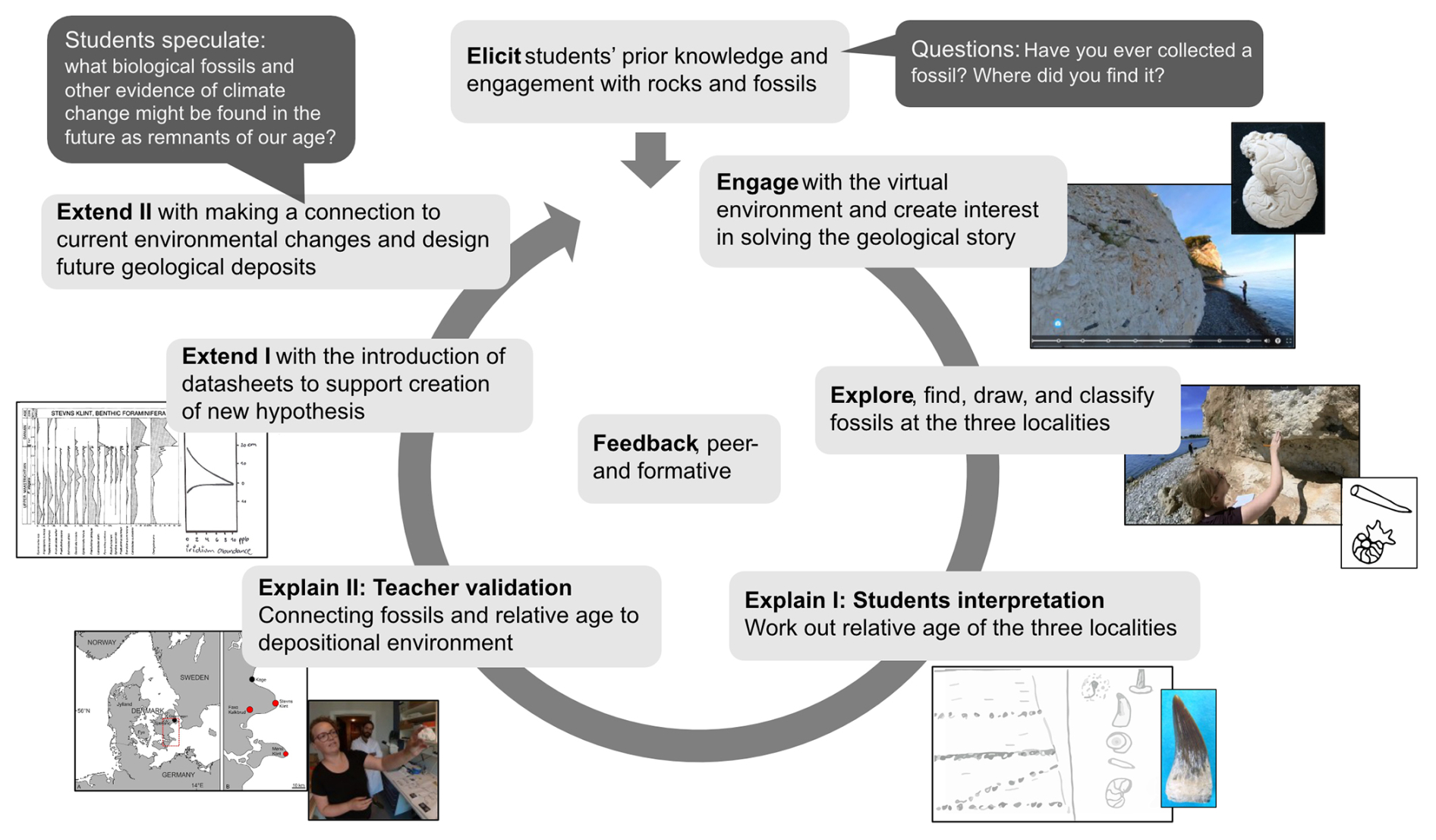
Figure 1Overview of the inquiry phases of the lesson designed with Elicit: Students prior knowledge, Engage: Creating interest in working out the geological story, Explore: Students independent exploration, Explain I: Students interpretation, Explain II: Teacher validation and expansion, Extend I: Teacher introduces datasheets, Extend II: Students design future geological deposits, and Feedback: Continuous formative feedback for students and teachers during the activity. The cyclic design emulates science by using one exploration's outcomes to engage students in another inquiry cycle. The design is meant to communicate that finding “an answer” is not the end of a scientific investigation but a possible motivation to continue exploration. Feedback is placed in the middle, indicating that students and the teacher both give and receive feedback throughout the inquiry. The screen captures show the virtual environment created by 360° video recordings modified with the software Thinglink.
Inquiry, regarded by many as a goal in science education, whether in person, in the field, in the laboratory, or online, requires a range of skills, attitudes, and content knowledge that all need to be embedded around the learning activity. Previously, virtual field trips have been used in both tertiary and secondary education to replace or augment real field trips and to teach specific fieldwork skills and most contain multiple elements from inquiry exercises (Bonali et al., 2021; Bond and Cawood, 2021; Dolphin et al., 2019; Madsen et al., 2021; Guillaume et al., 2023; Evelpidou et al., 2022, Pugsley et al., 2022; Senger et al., 2021; Saha et al., 2023). Elicit was added to the basic inquiry phases by Eisenkraft (2003) and aims to engage or map prior knowledge. An example is Watson et al.'s (2022) use of discussion boards before the interactive 3D activities, and we used open-ended questions. The Explore stage of the inquiry process has attracted teachers and researchers, as within these environments, students can safely and easily move over large virtual distances and across scales (e.g., Houghton et al., 2015). An element we added to our 360° videos was the use of both micro- and macrofossils, which enables exploration on multiple scales simultaneously. This challenged the students; nonetheless, in this case, both scales are needed because the fossils establish a link between two distinguishable environments, which is one of the indicators of environmental change that the students need to work out to solve the problem.
In our inquiry lesson, the Explain I and II components are critical for scaffolding knowledge and for approaching questions such as: “How does the fossil record translate into time and geological history”, and “how do we compare and contrast different physical sites”? During fieldwork and this exercise, this scaffolding process is expected to occur as students ask each other and their teachers questions. Peer learning is an important component of fieldwork in nature (El-Mowafy, 2014; Nyarko and Petcovic, 2023), and here it is essential for communicating and connecting specific knowledge from the three localities to the shared story in the classroom.
The Extend I and II activities are used to approach higher levels of the Bloom taxonomy, where knowledge can be interpreted (Anderson and Krathwohl, 2001). Teacher prompts are relied upon here, as they are commonly used in the field and have been implemented in other virtual environments (e.g., Engel et al., 2023). These extension activities can be explicitly embedded in a laboratory/workshop classroom environment after the virtual tasks are completed, as a part of classroom discussion. Additionally, we suggest linking past climate change and extinction events to inform our current understanding and to use an engaging fossil-hunting experience to motivate students to consider authentic problems, such as the sixth mass extinction event (Kolbert, 2014). The inquiry approach offers the opportunity to scaffold the necessary knowledge, skills and attitudes around a field experience where many of these skills and knowledge may not be directly related to the fieldwork but are critical to true inquiry (Houghton et al., 2015; Kennedy et al., 2025).
The ambition to build an inquiry lesson with a virtual reality component has challenged the format without making it a “show and tell”. In this inquiry lesson, the motivation from the rich digital 360 environment and the goal of mapping a genuine geological problem will carry students beyond just wanting a “correct” answer. The acknowledgement and use of students' answers on which the teacher builds what scientists think offer students the reward of figuring out a reasonable explanation of a scientific problem and having their thinking recognised.
The inquiry lesson is available at: https://doi.org/10.5281/zenodo.18596104 (Malm, 2026)
RHM, KRSH, RE, LMM, BK, JM and NRT co-designed the material; RHM, RE, LMM, and BK conceived the study and wrote the original draft; KRSH and LMM tested the lesson; JM and NRT provided the geological and palaeontological background for the project, reviewed, and edited the manuscript.
The contact author has declared that none of the authors has any competing interests.
Ethical approval was not required for this study as it is conceptual work that did not involve the collection of empirical material.
Publisher's note: Copernicus Publications remains neutral with regard to jurisdictional claims made in the text, published maps, institutional affiliations, or any other geographical representation in this paper. The authors bear the ultimate responsibility for providing appropriate place names. Views expressed in the text are those of the authors and do not necessarily reflect the views of the publisher.
The authors wish to thank the students who tested the teaching material for their enthusiasm and constructive feedback. Thanks to the reviewers and editor who took the time to read and offer feedback to improve the manuscript.
This paper was edited by David Crookall and reviewed by Sebastián Granados and one anonymous referee.
Anderson, L. W. and Krathwohl, D. R. (Eds.): A taxonomy for learning, teaching, and assessing: A revision of Bloom's taxonomy of educational objectives, Abridged, New York, Longman, ISBN 0-321-08405-5, 2001.
Anderson, R. D.: Reforming Science Teaching: What Research Says About Inquiry, Journal of Science Teacher Education, 13, 1–12, https://doi.org/10.1023/A:1015171124982, 2002.
Bonali, F. L., Russo, E., Vitello, F., Antoniou, V., Marchese, F., Fallati, L., Bracchi, V., Corti, N., Savini, A., Whitworth, M., Drymoni, K., Mariotto, F. P., Nomikou, P., Sciacca, E., Bressan, S., Falsaperla, S., Reitano, D., van Wyk de Vries, B., Krokos, M., Panieri, G., Stiller-Reeve, M. A., Vizzari, G., Becciani, U., and Tibaldi, A.: How academics and the public experienced immersive virtual reality for geo-education, Geosciences, 12, 9, https://doi.org/10.3390/geosciences12010009, 2021.
Bond, C. E. and Cawood, A. J.: A role for virtual outcrop models in blended learning – improved 3D thinking and positive perceptions of learning, Geosci. Commun., 4, 233–244, https://doi.org/10.5194/gc-4-233-2021, 2021.
Bond, C. E., Pugsley, J. H., Kedar, L., Ledingham, S. R., Skupinska, M. Z., Gluzinski, T. K., and Boath, M. L.: Learning outcomes, learning support, and cohort cohesion on a virtual field trip: an analysis of student and staff perceptions, Geosci. Commun., 5, 307–323, https://doi.org/10.5194/gc-5-307-2022, 2022.
Bybee, R. W.: The BSCS 5E instructional model and 21st century skills, Workshop on Exploring the Intersection of Science Education and the Development of 21st Century Skills, National Academies Board on Science Education, https://citeseerx.ist.psu.edu/viewdoc/download?doi=10.1.1.674.6559&rep=rep1&type=pdf (last access: 31 March 2026), 2009.
Bybee, R. W., Taylor, J. A., Gardner, A., Van Scotter, P., Powell, J. C., Westbrook, A., and Landes, N.: The BSCS 5E instructional model: Origins and effectiveness, Colorado Springs, Co: BSCS, 88–98, https://fremonths.org/ourpages/auto/2008/5/11/1210522036057/bscs5efullreport2006.pdf (last access: 31 March 2026), 2006.
Cawood, A. and Bond, C.: eRock: An open-access repository of virtual outcrops for geoscience education, GSA Today, 29, 36–37, https://doi.org/10.1130/GSATG373GW.1, 2019.
Cliffe, A. D.: A review of the benefits and drawbacks to virtual field guides in today's Geoscience higher education environment, International Journal of Educational Technology in Higher Education, 14, 28, https://doi.org/10.1186/s41239-017-0066-x, 2017.
Dewey, J.: How we think, Heath, Boston, 1933.
Dolphin, G., Dutchak, A., Karchewski, B., and Cooper, J.: Virtual field experiences in introductory geology: Addressing a capacity problem, but finding a pedagogical one, Journal of Geoscience Education, 67, 114–130, https://doi.org/10.1080/10899995.2018.1547034, 2019.
El-Mowafy, A.: Using peer assessment of fieldwork to enhance students' practical training, Assess. Eval. High. Edu., 39, 223–241, https://doi.org/10.1080/02602938.2013.820823, 2014.
Eisenkraft, A.: Expanding the 5E model, The Science Teacher, 70, 56–59, 2003.
Elkins, J. T. and Elkins, N. M.: Teaching geology in the field: Significant geoscience concept gains in entirely field-based introductory geology courses, Journal of Geoscience Education, 55, 126–132, https://doi.org/10.5408/1089-9995-55.2.126, 2007.
Engel, K. T., Davidson, J., Jolley, A., Kennedy, B., and Nichols, A. R. L.: Development of a virtual microscope with integrated feedback for blended geology labs, Journal of Geoscience Education, 72, 367–381, https://doi.org/10.1080/10899995.2023.2202285, 2023.
Evelpidou, N., Karkani, A., Komi, A., Giannikopoulou, A., Tzouxanioti, M., Saitis, G., Spyrou, E., and Gatou, M.-A.: GIS-Based Virtual Field Trip as a Tool for Remote Education, Geosciences, 12, 327, https://doi.org/10.3390/geosciences12090327, 2022.
Foley, K., Petcovic, H. L., and Semken, S.: How college geoscience instructors report finding and implementing virtual field experiences for their courses, Journal of Geoscience Education, 72, 450–462, https://doi.org/10.1080/10899995.2024.2334179, 2024.
Furtak, E. M., Seidel, T., Iverson, H., and Briggs, D. C.: Experimental and quasi-experimental studies of inquiry-based science teaching: A meta-analysis, Rev. Educ. Res., 82, 300–329, https://doi.org/10.3102/0034654312457206, 2012.
Granshaw, F. and Duggan-Haas, D.: Virtual fieldwork in geoscience teacher education: Issues, techniques and models, in: Google earth and virtual visualizations in geoscience education and research, edited by: Whitmeyer, S, Bailey, J. E., De Paor, D. G., and Ornduff, T., Geological Society of America, 285–303, https://doi.org/10.1130/2012.2492(20), 2012.
Guillaume, L., Laurent, V., and Genge, M. J.: Immersive and interactive three-dimensional virtual fieldwork: Assessing the student learning experience and value to improve inclusivity of geosciences degrees, Journal of Geoscience Education, 71, 462–475, https://doi.org/10.1080/10899995.2023.2200361, 2023.
Herodotou, C., Muirhead, D. K., Aristeidou, M., Hole, M. J., Kelley, S., Scanlon, E., and Duffy, M.: Blended and online learning: a comparative study of virtual microscopy in Higher Education, Interact. Learn. Envir., 28, 713–728, https://doi.org/10.1080/10494820.2018.1552874, 2020.
Heiss, E. D., Obourn, E. S., and Hoffman, C. W.: Modern Science Teaching, New York: Macmillan, 1950.
Houghton, J. J., Lloyd, G. E., Robinson, A., Gordon, C. E., and Morgan, D. J.: The Virtual Worlds Project: geological mapping and field skills, Geology Today, 31, 227–231, https://doi.org/10.1111/gto.12117, 2015.
Hurrell, E. R., Hutchinson, S. M., Yorke, L., Batty, L. C., Bunting, M. J., Swanton, D., McDougall, D. A., and Parsons, D. R.: The role of virtual field trips in Geography higher education: A perspective paper, Area, e70011, https://doi.org/10.1111/area.70011, 2025.
Hurst, S.: Use of virtual field trips in teaching introductory geology, Comput. Geosci., 24, 653–658, https://doi.org/10.1016/S0098-3004(98)00043-0, 1998.
Jeffery, A. J., Rogers, S. L., Jeffery, K. L. A., and Hobson, L.: A flexible, open, and interactive digital platform to support online and blended experiential learning environments: Thinglink and thin sections, Geosci. Commun., 4, 95–110, https://doi.org/10.5194/gc-4-95-2021, 2021.
Jolley, A., Kennedy, B. M., Brogt, E., Hampton, S. J., and Fraser, L.: Are we there yet? Sense of place and the student experience on roadside and situated geology field trips, Geosphere, 14, 651–667, https://doi.org/10.1130/GES01484.1, 2018.
Karplus, R. and Their, H. D.: A new look at elementary school science, new trends in curriculum and instruction series, Chicago: Rand McNally and Co., 1967.
Kennedy, B., Engel, K., Davidson, J., Tapuke, S., Hikuroa, D., Martin, T., and Zaka, P.: Incorporating science communication and bicultural knowledge in teaching a blended volcanology course, Geosci. Commun., 8, 107–124, https://doi.org/10.5194/gc-8-107-2025, 2025.
Klippel, A., Zhao, J., Oprean, D., Wallgrün, J. O., Stubbs, C., La Femina, P., and Jackson, K. L.: The value of being there: Toward a science of immersive virtual field trips, Virtual Real., 24, 753–770, https://doi.org/10.1007/s10055-019-00418-5, 2020.
Kolb, D.: Experiential learning: Experience as the source of learning and development, New Jersey: Prentice-Hall, 1984.
Kolbert, E.: The sixth extinction: An unnatural history, New York: Henry Holt and Company, ISBN 9781408851210, 2014.
Madsen, L. M., Evans, R., and Bruun, J.: Inquiry-based teaching: The 6F model – its origin and development in Denmark [Undersøgelsesbaseret undervisning: 6F-modellen – dens tilblivelse og udvikling i Danmark], MONA, 1, 26–45, 2020.
Madsen, L. M., Evans, R., and Malm, R. H.: Using a Wicked Problem for Inquiry-Based Fieldwork in High School Geology: Addressing Climate Change and Mass Extinction Events, in: Addressing Wicked Problems through Science Education: The Role of Out-of-School Experiences, edited by: Dillon, J., Achiam, M., and Glackin, M. Springer, 167–188, https://doi.org/10.1007/978-3-030-74266-9_9, 2021.
Malm, R. H.: Designing for inquiry in virtual fieldwork: using explorations of extinction event to teach climate change, Zenodo [data set], https://doi.org/10.5281/zenodo.18596104, 2026.
Malm, R. H., Madsen, L. M., and Lundmark, A. M.: Students' negotiations of belonging in geoscience: Experiences of faculty–student interactions when entering university, J. Geogr. Higher Educ., 44, 532–549, https://doi.org/10.1080/03098265.2020.1771683, 2020.
Minner, D. D., Levy, A. J., and Century, J.: Inquiry-based science instruction – what is it and does it matter? Results from a research synthesis years 1984 to 2002, J. Res. Sci. Teach., 47, 474–496, 2010.
Mogk, D. W. and Goodwin, C.: Learning in the field: Synthesis of research on thinking and learning in the geosciences, in: Earth and mind II: A synthesis of research on thinking and learning in the geosciences, edited by: Kastens, K. A. and Manduca, C. A., Special Paper 486, The Geological Society of America, https://doi.org/10.1130/2012.2486(24), 2012.
Nyarko, S. C. and Petcovic, H. L.: Do students develop teamwork skills during geoscience fieldwork? A case study of a hydrogeology field course, Journal of Geoscience Education, 71, 145–157, https://doi.org/10.1080/10899995.2022.2107368, 2023.
Posselt, J. R. and Nuñez, A. M.: Learning in the wild: Fieldwork, gender, and the social construction of disciplinary culture, J. High. Educ., 93, 163–194, https://doi.org/10.1080/00221546.2021.1971505, 2022.
Pugsley, J. H., Howell, J. A., Hartley, A., Buckley, S. J., Brackenridge, R., Schofield, N., Maxwell, G., Chmielewska, M., Ringdal, K., Naumann, N., and Vanbiervliet, J.: Virtual field trips utilizing virtual outcrop: construction, delivery and implications for the future, Geosci. Commun., 5, 227–249, https://doi.org/10.5194/gc-5-227-2022, 2022.
Rojas-Sánchez, M. A., Palos-Sánchez, P. R., and Folgado-Fernández, J. A.: Systematic literature review and bibliometric analysis on virtual reality and education, Education and Information Technologies, 28, 155–192, https://doi.org/10.1007/s10639-022-11167-5, 2023.
Rönnebeck, S., Bernholt, S., and Ropohl, M.: Searching for a common ground – A literature review of empirical research on scientific inquiry activities, Stud. Sci. Educ., 52, 161–197, https://doi.org/10.1080/03057267.2016.1206351, 2016.
Saha, S., Tapuke, S., Kennedy, B., Tolbert, S., Tapuke, K., Macfarlane, A., Hersey, S., Leonard, G., Tupe, R., Ngaropo, P., Milroy, K., and Smith, B.: A place-based virtual field trip resource that reflects understandings from multiple knowledge systems for volcano hazard education in Aotearoa NZ: Lessons from collaborations between Māori and non-Māori, Journal of Geoscience Education, 71, 388–402, https://doi.org/10.1080/10899995.2022.2109397, 2023.
Senger, K., Betlem, P., Birchall, T., Buckley, S. J., Coakley, B., Eide, C. H., Flaig, P. P., Forien, M., Galland, O., Gonzaga, L., Jensen, M., Kurz, T., Lecomte, I., Mair, K., Malm, R. H., Mulrooney, M., Naumann, N., Nordmo, I., Nolde, N., Ogata, K., Rabbel, O., Schaaf, N. W., and Smyrak-Sikora, A.: Using digital outcrops to make the high Arctic more accessible through the Svalbox database, Journal of Geoscience Education, 69, 123–137, https://doi.org/10.1080/10899995.2020.1813865, 2021.
Stokes, A. and Boyle, A. P.: The undergraduate geoscience fieldwork experience: Influencing factors and implications for learning, in: Field geology education: Historical perspectives and modern approaches, edited by: Whitmeyer, S. J., Mogk, D. W., and Pyle, E. J., Special Paper 461, The Geological Society of America, https://doi.org/10.1130/2009.2461(23), 2009.
Watson, A., Kennedy, B. M., Jolley, A., Davidson, J., and Brogt, E.: Design, implementation, and insights from a volcanology Virtual Field Trip to Iceland, Volcanica, 5, 451–467, https://doi.org/10.30909/vol.05.02.451467, 2022.
Whitmeyer, S. J. and Dordevic, M.: Creating virtual geologic mapping exercises in a changing world, Geosphere, 17, 226–243, https://doi.org/10.1130/GES02308.1, 2021.
- Abstract
- Introduction
- Background: virtual fieldwork and inquiry
- Results
- Discussion: To what extent does virtual reality fieldwork comply with the principles of inquiry learning?
- Conclusion
- Data availability
- Author contributions
- Competing interests
- Ethical statement
- Disclaimer
- Acknowledgements
- Review statement
- References
- Abstract
- Introduction
- Background: virtual fieldwork and inquiry
- Results
- Discussion: To what extent does virtual reality fieldwork comply with the principles of inquiry learning?
- Conclusion
- Data availability
- Author contributions
- Competing interests
- Ethical statement
- Disclaimer
- Acknowledgements
- Review statement
- References