
the Creative Commons Attribution 4.0 License.
the Creative Commons Attribution 4.0 License.
 | 21 Aug 2026
Editorial: Introducing a new article type: Limitations, Errors, Surprises, Shortcomings and Opportunities for New Science (LESSONS)

John Hillier
Stefan Gaillard
Theresa Blume
Eduardo Queiroz Alves
Susanne Buiter
Ken S. Carslaw
Kirsten von Elverfeldt
Tim H. M. van Emmerik
Barbara Ervens
Sam Illingworth
Daniel Klotz
Jonas Pyschik
Science is a rich process of well-informed trial-and-error and learning from errors often paves the way to scientific advances. However, this process and associated so-called null results are seldomly shared, because the publication culture and career incentives are biased towards positive results. This bias impedes scientific progress because errors or null results can be repeated by other scientists unless they are made public. In contrast, the publication of non-positive results and associated learnings completes an unbiased record of the research effort, contributes to open and transparent science, allows the authors and others to learn and may open opportunities for new science. A dedicated article type for these kinds of lessons as part of established journals clearly encourages such articles, and increases their visibility and recognition.
Here, we introduce and explain a new article type that covers lessons learned to help overcome the positive publishing bias and that is being introduced in participating European Geoscience Union (EGU) publications. “LESSONS” articles describe the Limitations, Errors, Surprises, Shortcomings and Opportunities for New Science emerging from the scientific process. Note that the terms included in the LESSONS abbreviation are just examples to clarify what these article types stand for without indicating definitions or exclusive categories. Importantly, a LESSONS article will offer a substantial, valuable insight within the scope of geosciences.
Specifically, we present two types of articles: LESSONS Reports are journal articles that apply the public peer review model of EGU's journals, whilst LESSONS Posts are not peer-reviewed preprints that allow early-stage reporting. Both article types are short, so the extent and depth to which the subject can be explored is deliberately limited (e.g., as for the GC Insights or Letter format) to help lower the barrier to journal publication. Details of how to structure and submit both of these article types are given, as well as guidance for reviewers. LESSONS articles will be published in EGU's community journals but are also summarized in a dedicated and ongoing interjournal compilation. In this way, these insights are easily findable for other scientists looking to prevent duplicate research, improve their meta-analyses, or otherwise gain value from the LESSONS articles of others.
- Article
(988 KB) - Full-text XML
- BibTeX
- EndNote


Failures have value. Thomas Edison is quoted as saying “Negative results are just what I'm after. They are just as valuable to me as positive results”. Indeed, the scientific process includes many Limitations, Errors, Surprises, Shortcomings, and Opportunities for New Science, i.e., LESSONS from which we learn. Examples of such errors, shortcomings, and limitations that scientists may stumble over in their work are errors in scientific software, so-called bugs (Miller, 2006; Merali, 2010; Soergel, 2015), as well as pitfalls in data collection (Wilby et al., 2017). Conversely, the results of scientific work often surprise us, be it with serendipitous (Merton and Barber, 2006; Yaqub, 2018) or null results. Negative or null results1 are outcomes that do not show an expected effect despite meticulous and systematic science execution.
All of these errors, limitations, and surprises can be seen as an opportunity for new science, advancing knowledge or pointing to the instances where understanding is lacking, but they are rarely published. Instead, positive results (those that support a research hypothesis) are more likely to be published, because authors are more likely to write them up and submit, and because editors and reviewers are more likely to accept them (Muradchanian et al., 2023). Also, the recognition system in academia is shaped such that researchers tend to mainly publish positive results (e.g., Dwan et al., 2008; Emery et al., 2025; Fanelli, 2012; Mueck, 2013; Kepes et al., 2014; Mack, 2014; Bartoš et al., 2024; Brazil, 2024), because the traditional incentive structures for funding and career progression reward high publication and citation metrics (Fanelli, 2013; Bespalov et al., 2019; Echevarría et al., 2021). Striving to produce positive results may lead to several conscious and unconscious biases at different stages of the scientific endeavour (e.g., study design, data collection and analysis, interpretation), potentially resulting in false positive findings (Neher, 1967; Nissen et al., 2016). In particular, the bias against null results and the reporting of errors and limitations can lead to researchers investing in experiments that have already been performed, which entails an avoidable waste of time, effort, and (public) resources. In the ongoing efforts to make science more open and transparent, explicitly publishing limitations, errors, surprises, and shortcomings contributes by providing a complete and unbiased record of research efforts, preventing duplication of failed experiments, and allowing the scientific community to learn from all outcomes, not just the successful ones. In addition, such publications enhance the credibility of and trust in science by demonstrating honesty about limitations and setbacks, strengthening public confidence in scientific integrity.
1.1 Reasons to publish LESSONS articles
We argue that Limitations, Errors, Surprises and Shortcomings, and similar Opportunities for New Science deserve to be considered as part of the scientific literature. Benefits of publishing LESSONS articles include (see also Cranford, 2024):
-
Advancing science: limitations, errors, surprises, and null results form a common and normal part of the research process. Depending on one's image of science, one may view them as a threat or as an opportunity to learn and discover, for example because they may inspire a new hypothesis or methodology (Emery et al., 2025). As Schwartz (2008) states, “one of the beautiful things about science is that it allows us to bumble along, getting it wrong time after time, and feel perfectly fine as long as we learn something each time”, which will eventually lead us to make new discoveries. Andréassian et al. (2010) invited workshop participants to share their experience with what they called anomalies, outliers, and failures in their everyday practice of hydrology. They show that the in-depth analysis of observations and results “blazes a trail that can only lead to progress”. Indeed, failures, anomalies, and outliers can point to new ways to improve methods and models (Andréassian et al., 2010) and drive science forward. Whether one views limitations, errors, surprises, and shortcomings as opportunities or as a threat, it is clear that scientists need to talk and hear about them. Therefore, it is important to lower the barrier for publication of these results, with journals explicitly welcoming their submission (PLOS Collections, 2015; Curry et al., 2025; Santiago Vispo, 2025).
-
Learning from each other's mistakes: the current bias towards publishing only positive results impedes scientific progress as mistakes are often repeated, wasting time and resources (van Emmerik et al., 2018). Publishing errors and null results makes it easier and more efficient for scientists to learn from these mistakes. As Andréassian et al. (2010) point out, reporting on limitations, surprises, and null results can also indicate that a subject is less mature than suspected or that a research line is not worth further effort. Without a written record, scientists are solely dependent on their personal networks and happenstance; with a written record they have access to “a body of knowledge that has only been shared at water coolers in academic hallways so far” (Devine et al., 2020). For example, defects of a model may be widely known within the institute developing it, but hidden for outside users of the model output. It is therefore valuable to publish such knowledge in order to make a research community aware of methodological issues or dead ends, but also of pitfalls or mistakes in widely used models and datasets.
-
Increasing transparency: more open communication of limitations, errors and surprises, and the lessons learned from them, can increase trust, for the public and within the scientific community. For researchers, the recognition that comes with publishing LESSONS articles could serve to strengthen integrity and promote honesty (Devine et al., 2020). Transparency of research failures and reporting of null results contribute to making research results verifiable and reproducible, and thus, contribute to openness and quality of science (see e.g. Hall et al., 2022). Such criteria are increasingly recognized as being valuable and impactful contributions to scientific progress, in addition to traditional indicators. For example, such a shift is suggested in the declaration of the Coalition of Advanced Research Assessment (CoARA, Arentoft et al., 2022) that has been endorsed by EGU as part of its commitment to open and responsible science.
-
Reducing positive publication bias: systematic reviews and meta-analyses depend on a publication record that includes non-positive results (van Assen et al., 2014; Devine et al., 2020; Bartoš et al., 2024). For example, East et al. (2022) highlight that “just as important as knowing when climate change is altering landscapes is knowing when it's not”. In addition to meta-analyses, machine learning models also depend on reliable and representative data to function effectively. If only positive results are published, the accuracy of such models is compromised. Strieth-Kalthoff et al. (2022) provide an example with a predictive model of chemical reactions that became overly optimistic when grounded in databases biased toward high-yield outcomes (Brazil, 2024).
To combat this publication bias, other disciplines such as psychology or neuroscience have introduced the publication of registered reports (Chambers, 2014; Nosek and Lakens, 2014; Kozlov, 2024). Registered reports get peer reviewed twice, before and after the study has been conducted. The first peer review may yield an “in-principle acceptance”, which means that the research will be published whatever its outcome, “as long as the authors adhere closely to their protocol and interpret the results according to the evidence” (Chambers, 2019). While pre-registration guarantees publication of negative results, it does not guarantee reporting of (found) errors and lessons, which is at the core of the LESSONS articles.
A Springer survey on null results highlighted that researchers do not send in null results because they do not know where to publish them (Emery et al., 2025). Only 15 % of respondents are aware of journals that actively encourage the submission of null results, while 69 % believe such results would not be accepted. Thus, clearly signalling which geoscience journals welcome null results will help researchers identify appropriate publication venues and reduce concerns about rejection based solely on the non-positive nature of their findings.
-
Providing credit and incentives: in the longer term, we hope that publishing LESSONS articles can have a positive impact for authors' reputation in the field and inspire collaboration with other research groups. van Emmerik et al. (2018) argue that publishing null results and errors serves to give experimental and especially field researchers – who, as they state, have a higher chance of generating null results – the scientific recognition they deserve (see also Blanchard and Dũng, 2024). On the side of model developers, Proske and Melsen (2025) noted that incentives for finding and fixing bugs in model codes are lacking, because funding and recognition reward new and short-term developments rather than the consolidation of existing code (see also Menard et al., 2024). Public documentation could at least serve to deliver recognition (Proske et al., 2024). If a bug constitutes a learning moment or occurs in widely used community code, it fits into the scope of LESSONS articles (Sect. 2.2). Thus, the LESSONS article type is also a means of giving appropriate professional credit to scientists who spend time on high-risk attempts to generate new knowledge and understanding – and to those who spend time rigorously identifying and documenting insightful errors.
1.2 Past initiatives in the geoscientific community and dedicated journals
Reporting and discussing insightful failures is not an entirely new topic and also within the EGU there have been various approaches to provide opportunities to do so. For example, during the EGU General Assembly there have been a series of sessions on this topic in several divisions (Pfister et al., 2009; van Emmerik et al., 2016; Buiter et al., 2016; Thieulot et al., 2017; Le Pourhiet et al., 2018). More recently, the interdisciplinary BUGS (Blunders, Unexpected Glitches and Surprises) session at the General Assembly was hosted across divisions (Proske et al., 2025), attracting 21 abstracts at EGU25 and 25 at EGU26. The numerous well-received sessions demonstrate the prolonged interest of the EGU community in sharing and learning from LESSONS articles. In turn, the LESSONS articles may help to transform our community and serve as an educative component to demonstrate that failures are integral to science (Perez-Diaz, 2025). The articles are also in line with EGU's efforts for transparency in scientific publishing, which are manifested, for example, in its publishing model that provides public peer review and mandatory public documentation of the manuscript evolution. Previously, the EGU journal Hydrology and Earth System Sciences (HESS) had a manuscript category called “Black Swans & Scientific Falsifications” with a focus on unforeseen events with significant impact. However, after several years with no submissions the manuscript type was discontinued. Its narrow scope, high level of expectation due to its focus on unpredictable, high-impact events (the “unknown unknowns”), presence in only a single EGU journal, and limited advertisement likely all contributed to the lack of submissions. Within the larger hydrological community a detailed discussion in the Hydrological Sciences Journal, which is led by the International Association of Hydrological Sciences, gave visibility to the topic in a series of commentaries (Blume et al., 2017; van Emmerik et al., 2018; Blume et al., 2018). Initiatives outside the geoscience community include dedicated journals like the Journal of Trial and Error (Devine et al., 2020) and the Journal of Negative Results in BioMedicine (discontinued, Springer Nature, 2017), or the “Missing Pieces Collection” in PLOS One that focused on negative, null, and inconclusive results (PLOS, 2020).
This editorial makes the case for the publication of Limitations, Errors, Surprises, Shortcomings and Opportunities for New Science, in the form of the new LESSONS article types and compilation across EGU publications. The design of the LESSONS article types is intended to avoid the pitfalls that likely ended earlier efforts: rather than depending on a single journal or a standalone venue, LESSONS spans many EGU journals and EGUsphere, casting a wider net and lowering the barrier to submission. With a dedicated article type rather than just stating the possibility of inclusion in traditional articles (like e.g. Frontiers or Springer Nature, Emery et al., 2025), we clearly label and encourage such articles as part of established publication outlets, which increases visibility and recognition. And rather than launching a separate new journal for the publications of LESSONS articles, a new article type ensures that all contributions have the same scientific standards as in the individual existing journals. In addition, the collection of all LESSONS articles in a separate compilation resembles a separate journal focused on the LESSONS theme and therefore, scientists interested in LESSONS articles only are served by this compilation.
In the following we introduce the new article types and describe their scope. Because it may not be obvious what LESSONS articles could look like, Sect. 3 gives advice on how to introduce and frame a LESSONS article. Section 4 gives advice to those who will be asked to review LESSONS articles. Regarding the technical implementation, Sect. 5 details how the new article type will be embedded in a new EGU compilation (interjournal and EGUsphere), its quality threshold and the process for submitting a LESSONS article.
2.1 What's in a name?
The intention of the LESSONS article types is to include all results that are not positive in the sense of a typical scientific paper. For the name we were looking for a permanent label for a publication with a positive, educative connotation. The LESSONS acronym includes a wide range of topics but also has an encouraging tone and stresses the positive learning impact of the articles. The components of the acronym, i.e. limitations, errors, etc., are not meant as exhaustive or restrictive categories, but should give examples of what the LESSONS articles could encompass.
2.2 LESSONS articles cover a wide scope
LESSONS articles can cover a wide range of insights within the scope of Geosciences (or the publishing journal for LESSONS Reports; see Sect. 2.3). The Limitations, Errors, Surprises, and Shortcomings included in the LESSONS abbreviation are just examples to clarify what these article types stand for without indicating definitions or exclusive categories. We use them here to illustrate exemplary content of LESSONS articles, but we encourage readers to see them as inspiration rather than as a restriction. In that spirit, the LESSONS article types invite concise, well-contextualized submissions relating to the following concepts:
-
Errors: unintentional errors made during study design, implementation, data analysis, or interpretation can lead to flawed results, erroneous assumptions, or misleading conclusions. LESSONS articles value honest reflection and what others can learn from the experience. Novelty and significance come from reporting an error that is not obvious, could readily be made by a competent practitioner, and has not been reported before.
Examples include:
-
Misuse of a widely adopted method or model. For instance, Brunner and Voigt (2024) show that a commonly used 31 d running window introduces a bias into the estimation of expected extreme frequency.
-
Erroneous assumptions in experimental design.
-
Oversights in fieldwork or instrumentation. For example, Wilby et al. (2017) demonstrate “tell-tale signs of ambiguous and/or anomalous data” to help uncover spurious field and experimental data.
-
-
Limitations and Shortcomings: unintended disruptions including technical or procedural failures may impede the original goal or lead to new understanding. Submissions should highlight what caused the disruption, how it was diagnosed, and what was learnt in order to help others avoid it.
Examples include:
-
Limitations of a well-used method, technique or model, where applying the method beyond the boundaries may lead to misinterpretation or invalid results. For instance, Hannah et al. (2022) noticed unusual patterns in model data and tracked them to a deep convective trigger condition in their model (see also Chen et al., 2025 for a pattern caused by a grid mismatch in physics–dynamics coupling). Hartmann and Rath (2005) analysed uncertainties and error sources in using borehole temperature data to reconstruct past ground surface temperature.
-
Shortcomings which detail steps of a method or technique that have not been applied or designed optimally (for example poor calibration). For example, Liaw et al. (2021) showed that log-transforming the dependent variable in a regression model has an under-prediction problem.
-
Field or lab hardware that upon inspection does not behave as indicated in documentation or datasheets. For example, Prior-Jones et al. (2025) compared the power consumption of 16 commercially available solar regulators to the manufacturers' reported values and found large discrepancies.
-
Software bugs in models or other code, either documenting a specific bug (Becker, 2022; Proske et al., 2024) or discussing and investigating them more broadly (Pipitone and Easterbrook, 2012; Menard et al., 2021; Proske and Melsen, 2025). The bug should constitute a learning moment or occur in community codes where many scientists benefit from knowing the bug.
-
-
Surprises: outcomes that were not anticipated, in that they defied predictions or assumptions, leading to novel insights, hypotheses, or reinterpretations of theory or data. This includes failures that triggered new lines of inquiry or upended established ideas but also null results where anticipated effects were not observed, or hypotheses were not supported by the evidence. Examples might involve:
-
Serendipitous results in experimental setups. For example, ecologists were investigating how wave action hinders the establishment of pioneer salt-marsh vegetation when they saw how ragworms pulled seedlings into the sediment (van Belzen, 2024). In follow-up studies they learned that ragworms play a prominent role in seedling establishment, and that they garden food (Zhu et al., 2016).
-
Surprising field or modelling observations that revealed a previously unrecognised phenomenon. For example, Vening-Meinesz (1948) conducted careful gravitational constant measurement with the hypothesis that tectonic movement did not exist, yet his results showed that it did (Bruins and Scholte, 1967). Warny et al. (2009) found abundant pollen in the Miocene part of an Antarctic sediment core, signaling warm Antarctic temperatures (Feakins et al., 2012; Feakins, 2012). van Emmerik et al. (2019) tested relationships between river discharge and plastic transport, but only one strong and significant correlation was found, which was between plastic transport and the amount of floating organic material. The latter mainly consisted of floating water hyacinths, which turned out to be very effective in entangling plastic pollution (Schreyers et al., 2024) and can even be used to strategically extract plastics from rivers (Hagenbeek et al., 2026).
-
Null results from carefully controlled studies (for advice see Schweinfurth and Frommen, 2025). For example, Sheffield et al. (2012) show that despite climate change there is little change in global drought between 1950 and 2008.
-
Demonstrations of non-reproducibility after substantial effort to reproduce.
-
-
Origin myths and cautionary tales: many widely used models, datasets, or methods have origin stories that are misunderstood or overly simplified, or they themselves are commonly misused or misinterpreted. LESSONS articles may aim to set the historical and methodological record straight by critically examining and clarifying such “myths”, providing historical context, tracing the evolution of ideas, or correcting inaccuracies or misapplications of tools or data.
They may thus, for example:
-
Re-examine the development and provenance of a prominent geophysical idea, model, dataset or metric. For example, Melsen et al. (2025) traced the history of the Nash-Shutcliffe Efficiency that is widely used in hydrology. Mielewczik and Moll (2016) reconstructed how the myth of the story, which supposedly explained how the myth that spinach is rich in iron, came about. Another example is the study by atmospheric aerosol scientists who traced the origins of the early “droplet-only” paradigm for COVID-19 transmission to historical assumptions and size thresholds that had been propagated while taken out of context. Their reassessment of these assumptions illustrates how revisiting established concepts, including their limitations and potential errors, is essential not only for scientific progress but also has societal impact (Randall et al., 2021).
-
Point out common misuses of datasets, tools or methodologies (see e.g. Wilby et al., 2017; Brunner and Voigt, 2024, mentioned above). For example, Makin and Orban de Xivry (2019) describe common statistical mistakes in the scientific literature.
-
Based on rigorous science, challenge a widely held belief within the Geoscience community. For example, in hydrology, Berghuijs et al. (2014) overturn the common assumption that a climate-driven shift from snow to rain leaves long-term mean streamflow unchanged, instead demonstrating that reduced snowfall systematically lowers mean streamflow rather than producing neutral effects.
-
Articles that fall into this scope have been published in EGU journals before, and we encourage authors to keep publishing their non-positive results or surprises in regular research articles. The key difference to LESSONS is that authors often perceive that a regular article can accommodate such results only when they are accompanied by a positive finding or substantial new advance, whereas a LESSONS article welcomes them on their own – a clear discussion of how the limitation, error or surprise helps advance science is enough. Together with the short format, the explicit label that removes the stigma associated with the failure to generate positive results, and the added visibility of the LESSONS compilation, this lowers the barrier for submissions where authors may previously have been hesitant.
2.3 Two formats of LESSONS articles
LESSONS articles come in two formats, as peer-reviewed articles (Reports) and stand-alone preprints (Posts). Both LESSONS Reports and Posts are initially posted on EGUsphere, EGU's interactive community platform and preprint repository, where they can be publicly discussed by the scientific community (Ervens et al., 2025).
LESSONS Reports are short format peer-reviewed journal articles that undergo public peer review on EGUsphere (Fig. 1 and Sect. 4; also: Ervens et al., 2025). They can document any well-substantiated finding that is not a classic positive result, describing the limitations, errors, surprises, shortcomings and opportunities for new science emerging from the scientific process, including non-confirmatory and null results. A LESSONS Report needs to offer a substantial insight and have wider relevance beyond the author's immediate research. LESSONS Reports normally have 1000–2000 words in the main text, and a commensurate number of figures, tables, and references. Material in the supplement and appendix should be limited – it is reserved for files containing material to make the work transparent and reproducible (e.g. questionnaires); data and code should be shared according to the general policy applied in all EGU journals (e.g., https://www.geoscience-communication.net/policies/data_policy.html, last access: 19 August 2026). Thereby, the extent and depth to which the subject can be explored is deliberately limited (e.g., as for the GC Insights or Letter format). Abstracts must include a sentence stating how the work is linked to the LESSONS acronym (see Sect. 3). LESSONS Reports published in an EGU journal are subject to the article processing charges (APC) for short article types (EUR 900, January 2026). However, authors who do not have the funds for publishing such articles are encouraged to request a full or partial APC waiver, according to EGU's financial support scheme (see, for example, https://www.geoscience-communication.net/about/financial_support.html, last access: 19 August 2026).
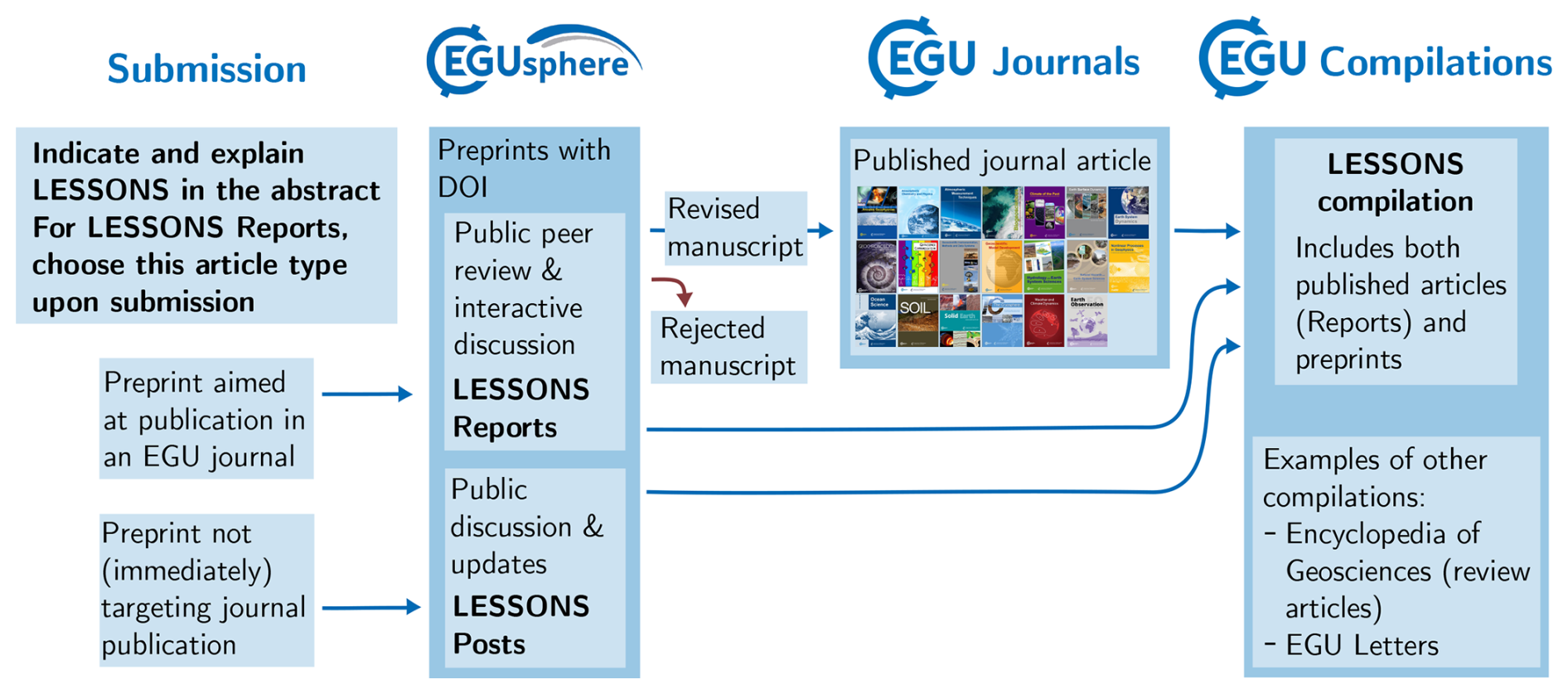
Figure 1LESSONS articles within the current workflow of the EGU Journals. Parts particular to LESSONS articles are highlighted bold. Note that not all EGU journals offer LESSONS Reports or Letters as an article type. The figure is adapted from Ervens et al. (2025, Fig. 13) and modified to highlight the LESSONS article specifics.
LESSONS Posts are not peer-reviewed, stand-alone preprints not (immediately) targeting journal publication (https://www.egusphere.net/preprints/preprint_options_on_egusphere.html, last access: 19 August 2026). LESSONS Posts are brief and more-preliminary versions of LESSONS Reports, providing authors with the opportunity to communicate their findings that do not yet warrant publication in a journal, perhaps in order to stimulate discussion or garner co-authors for a full LESSONS Report. Upon submission, an EGUsphere moderator checks whether the Post falls within the LESSONS article scope and meets the quality threshold as detailed in Sect. 2.4. Then the preprint is published on EGUsphere and included in the compilation (see Fig. 1). LESSONS Posts typically have fewer than 500 words and one figure. As for any preprint on EGUsphere, LESSONS Posts are not subject to any APCs.
2.4 Quality threshold
LESSONS articles (i.e., both Reports and Posts) must demonstrate methodological, conceptual, or practical learning. The article should thus go beyond mere description of an error or surprise, but rather offer insight into a method, process, or the research field. The message of the article should be relevant to the scientific community beyond the author's own research group or institute. The takeaway insight should have the potential to caution or benefit other researchers. This takeaway learning should be spelt out as clearly as possible.
The criteria in terms of scientific significance, scientific quality and presentation quality apply to LESSONS Reports as to any other journal article. LESSONS Reports should adhere to the quality standards of their field. The theory should be sound, the methodology appropriate, the data properly analysed and the conclusion logically drawn from the evidence. If appropriate, interpretation should be supported by data, code and analysis. LESSONS Reports must fall within the scope of the intended EGU journal; LESSONS Posts need to align with one or more of the EGUsphere topics (as for any other EGU journal or EGUsphere submission, https://www.egusphere.net/about/egusphere_topics.html, last access: 19 August 2026). In general, the submission's insight must be novel in the sense that it has not been formally described in the scientific literature before. In specific cases warranting an expanded examination, a LESSONS article may also explore some error, limitation or shortcoming that is mentioned in an already published article where it is unlikely to be found by a scientist searching for it. This could, for example, be a bug that the authors have fixed but that is not mentioned in the abstract or emphasised otherwise and described mainly in supplementary material. For further guidance, authors, editors and reviewers are directed to Sect. 4.
LESSONS Posts aim for the same quality standards as LESSONS Reports, but given their brief and more-preliminary nature, the presented problem and analysis need not be fully explored. Submitted LESSONS Posts are checked by an EGUsphere moderator for basic standards of scientific quality, standards of civil discourse and common decency.
In general, LESSONS Reports can be approached and written as you would do for a traditional research article. However, articles on non-positive results may be unfamiliar to the geoscientist, so here we provide some guidance to help authors to formulate and write a LESSONS article. It may be useful to think of LESSONS articles as telling a story. For instance: What did you think would work, and why? How and why did it not? What lessons can you draw from this experience? In all cases, LESSONS articles should be clear, self-reflective, respectful, avoid blame and be constructive in tone.
A natural question is when to write a LESSONS article, particularly as incentives tend to favour moving on to the next result. The most practical moment is usually while the experience is still fresh – when a related result is being written up, or when a line of work is set aside. The brief format and the LESSONS Post option keep the effort low enough to capture a lesson even when time is short.
Abstracts must include a sentence stating how the work falls in scope, specifying its link to the LESSONS acronym and spelling the acronym out (e.g., This study reports on the limitations of [method/instrument/model XXX] and is therefore submitted as a LESSONS Report, a paper category dedicated to documenting Limitations, Errors, Surprises, Shortcomings, and Opportunities for New Science.). The abstract should also include the take-home lessons that you have learnt through your endeavours and the insights gained.
It is important to provide context for the story you are telling. In a regular research article, Introduction sections often start with motivation, perhaps a real-world need (e.g., understanding the response of mangroves to sea level rise for mitigation efforts; van Bijsterveldt et al., 2023, or plastic pollution; Hauk et al., 2023; Lofty et al., 2025) or pure curiosity. Then, existing research is broadly defined, focusing in on a research gap that the article will explore. In a similar way, a LESSONS article introduction should set out the narrative arc. Illustratively, this could start with a motivation, why the area of science is worthy of study and yet challenging. Then perhaps describe your initial idea or expectation of how you aimed to progress scientific knowledge (e.g., new field method, application of a software package). This background should be comprehensive and fully referenced. After this, briefly outline what was tried, what fell short, and thus how your piece of work fits into the scope of the LESSONS article types (see Sect. 2.2). If applicable, share the data of your unsuccessful experiments as such data might be valuable to others in addition to the mere description of your experiments and outcomes. Other sections (e.g., Methods, Results, Discussion, data and code availability) perform very similar functions to more traditional article types. LESSONS Reports have the same flexibility in structure as other articles, provided that the purposes and functions of the sections are included.
When submitting, choose the LESSONS Reports article type in the journal submission system. However, not every EGU journal may choose to offer LESSONS Reports as an article type. Authors interested in submitting a Report in their scientific discipline should check the manuscript type menu of the respective journal. A LESSONS Report will be reviewed as any other paper of that journal, with the editors and reviewers being made aware of the thresholds and expectations for this article type (see Sect. 2.4). As any other article type, a LESSONS Report will appear on EGUsphere, and if accepted will ultimately be published within the intended journal (see Fig. 1).
LESSONS Posts are very flexible in their format, with the expectation that they are of appropriate quality (Sect. 2.4) and explain how the work fits into the scope of LESSONS. As for LESSONS Reports and any other research article, it is recommended to convey a story.
LESSONS Reports should be reviewed according to standards as any research paper, possibly following manuscript-specific guidelines for LESSONS as provided by the journal (see Sect. 2). Reviewer expectations should be commensurate with the deliberately short format of the LESSONS articles that is supposed to help lower the barrier to publishing LESSONS articles. Datasets, analysis or discussion may be less extensive than for a full-length journal article. Nevertheless, all LESSONS Reports should provide a novel perspective not otherwise described before and should be appropriately contextualized (see Sect. 3). Peer reviewers may recommend reclassification as a regular research article if they consider that the manuscript meets the relevant criteria, e.g., if it reports substantial new results, advances, conclusions and implications.
For null and unexpected results, peer reviewers and editors are expected to conduct the standard quality checks that they would conduct for a regular article from their field – is the theory sound, the methodology appropriate, the data properly analysed, and are the conclusions logically drawn from the evidence? These evaluations should be made regardless of the fact that the study ended up with null or unexpected results; the quality of the study is separate from its results.
Articles reporting errors, limitations or shortcomings should be informative for the broader field. This means that the error, limitation or shortcoming could not reasonably have been foreseen beforehand and that the idea of using the method or methodology was logically consistent with the known science at the time the study was conducted. Reviewers should assess whether: (i) the researchers could not reasonably have anticipated that the chosen method or methodology would fail, and (ii) other researchers are likely to employ the same method or methodology in a similar way or for similar purposes. Articles describing limitations and shortcomings should offer a clear lesson – either by providing tangible suggestions on how to avoid repeating the same error or unproductive approach, or by providing constructive recommendations and insights into more promising alternatives. In short, peer reviewers and editors should evaluate whether the manuscript offers valuable and generalizable insight into limitations and contributes to preventing similar failures in future research.
For articles on cautionary tales describing mistakes or errors common in the field, assess both the strength of the evidence that the mistake or error is common – or, if rare, that it has a significant impact when it occurs – and the persuasiveness of the argument that the phenomenon in question truly constitutes a mistake or error. Entirely predictable errors or “silly mistakes” do not fall into the LESSONS category, except where they are believed to be common in the community and a review or guidance would be useful.
For articles on origin myths, editors and peer reviewers should assess whether the article offers a clear and well-scoped contribution to understanding how erroneous foundational narratives emerged and developed over time. Evaluate the significance and clarity of the research question, the justification of the chosen corpus and period, and the handling of primary sources (including their provenance, rhetorical purpose, and limits as evidence). The article should directly engage with secondary literature that might exist on the topic.
While attracting reviewers may be a concern since they are a generally a scarce resource, we are cautiously optimistic. LESSONS Reports are screened before review and published in established EGU journals. The sustained interest in BUGS sessions also suggests an active interest in engaging with non-positive results within the community. EGU journals also allow review forms to be tailored to specific manuscript types. While this has not yet been done for LESSONS Reports, it is still possible to guide reviewers towards the characteristics that are most relevant to this format.
Another consideration is whether the peer review process could resolve the error that forms the basis of a LESSONS article. This is not the aim of the peer review and reviewers are not encouraged to always suggest new routes to try, but they may spot an underlying problem. In most cases, the resolution would be published as a separate research article, while the original LESSONS article would remain a valuable documented record of the problem and its solution.
This editorial introduces an EGU compilation that will include LESSONS articles published in multiple EGU journals and on EGUsphere. Thereby, EGU is answering the repeated call to have a dedicated venue to share null results, errors and refutations (van Emmerik et al., 2018; Blanchard and Dũng, 2024; Curry et al., 2025; Emery et al., 2025).
“Compilations” in EGU journals are groupings of selected papers by article type (e.g., EGU Letters and the Encyclopedia of Geosciences, see Fig. 1; Ervens et al., 2025). EGU Letters is a compilation of the article category Letter, which are short articles of particularly high relevance for the geoscientific community that is currently offered in eight EGU journals (https://www.egu-letters.net/, last access: 19 August 2026). The Encyclopedia of Geosciences compiles review papers published in the EGU journals (https://www.encyclopedia-of-geosciences.net/, last access: 19 August 2026). The journal articles are listed in the individual journals and also on the compilations' individual websites. Additions to EGU Letters and the Encyclopedia of Geosciences only takes place after acceptance of a paper as journal article, upon approval by the executive journal editors or the Encyclopedia editors, respectively. In contrast to the previous examples of compilations, the LESSONS compilation will combine peer-reviewed LESSONS Reports and LESSONS Posts, which are standalone EGUsphere preprints that are not peer-reviewed and not targeted at journal publication. Thus, LESSONS Posts on EGUsphere will differ from other stand-alone preprints as the latter are not assigned a specific manuscript type. Figure 1 shows how the LESSONS compilation will be integrated in the EGU journals. An essential difference to the existing EGU compilations is that LESSONS articles are included immediately in the LESSONS compilation upon preprint posting on EGUsphere, without an additional decision and distillation step by journal editors as done for review articles and Letters. The inclusion of LESSONS articles already at the preprint stage increases their visibility and encourages readers to actively participate in their public discussion on EGUsphere. The LESSONS compilation extends the existing EGU publications portfolio, in line with their philosophy of fostering transparent science in a community-driven, not-for-profit approach.
Both LESSONS Reports and LESSONS Posts will automatically appear within the LESSONS compilation upon posting on EGUsphere. If a LESSONS Report is rejected by a journal editor after peer review and public discussion, it will remain on EGUsphere either as a LESSONS Post or as a standalone preprint without indication of a specific manuscript type. If a journal editor decides that a submitted LESSONS Report is not suitable as such for the journal, authors are given the choice for a LESSONS Post on EGUsphere. Authors can request the retroactive inclusion of journal articles and preprints in the LESSONS Compilation. If authors consider their previously published articles to be suitable as LESSONS Report or Post, respectively, they should contact the Executive/Chief Editors of the journal or the EGUsphere Coordinator, as appropriate, who will decide on the eligibility of the article for the LESSONS compilation. In such a case, the original article will keep its article type (e.g. research article, or preprint without specific article type) and its inclusion in the LESSONS compilation will be evident only on the LESSONS website.
We have argued the case and opened up the opportunity to publish LESSONS articles – now it is up to you to act on it. We hope the examples given in this editorial serve as an inspiration to ultimately change the research culture and reduce the traditional bias towards studies with positive results. If you are unsure whether your research is suitable for a LESSONS article, feel free to contact any of the authors of this editorial and the Executive Editors of the journal you are considering. As with any guidelines within EGU publications portfolio, the LESSONS manuscript description may evolve over time as the Publications Committee of the EGU journals will revisit the LESSONS article guidelines periodically. Most importantly, submit your LESSONS article, participate in their review and the interactive public discussion on EGUsphere, and encourage your topical EGU journal to join the compilation. We hope to hear from you and look forward to learning from the community's LESSONS.
The whole author team conceptualized the idea for the LESSONS articles and the compilation together. This process was led by JH. UP led the writing process. UP, JH, SG, TB, and EQA wrote the initial draft. All authors contributed to the subsequent reviewing and editing of the manuscript.
Publisher's note: Copernicus Publications remains neutral with regard to jurisdictional claims made in the text, published maps, institutional affiliations, or any other geographical representation in this paper. The authors bear the ultimate responsibility for providing appropriate place names. Views expressed in the text are those of the authors and do not necessarily reflect the views of the publisher.
We thank Jack Atkinson, Nobuaki Fuji, Solmaz Mohadjer, and Laetitia Le Pourhiet, who joined the discussions leading to this editorial. In particular, we thank the EGU Publications Committee and EGU's service provider Copernicus Publications for their support with our proposed article types. We thankfully acknowledge the conveners and presenters of past EGU sessions that lead into the direction of LESSONS articles. Ulrike Proske is supported by a personal PostDoc.mobility grant (number 217899, entitled “The human factor in the construction of a new generation Earth System Model”) from the Swiss National Science Foundation.
This research has been supported by the Schweizerischer Nationalfonds zur Förderung der Wissenschaftlichen Forschung (grant no. 217899).
This paper was edited by Sebastian G. Mutz and reviewed by Daniela Brito Melo and Melissa Reidy.
Andréassian, V., Perrin, C., Parent, E., and Bárdossy, A.: The Court of Miracles of Hydrology: Can Failure Stories Contribute to Hydrological Science?, Hydrolog. Sci. J., 55, 849–856, https://doi.org/10.1080/02626667.2010.506050, 2010. a, b, c
Arentoft, M., Berghmans, S., Borrell-Damian, L., Bottaro, S., Faure, J.-E., Gaillard, V., Glinos, K., Albacete, J. L., Morais, R., Morris, J., Schiltz, M., and Stroobants, K.: Agreement on Reforming Research Assessment, Zenodo [data set], https://doi.org/10.5281/zenodo.13480728, 2022. a
Bartoš, F., Maier, M., Wagenmakers, E.-J., Nippold, F., Doucouliagos, H., Ioannidis, J. P. A., Otte, W. M., Sladekova, M., Deresssa, T. K., Bruns, S. B., Fanelli, D., and Stanley, T. D.: Footprint of Publication Selection Bias on Meta-Analyses in Medicine, Environmental Sciences, Psychology, and Economics, Res. Synth. Meth., 15, 500–511, https://doi.org/10.1002/jrsm.1703, 2024. a, b
Becker, T.: Fixing the Water and Energy Budget Imbalances in ECMWF's Integrated Forecasting System (IFS), nextGEMS Blog, https://nextgems-h2020.eu/fixing-the-water-and-energy-budget-imbalances-in-ecmwfs-integrated-forecasting-system- ifs/ (last access: 19 August 2026), 2022. a
Berghuijs, W. R., Woods, R. A., and Hrachowitz, M.: A Precipitation Shift from Snow towards Rain Leads to a Decrease in Streamflow, Nat. Clim. Change, 4, 583–586, https://doi.org/10.1038/nclimate2246, 2014. a
Bespalov, A., Steckler, T., and Skolnick, P.: Be Positive about Negatives – Recommendations for the Publication of Negative (or Null) Results, Eur. Neuropsychopharmacol., 29, 1312–1320, https://doi.org/10.1016/j.euroneuro.2019.10.007, 2019. a
Blanchard, E. and Dũng, L. T.: Papers Have Bugs – What Is to Be Done?, Undone Computer Science Conference, https://www.koliaza.com/assets/files/blanchard-2024-bugs.pdf (last access: 19 August 2026), 2024. a, b
Blume, T., van Meerveld, I., and Weiler, M.: The Role of Experimental Work in Hydrological Sciences – Insights from a Community Survey, Hydrolog. Sci. J., 62, 334–337, https://doi.org/10.1080/02626667.2016.1230675, 2017. a
Blume, T., van Meerveld, I., and Weiler, M.: Why and When It Is Useful to Publish and Share Inconclusive Results and Failures: Reply to “Reporting Negative Results to Stimulate Experimental Hydrology”, Hydrol. Sci. J., 63, 1273–1274, https://doi.org/10.1080/02626667.2018.1493204, 2018. a
Brazil, R.: Illuminating “the Ugly Side of Science”: Fresh Incentives for Reporting Negative Results, Nature, Springer, https://doi.org/10.1038/d41586-024-01389-7, 2024. a, b
Bruins, G. J. and Scholte, J. G. J.: Felix Andries Vening Meinesz, 1887–1966, Biographical Memoirs of Fellows of the Royal Society, 294–308, https://doi.org/10.1098/rsbm.1967.0015, 1967. a
Brunner, L. and Voigt, A.: Pitfalls in Diagnosing Temperature Extremes, Nat. Commun., 15, 2087, https://doi.org/10.1038/s41467-024-46349-x, 2024. a, b
Buiter, S., Le Pourhiet, L., and Thieulot, C.: The Gallery of Failed Models and Negative Results, https://meetingorganizer.copernicus.org/EGU2016/session/20589 (last access: 19 August 2026), 2016. a
Chambers, C.: What's next for Registered Reports?, Nature, 573, 187–189, https://doi.org/10.1038/d41586-019-02674-6, 2019. a
Chambers, C. D.: Instead of “Playing the Game” It Is Time to Change the Rules: Registered Reports at AIMS Neuroscience and Beyond, AIMS Neurosci., 1, https://doi.org/10.3934/Neuroscience.2014.1.4, 2014. a
Chen, J., Su, Y., Li, Z., Ma, Z., and Shen, X.: Stripe Patterns in Wind Forecasts Induced by Physics-Dynamics Coupling on a Staggered Grid in CMA-GFS 3.0, Geosci. Model Dev., 18, 8253–8267, https://doi.org/10.5194/gmd-18-8253-2025, 2025. a
Cranford, S.: Want for Nothing, Need for Null, Useful Output from Negative Results, Matter, 7, 1679–1683, https://doi.org/10.1016/j.matt.2024.04.005, 2024. a
Curry, S., Mercado-Lara, E., Arechavala-Gomeza, V., Begley, C. G., Bernard, C., Bernard, R., Bertuzzi, S., Bhalla, N., Bowers, D., Brod, S., Chambers, C., Dougherty, M. R., Bueso, Y. F., Forner, S., Freeman, A. L. J., Haas, M., Henderson, D. P., Khanna, K., Lawrence, R., Liakath-Ali, K., Liu, C., Malhotra, N., Merino, J. G., Miguel, E., Miles, R., Munson, M., Nakagawa, S., Nobles, R., Owango, J., Pham, M. T., Poe, G., Ramirez, A. N., Sarabipour, S., Silverman, J. L., Smith, L. N., Sriramarao, P., Sternberg, P. W., Swamy, G. K., Tansey, M. G., Torres, G. E., Turner, E. H., von Klinggraeff, L., and Weis-Garcia, F.: Ending Publication Bias: A Values-Based Approach to Surface Null and Negative Results, PLOS Biol., 23, e3003368, https://doi.org/10.1371/journal.pbio.3003368, 2025. a, b
Devine, S., Perpinya, M. B., Delrue, V., Gaillard, S., Jorna, T. F. K., and Visser, J.: Science Fails. Let's Publish, J. Trial Error, 1, https://doi.org/10.36850/ed1, 2020. a, b, c, d
Dwan, K., Altman, D. G., Arnaiz, J. A., Bloom, J., Chan, A.-W., Cronin, E., Decullier, E., Easterbrook, P. J., Elm, E. V., Gamble, C., Ghersi, D., Ioannidis, J. P. A., Simes, J., and Williamson, P. R.: Systematic Review of the Empirical Evidence of Study Publication Bias and Outcome Reporting Bias, PLOS ONE, 3, e3081, https://doi.org/10.1371/journal.pone.0003081, 2008. a
East, A. E., Warrick, J. A., Li, D., Sankey, J. B., Redsteer, M. H., Gibbs, A. E., Coe, J. A., and Barnard, P. L.: Measuring and Attributing Sedimentary and Geomorphic Responses to Modern Climate Change: Challenges and Opportunities, Earth's Future, 10, https://doi.org/10.1029/2022EF002983, 2022. a
Echevarría, L., Malerba, A., and Arechavala-Gomeza, V.: Researcher's Perceptions on Publishing “Negative” Results and Open Access, Nucl. Acid Therapeut., 31, 185–189, https://doi.org/10.1089/nat.2020.0865, 2021. a
Emery, C., O'Donnel, C., and Dhand, R.: The State of Null Results – Insights from 11,000 Researchers on Negative or Inconclusive Results, White paper, Springer Nature, https://stories.springernature.com/the-state-of-null-results-white-paper/index.html (last access: 19 August 2026), 2025. a, b, c, d, e, f
Ervens, B., Carslaw, K. S., Koop, T., and Pöschl, U.: Review of interactive open-access publishing with community-based open peer review for improved scientific discourse and quality assurance, Atmos. Chem. Phys., 25, 13903–13952, https://doi.org/10.5194/acp-25-13903-2025, 2025. a, b, c, d
Fanelli, D.: Negative Results Are Disappearing from Most Disciplines and Countries, Scientometrics, 90, 891–904, https://doi.org/10.1007/s11192-011-0494-7, 2012. a
Fanelli, D.: Positive Results Receive More Citations, but Only in Some Disciplines, Scientometrics, 94, 701–709, https://doi.org/10.1007/s11192-012-0757-y, 2013. a
Feakins, S.: My Oh Miocene!, RealClimate, https://www.realclimate.org/index.php/archives/2012/07/my-oh-miocene/ (last access: 19 August 2026), 2012. a
Feakins, S. J., Warny, S., and Lee, J.-E.: Hydrologic Cycling over Antarctica during the Middle Miocene Warming, Nat. Geosci., 5, 557–560, https://doi.org/10.1038/ngeo1498, 2012. a
Hagenbeek, G. W., van Emmerik, T. H., Jia, T., Khamdahsag, P., Boonma, K., Taormina, R., Mani, T., and Rußwurm, M.: Exploring transferability of plastic-water hyacinth interaction and detection in rivers, Iscience, 29, https://doi.org/10.1016/j.isci.2026.116238, 2026. a
Hall, C. A., Saia, S. M., Popp, A. L., Dogulu, N., Schymanski, S. J., Drost, N., van Emmerik, T., and Hut, R.: A Hydrologist's Guide to Open Science, Hydrol. Earth Syst. Sci., 26, 647–664, https://doi.org/10.5194/hess-26-647-2022, 2022. a
Hannah, W., Pressel, K., Ovchinnikov, M., and Elsaesser, G.: Checkerboard Patterns in E3SMv2 and E3SM-MMFv2, Geosci. Model Dev., 15, 6243–6257, https://doi.org/10.5194/gmd-15-6243-2022, 2022. a
Hartmann, A. and Rath, V.: Uncertainties and Shortcomings of Ground Surface Temperature Histories Derived from Inversion of Temperature Logs, J. Geophys. Eng., 2, 299–311, https://doi.org/10.1088/1742-2132/2/4/S02, 2005. a
Hauk, R., van Emmerik, T. H. M., van der Ploeg, M., de Winter, W., Boonstra, M., Löhr, A. J., and Teuling, A. J.: Macroplastic Deposition and Flushing in the Meuse River Following the July 2021 European Floods, Environ. Res. Lett., 18, 124025, https://doi.org/10.1088/1748-9326/ad0768, 2023. a
Kepes, S., Banks, G. C., and Oh, I.-S.: Avoiding Bias in Publication Bias Research: The Value of “Null” Findings, J. Business Psychol., 29, 183–203, https://doi.org/10.1007/s10869-012-9279-0, 2014. a
Kozlov, M.: So You Got a Null Result. Will Anyone Publish It?, Nature, 631, 728–730, https://doi.org/10.1038/d41586-024-02383-9, 2024. a
Le Pourhiet, L., Buiter, S., and Thieulot, C.: Learning from Failed Models and Negative Results, EGU General Assembly, https://meetingorganizer.copernicus.org/EGU2018/posters/27137 (last access: 19 August 2026, 2018. a
Liaw, K.-L., Khomik, M., and Arain, M. A.: Explaining the Shortcomings of Log-Transforming the Dependent Variable in Regression Models and Recommending a Better Alternative: Evidence From Soil CO2 Emission Studies, J. Geophys. Res.-Biogeo., 126, e2021JG006238, https://doi.org/10.1029/2021JG006238, 2021. a
Lofty, J., Rebai, D., Valero, D., and Franca, M.: The Shapes and Sizes of Macroplastics and Other Litter in Rivers, Earth ArXive, https://doi.org/10.31223/X5RX6T, 2025. a
Mack, C.: In Praise of the Null Result, J. Micro/Nanolithogr. MEMS MOEMS, 13, 030101, https://doi.org/10.1117/1.JMM.13.3.030101, 2014. a
Makin, T. R. and Orban de Xivry, J.-J.: Ten Common Statistical Mistakes to Watch out for When Writing or Reviewing a Manuscript, eLife, 8, e48175, https://doi.org/10.7554/eLife.48175, 2019. a
Melsen, L. A., Puy, A., Torfs, P. J., and Saltelli, A.: The Rise of the Nash-Sutcliffe Efficiency in Hydrology, Hydrolog. Sci. J., 70, https://doi.org/10.1080/02626667.2025.2475105, 2025. a
Menard, C. B., Essery, R., Krinner, G., Arduini, G., Bartlett, P., Boone, A., Brutel-Vuilmet, C., Burke, E., Cuntz, M., Dai, Y., Decharme, B., Dutra, E., Fang, X., Fierz, C., Gusev, Y., Hagemann, S., Haverd, V., Kim, H., Lafaysse, M., Marke, T., Nasonova, O., Nitta, T., Niwano, M., Pomeroy, J., Schädler, G., Semenov, V. A., Smirnova, T., Strasser, U., Swenson, S., Turkov, D., Wever, N., and Yuan, H.: Scientific and Human Errors in a Snow Model Intercomparison, B. Am. Meteorol. Soc., 102, E61–E79, https://doi.org/10.1175/BAMS-D-19-0329.1, 2021. a
Menard, C. B., Rasmus, S., Merkouriadi, I., Balsamo, G., Bartsch, A., Derksen, C., Domine, F., Dumont, M., Ehrich, D., Essery, R., Forbes, B. C., Krinner, G., Lawrence, D., Liston, G., Matthes, H., Rutter, N., Sandells, M., Schneebeli, M., and Stark, S.: Exploring the Decision-Making Process in Model Development: Focus on the Arctic Snowpack, The Cryosphere, 18, 4671–4686, https://doi.org/10.5194/tc-18-4671-2024, 2024. a
Merali, Z.: Computational Science: … Error, Nature, 467, 775–777, https://doi.org/10.1038/467775a, 2010. a
Merton, R. K. and Barber, E.: The Travels and Adventures of Serendipity, Princeton University Press, ISBN 978-0-691-12630-2, 2006. a
Mielewczik, M. and Moll, J.: Spinach in Blunderland: How the Myth That Spinach Is Rich in Iron Became an Urban Academic Legend, Ann. Hist. Philos. Biol., 21, https://doi.org/10.17875/gup2018-1125, 2016. a
Miller, G.: A Scientist's Nightmare: Software Problem Leads to Five Retractions, Science, 314, 1856–1857, 2006. a
Mueck, L.: Report the Awful Truth!, Nat. Nanotechnol., 8, 693–695, https://doi.org/10.1038/nnano.2013.204, 2013. a
Muradchanian, J., Hoekstra, R., Kiers, H., and van Ravenzwaaij, D.: The Role of Results in Deciding to Publish: A Direct Comparison across Authors, Reviewers, and Editors Based on an Online Survey, PLOS ONE, 18, e0292279, https://doi.org/10.1371/journal.pone.0292279, 2023. a
Neher, A.: Probability Pyramiding, Research Error and the Need for Independent Replication, Psycholog. Rec., 17, 257–262, https://doi.org/10.1007/BF03393713, 1967. a
Nissen, S. B., Magidson, T., Gross, K., and Bergstrom, C. T.: Publication Bias and the Canonization of False Facts, eLife, 5, e21451, https://doi.org/10.7554/eLife.21451, 2016. a
Nosek, B. A. and Lakens, D.: Registered Reports: A Method to Increase the Credibility of Published Results, Social Psychol., 45, 137–141, https://doi.org/10.1027/1864-9335/a000192, 2014. a
Perez-Diaz, L.: Poster Safaris, Wildcard Talks, and Other EGU25 Adventures, EGU Blog GeoLog, https://blogs.egu.eu/geolog/2025/04/29/poster-safaris-wildcard-talks-and-other-egu25-adventures/ (last access: 19 August 2026), 2025. a
Pfister, L., Fenicia, F., and Matgen, P.: Progress in Hydrological Sciences: What Do We Learn from Our Mistakes?, EGU General Assembly, https://meetingorganizer.copernicus.org/EGU2009/session/422 (last access: 19 August 2026), 2009. a
Pipitone, J. and Easterbrook, S.: Assessing climate model software quality: a defect density analysis of three models, Geosci. Model Dev., 5, 1009–1022, https://doi.org/10.5194/gmd-5-1009-2012, 2012. a
PLOS: The Missing Pieces: A Collection of Negative, Null and Inconclusive Results, https://collections.plos.org/collection/missing-pieces/ (last access: 12 February 2026), 2020. a
PLOS Collections: Positively Negative: A New PLOS ONE Collection Focusing on Negative, Null and Inconclusive Results, https://collectionsblog.plos.org/positively-negative-new-plos-one-collection-focusing-negative-null-inconclusive-results- everyone/ (last access: 19 August 2026), 2015. a
Prior-Jones, M. R., Craw, L., Hawkins, J. D., Bagshaw, E. A., Carpenter, P., Nylen, T. H., and Pettit, J.: Solar Regulators for Polar Instrumentation: Why Night Consumption Matters, Geoscientific Instrumentation, Meth. Data Syst., 14, 503–512, https://doi.org/10.5194/gi-14-503-2025, 2025. a
Proske, U. and Melsen, L. A.: How Climate Model Developers Deal With Bugs, Earth's Future, 13, e2025EF006318, https://doi.org/10.1029/2025EF006318, 2025. a, b
Proske, U., Brüggemann, N., Gärtner, J. P., Gutjahr, O., Haak, H., Putrasahan, D., and Wieners, K.-H.: A case for open communication of bugs in climate models, made with ICON version 2024.01, EGUsphere [preprint], https://doi.org/10.5194/egusphere-2024-3493, 2024. a, b
Proske, U., Le Pourhiet, L., Klotz, D., Fuji, N., and Pyschik, J.: BUGS: Blunders, Unexpected Glitches, and Surprises (Session EOS4.8), EGU General Assembly, https://meetingorganizer.copernicus.org/EGU25/session/52496 (last access: 19 August 2026), 2025. a
Randall, K., Ewing, E. T., Marr, L. C., Jimenez, J. L., and Bourouiba, L.: How did we get here: What are droplets and aerosols and how far do they go? A historical perspective on the transmission of respiratory infectious diseases, Interface Focus, 11, 20210049, https://doi.org/10.1098/rsfs.2021.0049, 2021. a
Santiago Vispo, N.: Redefining Scientific Success: How Null Results Foster Open Research, Bionatura J., 2, https://doi.org/10.70099/BJ/2025.02.03.1, 2025. a
Schreyers, L. J., van Emmerik, T. H., Bui, T.-K. L., Biermann, L., Uijlenhoet, R., Nguyen, H. Q., Wallerstein, N., and van der Ploeg, M.: Water hyacinths retain river plastics, Environ. Pollut., 356, 124118, https://doi.org/10.1016/j.envpol.2024.124118, 2024. a
Schwartz, M. A.: The Importance of Stupidity in Scientific Research, J. Cell Sci., 121, 1771–1771, https://doi.org/10.1242/jcs.033340, 2008. a
Schweinfurth, M. K. and Frommen, J. G.: Beyond the Null: Recognizing and Reporting True Negative Findings, iScience, 28, 111676, https://doi.org/10.1016/j.isci.2024.111676, 2025. a
Sheffield, J., Wood, E. F., and Roderick, M. L.: Little Change in Global Drought over the Past 60 Years, Nature, 491, 435–438, https://doi.org/10.1038/nature11575, 2012. a
Soergel, D. A. W.: Rampant Software Errors May Undermine Scientific Results, F1000 Research, https://doi.org/10.12688/f1000research.5930.2, 2015. a
Springer Nature: Journal of Negative Results in BioMedicine, https://link.springer.com/journal/12952/articles (last access: 13 February 2026), 2017. a
Strieth-Kalthoff, F., Sandfort, F., Kühnemund, M., Schäfer, F. R., Kuchen, H., and Glorius, F.: Machine Learning for Chemical Reactivity: The Importance of Failed Experiments, Comput. Chem., 61, https://doi.org/10.1002/anie.202204647, 2022. a
Thieulot, C., Buiter, S., and Le Pourhiet, L.: Learning from Failed Models and Negative Results, https://meetingorganizer.copernicus.org/EGU2017/posters/23644 (last access: 19 August 2026), 2017. a
van Assen, M. A. L. M., van Aert, R. C. M., Nuijten, M. B., and Wicherts, J. M.: Why Publishing Everything Is More Effective than Selective Publishing of Statistically Significant Results, PLOS ONE, 9, e84896, https://doi.org/10.1371/journal.pone.0084896, 2014. a
van Belzen, J.: Ragworms Anecdotes, J. Trial Error, https://doi.org/10.36850/d17f-489b, 2024. a
van Bijsterveldt, C. E. J., Herman, P. M. J., van Wesenbeeck, B. K., Ramadhani, S., Heuts, T. S., van Starrenburg, C., Tas, S. A. J., Triyanti, A., Helmi, M., Tonneijck, F. H., and Bouma, T. J.: Subsidence Reveals Potential Impacts of Future Sea Level Rise on Inhabited Mangrove Coasts, Nat. Sustain., 6, 1565–1577, https://doi.org/10.1038/s41893-023-01226-1, 2023. a
van Emmerik, T., Müller-Thomy, H., Bartens, A., and Pohle, I.: Hydrology Pop-Ups: Sharing Failures, Lessons Learned and New Ideas, https://meetingorganizer.copernicus.org/EGU2016/pico/21034 (last access: 19 August 2026), 2016. a
van Emmerik, T., Popp, A., Solcerova, A., Müller, H., and Hut, R.: Reporting Negative Results to Stimulate Experimental Hydrology: Discussion of “The Role of Experimental Work in Hydrological Sciences – Insights from a Community Survey”, Hydrolog. Sci. J., 63, 1269–1272, https://doi.org/10.1080/02626667.2018.1493203, 2018. a, b, c, d
van Emmerik, T., Strady, E., Kieu-Le, T.-C., Nguyen, L., and Gratiot, N.: Seasonality of riverine macroplastic transport, Sci. Rep., 9, 13549, https://doi.org/10.1038/s41598-019-50096-1, 2019. a
Vening-Meinesz, F. A.: Gravity Expeditions at Sea 1923–1938, Publication of the Netherlands Geodetic Commission IV, 233 pp., https://doi.org/10.1038/132586a0, 1948. a
Warny, S., Askin, R. A., Hannah, M. J., Mohr, B. A., Raine, J. I., Harwood, D. M., Florindo, F., and the SMS Science Team: Palynomorphs from a Sediment Core Reveal a Sudden Remarkably Warm Antarctica during the Middle Miocene, Geology, 37, 955–958, https://doi.org/10.1130/G30139A.1, 2009. a
Wilby, R. L., Clifford, N. J., De Luca, P., Harrigan, S., Hillier, J. K., Hodgkins, R., Johnson, M. F., Matthews, T. K., Murphy, C., Noone, S. J., Parry, S., Prudhomme, C., Rice, S. P., Slater, L. J., Smith, K. A., and Wood, P. J.: The “Dirty Dozen” of Freshwater Science: Detecting Then Reconciling Hydrological Data Biases and Errors, WIREs Water, 4, e1209, https://doi.org/10.1002/wat2.1209, 2017. a, b, c
Yaqub, O.: Serendipity: Towards a Taxonomy and a Theory, Res. Policy, 47, 169–179, https://doi.org/10.1016/j.respol.2017.10.007, 2018. a
Zhu, Z., van Belzen, J., Hong, T., Kunihiro, T., Ysebaert, T., Herman, P. M. J., and Bouma, T. J.: Sprouting as a Gardening Strategy to Obtain Superior Supplementary Food: Evidence from a Seed-Caching Marine Worm, Ecology, 97, 3278–3284, https://doi.org/10.1002/ecy.1613, 2016. a
Emery et al. (2025) recommend to use “null results” instead of “negative results” to improve their perception, but as we believe that the association and attitude is the problem rather than a negative word itself, we use both interchangeably.
- Abstract
- The value of failures
- LESSONS: two new article types
- When and how to write a LESSONS article
- Guidelines for editors and peer-reviewers
- A new EGU compilation to publish LESSONS articles
- Share your LESSONS!
- Author contributions
- Disclaimer
- Acknowledgements
- Financial support
- Review statement
- References
- Abstract
- The value of failures
- LESSONS: two new article types
- When and how to write a LESSONS article
- Guidelines for editors and peer-reviewers
- A new EGU compilation to publish LESSONS articles
- Share your LESSONS!
- Author contributions
- Disclaimer
- Acknowledgements
- Financial support
- Review statement
- References