the Creative Commons Attribution 4.0 License.
the Creative Commons Attribution 4.0 License.
 | 11 Jun 2026
Make the invisible visible: reveal the magnetic field and air pollution to foster engagement in a community-based participatory research project
Sonia Rousse
Sandrine Suchon
Loïc Drigo
Laure Laffont
Laurence Delville
Eva Vedel
Paul Antonio
Jean-François Léon
Arua da Silva Leite
Eva Schreck
Fabrice Gangneron
Citizen science is increasingly recognized as essential for engaging the public in participatory sustainability research and for addressing the complex challenges of the Anthropocene. However, fostering meaningful dialogue between science and society remains difficult, often hindered by limited opportunities for interaction and varying levels of scientific understanding.
Identifying outreach formats that foster citizen engagement and initiate productive exchanges between scientists and the public is therefore a key challenge.
Here, we present a hands-on science outreach workshop designed to promote participation in science and foster dialogue between citizen and researchers. The workshop demonstrates the use of tree bark as a biomonitor of urban air quality through magnetic methods. It was conducted in schools and science fairs between 2018 and 2023, reaching 850 participants across nine scientific outreach events and 195 children in three elementary schools. The workshop, originally developed to engage with residents and introduce our approach and underlying concepts prior to participation in the NanoEnvi participatory research project, prompted more than 150 people to participate in the NanoEnvi community-based participatory research project, which offered to host passive biosensors to monitor air quality in their homes or at school in the Toulouse city (France). The workshop included three hands-on demonstrations and experiences. It invited participants to (i) discover the magnetic phenomena, (ii) extract airborne magnetic particles from soils, and (iii) measure air pollution trapped on bark like a scientist. The workshop was also accompanied by lectures and an exhibition.
We observed that the workshop fostered two-way dialogue between researchers and a wide range of participants, creating opportunities for shared experimentation and knowledge co-production. We also found that the positive emotions raised by hands-on exploration of magnetic phenomena during the workshop led to engagement in a participatory project on potential air pollution in urban surroundings. These results led us to identify four key lessons: protocol evolution, science-society dialogue, inter-science communication, and eco-anxiety mitigation, highlighting the potential of hands-on geoscience outreach activities to strengthen science–society interactions.
- Article
(3191 KB) - Full-text XML
-
Supplement
(1801 KB) - BibTeX
- EndNote


Citizen science has emerged as a powerful tool to engage the public and bridge the gap between scientific research and society (OECD, 2020). By involving citizens in research projects related to pressing societal issues, they contribute to a better understanding of current challenges and foster inclusive knowledge production. One of the key aspects of this dynamic is the need to establish a constructive dialogue between science and society, especially to address anthropogenic problems such as air pollution (Carvallo et al., 2024; Mahajan et al., 2020; Rickenbacker et al., 2019) and climate change (Kitchen, 2023). However, this dialogue is often hindered by misunderstandings and different levels of awareness, which can lead to mistrust in science, and even defiance, particularly in relation to pollution or climate change (Oreskes, 2019).
Involving citizens, non-professional researchers, in the research process is increasingly recognized as a way to strengthen this connection (Clark and Cornes, 2023; Vohland et al., 2021). Their participation can enrich research with new perspectives, improve transparency, and support more inclusive scientific practices. But participation cannot be assumed; it must be actively encouraged (Rotman et al., 2012; Shirk et al., 2012). To promote citizen participation in geosciences, researchers need effective and accessible approaches (Loroño-Leturiondo et al., 2019). Among these, hands-on outreach activities may offer a promising way forward. How can such experiences foster citizen engagement and initiate a productive dialogue between science and society?
Here we present a hands-on science outreach workshop that introduced the use of tree bark as a biomonitor of urban air quality using environmental magnetism methods, with the aim of promoting participation in science and foster dialogue between citizen and researchers. The workshop was developed to promote citizen participation in the NanoEnvi community-based participatory research air monitoring project in Toulouse (France). It was conducted at schools and science fairs. We found that it fostered two-way dialogues between researchers and participants of all kinds. We found that experimenting with magnetic phenomena during the workshop elicited positive emotions, which helped reduced anxiety caused by the awareness of potential air pollution in urban surroundings.
2.1 Workshop design in the context of the NanoEnvi project: a community-based participative research project
We initially designed and proposed this workshop for the launch of the NanoEnvi participatory program in April 2018 in Toulouse (France). The workshop was also implemented beyond the participatory project in France and in Senegal to share our approach and demonstrate the use of tree bark as a biomonitor for PM.
The NanoEnvi project was a community-based participatory research initiative (Leite et al., 2022; Macouin et al., 2023) aimed at assessing air quality by deploying passive biosensors. Residents and school classrooms hosted these sensors for 1 year between 2018 and 2019. The passive biosensors consisted of garlands composed of 5–6 squares (∼ 4 cm2 each) of Platanus × acerifolia bark, suspended from a nylon thread.
The project relied on tree bark as a biomonitoring medium and on environmental magnetism methods as a biomonitoring method to assess particulate matter (PM) concentration. Tree bark is an efficient natural collector of airborne particles (Chen-ming et al., 2025), capturing them on its surface through physical interception (Brignole et al., 2018; Li et al., 2025). It has therefore been used as a biomonitoring medium for atmospheric PM pollution, including potential toxic elements on pine bark (Kousehlar and Widom, 2019; Odabasi et al., 2016; Sut-Lohmann et al., 2020) and in other tree bark (Conkova and Kubiznakova, 2008; Li et al., 2025; Xu et al., 2018).
Environmental magnetism offers several advantages for biomonitoring, as it enables the detection of iron-rich magnetic particles that act as reliable proxies for PM pollution (Delville et al., 2025; Gonet and Maher, 2019; Leite et al., 2021). Magnetic measurements have been successfully applied to vegetation, including tree bark, to reflect PM accumulation (Brignole et al., 2018; Carvallo et al., 2024; Castañeda-Miranda et al., 2021; Chaparro et al., 2020; Dawaï et al., 2021; Leite et al., 2022; Van Mensel et al., 2023; Vezzola et al., 2017). These approaches are cost-effective, rapid and non-destructive (Maher, 1988), making them particularly suitable for participatory monitoring (Carvallo et al., 2024; Leite et al., 2022).
To engage with residents and introduce both the method and its underlying principles, we developed a hands-on science workshop presented here.
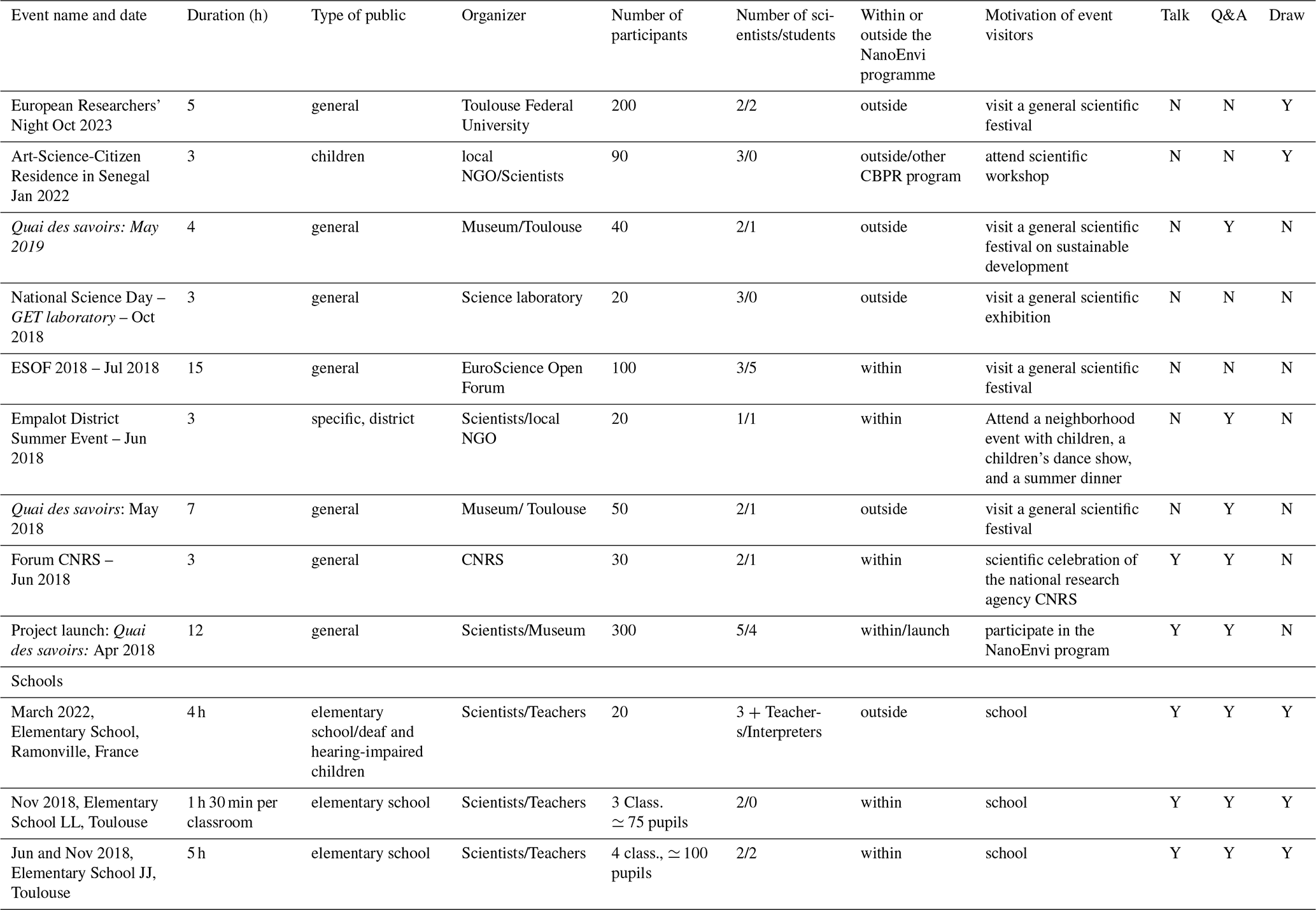
Exchanges with teachers (see Leite et al., 2022) prior the workshops supported the implementations of school-based interventions by helping define appropriate timing and the duration of each activity, understand children's perceptions and fears regarding environmental issues, and address the activities in practice. In addition to researchers and engineers (research staff), both undergraduate and graduate students participated in the events (Table 1).
Table 1Synthesis of the workshop implementation. “Talk” is when a seminar is given by a researcher, “Q&A” means debate and open questions, “Draw” represents a proposition to draw. Y/N means Yes and No, respectively, “CBPR”: Community-based Participatory Research. All events were held in Toulouse, France, except one in Senegal.
2.2 Evaluation and Ethical Considerations
We did not collect any personal information during the workshops. To preserve interaction and engagement, we chose not to administer a survey to evaluate the workshops. In such interactive and time-constrained workshop settings, standardized surveys may introduce response and participation biases and offer limited quantitative reliability (Tourangeau et al., 2000; Groves et al., 2009). They may also alter interaction dynamics and potentially reduce participant engagement (Bryman, 2016). Nevertheless, we attempted to administer a questionnaire twice. However, this approach was not only challenging to implement, but also prone to introducing biases, and it was perceived as fostering implicit expectations of reciprocity, thereby shaping participants' responses. It was therefore discontinued after two administrations.
Two teachers who participated in the NanoEnvi project by hosting biosensors in their classrooms took part in semi-structured interviews reflecting on their experience and on the children's response to the activities (see Leite et al., 2022). In this study, we draw specifically on the sections referring to the workshop conducted in their classrooms. The teachers were informed about the research project and the potential publication.
We assumed that participants' commitment, energy, and overall satisfaction were important aspects to consider. These elements are therefore discussed in the Results section. Particular attention was given to the type of audience reached, including schools in priority education zones and community centers in neighborhoods with predominantly immigrant populations, with the aim of engaging groups who do not typically attend science outreach events. Our goal was to promote encounters and get our experiences out of the laboratory.
We also evaluated the impact of the workshop by considering the number of actual registrations in the NanoEnvi project, whenever appropriate. We evaluated the outreach events based on the total number of attendees rather than the ratio of attendees to registrations, as our objective was not to maximize participation but to share our scientific approach as broadly and inclusively as possible.
3.1 General structure and implementation
We performed the workshop in several places (Table 1) from science festivals to small neighborhood events. We also carried it out in 3 schools in Toulouse (France). We capitalized on a series of NanoEnvi outreach projects to conduct the workshops. They were therefore sometimes accompanied by an exhibition consisting of 12 posters, a video, lectures, and a communication campaign. In some cases, we were invited to carry out this workshop outside the NanoEnvi project. We also deployed the workshop during a following community-based participative project in Senegal in a social center (90 children) (see online scientific blog: https://airgeo.hypotheses.org/792, last access: 18 May 2026).
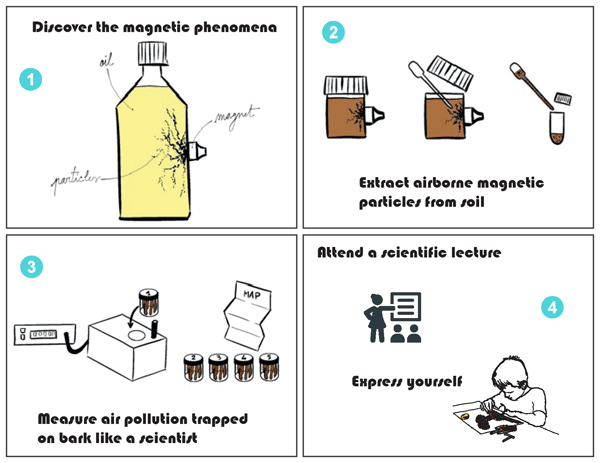
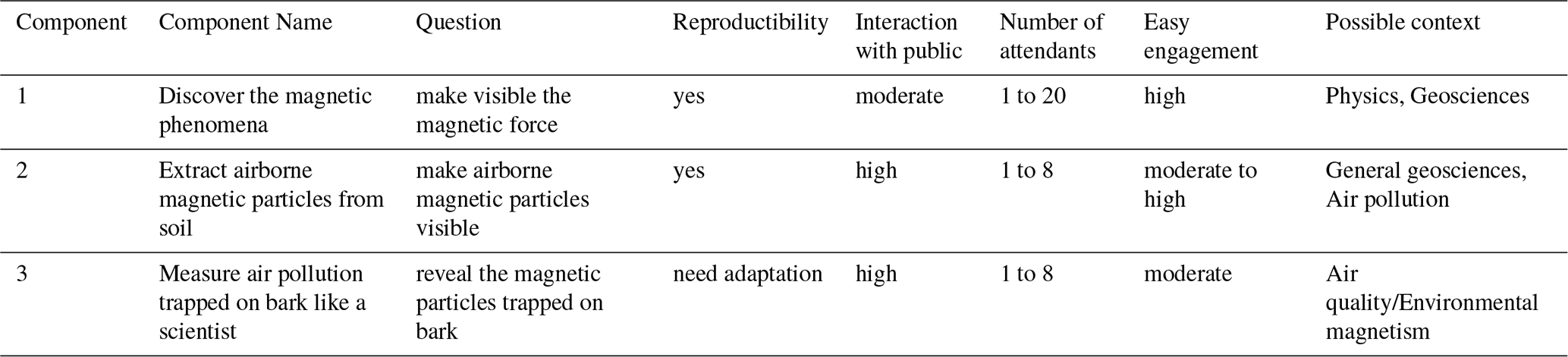
We present here the workshop set-up that was designed for the launch of the NanoEnvi participatory program. It comprises 4 independent components described below. To conceive the set-up, one of us (Melina Macouin) conducted a preliminary test during the “European researcher's night” in 2013 in Toulouse (France). The test involved bark magnetic susceptibility measurements made by children using a portable susceptibility meter, which helped inform the development of Component 4. The four components of the workshop set-up were thought to explain the method and approach, make airborne particles visible, and let the magnetic phenomenon fascinate visitors (Table 2, Fig. 1).
Table 2Characteristics of the NanoEnvi workshop components: component name, Question: the question it addresses, Reproducibility: how it is reproducible by academic or non-academic teams, Interaction with public: the degree of interaction it involves with participants, Number of attendants: the range of possible participants, Easy engagement: the degree to which it is easy for participants to engage, and Possible context: the scientific context in which the component might be used.
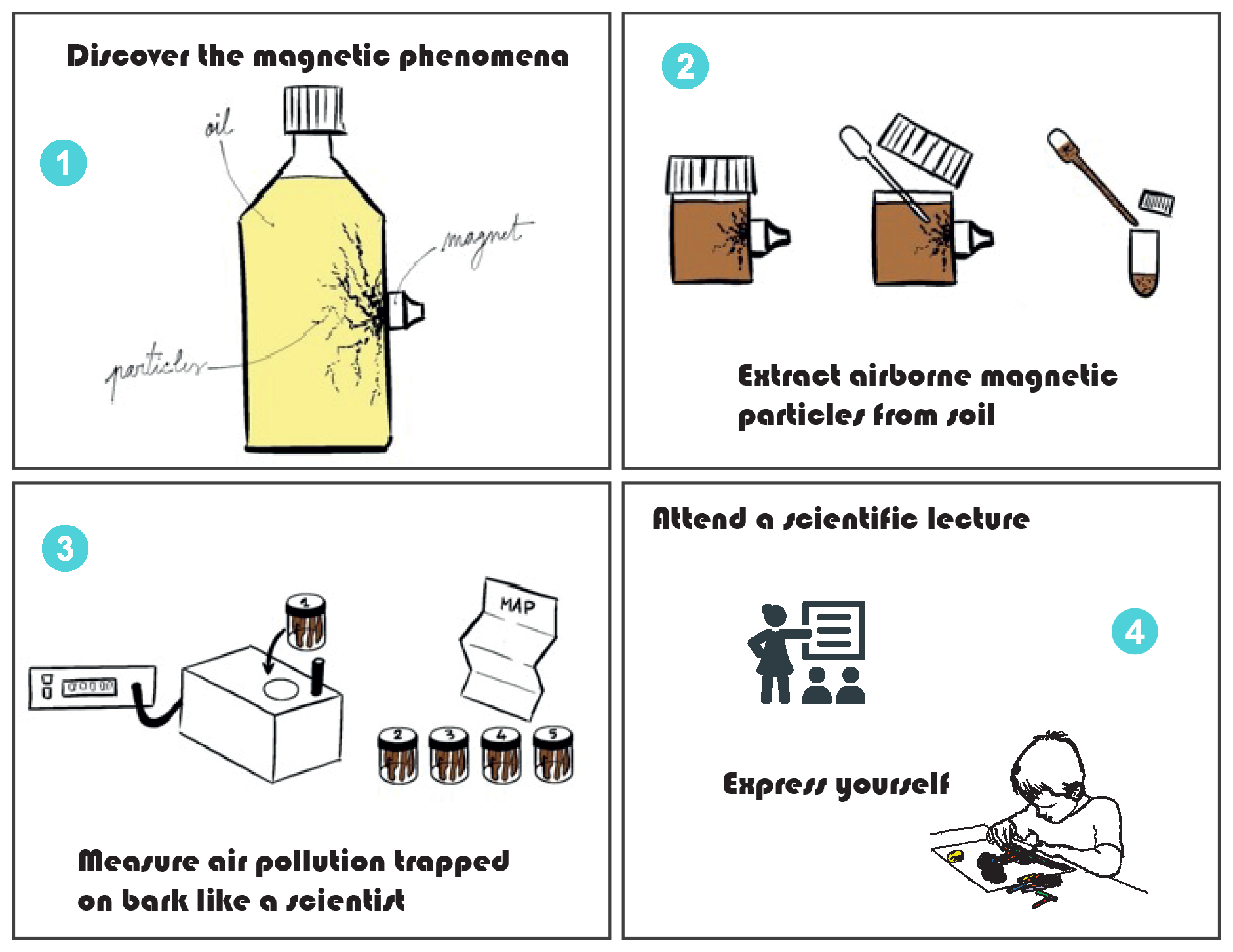
The workshop was implemented in two main settings: (1) a large group (in schools) divided into four sub-groups subgroups that rotate through the 4 experiments for a given period of time, and (2) informally, without registration, at science fair stands.
3.2 Discover the magnetic phenomena
To render the magnetic force visible, the first component mainly consisted of demonstrations of magnetic experiments. This part was meant to be carried out by a researcher (or more generally a science communicator), with only a few manipulations by the public. First, demonstrations of attraction between magnets were presented, starting with toys containing magnets (a common wooden train, a familiar toy to most French children) and finishing with the presentation of strong neodymium or ferrite magnets used in the laboratory. Precautions were taken when displaying powerful magnets, which posed risks when handled: fingers or hands could be caught between magnets, there was a risk of ingestion, and magnets were kept away from individuals with pacemakers. The public did not handle them. Second, to render the magnetic fields visible, transparent plastic bottles were filled with cooking oil (sunflower, rapeseed), chosen for their viscosity properties, and iron powders (Figs. 1–2). Two grain sizes of iron powder were used (coarse and fine). The demonstration consisted of shaking the bottle to disperse the iron particles and applying a magnet to the bottle's surface. The iron particles stuck to the magnet in specific shapes along the field lines, while more distant particles aligned themselves along the field lines (Fig. 2). This experiment offered an opportunity to discuss the geometry of the Earth's magnetic field. It illustrated the differences according to latitude, allowing us to discuss geomagnetism and paleomagnetism with the public. It also provided a first sensory and poetic approach to magnetic phenomena through the appearance of shapes. It was possible to have the public manipulate neodymium magnets that were not too powerful. In certain configurations (concentration of iron particles and magnet strength), the magnet stuck to the bottle's surface.
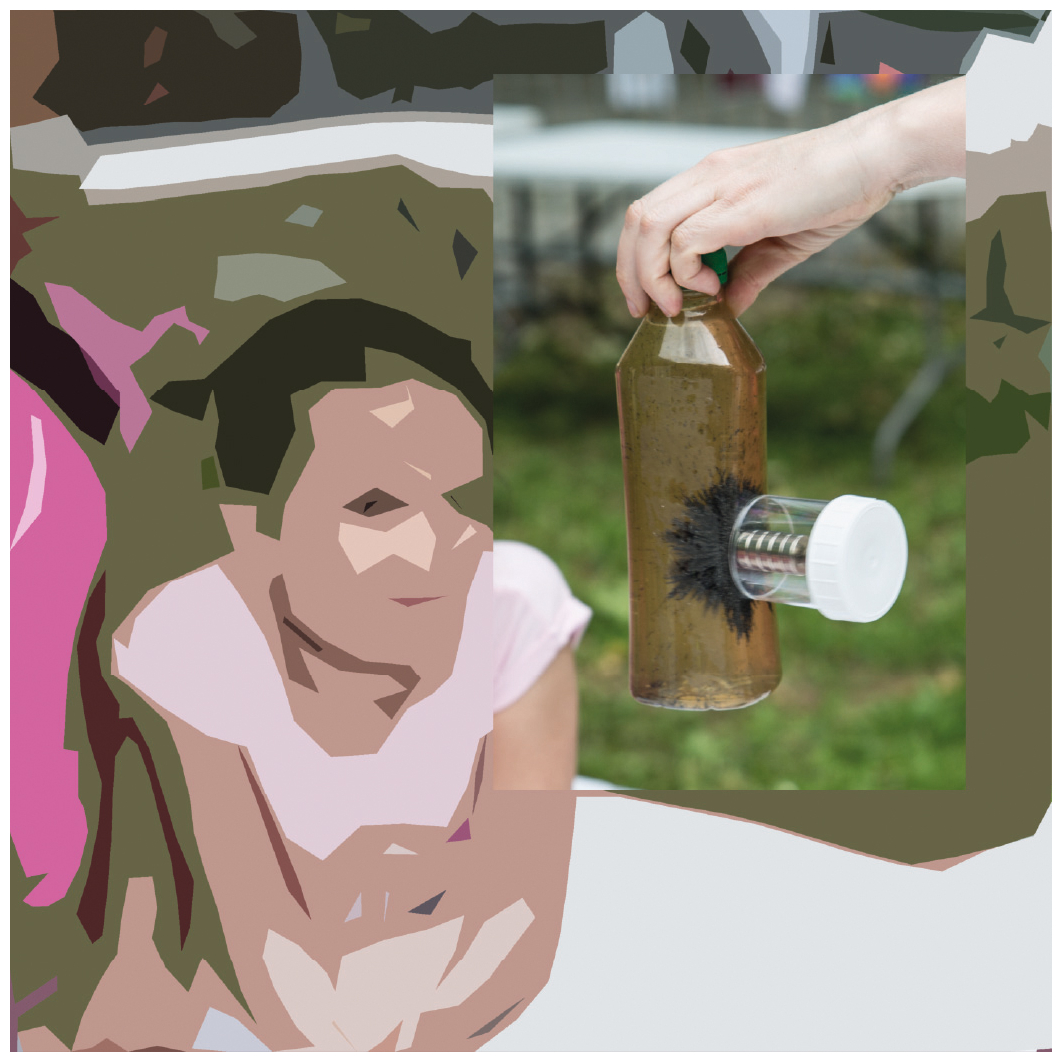
Figure 2Demo during Component 1 of the workshop. The bottle is filled with oil and iron particles. Magnets attract iron particles, which align along magnetic field lines. Photo credit: ASEER association – Toulouse modified for the publication by the authors.
Third, the animator introduced the magnetic paste slime (@Intelligente). In this experiment, the leader's creativity was expressed in the way they told a story by making the magnetic paste “dance” with a magnet. Often a snake was evoked because of the elongated shape that the person had to form with the paste to make it work. The dynamics of the dough were fascinating and captivating.
These experiments were designed to build up amazement and wonder throughout the demonstrations. During events, presenters (researchers or students) were free to perform the demos in their own way with their sensibility.
3.3 Extract airborne magnetic particles from soil
To make airborne magnetic particles visible, we proposed an experiment consisting of extracting magnetic particles from soil. The narrative was that some airborne magnetic particles could fall to the ground and contaminate it, and we were attempting to retrieve them. We also explained that this experiment corresponded to a manipulation we often carried out in our “environmental magnetism” laboratory.
Each visitor was given a vial (30 to 120 mL) filled with soil and water. Magnetic particles (commercial magnetite powder) were added to each vial prior to the experiment to facilitate the experience. Soils contain natural and anthropogenic magnetic particles that can be easily extracted with this protocol (as we do in our laboratory), but the number of extracted particles is insufficient to be easily visible to the naked eye. For this reason, a substantial input of magnetite was made here to enable a quick and easy experiment. In addition, visitors were given a magnet, a plastic pipette (2 mL), and a small scientific tube (Eppendorf type) (Fig. 3). Visitors first gained hands-on experience of pipetting, where they learned to aspirate and release liquids. Next, the experiment consisted of 7 steps:
-
shake the vial to disperse the soil in the water after making sure the vial is properly capped, open the vial,
-
apply the magnet to the surface of the vial slightly below the water line (with or without tape),
-
observe whether a black spot corresponding to the magnetic particles attracted by the magnet is present (if not, return to 1),
-
pipette the liquid containing the magnetic particles and simultaneously remove the magnet to allow the magnetic particles to be collected,
-
release the liquid into the tube,
-
close the tube and check with the magnet if magnetic particles are present.
-
Enjoy! Stop or return to 1.
Some people needed help to pipette or remove the magnet and pipette at the same time. The latter required coordinated actions that could be difficult regardless of the person's age and education. For example, some of us found it difficult, whereas some 7-year-olds with learning difficulties grasped it easily. As a result, this experience facilitated researcher-citizen interaction. Children were offered the possibility to take the tube home.
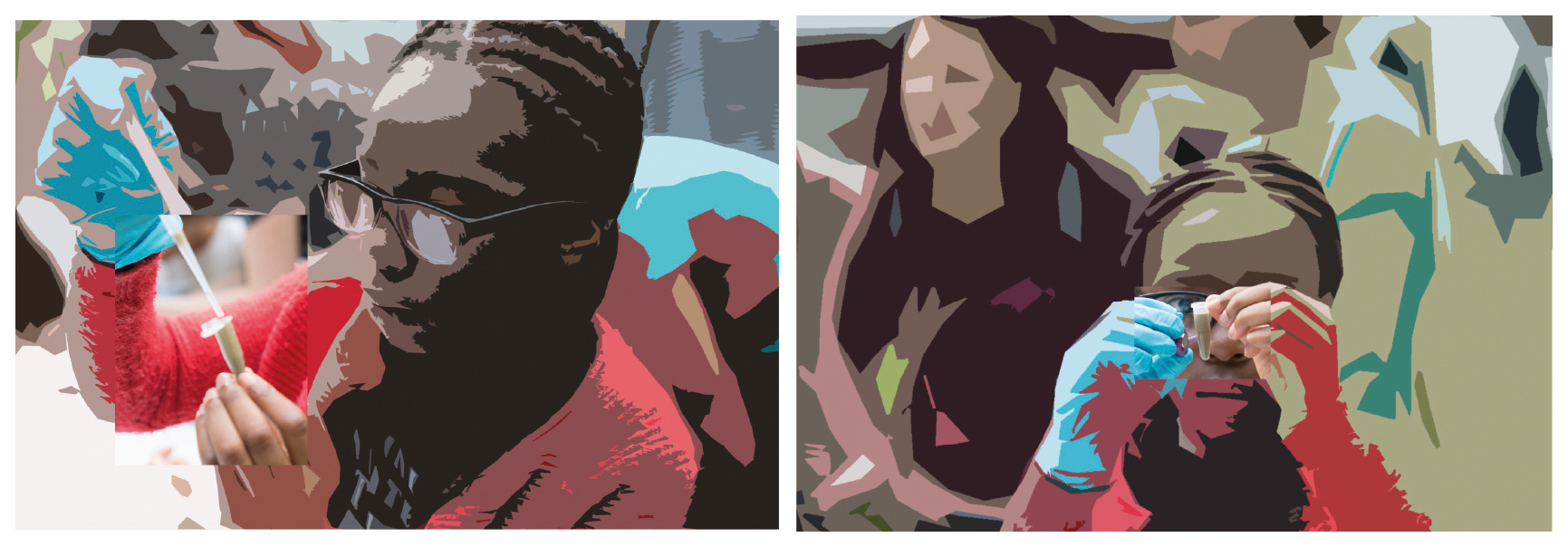
Figure 3Child performing the extraction in Component 2. Photo credit: ASEER association – Toulouse modified for the publication by the authors.
3.4 Measure air pollution trapped on bark like a scientist
To reveal the magnetic particles trapped on bark, the third experiment provided participants with the opportunity to perform hands-on measurements of magnetic susceptibility. Magnetic susceptibility was used to estimate the concentration of magnetic minerals, such as magnetite, deposited at the surface of tree bark. These magnetic minerals were used as proxies for anthropogenic pollution sources, particularly traffic-related emissions, including exhaust and non-exhaust particles (Delville et al., 2025). This approach has been applied in a limited number of participatory and environmental studies, including citizen-based projects in Toulouse (Leite et al., 2022) and Paris (Carvallo et al., 2024), as well as in broader environmental assessments (Chaparro et al., 2023). In this third component of the workshop, we invited participants to acquire measurements from plane tree bark (Platanus × acerifolia) using a laboratory instrument (Bartington MS2 magnetic susceptibility system coupled with the MS2B sensor) adapted for field use (Fig. 4). First, we showed attendees how to perform magnetic susceptibility measurements with the magnetic susceptibility meter and explained what the measurements represented. A set of five tree bark samples placed in 40 mL numbered plastic containers was provided. We also provided a map of the city of Toulouse showing the locations where the five bark samples were collected. The participants measured the 5 samples and wrote the data in a table (see Fig. S1 in the Supplement). Participants mapped the data using colored stickers, each corresponding to a defined range of magnetic susceptibility values displayed on the table (See Fig. S2). Once the colored stickers representing the magnetic mineral concentration values had been placed, the animator helped with interpretation. With the location of the samples on the map, participants could follow a path along the canal through the city, from a quiet urban environment (Point 1, Fig. S1) to the dense road traffic in the city center (Point 5, Fig. S1). In this way, participants could formulate the hypothesis that the magnetic particles present in the air and captured by the bark originated from road traffic, which intensified toward the center of the city, along with an increase in the concentration of magnetic and other airborne particles in the air we breathe. This encouraged an exchange between participants and researchers, allowing them to discuss the sources of ambient air particles in urban settings and the broader implications for air quality.
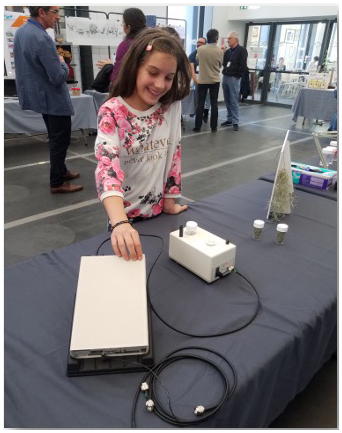
Figure 4Child performing measurements of bark samples in Component 3 with a susceptibility meter. Photo credit: Melina Macouin. Image reproduced with permission from the child's legal guardians.
While plane tree bark from the city could be measured directly with the instrument we proposed (as we sometimes do during our experiments in the field), we chose to enrich the samples with magnetic powder to obtain more easily measurable data, with a clear difference between samples. The experiment is feasible for children from 8 years of age or older.
3.5 Attend a scientific lecture and express yourself
Depending on the type of event, the first three components of the workshop were complemented by a lecture given by a researcher, a debate, and/or a proposition to draw solutions or observations (Table 1).
This was the case for all interventions in the 3 elementary schools. First, a 20 min talk was given by a researcher to explain the project, the scientific objectives of the project, and how the school and their class could participate. Debates (10 to 15 min) were proposed after the talk. In addition to the three previously described experiences (see Sect. 3.2, 3.3, 3.4), a fourth was proposed in which children could draw solutions for better air quality in the city or their observations about air pollution in their day-to-day activity (Fig. 5).
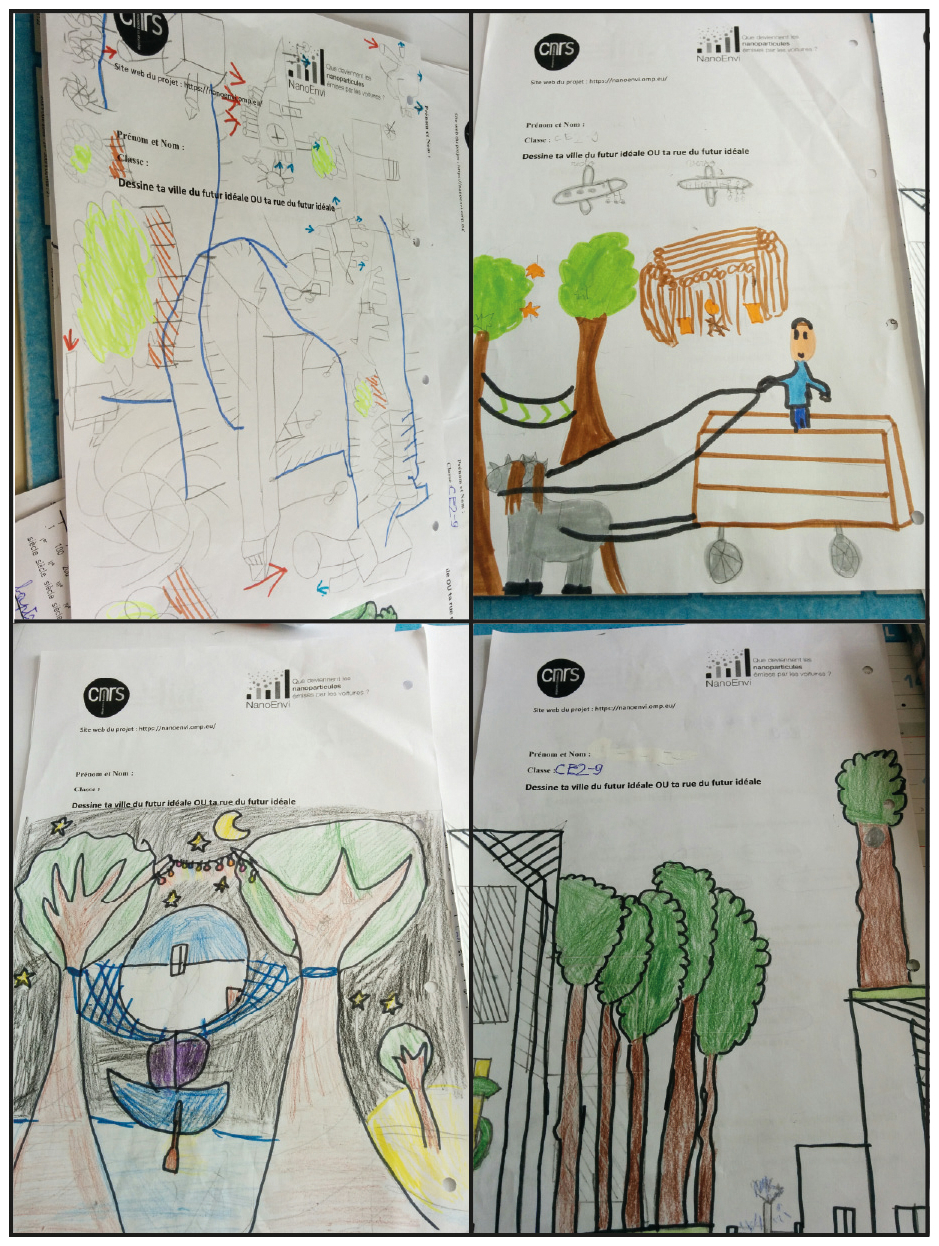
Figure 5Drawings made by children in school during Component 4.
The presence of a live sketching artist in one of the schools gave the children examples of artistic views of the workshop (Fig. 6). It also made it easier to report on what was happening in the classroom, where photography was prohibited by the school or children legal guardians.
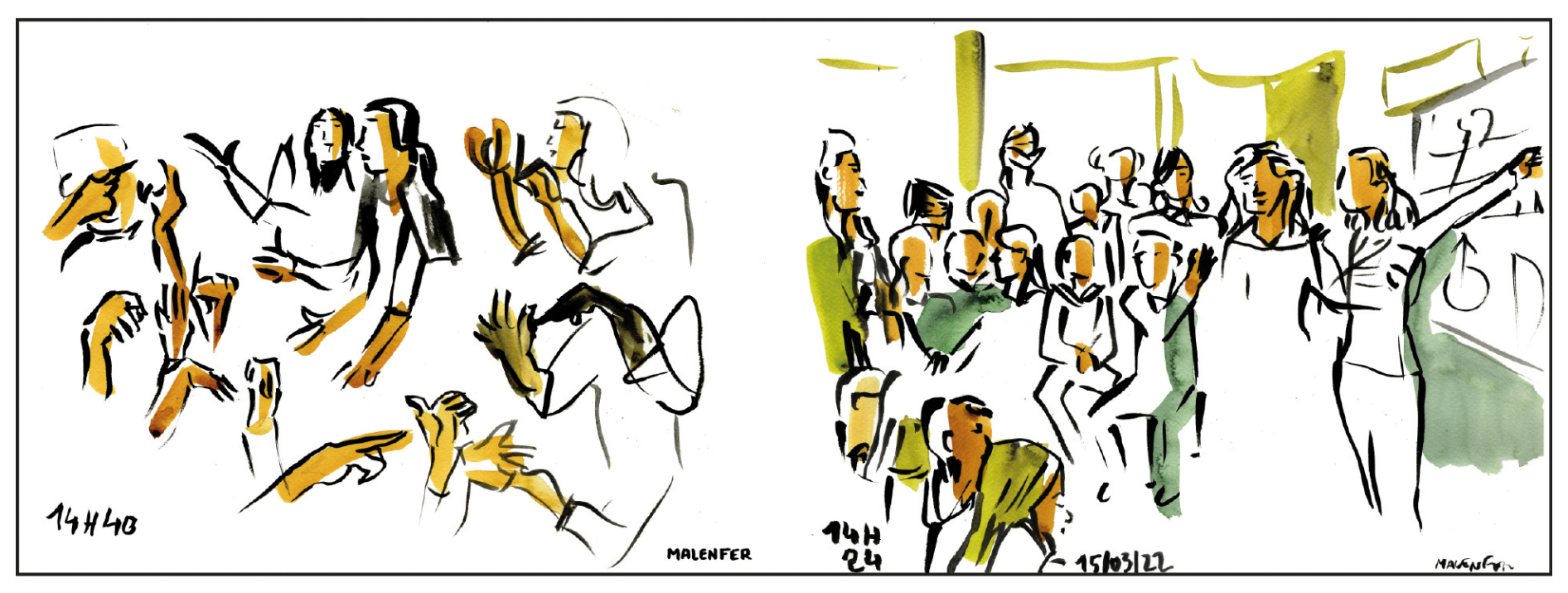
Figure 6Painting realized during a workshop in a hearing-impaired children's classroom by the live sketching artist, Frederic Malenfer. The artist illustrated the collective work of deciding and inventing sign-language gestures for “air pollution sensor”.
The effectiveness of the protocol in engaging visitors and pupils could be assessed from the stakeholders' perspectives: researchers and students, teachers, children and visitors, and citizen science participants.
4.1 Researchers and Students' perspectives
Overall, researchers and students expressed their satisfaction with the protocol. Almost no adjustments were required during the project. Satisfaction was expressed with the ease with which volunteers (students and researchers) were mobilized to run the workshops. These were mainly held outside working hours. One of the researchers (Melina Macouin) reported that although she had accompanied the extraction experiment with over 200 children, she was still moved by the stars that appeared in the children's eyes when they managed to capture the magnetic particles in the tube. Another scientist (Laure Laffont) said “What really stood out for me was the children's motivation to catch the particles, the laughter and fun, and their pride in their success”. Another researcher (Jean-François Léon) was surprised by adults: “I was struck by the adults' determination to achieve a good result. We see coercive science education (“you have to get there and only the right result is possible”). No one questioned the experimental protocol”
4.2 Teacher's perspective
We collected the impressions of the three teachers most involved in the project. Although two of the teachers responded to a semi-structured interview, the interviews were about hosting the biosensors and managing air quality in the classroom. Yet, during the interview, one of the teachers expressed their appreciation for the protocol (Fig. 7). All teachers informally expressed their satisfaction and gratitude after the workshop. Two of them asked about the opportunity to continue the workshop in the following years.

Figure 7Verbatim from a teacher in one of the participating elementary schools (children aged 9 to 12).
Another type of evaluation can be given by the example of the school principal who authorized us to intervene in the school after informally observing the reaction of children during a workshop held in the neighborhood. During this workshop, three children, aged around 9, left the stand with magnets after having taken part in the workshop. Half an hour later, they came back very excited, having conducted their own experiments with the soil and leaves they had found around them. The school principal was impressed by the scientific enthusiasm generated, particularly in relation to a child facing learning difficulties.
4.3 Children and visitors' perspectives
Besides the satisfaction expressed by children and visitors during the workshops, three observations can be used for evaluation purposes. First, children and visitors usually completed the experiences. Children generally took home their map and their tubes. Some children told us in subsequent meetings that they were eager to show their families the magnetic particles in their tube using the fridge magnets. Secondly, during a recent visit to a school class (11–12-year-old children) specializing in learning difficulties, one student recalled the workshop we had conducted two years earlier in their elementary classroom. The student was eager to share the experience and could describe its objectives, much to the surprise of the current teachers. This probably illustrates the importance of hands-on experience in scientific learning as often reported (Vennix et al., 2018; Wieman, 2014). Thirdly, during the presentation of an active pumping experiment to collect air filters in the classroom, a child questioned the researcher about the pump's ecological impact (Fig. 8). This comment shows that the student understood and remembered the concept of passive biosensors that we had presented during our previous intervention when we conducted the workshop. This remark moved the researcher and changed his point of view about passive/active particle collection, leading to new discussions among researchers.

Figure 8Verbatim of a dialogue between a child and a scientist in response to the presentation of an active pumping for air filters collection by a scientist, in one of the participating elementary schools (children aged 9 to 12).
4.4 Citizen science participants
Evaluation of the workshop protocol also relied on the engagement of participants in our citizen science project NanoEnvi during workshops. The passive biosensors distribution and registration were, in some cases, part of the stand. We took particular care to ensure that there was no pressure to sign up for the project during the workshops. In any case, the large number of visitors to the stand prevented any such pressure, as well as the fact that we generally did not produce enough sensors to distribute. A researcher or a PhD student was in charge of explaining the project and registration, which generally took 10 to 20 min. This part of the stand privileged a direct dialogue between the researcher and the participant. The participant (or his/her family) generally attended the rest of the stand beforehand. Most of the participants (more than 150) registered during or after these events, denoting the active role of the outreach protocol.
One of the challenges of citizen science in geosciences is to promote citizen participation by finding effective ways to reach and engage citizens, including those who have not traditionally been encouraged to engage with science (Kirch et al., 2005; NSF, 2023). To support inclusive involvement in community-based geoscience research, we designed a hands-on workshop presented at various public events and schools. Central to the workshop was the discovery and experimentation with magnetic phenomena, which offered an alternative, tangible way to approach the issue of air quality. This interactive experience acted as a key driver of engagement: it encouraged curiosity, fostered interaction between scientists and citizens, and created space for dialogue – even for those who did not ultimately join the NanoEnvi research project.
5.1 Make the experimentation protocol evolve
The workshop was a success in every respect, but there were some adjustments and improvements that could be made to enhance its inclusivity and adaptability. For instance, the “extraction” experiment (Sect. 3.3) could be adjusted to offer more autonomy to people who have difficulty with fine motor skills or the simultaneity of actions required by the experience. The current set-up has the advantage of using commonly available laboratory materials. However, a larger container with a wide base could be designed and coupled with a system for simply moving the magnet closer or further away.
Another limitation is that the workshop is really well suited for explaining an air monitoring project based on environmental magnetism methods. This type of project is not common outside our specific academic fields. It is, therefore, difficult for other academics or teachers to reproduce the workshop (Table 2). However, experiments demonstrating magnetic phenomena and the extraction of magnetic particles are easily reproducible and adaptable to different types of science educational projects, for instance, they could complement some Earth magnetic field workshops (van der Boon et al., 2022). Our team will be happy to advise on adjustments for different projects.
5.2 Foster dialogue between science and society
The workshop fostered science-society interaction through direct encounters between researchers and citizens. During a total of 9 science outreach events and workshops in 3 elementary schools, scientists interacted with 850 participants and 195 primary school pupils who took part in the workshop through one or more experiments. This also led to the involvement of more than 150 citizens (not counting other people in the participating households) in the participatory science project. Engaging with participants has been identified as a key lesson for long-term citizen science projects (Lopez et al., 2024). The face-to-face encounters opened up opportunities for two-way dialogues, enabling the scientists to convey their motivations and ethics underlying the approach, while also addressing the need for researchers to clearly communicate (Riaux et al., 2023) and acknowledge (Dietz, 2013) their value system. In particular, exchanges surrounding the environmental impact of using vegetal media instead of short-lived, low-cost sensors highlighted these underlying values and methodological choices, even prior to the broader science-society dialogue enabled by citizen science (Wagenknecht et al., 2021). At the same time, participants were able to contribute their points of view, thus nurturing the evolution of the citizen science project. For example, participant feedback led to the inclusion of new districts, the development of a project in a community garden, and the continued refinement of passive biosensors.
5.3 Facilitate inter-sciences communication
The NanoEnvi citizen project involved researchers from physics, humanities, and geosciences. We were able to witness an unexpected outcome in terms of facilitated dialogue and mutual understanding between radically different scientific fields. The need to adapt the discourse to a non-academic audience helped identify a level of language that is understandable across disciplines. Additionally, the shared time spent around the workshop experience and the interactions it generated led to new collaborative ideas, some of which have since been implemented with researchers from the project and others encountered at the same scientific fairs (Tastevin et al., 2026). This underscores the workshop's capacity not only to disseminate knowledge but also to facilitate interdisciplinary innovation and the initiation of sustainability science projects. This aligns with Lõhmus et al. (2025), who emphasize the importance of explicitly sharing disciplinary knowledge to foster interdisciplinary collaboration. In our case, this process was further reinforced by the presence of a non-academic audience, prompting a clearer articulation of disciplinary knowledge across fields. Such outcomes are rarely described in the literature, which more often reports the reverse dynamic (D'Este and Robinson-García, 2023; Norström et al., 2020).
5.4 Addressing the eco-anxiety associated with raising difficult issues such as air pollution
The design of the citizen science and of the workshop took into account the need to go beyond denouncing the worrisome, anxiety-provoking problems of potentially degraded urban air quality without generating eco-anxiety (Léger-Goodes et al., 2022; Watts et al., 2015) and solastalgia (Albrecht et al., 2007). Indeed, exposure to air pollution is one of the main environmental causes of premature death in Europe (European Environment Agency, 2021). The figure of 9 million premature deaths worldwide, including 67 000 in France, announced by WHO, was circulating in the French media in 2019 at the time of some of our interventions. The media's denunciation of the harmful health impacts of poor air quality generated negative emotions. In this context, our approach dealt with air quality, but positive emotions were also generated by hands-on magnetic experiences, by touching and discovering the wonder of a physical phenomenon. We believe that these stimulating experiences, which reveal forms of art-like beauty, helped to provide possible outlets and reduce environmental anxiety. To illustrate this, we can compare it with our first attempt to engage the public at a local open-air market, where we promoted the launch of the project through leaflet distribution, without the hands-on workshop component. This approach proved unsuccessful: passersby either ignored the issue altogether or reacted with high levels of anxiety when confronted with the topic of air pollution. In contrast, the interactive nature of the workshop created a more constructive and emotionally accessible entry point into the conversation. Participation and involvement in the rest of the project (Leite et al., 2022) could then be a means of empowering citizens confronted with potentially poor air quality.
This work demonstrates how a hands-on outreach activity could serve as an effective strategy to promote citizen engagement and initiate meaningful science-society interactions in the geosciences. We designed and conducted a hands-on science workshop with three experiments on magnetism and environmental magnetism. The workshop was held in three schools and at 9 science outreach events, promoting direct encounters between scientists and citizens for more than 1000 people.
Central to the workshop was the playful exploration of magnetic phenomena, offering a concrete and unconventional entry point to the topic of air quality. This hands-on approach stimulated curiosity, lowered barriers to communication, and facilitated meaningful exchanges between scientists and citizens.
Our findings show that this interactive approach encouraged dialogue, and opened participation even among those initially unfamiliar or hesitant. A concrete outcome of this strategy was the involvement of over 150 households and two elementary schools in the NanoEnvi participatory research project.
For researchers and students alike, the workshop offered a dynamic and impactful model of science outreach – one that not only communicates knowledge, but also empowers. In the context of geosciences, where environmental issues like urban air quality can provoke anxiety or disengagement, this type of hands-on mediation creates accessible and constructive entry points into citizen science. Overall, our results highlight the potential of playful, discovery-based engagement with physical phenomena as an effective lever to foster participation in citizen science initiatives.
The data from the teacher interviews for this study are not available for sharing as per ethical considerations.
The supplement related to this article is available online at https://doi.org/10.5194/gc-9-261-2026-supplement.
MM and SR planned the campaign; all authors performed the workshops; MM analyzed the data; MM wrote the manuscript draft; EV drew Fig. 1, EV and MM designed figures, all authors reviewed and edited the manuscript.
The contact author has declared that none of the authors has any competing interests.
The workshop was conducted in accordance with the ethical guidelines of the CNRS and Toulouse Museum departments, as well as general French national guidelines. We did not collect any personal information about participants during the workshop.
Interventions in schools were carried out with the agreement of the Toulouse administrative education department and after discussion with the teachers.
In all locations, we took into account the potential anxiety raised by the subject of air quality. We were careful to provide information that was appropriate, accessible, accurate, and balanced.
Publisher's note: Copernicus Publications remains neutral with regard to jurisdictional claims made in the text, published maps, institutional affiliations, or any other geographical representation in this paper. The authors bear the ultimate responsibility for providing appropriate place names. Views expressed in the text are those of the authors and do not necessarily reflect the views of the publisher.
The authors sincerely thank the pedagogical teams and children of Jules Julien and Leo Lagrange schools of Toulouse, the participants of the NanoEnvi project. They also thank the children of Sebikotane (Senegal) and the Tadjabone center. The authors acknowledge the support of the city of Toulouse, Toulouse Metropole, and the “Quai des Savoirs”. The authors thank the communication team of the CNRS-délégation Occitanie Ouest for their help along this project.
This study was funded by the French National Research Agency ANR-grant number ANR-19-CE04-0008 through the BREATHE project and ANR-grant ANR-21-SDG1-0009 through the AIRGEO project, and has received financial support from the CNRS through the MITI interdisciplinary programs – Osez l'interdisciplinarité-NanoEnvi. A.L. was supported by a scholarship of the French Government and Ministry of Education.
This paper was edited by Shahzad Gani and reviewed by two anonymous referees.
Albrecht, G., Sartore, G.-M., Connor, L., Higginbotham, N., Freeman, S., Kelly, B., Stain, H., Tonna, A., and Pollard, G.: Solastalgia: the distress caused by environmental change, Australas. Psychiatry, 15, S95, https://doi.org/10.1080/10398560701701288, 2007.
Brignole, D., Drava, G., Minganti, V., Giordani, P., Samson, R., Vieira, J., Pinho, P., and Branquinho, C.: Chemical and magnetic analyses on tree bark as an effective tool for biomonitoring: A case study in Lisbon (Portugal), Chemosphere, 195, 508–514, https://doi.org/10.1016/j.chemosphere.2017.12.107, 2018.
Bryman, A.: Social Research Methods, 5th Edn., Oxford University Press, Oxford, ISBN 9780190853662, 2016.
Carvallo, C., Isambert, A., Franke, C., Turcati, L., Sivry, Y., Coural, S., Macouin, M., Rousse, S., and Fluteau, F.: Ecorc'Air: A citizen science project for the biomonitoring of vehicular air pollution in Paris, France, Community Science, 3, e2024CSJ000084, https://doi.org/10.1029/2024CSJ000084, 2024.
Castañeda-Miranda, A. G., Chaparro, M. A. E., Böhnel, H. N., Chaparro, M. A. E., Castañeda-Miranda, R., Pacheco-Castro, A., Martinez-Fierro, M. L., Solis-Sánchez, L. O., and Ornelas-Vargas, G.: Bursera fagaroides bark as a bioindicator for air particle pollution using magnetic properties, J. South Am. Earth Sci., 108, 103217, https://doi.org/10.1016/j.jsames.2021.103217, 2021.
Chaparro, M. A. E., Chaparro, M. A. E., Castañeda-Miranda, A. G., Marié, D. C., Gargiulo, J. D., Lavornia, J. M., Natal, M., and Böhnel, H. N.: Fine air pollution particles trapped by street tree barks: In situ magnetic biomonitoring, Environ. Pollut., 266, 115229, https://doi.org/10.1016/j.envpol.2020.115229, 2020.
Chaparro, M. A. E., Buitrago Posada, D., Molinari, D., Chiavarino, L., Alba, B., Marié, D. C., Natal, M., Böhnel, H. N., and Vaira, M.: Urban and suburban's airborne magnetic particles accumulated on Tillandsia capillaris, Sci. Total Environ., 907, 167890–167890, https://doi.org/10.1016/j.scitotenv.2023.167890, 2023.
Chen-ming, G., Bo, W., and Xiao-han, S.: Biomagnetic monitoring of urban atmospheric pollution: A review of magnetic signatures from different types of plants, Sci. Total Environ., 963, https://doi.org/10.1016/j.scitotenv.2025.178518, 2025.
Clark, M. and Cornes, M.: Citizen Science as a Framework for Improving the Science-Society Interface in Long-Term Care Research, J. Long Term Care, 92–99, https://doi.org/10.31389/jltc.142, 2023.
Conkova, M. and Kubiznakova, J.: Lead isotope ratios in tree bark pockets: An indicator of past air pollution in the Czech Republic, Sci. Total Environ., 404, 440–445, https://doi.org/10.1016/j.scitotenv.2008.04.025, 2008.
Dawaï, D., Macouin, M., Rousse, S., Léon, J.-F., Gountié Dedzo, M., and Drigo, L.: Tracking Airborne Pollution with Environmental Magnetism in A Medium-Sized African City, Atmosphere, 12, 1281, https://doi.org/10.3390/atmos12101281, 2021.
Delville, L., Léon, J.-F., Macouin, M., Tastevin, Y.-P., Demory, F., Proietti, A., da Silva Chibane, P. H., Dias Alves, M., Gueye, M., and Laffont, L.: Size-fractionated carbonaceous and iron-rich particulate matter in urban environments of France and Senegal, Environ. Sci. Pollut. Res., 32, 677–692, 2025.
D'Este, P. and Robinson-García, N.: Interdisciplinary research and the societal visibility of science: The advantages of spanning multiple and distant scientific fields, Res. Policy, 52, 104609, https://doi.org/10.1016/j.respol.2022.104609, 2023.
Dietz, T.: Bringing values and deliberation to science communication, P. Natl. Acad. Sci. USA, 110, 14081–14087, https://doi.org/10.1073/pnas.1212740110, 2013.
European Environment Agency: A year in brief, ISBN 978-92-9480-476-1, https://doi.org/10.2800/01564, 2021.
Gonet, T. and Maher, B. A.: Airborne, Vehicle-Derived Fe-Bearing Nanoparticles in the Urban Environment: A Review, Environ. Sci. Technol., 53, 9970–9991, https://doi.org/10.1021/acs.est.9b01505, 2019.
Groves, R. M., Fowler, F. J., Couper, M. P., Lepkowski, J. M., Singer, E., and Tourangeau, R.: Survey Methodology, 2nd Edn., Wiley, Hoboken, NJ, ISBN 9780470465462, 2009.
Kirch, S. A., Bargerhuff, M. E., Turner, H., and Wheatly, M.: Inclusive Science Education: Classroom Teacher and Science Educator Experiences in CLASS Workshops, School Sci. Math., 105, 175–196, https://doi.org/10.1111/j.1949-8594.2005.tb18157.x, 2005.
Kitchen, D.: Global climate change: Turning knowledge into action: 2nd Edn., 1 pp., https://doi.org/10.4324/9781003146636, 2023.
Kousehlar, M. and Widom, E.: Sources of metals in atmospheric particulate matter in Tehran, Iran: Tree bark biomonitoring, Appl. Geochem., 104, 71–82, https://doi.org/10.1016/j.apgeochem.2019.03.018, 2019.
Léger-Goodes, T., Malboeuf-Hurtubise, C., Mastine, T., Généreux, M., Paradis, P.-O., and Camden, C.: Eco-anxiety in children: A scoping review of the mental health impacts of the awareness of climate change, Front. Psychol., 13, https://doi.org/10.3389/fpsyg.2022.872544, 2022.
Leite, A. D. S., Léon, J.-F., Macouin, M., Rousse, S., Trindade, R. I. F. D., Proietti, A., Drigo, L., Antonio, P. Y. J., Akpo, A. B., Yoboué, V., and Liousse, C.: PM2.5 Magnetic Properties in Relation to Urban Combustion Sources in Southern West Africa, Atmosphere, 12, 496, https://doi.org/10.3390/atmos12040496, 2021.
Leite, A. D. S., Rousse, S., Léon, J. -F., Trindade, R. I. F., Haoues-Jouve, S., Carvallo, C., Dias-Alves, M., Proietti, A., Nardin, E., and Macouin, M.: Barking up the Right Tree: Using Tree Bark to Track Airborne Particles in School Environment and Link Science to Society, GeoHealth, 6, 1–18, https://doi.org/10.1029/2022gh000633, 2022.
Li, Y., Wang, B., Zhang, X., Chen, X., Sun, X., and Jia, J.: Source apportionment of trace elements in urban atmospheric particulates using tree bark biomonitoring with receptor modeling: A case study from Hangzhou, China, Environ. Pollut., 385, 127114, https://doi.org/10.1016/j.envpol.2025.127114, 2025.
Lõhmus, A., Kiisel, M., and Lõhkivi, E.: Interdisciplinary collaboration for sustainability science: the training challenge, Humanit. Soc. Sci. Commun., 12, 1936, https://doi.org/10.1057/s41599-025-06221-9, 2025.
Lopez, L. S., Basu, A., Blagrave, K., Bove, G., Stewart, K., Bazely, D., and Sharma, S.: Establishing a long-term citizen science project? Lessons learned from the Community Lake Ice Collaboration spanning over 30 yr and 1000 lakes, Limnol. Oceanogr. Lett., 9, 99–111, https://doi.org/10.1002/lol2.10336, 2024.
Loroño-Leturiondo, M., O'Hare, P., Cook, S. J., Hoon, S. R., and Illingworth, S.: Building bridges between experts and the public: a comparison of two-way communication formats for flooding and air pollution risk, Geosci. Commun., 2, 39–53, https://doi.org/10.5194/gc-2-39-2019, 2019.
Macouin, M., Suchon, S., Gangneron, F., Haouès-Jouve, S., Rousse, S., Léon, J.-F., Leite, A., Schreck, E., and Respaud, M.: L'interdisciplinarité et la science participative pour relever le défi de la pollution de l'air urbain, in: L'interdisciplinarité, Voyages au-delà des disciplines, 162–166, EAN 9782271139832, 2023.
Mahajan, S., Kumar, P., Pinto, J. A., Riccetti, A., Schaaf, K., Camprodon, G., Smári, V., Passani, A., and Forino, G.: A citizen science approach for enhancing public understanding of air pollution, Sustain. Cities Soc., 52, 101800, https://doi.org/10.1016/j.scs.2019.101800, 2020.
Maher, B. A.: Magnetic properties of some synthetic sub-micron magnetites, Geophys. J. Int., 94, 83–96, https://doi.org/10.1111/j.1365-246X.1988.tb03429.x, 1988.
Norström, A. V., Cvitanovic, C., Löf, M. F., West, S., Wyborn, C., Balvanera, P., Bednarek, A. T., Bennett, E. M., Biggs, R., De Bremond, A., Campbell, B. M., Canadell, J. G., Carpenter, S. R., Folke, C., Fulton, E. A., Gaffney, O., Gelcich, S., Jouffray, J.-B., Leach, M., Le Tissier, M., Martín-López, B., Louder, E., Loutre, M.-F., Meadow, A. M., Nagendra, H., Payne, D., Peterson, G. D., Reyers, B., Scholes, R., Speranza, C. I., Spierenburg, M., Stafford-Smith, M., Tengö, M., Van Der Hel, S., Van Putten, I., and Österblom, H.: Principles for knowledge co-production in sustainability research, Nat. Sustain., 3, 182–190, https://doi.org/10.1038/s41893-019-0448-2, 2020.
NSF: Diversity and STEM: Women, Minorities, and Persons with Disabilities, Alexandria, VA, NSF 23-315, 2023.
Odabasi, M., Tolunay, D., Kara, M., Ozgunerge Falay, E., Tuna, G., Altiok, H., Dumanoglu, Y., Bayram, A., and Elbir, T.: Investigation of spatial and historical variations of air pollution around an industrial region using trace and macro elements in tree components, Sci. Total Environ., 550, 1010–1021, https://doi.org/10.1016/j.scitotenv.2016.01.197, 2016.
OECD: Addressing societal challenges using transdisciplinary research, OECD Science, Technology and Industry Policy Papers, No. 88, OECD Publishing, Paris, https://doi.org/10.1787/0ca0ca45-en, 2020.
Oreskes, N.: Why Trust Science?, Princeton University Press, https://doi.org/10.2307/j.ctv17ppcp4, 2019.
Riaux, J., Kuper, M., Massuel, S., and Mekki, I.: Riding the waves of discomforts: Reflecting on the dialogue of hydrologists with society, J. Hydrol., 626, 130189, https://doi.org/10.1016/j.jhydrol.2023.130189, 2023.
Rickenbacker, H., Brown, F., and Bilec, M.: Creating environmental consciousness in underserved communities: Implementation and outcomes of community-based environmental justice and air pollution research, Sustain. Cities Soc., 47, 101473–101473, https://doi.org/10.1016/j.scs.2019.101473, 2019.
Rotman, D., Preece, J., Hammock, J., Procita, K., Hansen, D., Parr, C., Lewis, D., and Jacobs, D.: Dynamic changes in motivation in collaborative citizen-science projects, in: Proceedings of the ACM 2012 conference on Computer Supported Cooperative Work, CSCW '12: Computer Supported Cooperative Work, 217–226, https://doi.org/10.1145/2145204.2145238, 2012.
Shirk, J. L., Ballard, H. L., Wilderman, C. C., Phillips, T., Wiggins, A., Jordan, R., McCallie, E., Minarchek, M., Lewenstein, B. V., Krasny, M. E., and Bonney, R.: Public Participation in Scientific Research: a Framework for Deliberate Design, E&S, 17, art29, https://doi.org/10.5751/ES-04705-170229, 2012.
Sut-Lohmann, M., Jonczak, J., Parzych, A., Šimanský, V., Polláková, N., and Raab, T.: Accumulation of airborne potentially toxic elements in Pinus sylvestris L. bark collected in three Central European medium-sized cities, Ecotox. Environ. Safe., 200, 110758, https://doi.org/10.1016/j.ecoenv.2020.110758, 2020.
Tastevin, Y. P., Macouin, M., Léon, J.-F., Delville, L., Laffont, L., Gueye, M., Sagna, M. B., Dutrait, C., Cabral, M., and Diaw, M.: Etude scientifique et participative sur la qualité du sol et de l'air et sur la perception des pollutions par les habitants dans la zone Sebikotane-Diamniadio, Sénégal-Résultats du projet AirGeo (2021–2024), hal-05539974v2, 2026.
Tourangeau, R., Rips, L. J., and Rasinski, K.: The Psychology of Survey Response, Cambridge University Press, Cambridge, https://doi.org/10.1017/CBO9780511819322, 2000.
van der Boon, A., Biggin, A. J., Paterson, G. A., and Kavanagh, J. L.: Magnetic to the Core – communicating palaeomagnetism with hands-on activities, Geosci. Commun., 5, 55–66, https://doi.org/10.5194/gc-5-55-2022, 2022.
Van Mensel, A., Wuyts, K., Pinho, P., Muyshondt, B., Aleixo, C., Orti, M. A., Casanelles-Abella, J., Chiron, F., Hallikma, T., Laanisto, L., Moretti, M., Niinemets, Ü., Tryjanowski, P., and Samson, R.: The magnetic signal from trunk bark of urban trees catches the variation in particulate matter exposure within and across six European cities, Environ. Sci. Pollut. Res., 30, 50883–50895, https://doi.org/10.1007/s11356-023-25397-8, 2023.
Vennix, J., Brok, P. den, and Taconis, R. R.: Do Outreach Activities in Secondary STEM Education Motivate Students and Improve Their Attitudes Towards STEM?, Int. J. Sci. Educ., https://doi.org/10.1080/09500693.2018.1473659, 2018.
Vezzola, L. C., Muttoni, G., Merlini, M., Rotiroti, N., Pagliardini, L., Hirt, A. M., and Pelfini, M.: Investigating distribution patterns of airborne magnetic grains trapped in tree barks in Milan, Italy: insights for pollution mitigation strategies, Geophys. J. Int., 210, 989–1000, https://doi.org/10.1093/gji/ggx232, 2017.
Vohland, K., Land-Zandstra, A., Ceccaroni, L., Lemmens, R., Perelló, J., Ponti, M., Samson, R., and Wagenknecht, K. (Eds.): The Science of Citizen Science, Springer International Publishing, Cham, https://doi.org/10.1007/978-3-030-58278-4, 2021.
Wagenknecht, K., Woods, T., Nold, C., Rüfenacht, S., Voigt-Heucke, S., Caplan, A., Hecker, S., and Vohland, K.: A question of dialogue? Reflections on how citizen science can enhance communication between science and society, JCOM, 20, A13, https://doi.org/10.22323/2.20030213, 2021.
Watts, N., Adger, W. N., Agnolucci, P., Blackstock, J., Byass, P., Cai, W., Chaytor, S., Colbourn, T., Collins, M., Cooper, A., Cox, P. M., Depledge, J., Drummond, P., Ekins, P., Galaz, V., Grace, D., Graham, H., Grubb, M., Haines, A., Hamilton, I., Hunter, A., Jiang, X., Li, M., Kelman, I., Liang, L., Lott, M., Lowe, R., Luo, Y., Mace, G., Maslin, M., Nilsson, M., Oreszczyn, T., Pye, S., Quinn, T., Svensdotter, M., Venevsky, S., Warner, K., Xu, B., Yang, J., Yin, Y., Yu, C., Zhang, Q., Gong, P., Montgomery, H., and Costello, A.: Health and climate change: policy responses to protect public health, Lancet, 386, 1861–1914, https://doi.org/10.1016/S0140-6736(15)60854-6, 2015.
Wieman, C.: Large-Scale Comparison of Science Teaching Methods Sends Clear Message, P. Natl. Acad. Sci. USA, https://doi.org/10.1073/pnas.1407304111, 2014.
Xu, Y., Xiao, H., Guan, H., and Long, C.: Monitoring atmospheric nitrogen pollution in Guiyang (SW China) by contrasting use of Cinnamomum Camphora leaves, branch bark and bark as biomonitors, Environ. Pollut., 233, 1037–1048, https://doi.org/10.1016/j.envpol.2017.10.005, 2018.