
the Creative Commons Attribution 4.0 License.
the Creative Commons Attribution 4.0 License.
 | 03 Jun 2026
Hello world! An interdisciplinary climate modelling course
Martin Staab
Climate models are not just physics translated into computer code. They are powerful actors influencing and influenced by humans. Thus modelers need to learn and modelling courses need to teach not only the techniques of numerical discretisation and the physical understanding of the climate system, but also the underlying motivations, the uncertainties and the societal embededness of the modelling approach. Following a design-based research approach, this study develops a 50 h long course at Bachelor level that aims to teach students such interdisciplinary perspectives. With a reflective open-ended exercise, we elicit students' learning process through challenging climate modelling topics. We find that the students learn to appreciate the complexity of climate models and the intricacies of scientific practice itself, highlighting for example the role of values in science. The exercise reveals few misconceptions and no major hurdles in the students' learning that may have been expected from the interdisciplinary nature of the material. We thus conclude that the course is a practice-proven approach to teaching the physical basis of climate modelling as well as its critical reflection. Together with the openly shared material, it supplies an inspiration and practical template for lecturers to include more interdisciplinary content and reflection into their modelling courses.
- Article
(3669 KB) - Full-text XML
- BibTeX
- EndNote


Geoscientists are trained to think of climate change as a technical issue. In its simplest form, it is a problem of greenhouse gas emissions. Diving deeper, it relates to an entanglement of Earth system processes and compartments, providing ample justification for detailed investigations of those. To cope with this immense complexity and to tame it in order to provide projections, general circulation models (GCMs) have been developed. GCMs solve the equations of fluid dynamics numerically and include other (parameterised) computations of for example radiation and clouds' formation or effects (Gettelman and Rood, 2016; Easterbrook, 2023). They have gained authority in climate science and beyond (Sundberg, 2007; Heymann, 2020). GCMs have allowed investigating the threat of climate change in the first place, raised it on the political agenda, and are exceptional tools for attribution, process and sensitivity studies (Shackley et al., 1998; Edwards, 2001; Parker, 2003; Heymann, 2013),
Thus modelers yield powerful tools, yet these are not neutral. On the one hand, they are not built straight from physical principles. Instead, modelling involves “literally thousands” of “unforced” methodological choices (where one option is not “objectively better” than the alternatives; Ward, 2021, quoting Winsberg, 2012). These allow human influences to enter the design and analysis process. In environmental modelling, development decisions have been shown to be influenced by modelers' habits (Babel, 2019), context (Addor and Melsen, 2019; Melsen, 2022), and values (Undorf et al., 2022). On the other hand, GCMs shape climate science as well as society and the public understanding of climate change. They tighten the grip of natural sciences around the understanding and discussion of climate change, emphasizing projections and a problem-solution or managerial policy framing (Shackley et al., 1998; Hulme, 2008; Mahony and Hulme, 2016). For example, Heymann et al. (2017b) criticise that GCMs sidelined alternative approaches to understanding climate. The global view propagated by GCMs restricts the space of imaginable interventions (Heymann et al., 2017b). It is also separated from local, personal experience and perception (Mahony and Hulme, 2018).
The issues sketched above were studied and brought up by researchers from history and philosophy of climate modelling, or science and technology studies (STS, Jasanoff, 2007; Sismondo, 2010), but they have become part of the (climate) modelling debate (Rödder et al., 2020; Pulkkinen et al., 2022; Remmers et al., 2025). While they have motivated the reflection on good modelling practices (Saltelli et al., 2020; Jakeman et al., 2024), they have yet to reach many modelers and model developers themselves. For informed and active reflection to become part of modelling practice, it also needs to be integrated into modelling education. In addition to learning the physical and technical basis of how to construct numerical models, modelers also need to learn to reflect on other influences and model limitations, such as modelling motivations, model uncertainties, and models' historical development.
A particular motivation and challenge for this kind of learning lies in the inherent interdisciplinarity. Students should learn the actual modelling application (model building and use), as well as the historical and philosophical reflection on it. Alves (2012) highlights that especially for Earth System research, this interdisciplinarity is key, as the field needs to grapple with attribution of environmental changes as well as societal responses. Similarly, Rafolt et al. (2019) argue that socio-scientific issues like climate change require both scientific literacy and critical thinking. For hydrological modelling, Remmers et al. (2025) argue that modelling education should include basic learnings from social science as well as reflexivity (see also Oldfield, 2022). The current study presents an interdisciplinary course on climate modelling, called “Hello world! From numerical programming to complex climate models”, as we have taught it in 2024. Following design-based research practice (see Sect. 2.1), we have developed a course for high-school students that aims to teach (see Fig. 1):
-
how to translate differential equations into a numerical model of a given system
-
the various roles of model building in science
-
the structure, function and peculiarities of GCMs
-
an interdisciplinary reflection on climate model building to understand the role of models holistically
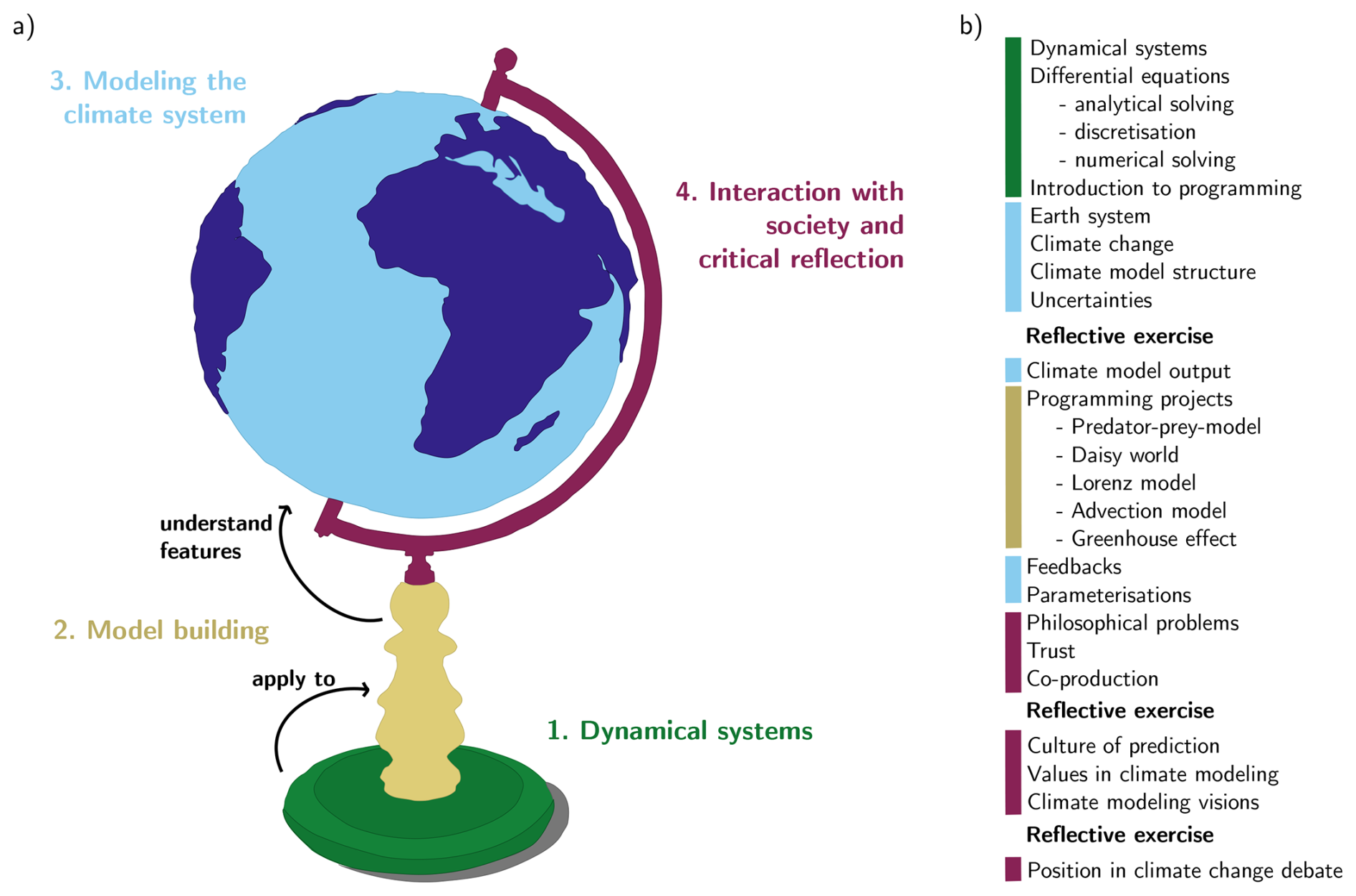
Figure 1Content of the course, divided by the four topic groups or aims of the course (colors). The content builds up from bottom to top in principal, as indicated by the arrows and numbering in (a), but as we detail in Sect. 3.2, we integrated the content more and more to have the understanding of the numerical modelling and the philosophical perspectives and science and technology studies (STS) content benefit each other, as evident in the chronological course structure detailed in (b). The reflective exercises are indicated in (b), and they each covered all the modules treated before each exercises. Each of the three rounds included the “a posteriori” and the “a priori” question and the analysis in Sect. 3 treats all three rounds of the exercises at the same time. The colors correspond roughly to the ones used to illustrate the content analysis results in Figs. 2 and 3. For the detailed course structure, see Table A1. The sketch is based on © Corona Bustamante (1860).
While these topics may seem advanced, the course is entry-level and requires no BSc level knowledge or coding experience. It can certainly be adapted to a university, informal education or outreach setting. To our knowledge a course like this has not been documented in the literature before, and thus this study contributes to a generally small base of literature that explicitly treats the teaching of climate modelling (see e.g. Storch et al., 1999; McGuffie and Henderson-Sellers, 2005; Stensrud, 2007; Stocker, 2011; Slawig, 2015; Gettelman and Rood, 2016; Bice, 2001; Bhattacharya et al., 2021; Seeley, 2023; Aroskay et al., 2024). Our goals for this article are twofold: First, document the course to give inspiration and materials for others (see course schedule in Appendix A and also the teaching material shared at Proske and Staab, 2026). Second, evaluate our concept to teach both model;ing knowledge and its reflection at the same time. Due to the qualitative methodology employed, our findings are conceptual and subjective in that we interpret how the course resonates with the students. In particular, we evaluate scientifically whether the course triggers a reflection process for the students and what that looks like.
This course was developed for and taught at the NAka, a 2-week summer camp in Papenburg, Germany, for especially motivated German high-school students. In total, around 100 students take part in the NAka program each year, aged between 15 and 18, and they are distributed over six courses. The courses are taught by young adults with university education in the field they are teaching and ideally with some teaching experience. When students apply, they select 5 out of the over 50 possible course choices from around 10 similar camps taking place over the summer. The NAka, however, is the only such camp with a focus on sustainability and climate change, which may affect students' choice of the course. The NAka is organized by the non-profit organisation JGW e.V. The camp's goal is to teach a holistic understanding of climate change and sustainability, foster participants' skills, and encourage them to take responsibility and engage in society (JGW e.V., 2025).
The NAka creates a special learning and teaching experience, where several factors need to be highlighted for the course we present here and our study
-
While the participants are high-school students, the course is aimed to be at a Bachelor studies university level. This is to challenge students who perform well in school, but also to teach something outside their school curricula and to accommodate the fact that the previous knowledge of participants is varied (since students come from all over Germany as well as German schools abroad).
-
Students attend the camp voluntarily, the course was one of their selected five, and they have been suggested for participation by their school teachers. Thus their high motivation makes for an especially fruitful learning experience, both for them and for the teachers.
-
Our engagement in the NAka is a voluntary and unpaid free time activity. Our disciplinary background is in climate science, physics and numerical modelling, with university teaching experience in lectures and tutorials (see also Sect. 2.3). While the course benefits from our knowledge, and research and teaching experience, we approach it with few organisational restrictions which enables us to design the course freely.
-
It's a summer camp! There are no assessments or gradings included in the course, activities need to be engaging, and we aim for an enjoyable atmosphere.
A usual day at the NAka consists of 3.5 h of coursework in the morning and 2.5 h in the afternoon. In total, there are 50 h of coursework. Our course in 2024 had 17 students (mixed gender).
2.1 Design-based research
In developing the course, we were engaging in design-based research (see, for example, Assaraf and Orion, 2009). This branch of education studies simultaneously develops, tests and improves an educational module, proceeding over iterative cycles. Cohen et al. (2011b, Chp. 16.10) link it to engineering studies, where prototypes are developed, tested, and the feedback is applied to a new development round of the product. While our analysis for this study rests on the 2024 course edition, we have taught the course four times in total (2022–2025). During the first two years we incorporated participants' feedback (see Sect. 3.2). Then we took the third year (in 2024) as an opportunity for a more thorough evaluation of the course concepts. The design-based research framework fits our approach because it formalises our two-fold goal of designing and researching the teaching and thereby fruitfully combines our two interlinked roles of teachers and designers. In design-based research, the “agenda of the designers is seen as a positive force rather than a threat to validity” (Hoadley and Campos, 2022). Moreover, the approach is interventionist, for example allowing “tweaking the intervention to better match the design intent mid-implementation” (Hoadley and Campos, 2022) rather than sticking with an ill-suited design in order to keep study conditions constant. We made use of this when improving the course in between editions.
2.2 Research questions and their assessment
For the third cycle, we set out to not only evaluate and improve the course in terms of direct feedback, but wanted to dive deeper into understanding the students' learning progress. Our goal for the course has been to teach both numerical (climate) modelling and its critical reflection. The combination of natural sciences with philosophy of science and STS has been a thought-provoking and challenging experience for us. We were motivated to give students in the course a similar intellectual experience as well as a holistic picture of climate change modelling as a socio-scientific issue from the start (Rafolt et al., 2019). During the first two cycles, we have noted incidents that hinted at individual students undergoing a profound change of their perspectives and conceptions. Therefore, in the third cycle we wanted to study what that process looks like and whether more than single students were undergoing it. Additionally, we were interested in which modules in particular facilitated the learning process and where students faced challenges integrating modules with their thoughts. Accordingly, we formulated our research question as:
In our interdisciplinary course on climate modelling, what does the students' learning look like and does it align with envisioned learning outcomes? What thought processes does the course trigger? Do we see evidence for change in students' thinking about climate models?
In choosing the assessment method we were guided by the following considerations.
-
As time for the course is short, the course should not be interrupted by extra activities, but these should be integrated into the course flow.
-
The participants should gain something from the tasks they fulfill for the assessment.
-
The exercise should not feel like they are being “assessed” in school, which would entail pressure as well as an enhanced risk of the “good-subject effect” (Orne, 1962; Nichols and Maner, 2008, a form of participant bias), meaning that the students would be encouraged to answer what they believe we would want to see.
-
Assessment products should be written down in order for us to have them documented and accessible for analysis and interpretation further on.
-
The assessment exercise should take place close to the modules that we foresee to trigger thought processes (“Climate model structure” and uncertainties; “philosophical problems”, trust and co-production; “culture of prediction”; values and visions; see Table A1). In the second cycle (2023) we attempted to get an impression of students' reflective change by asking in a survey in the end how their perceptions changed, but their answers were shallow and short. Thus, for the formal evaluation in the third cycle (2024) we opted against an assessment at the end of the course.
-
We chose a method with multiple iterations so that we could have improved the approach if it had appeared unfruitful.
-
Since the goal of the exercise was reflection, it should be open enough so that students can answer individually rather than having their thoughts pressed into a template.
We thus opted for the iterative direct assessment of students' perception changes in a reflective exercise. Asking students for changes in their thoughts and opinions directly demands a high level of self-reflectivity on the spot. To ease them into this task, we chose to ask first what thoughts or new ideas were going through their head after a specific module (posteriori). In a second step, they were asked to add what they had been thinking about that topic beforehand (a priori). The direct confrontation was thought to be helpful for the students' reflection, but bears the threat of increasing the “good-subject effect.” For each assessment we asked:
-
a posteriori: “In relation to the material covered in the last class session, note which ideas, insights or concepts are spinning in your head now. You can do that in the form of, for example text, notes or pictures.”
-
a priori: “Consider how you have thought about these concepts before.”
to address the research question. We repeated this exercise 4 times, giving each of the questions 5 min of time (see Fig. 1 and Table A1, where the latter indicates that the fourth time was excluded from the analysis for this study, which is why we refer to only three exercise rounds in Fig. 1 and the remainder of this manuscript). After each exercise, we had a short plenum discussion, with students being asked to name and explain a point from their list, collecting them on a whiteboard, and giving others and us the chance to comment or ask questions. In this way, students could learn reflection also from each other, and we could learn from their explanations, also in order to clarify the assessment.
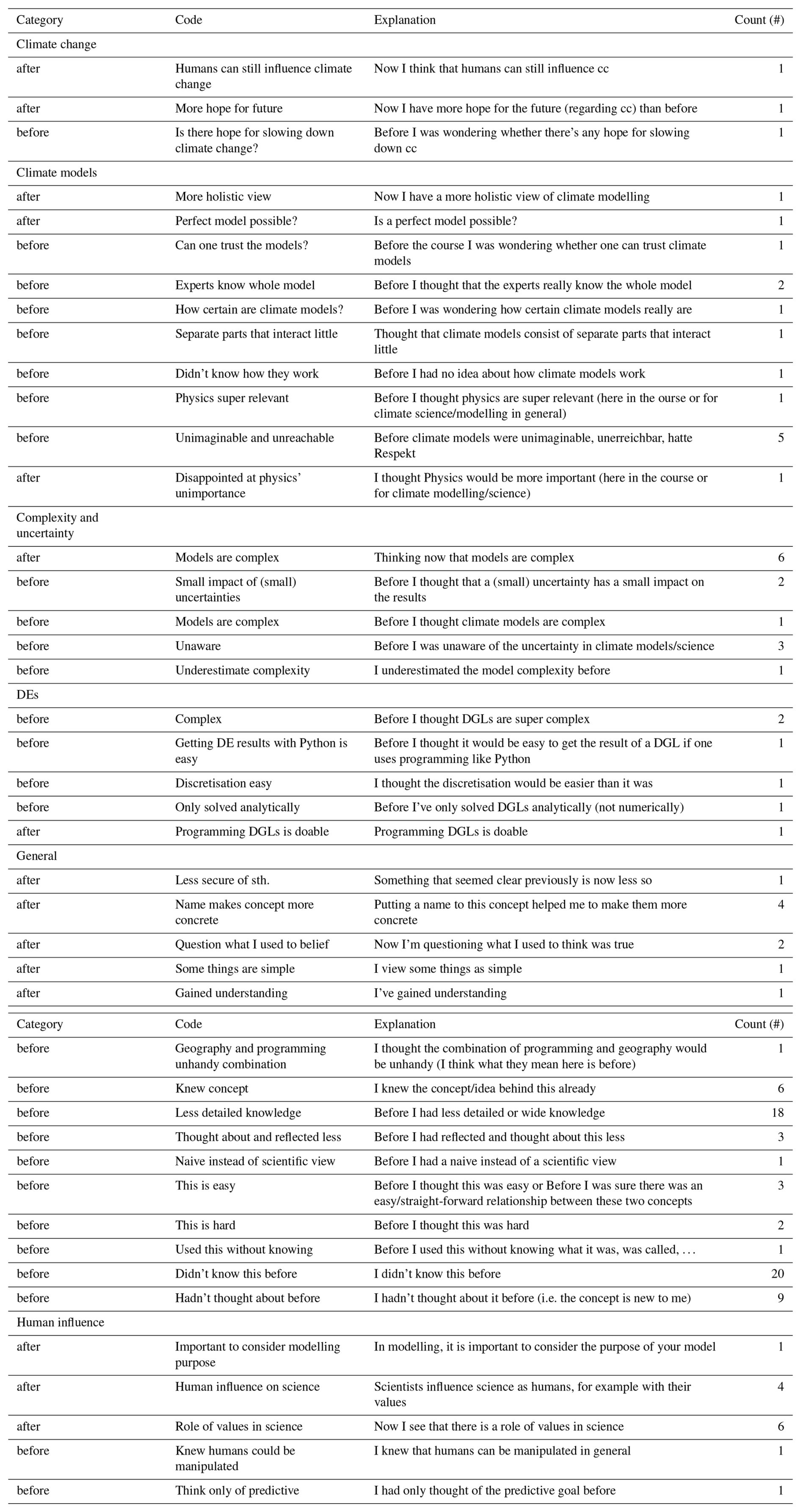
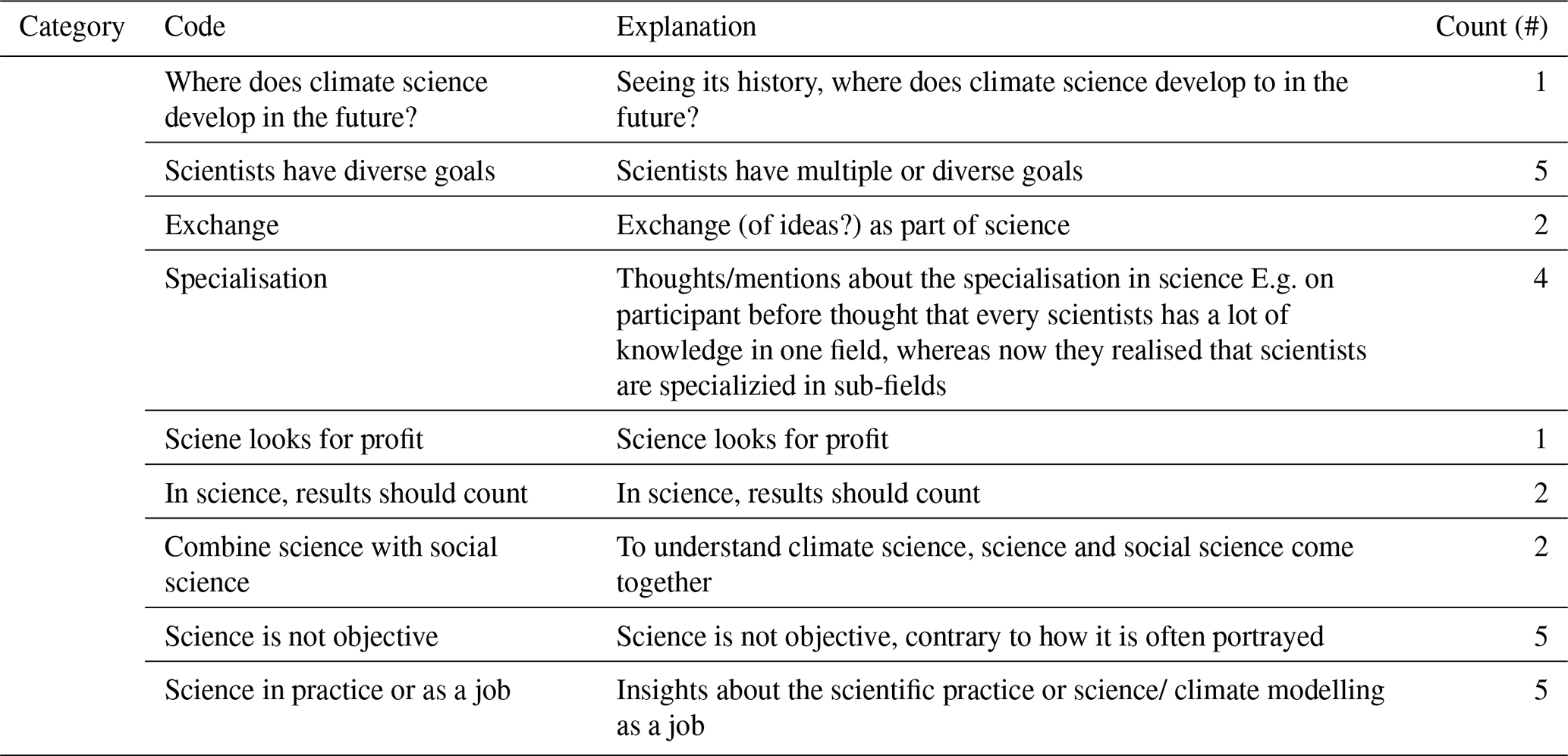
After the course completion, we applied inductive, open-coded content analysis (Cohen et al., 2011a) to the students' output, using QualCoder (Curtain and Dröge, 2025). The first author coded for ideas and conceptions that came up, tagged each of them according to whether they belonged in the a priori or a posteriori category. For example, the statement “Significance of values and society for goals and principles of climate science” was coded as “After: role of values in science”, “values enter science” and “combine science with social science”. We described the latter code as “to understand climate science, science and social science come together”. This assignment includes some inference from the student's statement and highlights the interpretative nature of the coding. The resulting codes and their descriptions are listed in Appendix B. The Appendix also lists the few codes that we excluded from the analysis because they relate to features of the climate system that the course treated but that the reflections were not targeting.
To evaluate the dependence of the coding on the coder, intercoder reliability was checked. After coding was completed by the first author of this paper, the second author went through 17 randomly sampled quotations and assigned the first author's codes to them. Comparing the coding between the two researchers, for 15 (88 %) of the quotations, the second coder assigned at least one code that fit directly one that the first coder had assigned (intercoder agreement); for one quotation, they afterwards agreed on the label of the first coder; for one quotation they assigned 4 and 3 codes, respectively, and while none of them matched, they understood each other's reasoning. While these results indicate shared understanding between the two coders, they again highlight the interpretative nature of the coding exercise, especially when assigning many codes in total and multiple per quotation. Note that not all codes that we found form a part of our analysis and the presented figures, but we focused on those that contributed to answering our research question.
Prior to the NAka, all students and/or their guardians provided their informed consent to participate in our study, which had been approved by the WUR Research Ethics Committee (approval number 2024-069). The students also all had the opportunity to offer feedback on the manuscript before submission.
2.3 Positionality
Our position and experiences shape the knowledge that we produce as researchers (see, for example, Hausermann and Adomako, 2022). Thus it is important to make them explicitly transparent (Cohen et al., 2011b, p. 225). In this case, our role in this research is shaped by our deep engagement and identification with the NAka project, as we have both been involved multiple years, and one of us is a former participant as well as former project leader. During each course year, the students and we build a relationship that is conducive for teaching, but also colors our approach to the students as research subjects. It may also enhance the participant bias (Nichols and Maner, 2008). In addition, we have teaching training and experience, but are by no means educational (research) experts. Thus, our goal with this study is not to provide an objective evaluation, but rather to showcase a course approach that has proven itself in practice. Rather than hampering the results, we think our enthusiasm and the relationships we built play a large part in the success of the course.
The primary result of design-based research is the course itself, which we describe in Sect. 3.1. Sect. 3.2 deals with changes that occurred as we were improving the course design between iterations. The evaluation of the course in terms of students' thought process and thus the answer to our research question is given in Sect. 3.3.
3.1 Course
Figure 1 and Table A1 give an overview of the course schedule. It is divided broadly into two themes: the first theme is concerned with the mathematical and physical aspects of numerical modelling and its application to climate models, while the second theme reflects model building critically and discusses the development of climate models in a socio-historic context.
The first topical module introduces numerical modelling as a general method and its various applications. To motivate the relevance of numerical modelling we showcase examples from various scientific disciplines in the form of pictures, brainstorming possible subjects and their diverse goals and challenges with the students. Next, we define the modelling of dynamical systems more formally and agree on a common nomenclature. This is achieved via a student presentation showcasing the differential equation (DE) of a simple physical system. To practice the newly learned terminology for the different types of DEs and their constituents we use further examples of DEs describing dynamical systems in natural sciences.
The next module is concerned with the analytical solution of the DEs. Given the varying mathematical education of the students this is a challenging topic. Therefore, we solely rely on finding a solution by means of “good guessing”. The difficulties encountered during the exercise and the fact that the analytical method is only limited to a small collection of simple systems motivate the use of numerical methods for the remainder of the course.
As the most basic discretisation method for solving ordinary DEs numerically we introduce the Euler method (forward and backward). For practice we let the students solve the logarithmic spiral only using pen, paper and a calculator. Since this example was already part of the analytical exercise, the students were able to compare both methods. The important lessons are: (i) the numerical method is not exact as it deviates from the analytical solution and (ii) the numerical method takes much effort since many more computational steps are involved. This is why we ultimately resort to computers for automating the calculations.
Our course has no requirements on prior knowledge of programming. Therefore, we teach the basics from the ground up using a simple tutorial notebook that includes exercises. As we do not have the time for an extensive programming class we follow a learning-by-doing approach in the rest of the course and rely on more experienced students to help less experienced ones. Our choice of programming language is Python as it is easy to learn and widely used in the scientific community.
Then, we form the basis for understanding the climate system and its numerical modelling in climate models. This is achieved via first collecting students' prior knowledge of the Earth system and their interactions in a black board diagram. Additionally, there is input on climate change, climate model structure and the uncertainties in climate modelling via student presentations to dive deeper. Climate models are explored hands-on by showing the students actual climate model code and via the IPCC Interactive Atlas (Gutiérrez et al., 2021; Iturbide et al., 2022), which illustrates real model output for different variables and scenarios. Furthermore, the students write their own program to model a simplified version of the greenhouse effect, which illustrates the usefulness of numerical simulations to study processes in the Earth system.
To further practice numerical programming and learn about model building the students work on programming projects in groups. We offer a diverse set of topics (see Table A1) related to the Earth system that highlight different aspects of dynamical systems, e.g., feedbacks and chaos, and also different technical intricacies of numerical modelling, e.g., the comparison of alternative discretisation schemes for partial DEs. Half way into the programming projects we ask the students to reflect on their efforts: Why do we model? This question bridges to the second theme of the course about critical reflection of model building.
This second thematic part covers the goals underlying climate model development, issues in the interpretation of climate model results and their development as embedded in the societal context. For example, by constructing a timeline from given index cards, the students dissect the co-evolution of climate models alongside relevant historical events (for the material, see Proske and Staab, 2026). The subsequent first silent and then guided discussion reflects how the historic context has influenced the field of climate science and thus how models and for example views of a global Earth were co-produced (Heymann, 2019). In another exercise, the students get to know three main motivations or visions for climate model development by assigning quotes or methods to the vision categories. These have been developed by Shackley et al. (1999); Shackley (2001); Sundberg (2009) and summarized by Proske et al. (2024) as the representative, predictive and heuristic vision. These visions put the focus on the model being a copy of the real system, providing accurate forecasts, or on being used as a tool to generate understanding, respectively. While these visions can work together, they may also lead to conflict, for example where more detailed models that are more representative become too complex to understand, thus decreasing their heuristic utility (Proske et al., 2023, 2024). Parker (2006) and Winsberg (2012) have explained some problems of climate modelling from a philosophical perspective, such as distributed epistemic agency and generative entrenchment. These texts serve as the basis for a group work where students read the texts in groups and then present them to the others in a creative format. An example of a particularly vivid display is shown in Fig. 4 and described further in Sect. 3.3. After discussing long- or outstanding issues in climate model development, we find it important to circle back to the question of why one can trust many climate model results after all. Knutti (2008a, b) has written accessible elaborations of the reasons that serve as the basis for one student pair's presentation. The course content ends with a “fish bowl discussion” of climate scientists' position in the climate change debates. In a “fish bowl discussion”, students are divided in groups and get some input for a particular position they are asked to represent. One student of each group then sits on the podium and represents this position in the discussion, but at any time another member of the group can leave the audience, tap on the discussant's shoulder and take up their position on the podium, allowing everyone to participate and bring fresh arguments to the table. In our case, the positions ranged from disinterestedness in public discussion to activist positions. While students can use knowledge gained in the course to back up their arguments in the ensuing discussion, the topic circles back to the idea that climate models are a product of and feed back into our society.
3.2 Course development cycles
Each of the four years that we taught the course (2022–2025) offered an opportunity for improvement, based on our own experiences and students' feedback. After initial struggles with the analytical solving of differential equations, the basics of numerical modelling and model building seemed to always be well understood by the students. Integrating the philosophical perspectives and STS content was more challenging. In the first year, we separated the numerical modelling from the “Interaction with society and critical reflection” as a first and second thematic block, but in the following years we integrated the two approaches more. The integration serves to have the understanding of both perspectives benefit each other, with parameterisations being a key component of model formulation and reflected in the representative modelling vision, but also a basic reason for modelling uncertainties. Also, the integration allows to mix methodologies, with more discussions and text-based work in the “Interaction with society and critical reflection” part of the course. For the same purpose, we have increasingly dispersed the students' presentations throughout the course. Appendix A provides the course schedule from the third iteration (2024).
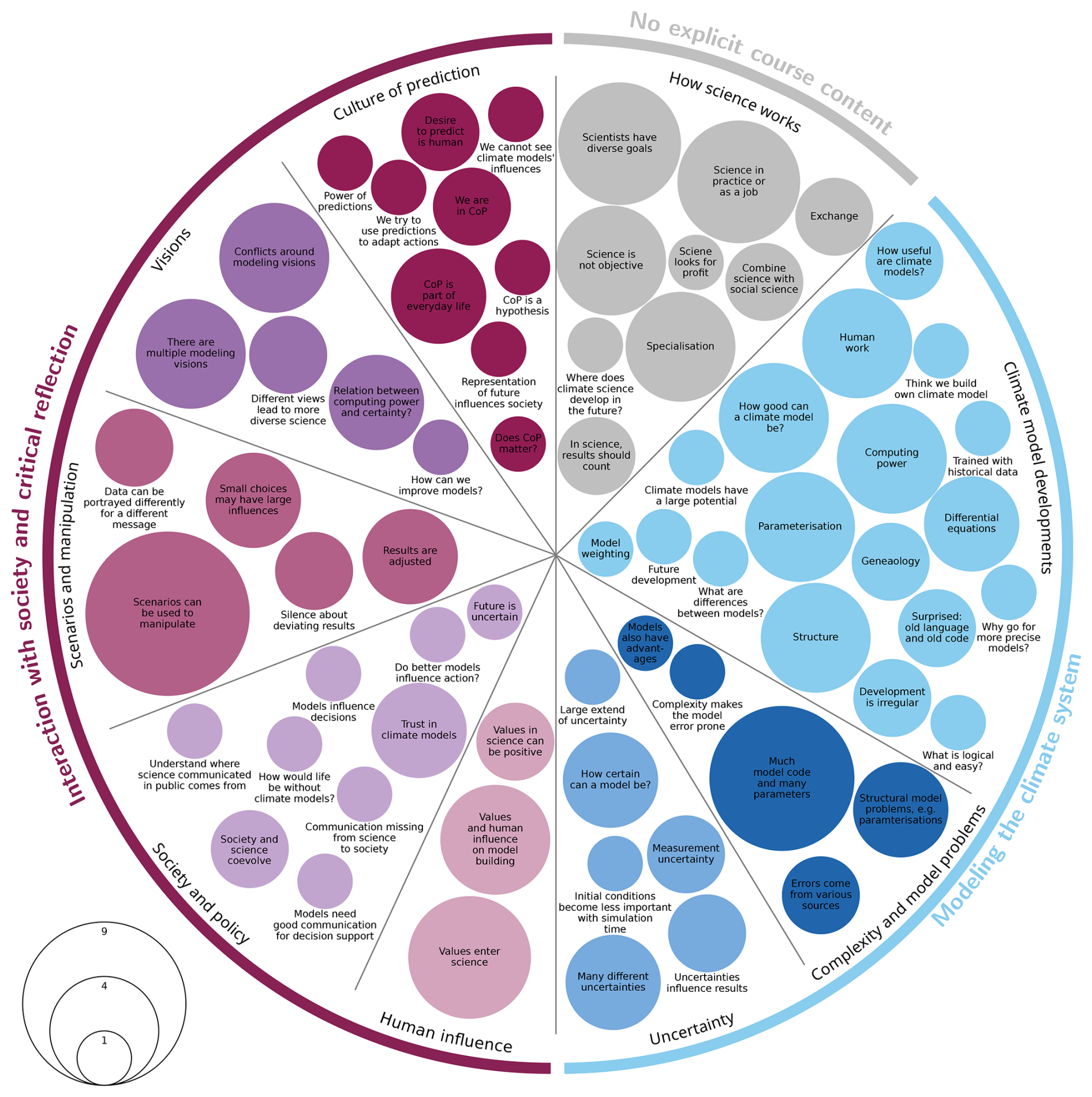
Figure 2Overview of topics brought up in the reflective exercises, over all three assessment rounds and both a posteriori and a priori answers. The codes are color-coded by topics as in Fig. 1 (red tones for “Interaction with society and critical reflection”, blue tones for “Modelling the climate system”), but deviate from the exact topics mentioned there, because students were only reflecting on parts of the course, and noted other points than we considered in the course structure that underlies Fig. 1. For example, the topic “How science works” was not an explicit part of the course structure and is thus marked grey. The topics were assigned inductively during the content coding and are meant as representations rather than mutually exclusive definitions. See Fig. 3 for codes that specifically treat the “a priori” and “a posteriori” content of the exercises. The circle areas correspond to the number of times the codes were assigned.
3.3 Reflective exercise
Figure 2 shows the topics that participants included in their reflective exercises. After inductive coding, we found that main topics correspond to topical blocks in the course program, for example model problems, visions, or the concept of a culture of prediction (Heymann et al., 2017a), and thus assigned those deductively (compare Table A1). Regarding our research question, this already shows that the learning aligns with the teaching goals. The frequencies of topic mentions also relate to when the reflective exercises were conducted (see Fig. 1b): for example, the topic group “1. Dynamical systems” was not explicitly sampled, because the emphasis of our evaluation was on topic block 3 and 4. Regarding climate model development – one of the most prominent topics mentioned – students highlighted topics that were explicitly treated in the course, such as the model structure or parameterisations (Stensrud, 2007). A particular piece of research that has left an impression on some of the students is climate model geneaology (Knutti et al., 2013; Kuma et al., 2023), meaning how different (generations of) climate models are interconnected, for example by one model being built on the basis of another. In particular, Kuma et al. (2023) have provided a display of models' relationships in their Fig. 2, which we have used to visualise both the multitude of models, the countries of those who develop them and the interrelationships. This visualisation speaks to the students as they have repeatedly referred to it during discussions in the course.
One prominent topic in the participants' responses are the different modelling visions. The understanding that there are multiple visions that may lead to conflict emerges directly from the corresponding exercise conducted in the course (see Table A1). However, two students also expressed the idea that the different visions lead to more diverse science, i.e. multiple approaches being followed. While this positive understanding was not an explicit part of the exercise, it corresponds to arguments in favour of climate model hierarchies as brought forward in the literature (Jeevanjee et al., 2017).
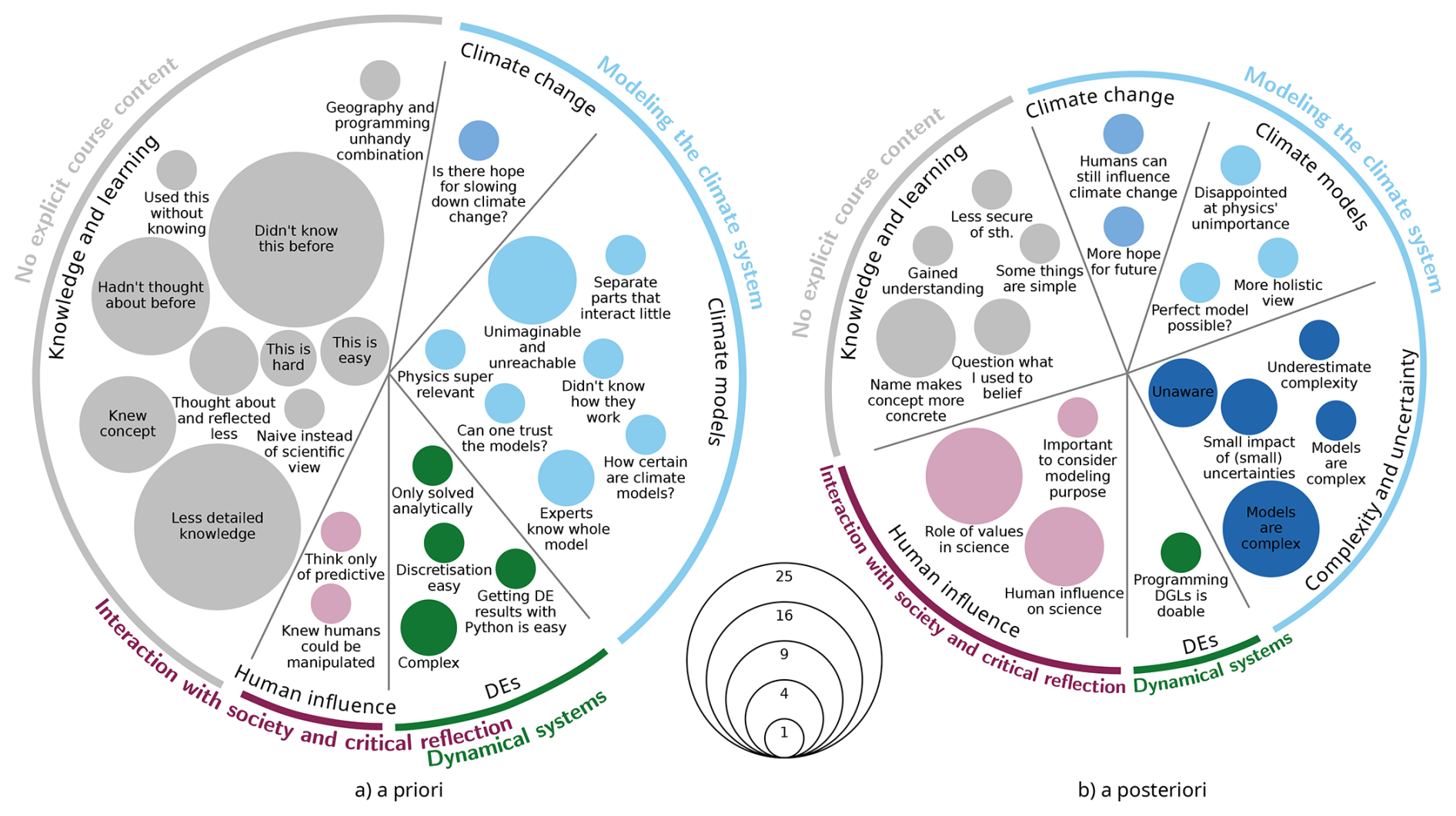
Figure 3Codes that emerged from the content analysis of the students' three reflective exercises (see Fig. 1b), specifically regarding what they answered as concepts and thoughts they had (a) “a priori” the course or course module and (b) “a posteriori” the course module. Figure 2 treats the topics brought up in the exercises more generally. The codes are color-coded by topics (related to Fig. 1) and the circle areas correspond to the number of times the codes were assigned. Note that quotes could be assigned to multiple codes were they fit to multiple. The circles for “a priori” are generally smaller because students noted fewer points (for example none for differential equations (DEs)).
Another topic is that of how science works. That this topic came up is surprising to us because it was not explicitly treated in the course. Here participants viewed science as a practical job, the scientists as people, and scientific process in general as not being objective (as discussed by Stefanidou and Skordoulis, 2014). For example, one participant commented on the “chaotic scientific work” and elaborated that “the everyday life of science is by far not as polished as papers can make it seem [TN19, RE2].” In particular, one participant seems to have imagined themselves in the climate modelling job, asking “How many feelings of success does one have in climate modelling? [TN03, RE1]”
There are no clear misconception in the responses. However, the pronounced presence of the “scenarios and manipulation” code topic strikes a cautious note. This topic arose out of the course work with the IPCC Interactive Atlas (Gutiérrez et al., 2021). Students were asked to think of a question to investigate with the simulation results and plotting capabilities available on the platform. In the discussion of their results, we paid particular attention to how the different time frames and climate change scenarios they used can influence the answers to their questions. Our treatment of the influence of scenario choices seems to have combined with pre-conceived ideas of manipulation to form the idea that scenarios can be or even are used to manipulate: “by choosing different scenarios one can easily manipulate humans” (N13, RE2). Informal conversations with students at the NAka 2025 pointed us to what these pre-conceived ideas could be about: students were sensitive to fake news and manipulative statements, seemingly because of frequent treatment of these issues in school (see e.g. ISB-Arbeitskreis Link-Ebene, 2004; Democratic Schools for All, 2026), also due to the growth of right-wing populism in Germany (Franke et al., 2024). While scenarios do have a large influence that should be questioned, manipulation is not what climate science uses them for. Here we recognize an issue that STS have had to grapple with: on the one hand, from a constructivist point of view one comes to criticise the power of science and its human foundations (see, for example, Jasanoff, 1996, and Moon and Blackman, 2014 for an explanation of constructivism). On the other hand, most critics do recognise science's results as true and do not wish to imply that for example climate change is not real. This is a delicate balance to be struck (see, for example, Schindler, 2020). From the students' responses we saw that they conflated subjectivity within the scientific process with more or less deliberate manipulation. Consequently, we took more time in the next year to introduce scenarios more rigorously, detailing their scientific basis as well as the choices embedded in their creation and the need for careful interpretation of the scenario used in a study.
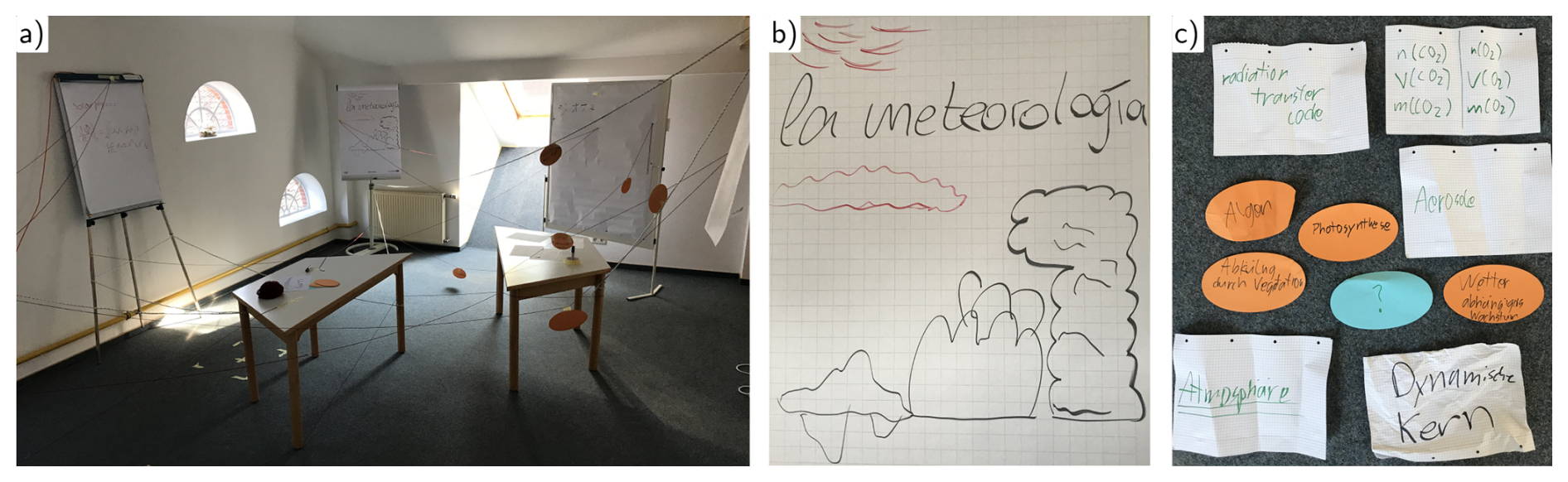
Figure 4Students' result of the task to creatively present their text from the “Climate model problems” module. They chose to represent (a) a climate model in the room. Climate system components are displayed on (b) flipcharts. Interactions between them are displayed with ropes named with (c) tags.
The second part of the exercise also targeted changes in students' perceptions, as they had to describe how they thought about the mentioned topics before the course or before the last course modules. Fig. 3 displays the results of that exercise. The answers to the different rounds of the reflective exercise are combined here, because answers usually do not refer to (topics of) past modules covered in other rounds. In general, students reported less knowledge before the course and simply not having thought about some issues before (for example “I didn't know so clearly that there are also many negative feedback loops (I had only heard of the halting of the Gulf Stream before)” (TN16, RE2)) , which supports the course's goal to introduce knowledge from beyond what is present in high-school curricula. When they knew a concept from before, some students said that giving it a name makes the concept more concrete. Establishing a language to grasp concepts and talk about them is one part of what social science knowledge can do for natural scientists, as for example Remmers et al. (2025) explain. With regards to climate models, multiple students reported to have found them “unimaginable” (P3, RE1) before, but that their idea of them became more concrete. In that sense, the course allowed them to un-box climate models and build an understanding as a basis for interpretation, as students demonstrated with the exercise displayed in Fig. 4. The understanding that climate models are complex goes hand in hand with this unboxing. One students said they had been aware of complexity before, another said they had underestimated it, and more had been unaware before. Human influence was a topic that was more frequent in “a posteriori” comments, where students realised that scientific endeavours such as building or running a climate model are subject to values and human influences, again in line with the course content.
A particular insight into participants' thoughts during the course came from the questions they asked themselves during the reflective exercise. During the first exercise, one participant asked (arrow present in their notes):
How much of climate modelling is logical and easily explainable and deducible? → How much can/could we implement in our own climate model? (TN04, RE1)
We interpret this as an awe of climate modelling and the complex concepts they thought would be underlying it. Others were wondering already: “How good/precise can a climate model be? (TN10, RE1)” and how this precision could be increased. One participant was increasingly doubting whether a “perfect” climate model is even possible. “How can one make projections of climate models more secure or rather more precise? → Is this possible with the current computing power and the time that one would need to spend to find possible errors? (TN06, RE2)” They added in the third round:
Is it even possible to write a “perfect” climate model, if one is using prior data and models? → This question arises for example because of mistakes in initial computations → requires enormous amounts of data and variables (TN06, RE3)
Others took this question further, wondering whether such a model would even be useful: “What are the advantages of more precise climate models? Does that influence human action? → Aren't current statements enough? (TN10, RE3)” The course-block on the historical evolution of climate modelling brought up the question of how it will continue: “History of (climate) science extremely interesting → for me it raises the question: where are we going? How will these sciences evolve? (TN03, RE3).” These comments and questions highlight that at least for some students the course prompted a thought process on the goals and future of climate modelling.
A particularly vivid display of students' thinking about climate models emerged from the exercise on climate model problems. Three groups were asked to read different excerpts from Parker (2006) and Winsberg (2012), discuss them and present the content to the other groups, in a creative format. The group tasked with the excerpts from Winsberg (2012) decided to turn a small spare room into a climate model display. Figure 4 shows how they used flipcharts as model components, ropes to link them, and annotated the ropes with the linking elements. For example, aerosols would be linking the atmosphere and radiation component of the model. Model components were written in different languages to represent international development distributed in time and space. They purposefully included a mistake or bug in the model (Pipitone and Easterbrook, 2012; Proske and Melsen, 2025), and the overall entanglement of the ropes served to represent the complexity of the model.
3.4 Caveats and limitations
The reflective exercise we conducted revealed topics students were debating at the time of the exercise. On the one hand, these mostly aligned closely with the course content, so it was difficult to identify students' personal thought process amidst the general course progression, and thus our contribution to that research question is limited. On the other hand, many codes of the students' answers only had one count, as students mentioned a wide potpourri of statements among each other. That each student takes away something different is of course an interesting feedback and learning for the teachers. It also confirms that the method was suited to allow for a wide range of responses and gave students the freedom to detail their own thoughts (which then still were closely aligned with the course progression). One weakness of the method was that students often did not spell out the “a posteriori” when naming the “a priori” and vice versa. For example, they said climate models were unimaginable before and that only implied that it is not unimaginable afterwards anymore. A clear caveat to our approach are the various forms of participant bias. For example, in an assessment setting, participants are prone to answer according to how they think their viewpoint and ideas should have changed from our point of view. We addressed this by explaining the purpose of our study to the students and encouraged their own scientific curiosity in the reflection. In addition, the plenum discussion following the exercise provided us the opportunity to analyse their expressions in more context. The exercise did encourage students to reflect, as the nature of responses changed from content and feedback related notes to reflections with more exercise rounds. Reflective group discussions or a reflective essay may have provided more in-depth views of students' reflections.
We have presented the making and evaluation of an interdisciplinary course on climate modelling that combines physical knowledge about the climate system and how to construct numerical models with perspectives and reflections from philosophy of climate science and STS. In this study we wanted to understand what the students' learning looks like, whether the course triggers thought processes and in particular changes students' thinking about climate models. The learning and thought processes triggered by the course are clearly visible in Figs. 2–4. The course taught the students not only how to set up a numerical model themselves, but expanded on a reflection on climate models inspired by historical, philosophical and STS treatments. Students displayed a learning of the physical science and the reflection content together, and grew to have a multi-faceted view of climate modelling with an advanced view on climate models' challenges and problems as well as on science as a human enterprise. From the different modules we surveyed, none stood out as a particular challenge or catalyst. We found little evidence for misconceptions that students developed, and similarly no clear challenges or hurdles that arose from the course's interdisciplinary content. In a previous course edition, the reflections on the influence of values on climate model development and use were treated in the last days of the course. Back then, one participant told us that this shook up their whole belief in objective science, and that they would have liked to have more time to process this during the course. Thus, we expected protest or at least critical questions from students overwhelmed by the combination of learning differential equations at the same time as the societal influence on science (akin to the “disorienting dilemmas” studied by Feng et al., 2025). These were missing from our results. Because these questions also did not appear during the course, we conclude that students simply were not shocked. We suspect that without students having undergone a full scientific academic education, attacking the pillars of a positivist belief in scientific truth does not in general shake them up. This may also be an indication that while students take up the knowledge easily, they do not integrate it immediately into their belief system and therefore do not show an emotional or deep-felt response.
Design-based research is a continuous journey. From the findings of the present study and the direct feedback from the 2024 students we have again modified the next course iteration in 2025. For example, we introduced scenarios more explicitly in order to pick up students' thoughts on human “manipulation”. Because students criticized too much time in plenary discussions, we used poster sessions instead of presentations and also had only two programming projects in parallel, in order to keep the need for transfer of knowledge and results between groups small.
Overall, while this study does not “validate” our course as an ideal way for interdisciplinary climate model education, it does show that there are ways to integrate modelling and social sciences already in teaching. Thus, it seems that a climate modelling course that is interdisciplinary from the start is possible, with the hope that it contributes to reflected model use and development, and an awareness of human influences on models as well as their restricted purposes. The resources developed for this course are openly available, inviting to their use and providing inspiration for other modelling courses.
Table A1Course schedule from the third iteration (2024) detailing the modules, the methods used within and the goals worked towards, as well as the approximate time planned for each of them. The reflective exercises are underlined. Note that the last reflective exercise was not used in our analysis as it focused only on the previous discussion module and thus the topics mentioned were specific and relating to a different scope than that of this study's analysis. Horizontal lines denote the end of a course block, which took 3:20 h in the morning or 2:20 h in the afternoon.
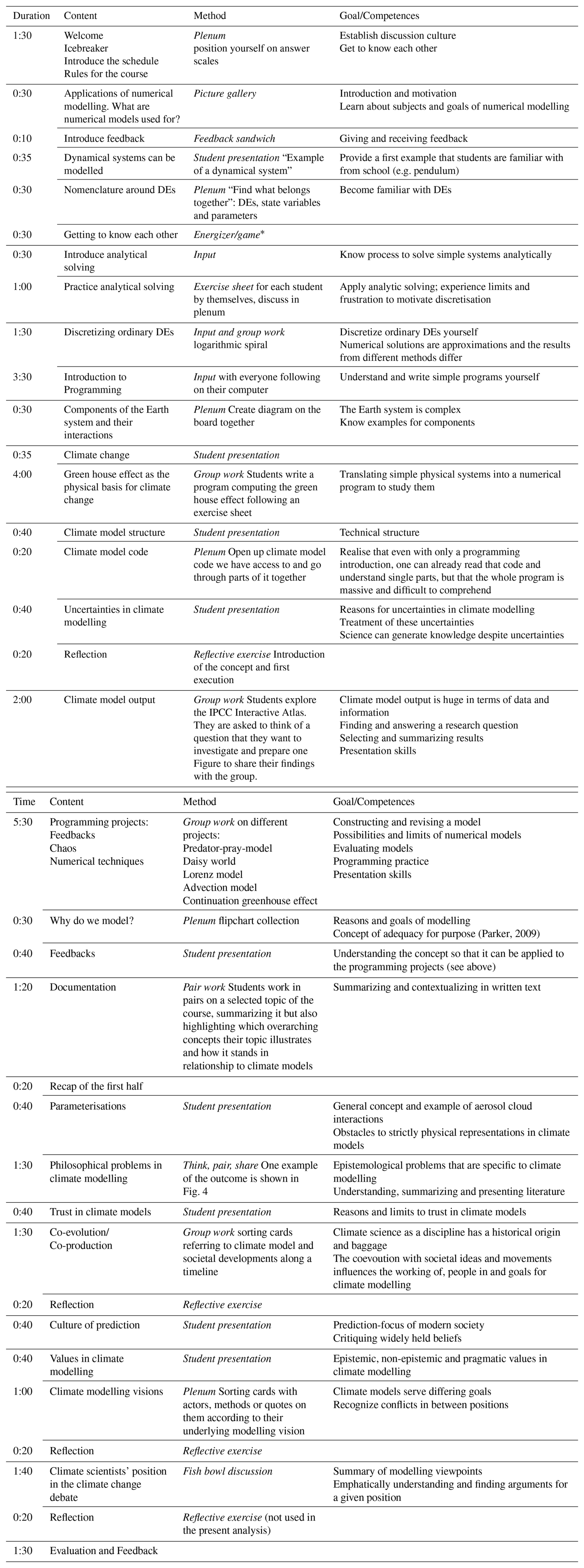
* Energizer, games or various feedback formats are part of every course unit but are excluded from this overview for the sake of brievity.
Codes that do not appear in the manuscript Figures and analysis are in italics.
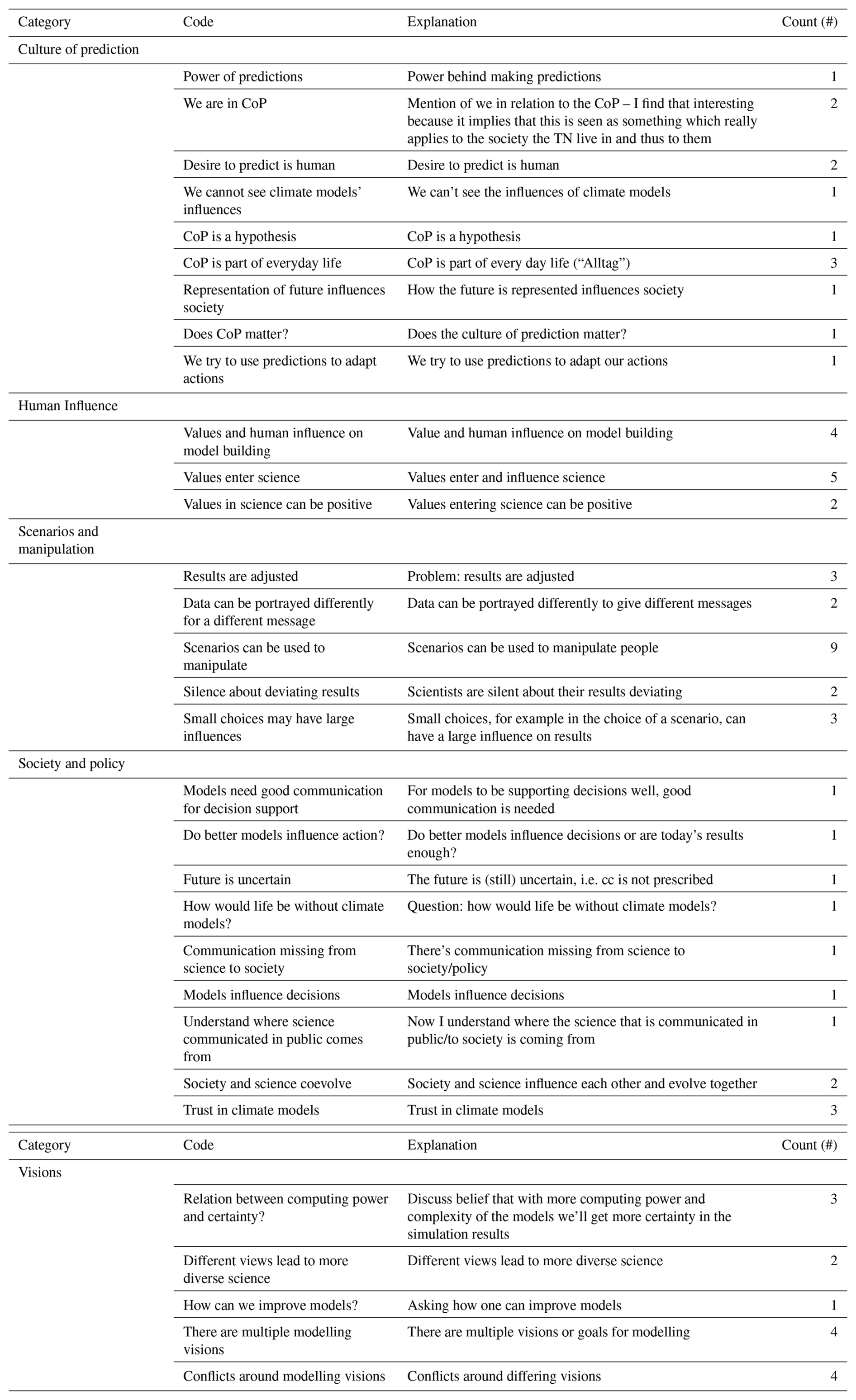
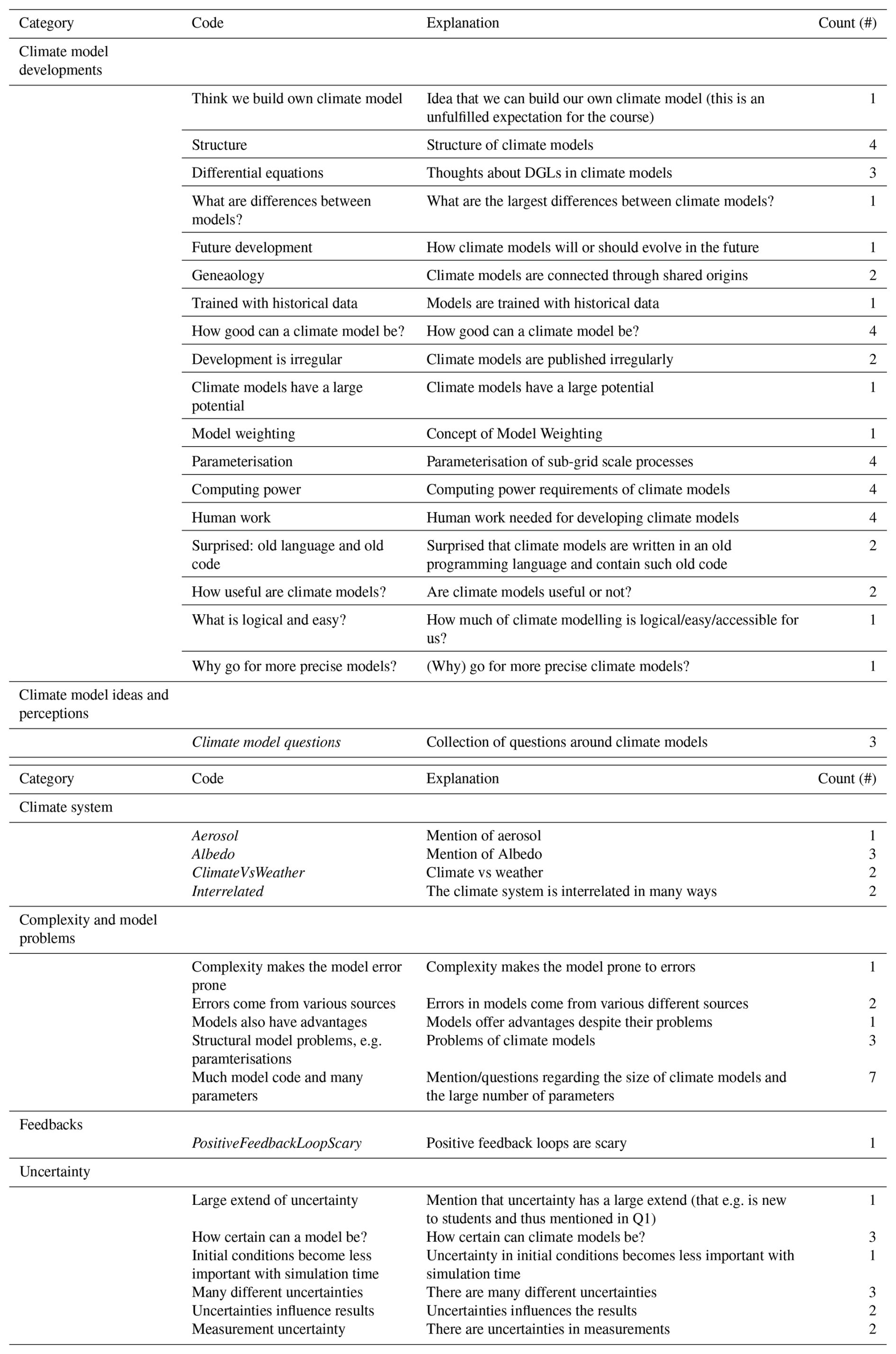
We have shared the material that we use for the course at Zenodo: https://doi.org/10.5281/zenodo.17791563 (Proske and Staab, 2026), where this was possible without copyright limitations.
UP conceptualized the research and conducted the formal analysis. MS developed the figures. UP and MS both conducted the research, developed and conducted the teaching, and wrote the manuscript.
The contact author has declared that neither of the authors has any competing interests.
Prior to the NAka, all students and/or their guardians provided their informed consent to participate in our study, which had been approved by the WUR Research Ethics Committee (approval number 2024-069).
Publisher's note: Copernicus Publications remains neutral with regard to jurisdictional claims made in the text, published maps, institutional affiliations, or any other geographical representation in this paper. The authors bear the ultimate responsibility for providing appropriate place names. Views expressed in the text are those of the authors and do not necessarily reflect the views of the publisher.
First and foremost, we thank the participants in our courses in 2022, 2023, 2024 and 2025. The 2024 participants were the ones participating in the explicit study of the research question, and the others helped us to iteratively develop the course. We also thank the whole NAka, JGW e.V. and Bildung und Begabung gGmbH teams for making the NAka such a wonderful experience for us, and allowing us to develop this course and study in the first place. We thankfully acknowledge Matthias Glade and Denis Kom for help with the setup of the pedagogical study. We are grateful to Julien Pooya Weihs and Matthias Glade for clarifying and encouraging discussions. We thank them as well as Stephanie Zihms as editor and two anonymous referees for their feedback that helped us greatly to improve the manuscript.
This research has been supported by the Schweizerischer Nationalfonds zur Förderung der Wissenschaftlichen Forschung (grant no. 217899).
This paper was edited by Stephanie Zihms and reviewed by two anonymous referees.
Addor, N. and Melsen, L. A.: Legacy, Rather Than Adequacy, Drives the Selection of Hydrological Models, Water Resources Research, 55, 378–390, https://doi.org/10.1029/2018WR022958, 2019. a
Alves, D. S.: Two Cultures, Multiple Theoretical Perspectives: The Problem of Integration of Natural and Social Sciences in Earth System Research, International Perspectives on Global Environmental Change, edited by: Young, S., InTech, ISBN 978-953-307-815-1, 2012. a
Aroskay, A., Hirtzig, M., Klein, S., Vial, J., and Vogt, N.: The climate in our hands – Climate Models, a teacher’s handbook for high schools, edited by: Vogt, N., Office for Climate Education (OCE), Paris, 2024. a
Assaraf, O. B.-Z. and Orion, N.: A Design Based Research of an Earth Systems Based Environmental Curriculum, Eurasia J. Math. Sci. T., 5, 47–62, 2009. a
Babel, L.: Decision-Making in Model Construction: Unveiling Habits, Environ. Modell. Softw., 120, 14, https://doi.org/10.1016/j.envsoft.2019.07.015, 2019. a
Bhattacharya, D., Carroll Steward, K., and Forbes, C. T.: Climate Education in Secondary Science: Comparison of Model-Based and Non-Model-Based Investigations of Earth's Climate, Int. J. Sci. Educ., 43, 2226–2249, https://doi.org/10.1080/09500693.2021.1958022, 2021. a
Bice, D. M.: Using Stella Models To Explore The Dynamics Of Earth Systems: Experimenting With Earth's Climate System Using A Simple Computer Model, Journal of Geoscience Education, 49, 170–181, https://doi.org/10.5408/1089-9995-49.2.170, 2001. a
Cohen, L., Manion, L., and Morrison, K.: Coding and Content Analysis, Chapter 30 in: Research Methods in Education, Routledge, 7th edn., ISBN 978-0-415-58336-7, 2011a. a
Cohen, L., Manion, L., and Morrison, K.: Research Methods in Education, Routledge, 7th edn., ISBN 978-0-415-58336-7, 2011b. a, b
Corona Bustamante, J.: Globe Terrestre En Relief [Document Cartographique], Bibliothèque nationale de France, département Cartes et plans, GE A-283, https://catalogue.bnf.fr/ark:/12148/cb40673676k (last access: 27 May 2026), 1860. a
Curtain, C. and Dröge, K.: QualCoder 3.6, GitHub, https://github.com/ccbogel/QualCoder/releases/tag/3.6 (last access: 27 May 2026), 2025. a
Democratic Schools for All: Dealing with Propaganda, Misinformation and Fake News, Council of Europe, https://www.coe.int/en/web/campaign-free-to-speak-safe-to-learn/dealing-with-propaganda-misinformation-and-fake-news (last access: 27 May 2026), 2026. a
Easterbrook, S. M.: Computing the Climate: How We Know What We Know About Climate Change, Cambridge University Press, Cambridge, https://doi.org/10.1017/9781316459768, 2023. a
Edwards, P. N.: Representing the Global Atmosphere, in: Changing the Atmosphere, edited by: Miller, C. A. and Edwards, P. N., The MIT Press, https://doi.org/10.7551/mitpress/1789.003.0005, 2001. a
Feng, X., Sundman, J., Aarnio, H., Taka, M., Keskinen, M., and Varis, O.: Towards transformative learning: students’ disorienting dilemmas and coping strategies in interdisciplinary problem-based learning, European Journal of Engineering Education, 50, 428–450, https://doi.org/10.1080/03043797.2024.2424197, 2025. a
Franke, L., Hajok, D., and Rau, J.: Desinformation und Rechtsextremismus, Bundeszentrale für politische Bildung, https://www.bpb.de/themen/medien-journalismus/desinformation/ (last access: 27 May 2026), 2024. a
Gettelman, A. and Rood, R. B.: Demystifying Climate Models, Springer Berlin Heidelberg, New York, NY, ISBN 978-3-662-48957-4, 2016. a, b
Gutiérrez, J. M., Jones, R. G., Narisma, G. T., Alves, L. M., Amjad, M., Gorodetskaya, I. V., Grose, M., Klutse, N. A. B., Krakovska, S., Li, J., Martínez-Castro, D., Mearns, L. O., Mernild, S. H., Ngo-Duc, T., van den Hurk, B., and Yoon, J.-H.: Atlas, in: Climate Change 2021: The Physical Science Basis. Contribution of Working Group I to the Sixth Assessment Report of the Intergovernmental Panel on Climate Change, Cambridge University Press, Cambridge, United Kingdom and New York, NY, USA, https://doi.org/10.1017/9781009157896.021, 2021. a, b
Hausermann, H. and Adomako, J.: Positionality, “the Field”, and Implications for Knowledge Production and Research Ethics in Land Change Science, Journal of Land Use Science, 17, 211–225, https://doi.org/10.1080/1747423X.2021.2015000, 2022. a
Heymann, M.: Constructing Evidence and Trust: How Did Climate Scientists' Confidence in Their Models and Simulations Emerge?, in: The Social Life of Climate Change Models, edited by: Skrydstrup, M. and Hastrup, K., Taylor & Francis, 213–234, ISBN 0-415-62858-X, 2013. a
Heymann, M.: The Climate Change Dilemma: Big Science, the Globalizing of Climate and the Loss of the Human Scale, Reg. Environ. Change, 19, 1549–1560, https://doi.org/10.1007/s10113-018-1373-z, 2019. a
Heymann, M.: Knowledge Production with Climate Models: On the Power of a “Weak” Type of Knowledge, in: Weak Knowledge: Forms, Functions, and Dynamics, edited by: Epple, M., Imhausen, A., and Müller, F., Campus Verlag, Frankfurt, 321–349, ISBN 978-3-593-50977-8, 2020. a
Heymann, M., Gramelsberger, G., and Mahony, M. (Eds).: Cultures of Prediction in Atmospheric and Climate Science: Epistemic and Cultural Shifts in Computer-Based Modelling and Simulation, Routledge Environmental Humanities Series, Routledge, Taylor & Francis Group, London New York, NY, ISBN 978-1-138-22298-4, 2017a. a
Heymann, M., Gramelsberger, G., and Mahony, M.: Key Characteristics of Cultures of Prediction, in: Cultures of Prediction in Atmospheric and Climate Science, Routledge, Taylor & Francis Group, 18–41, ISBN 978-0-262-63219-5, 2017b. a, b
Hoadley, C. and Campos, F. C.: Design-Based Research: What It Is and Why It Matters to Studying Online Learning, Educ. Psychol., 57, 207–220, https://doi.org/10.1080/00461520.2022.2079128, 2022. a, b
Hulme, M.: Geographical Work at the Boundaries of Climate Change: Boundary Crossings, T. I. Brit. Geogr., 33, 5–11, https://doi.org/10.1111/j.1475-5661.2007.00289.x, 2008. a
ISB-Arbeitskreis Link-Ebene: SpG 9.2 Kommunikation Und Manipulation, Staatsinstitut für Schulqualität und Bildungsforschung München, 2004. a
Iturbide, M., Fernández, J., Gutiérrez, J. M., Pirani, A., Huard, D., Al Khourdajie, A., Baño-Medina, J., Bedia, J., Casanueva, A., Cimadevilla, E., Cofiño, A. S., De Felice, M., Diez-Sierra, J., García-Díez, M., Goldie, J., Herrera, D. A., Herrera, S., Manzanas, R., Milovac, J., Radhakrishnan, A., San-Martín, D., Spinuso, A., Thyng, K. M., Trenham, C., and Yelekçi, Ö.: Implementation of FAIR Principles in the IPCC: The WGI AR6 Atlas Repository, Scientific Data, 9, 629, https://doi.org/10.1038/s41597-022-01739-y, 2022. a
Jakeman, A. J., Elsawah, S., Wang, H.-H., Hamilton, S. H., Melsen, L., and Grimm, V.: Towards Normalizing Good Practice across the Whole Modeling Cycle: Its Instrumentation and Future Research Topics, Socio-Environmental Systems Modelling, 6, 18755–18755, https://doi.org/10.18174/sesmo.18755, 2024. a
Jasanoff, S.: Is Science Socially Constructed – And Can It Still Inform Public Policy?, Sci. Eng. Ethics, 2, 263–276, https://doi.org/10.1007/BF02583913, 1996. a, b
Jasanoff, S. (Ed.): Handbook of Science and Technology Studies, rev. edn., 2nd print edn., Sage, Thousand Oaks, Calif., ISBN 978-0-7619-2498-2, 2007. a
Jeevanjee, N., Hassanzadeh, P., Hill, S., and Sheshadri, A.: A Perspective on Climate Model Hierarchies, J. Adv. Model. Earth Sy., 9, 1760–1771, https://doi.org/10.1002/2017MS001038, 2017. a
JGW e.V.: NachhaltigkeitsAkademie, https://jgw-ev.de/nachhaltigkeitsakademie/ (last access: 27 May 2026), 2025. a
Knutti, R.: Hotter or Not? Should We Believe Model Predictions of Future Climate Change?, Significance, 5, 159–162, https://doi.org/10.1111/j.1740-9713.2008.00320.x, 2008a. a
Knutti, R.: Should We Believe Model Predictions of Future Climate Change?, Philos. T. R. Soc. A,, 366, 4647–4664, https://doi.org/10.1098/rsta.2008.0169, 2008b. a
Knutti, R., Masson, D., and Gettelman, A.: Climate Model Genealogy: Generation CMIP5 and How We Got There, Geophys. Res. Lett., 40, 1194–1199, https://doi.org/10.1002/grl.50256, 2013. a
Kuma, P., Bender, F. A.-M., and Jönsson, A. R.: Climate Model Code Genealogy and Its Relation to Climate Feedbacks and Sensitivity, J. Adv. Model. Earth Sy., 15, e2022MS003588, https://doi.org/10.1029/2022MS003588, 2023. a, b
Mahony, M. and Hulme, M.: Modelling and the Nation: Institutionalising Climate Prediction in the UK, 1988–92, Minerva, 54, 445–470, https://doi.org/10.1007/s11024-016-9302-0, 2016. a
Mahony, M. and Hulme, M.: Epistemic Geographies of Climate Change: Science, Space and Politics, Prog. Hum. Geog., 42, 395–424, https://doi.org/10.1177/0309132516681485, 2018. a
McGuffie, K. and Henderson-Sellers, A.: A Climate Modelling Primer: McGuffie/A Climate Modelling Primer, John Wiley & Sons, Ltd, Chichester, UK, https://doi.org/10.1002/0470857617, 2005. a
Melsen, L. A.: It Takes a Village to Run a Model – The Social Practices of Hydrological Modeling, Water Resources Research, 58, https://doi.org/10.1029/2021WR030600, 2022. a
Moon, K. and Blackman, D.: A Guide to Understanding Social Science Research for Natural Scientists, Conserv. Biol., 28, 1167–1177, https://doi.org/10.1111/cobi.12326, 2014. a, b
Nichols, A. L. and Maner, J. K.: The Good-Subject Effect: Investigating Participant Demand Characteristics, J. Gen. Psychol., 135, 151–166, https://doi.org/10.3200/GENP.135.2.151-166, 2008. a, b
Oldfield, M.: Towards Pedagogy Supporting Ethics in Modelling, Journal of Humanistic Mathematics, 12, 128–159, https://doi.org/10.5642/jhummath.XVSP3245, 2022. a
Orne, M. T.: On the Social Psychology of the Psychological Experiment: With Particular Reference to Demand Characteristics and Their Implications, Am. Psychol., 17, https://doi.org/10.1037/h0043424, 1962. a
Parker, W. S.: Computer Modeling in Climate Science: Experiment, Explanation, Pluralism, PhD thesis, University of Pittsburgh, 2003. a
Parker, W. S.: Understanding Pluralism in Climate Modeling, Found. Sci., 11, 349–368, https://doi.org/10.1007/s10699-005-3196-x, 2006. a, b
Parker, W. S.: Confirmation and Adequacy-for-Purpose in Climate Modelling, Arist. Soc P., 83, 233–249, https://doi.org/10.1111/j.1467-8349.2009.00180.x, 2009. a
Pipitone, J. and Easterbrook, S.: Assessing climate model software quality: a defect density analysis of three models, Geosci. Model Dev., 5, 1009–1022, https://doi.org/10.5194/gmd-5-1009-2012, 2012. a
Proske, U. and Melsen, L. A.: How Climate Model Developers Deal With Bugs, Earths Future, 13, e2025EF006318, https://doi.org/10.1029/2025EF006318, 2025. a
Proske, U. and Staab, M.: Teaching Materials for “Hello World! Teaching an Interdisciplinary Understanding of Climate Modelling”, Zenodo [data set], https://doi.org/10.5281/zenodo.17791563, 2026. a, b, c
Proske, U., Ferrachat, S., Klampt, S., Abeling, M., and Lohmann, U.: Addressing Complexity in Global Aerosol Climate Model Cloud Microphysics, J. Adv. Model. Earth Sy., 15, e2022MS003571, https://doi.org/10.1029/2022MS003571, 2023. a
Proske, U., Ferrachat, S., and Lohmann, U.: Developing a climatological simplification of aerosols to enter the cloud microphysics of a global climate model, Atmos. Chem. Phys., 24, 5907–5933, https://doi.org/10.5194/acp-24-5907-2024, 2024. a, b
Pulkkinen, K., Undorf, S., Bender, F., Wikman-Svahn, P., Doblas-Reyes, F., Flynn, C., Hegerl, G. C., Jönsson, A., Leung, G.-K., Roussos, J., Shepherd, T. G., and Thompson, E.: The Value of Values in Climate Science, Nat. Clim. Change, 12, 4–6, https://doi.org/10.1038/s41558-021-01238-9, 2022. a
Rafolt, S., Kapelari, S., and Kremer, K.: Kritisches Denken im naturwissenschaftlichen Unterricht – Synergiemodell, Problemlage und Desiderata, Zeitschrift für Didaktik der Naturwissenschaften, 25, 63–75, https://doi.org/10.1007/s40573-019-00092-9, 2019. a, b
Remmers, J. O. E., ter Horst, R., Nabavi, E., Proske, U., Teuling, A. J., Vos, J., and Melsen, L. A.: HESS Opinions: Reflecting and acting on the social aspects of modelling, EGUsphere [preprint], https://doi.org/10.5194/egusphere-2025-673, 2025. a, b, c
Rödder, S., Heymann, M., and Stevens, B.: Historical, Philosophical, and Sociological Perspectives on Earth System Modeling, J. Adv. Model. Earth Sy., 12, https://doi.org/10.1029/2020MS002139, 2020. a
Saltelli, A., Bammer, G., Bruno, I., Charters, E., Di Fiore, M., Didier, E., Nelson Espeland, W., Kay, J., Lo Piano, S., Mayo, D., Pielke Jr, R., Portaluri, T., Porter, T. M., Puy, A., Rafols, I., Ravetz, J. R., Reinert, E., Sarewitz, D., Stark, P. B., Stirling, A., van der Sluijs, J., and Vineis, P.: Five Ways to Ensure That Models Serve Society: A Manifesto, Nature, 582, 482–484, https://doi.org/10.1038/d41586-020-01812-9, 2020. a
Schindler, S.: The Task of Critique in Times of Post-Truth Politics, Rev. Int. Stud., 46, 376–394, https://doi.org/10.1017/S0260210520000091, 2020. a
Seeley, L. H.: Tutorials in Climate Modeling, Am. J. Phys., 91, 690–695, https://doi.org/10.1119/5.0134144, 2023. a
Shackley, S.: Epistemic Lifestyles in Climate Change Modelling, in: Changing the Atmosphere, edited by: Miller, C. A. and Edwards, P. N., MIT Press, ISBN 978-0-262-63219-5, 2001. a
Shackley, S., Young, P., Parkinson, S., and Wynne, B.: Uncertainty, Complexity and Concepts of Good Science in Climate Change Modelling: Are GCMs the Best Tools?, Climatic Change, 38, 159–205, https://doi.org/10.1023/A:1005310109968, 1998. a, b
Shackley, S., Risbey, J., Stone, P., and Wynne, B.: Adjusting to Policy Expectations in Climate Change Modeling, Climatic Change, 43, 413–454, https://doi.org/10.1023/A:1005474102591, 1999. a
Sismondo, S.: An Introduction to Science and Technology Studies, second edition edn., Wiley-Blackwell, Chichester, ISBN 978-1-4051-8765-7, 2010. a
Slawig, T.: Klimamodelle und Klimasimulationen, Springer Berlin Heidelberg, Berlin, Heidelberg, https://doi.org/10.1007/978-3-662-47064-0, 2015. a
Stefanidou, C. and Skordoulis, C.: Subjectivity and Objectivity in Science: An Educational Approach, Advances in Historical Studies, 3, 183–193, https://doi.org/10.4236/ahs.2014.34016, 2014. a
Stensrud, D. J.: Parameterization Schemes: Keys to Understanding Numerical Weather Prediction Models, 1st edn., Cambridge University Press, https://doi.org/10.1017/CBO9780511812590, 2007. a, b
Stocker, T.: Introduction to Climate Modelling, in series: Advances in Geophysical and Environmental Mechanics and Mathematics, Springer, New York, ISBN 978-3-642-00772-9, 2011. a
Storch, H., Güss, S., and Heimann, M.: Das Klimasystem und seine Modellierung: Eine Einführung, Springer, ISBN 978-3-540-65830-6, 1999. a
Sundberg, M.: Parameterizations as Boundary Objects on the Climate Arena, Soc. Stud. Sci., 37, 473–488, https://doi.org/10.1177/0306312706075330, 2007. a
Sundberg, M.: The Everyday World of Simulation Modeling: The Development of Parameterizations in Meteorology, Sci. Technol. Hum. Val., 34, 162–181, https://doi.org/10.1177/0162243907310215, 2009. a
Undorf, S., Pulkkinen, K., Wikman-Svahn, P., and Bender, F. A.-M.: How Do Value-Judgements Enter Model-Based Assessments of Climate Sensitivity?, Climatic Change, 174, 19, https://doi.org/10.1007/s10584-022-03435-7, 2022. a
Ward, Z. B.: On Value-Laden Science, Stud. Hist. Philos. Sci. A, 85, 54–62, https://doi.org/10.1016/j.shpsa.2020.09.006, 2021. a, b
Winsberg, E.: Values and Uncertainties in the Predictions of Global Climate Models, Kennedy Inst. Ethic. J., 22, 111–137, https://doi.org/10.1353/ken.2012.0008, 2012. a, b, c, d, e