
Articles | Volume 9, issue 1
https://doi.org/10.5194/gc-9-101-2026
© Author(s) 2026. This work is distributed under
the Creative Commons Attribution 4.0 License.
the Creative Commons Attribution 4.0 License.
https://doi.org/10.5194/gc-9-101-2026
© Author(s) 2026. This work is distributed under
the Creative Commons Attribution 4.0 License.
the Creative Commons Attribution 4.0 License.
Research article
| 
30 Jan 2026
Research article |
| 30 Jan 2026
| 30 Jan 2026
Organizing an Earthquake Learning Exhibition for transferring geoscience knowledge to the public: the example from Nepal

Nepal Academy of Science and Technology, Lalitpur, Nepal
Nadja Valenzuela
Swiss Seismological Service (SED) at ETH Zurich, Zurich, Switzerland
Priyanka Dhami
Nepal Academy of Science and Technology, Lalitpur, Nepal
Maren Böse
Swiss Seismological Service (SED) at ETH Zurich, Zurich, Switzerland
György Hetényi
Institute of Earth Sciences, University of Lausanne, Lausanne, Switzerland
Lauriane Chardot
Earth Observatory of Singapore, Nanyang Technological University, Singapore
Lok Bijaya Adhikari
National Earthquake Monitoring and Research Centre, Department of Mines and Geology, Kathmandu, Nepal
Mukunda Bhattarai
National Earthquake Monitoring and Research Centre, Department of Mines and Geology, Kathmandu, Nepal
Rabindra Prasad Dhakal
Nepal Academy of Science and Technology, Lalitpur, Nepal
Sarah Houghton
St Michael Steiner School, London, United Kingdom
Bishal Nath Upreti
Nepal Academy of Science and Technology, Lalitpur, Nepal
Related authors
Shiba Subedi, György Hetényi, Sarah Houghton, Priyanka Dhami, Aastha Poudel, Shreedhar Dhakal, and Kushal Pokhrel
EGUsphere, https://doi.org/10.5194/egusphere-2026-4706, https://doi.org/10.5194/egusphere-2026-4706, 2026
This preprint is open for discussion and under review for Natural Hazards and Earth System Sciences (NHESS).
Short summary
Short summary
Many schools in Nepal remain vulnerable to future earthquakes despite reconstruction efforts after the 2015 earthquake. We assessed earthquake risks in 730 classrooms by examining buildings, evacuation routes, and safe open spaces. We found that many risks can be reduced through simple, low-cost improvements and better preparedness. Our study provides practical guidance to help schools become safer and can support earthquake risk reduction across Nepal and the Himalayan region.
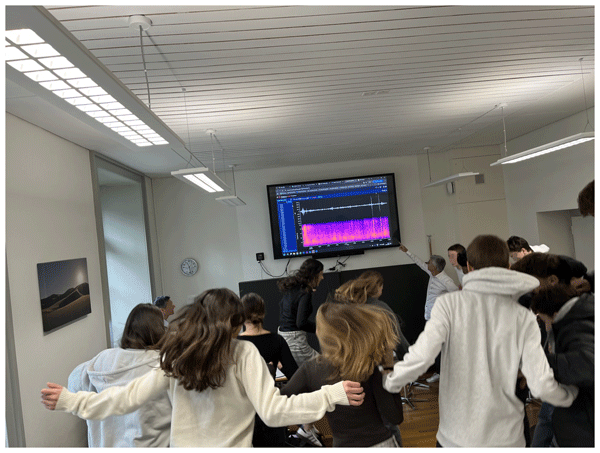
Maren Böse, Nadja Valenzuela, György Hetényi, Romain Roduit, Irina Dallo, Kerstin Bircher, John Clinton, Urs Fässler, Florian Haslinger, Tanja Jaeger, Michèle Marti, Roman Racine, Anne Sauron, Shiba Subedi, and Stefan Wiemer
Geosci. Commun., 9, 223–237, https://doi.org/10.5194/gc-9-223-2026, https://doi.org/10.5194/gc-9-223-2026, 2026
Short summary
Short summary
Although Switzerland faces moderate seismic hazard, earthquakes represent the natural risk with the greatest impact potential. As most residents have never experienced a damaging earthquake, education is critical for raising awareness and enhancing preparedness. In a recent project, we expanded the seismo@school program in Switzerland by developing new teaching materials in four languages, related classroom activities, and by installing Raspberry Shake seismometers in schools across the country.
Shiba Subedi, György Hetényi, Sarah Houghton, Priyanka Dhami, Aastha Poudel, Shreedhar Dhakal, and Kushal Pokhrel
EGUsphere, https://doi.org/10.5194/egusphere-2026-4706, https://doi.org/10.5194/egusphere-2026-4706, 2026
This preprint is open for discussion and under review for Natural Hazards and Earth System Sciences (NHESS).
Short summary
Short summary
Many schools in Nepal remain vulnerable to future earthquakes despite reconstruction efforts after the 2015 earthquake. We assessed earthquake risks in 730 classrooms by examining buildings, evacuation routes, and safe open spaces. We found that many risks can be reduced through simple, low-cost improvements and better preparedness. Our study provides practical guidance to help schools become safer and can support earthquake risk reduction across Nepal and the Himalayan region.
Maren Böse, Nadja Valenzuela, György Hetényi, Romain Roduit, Irina Dallo, Kerstin Bircher, John Clinton, Urs Fässler, Florian Haslinger, Tanja Jaeger, Michèle Marti, Roman Racine, Anne Sauron, Shiba Subedi, and Stefan Wiemer
Geosci. Commun., 9, 223–237, https://doi.org/10.5194/gc-9-223-2026, https://doi.org/10.5194/gc-9-223-2026, 2026
Short summary
Short summary
Although Switzerland faces moderate seismic hazard, earthquakes represent the natural risk with the greatest impact potential. As most residents have never experienced a damaging earthquake, education is critical for raising awareness and enhancing preparedness. In a recent project, we expanded the seismo@school program in Switzerland by developing new teaching materials in four languages, related classroom activities, and by installing Raspberry Shake seismometers in schools across the country.
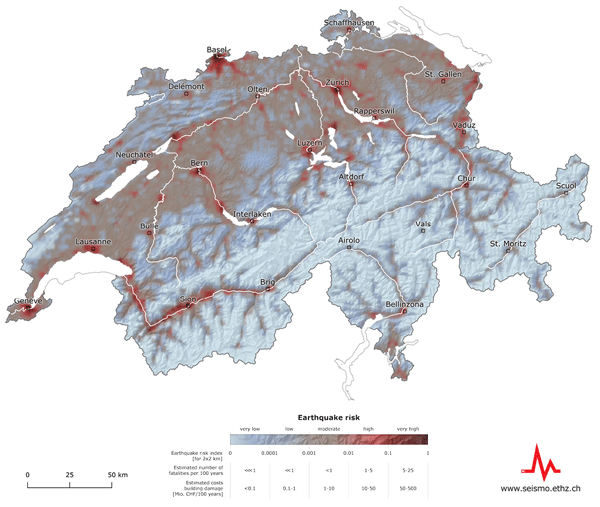
Athanasios N. Papadopoulos, Philippe Roth, Laurentiu Danciu, Paolo Bergamo, Francesco Panzera, Donat Fäh, Carlo Cauzzi, Blaise Duvernay, Alireza Khodaverdian, Pierino Lestuzzi, Ömer Odabaşi, Ettore Fagà, Paolo Bazzurro, Michèle Marti, Nadja Valenzuela, Irina Dallo, Nicolas Schmid, Philip Kästli, Florian Haslinger, and Stefan Wiemer
Nat. Hazards Earth Syst. Sci., 24, 3561–3578, https://doi.org/10.5194/nhess-24-3561-2024, https://doi.org/10.5194/nhess-24-3561-2024, 2024
Short summary
Short summary
The Earthquake Risk Model of Switzerland (ERM-CH23), released in early 2023, is the culmination of a multidisciplinary effort aiming to achieve, for the first time, a comprehensive assessment of the potential consequences of earthquakes on the Swiss building stock and population. ERM-CH23 provides risk estimates for various impact metrics, ranging from economic loss as a result of damage to buildings and their contents to human losses, such as deaths, injuries, and displaced population.
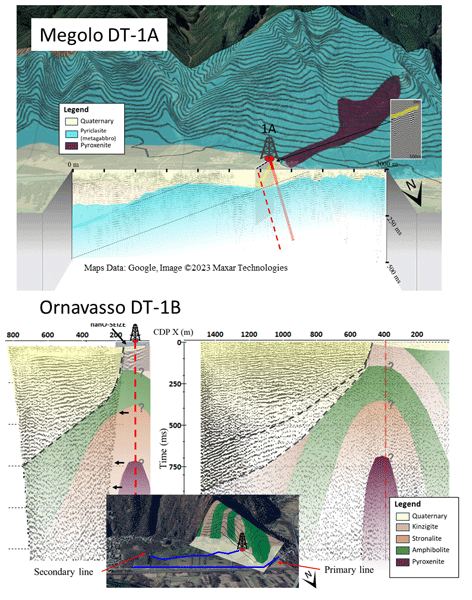
Andrew Greenwood, György Hetényi, Ludovic Baron, Alberto Zanetti, Othmar Müntener, and the MOS field team
Sci. Dril., 33, 219–236, https://doi.org/10.5194/sd-33-219-2024, https://doi.org/10.5194/sd-33-219-2024, 2024
Short summary
Short summary
A set of seismic reflection surveys were conducted in May 2019 in the Ossola Valley, Western Italian Alps, to image the geologic structure below two proposed boreholes. The boreholes plan to penetrate the upper 2 km of the lower continental crust, a zone of much scientific interest. The seismic surveys have defined the valley structure to depths of 550 m, determined the dip of geological banding, and ruled out the possibility of major geologic drilling hazards that could be encountered.
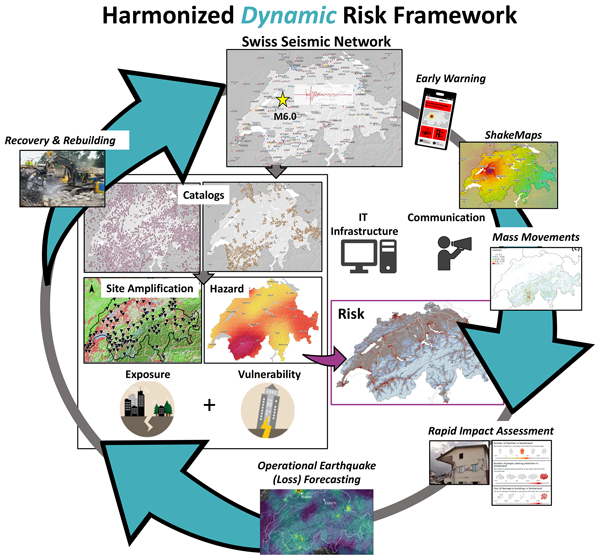
Maren Böse, Laurentiu Danciu, Athanasios Papadopoulos, John Clinton, Carlo Cauzzi, Irina Dallo, Leila Mizrahi, Tobias Diehl, Paolo Bergamo, Yves Reuland, Andreas Fichtner, Philippe Roth, Florian Haslinger, Frédérick Massin, Nadja Valenzuela, Nikola Blagojević, Lukas Bodenmann, Eleni Chatzi, Donat Fäh, Franziska Glueer, Marta Han, Lukas Heiniger, Paulina Janusz, Dario Jozinović, Philipp Kästli, Federica Lanza, Timothy Lee, Panagiotis Martakis, Michèle Marti, Men-Andrin Meier, Banu Mena Cabrera, Maria Mesimeri, Anne Obermann, Pilar Sanchez-Pastor, Luca Scarabello, Nicolas Schmid, Anastasiia Shynkarenko, Bozidar Stojadinović, Domenico Giardini, and Stefan Wiemer
Nat. Hazards Earth Syst. Sci., 24, 583–607, https://doi.org/10.5194/nhess-24-583-2024, https://doi.org/10.5194/nhess-24-583-2024, 2024
Short summary
Short summary
Seismic hazard and risk are time dependent as seismicity is clustered and exposure can change rapidly. We are developing an interdisciplinary dynamic earthquake risk framework for advancing earthquake risk mitigation in Switzerland. This includes various earthquake risk products and services, such as operational earthquake forecasting and early warning. Standardisation and harmonisation into seamless solutions that access the same databases, workflows, and software are a crucial component.
Irina Dallo, Michèle Marti, Nadja Valenzuela, Helen Crowley, Jamal Dabbeek, Laurentiu Danciu, Simone Zaugg, Fabrice Cotton, Domenico Giardini, Rui Pinho, John F. Schneider, Céline Beauval, António A. Correia, Olga-Joan Ktenidou, Päivi Mäntyniemi, Marco Pagani, Vitor Silva, Graeme Weatherill, and Stefan Wiemer
Nat. Hazards Earth Syst. Sci., 24, 291–307, https://doi.org/10.5194/nhess-24-291-2024, https://doi.org/10.5194/nhess-24-291-2024, 2024
Short summary
Short summary
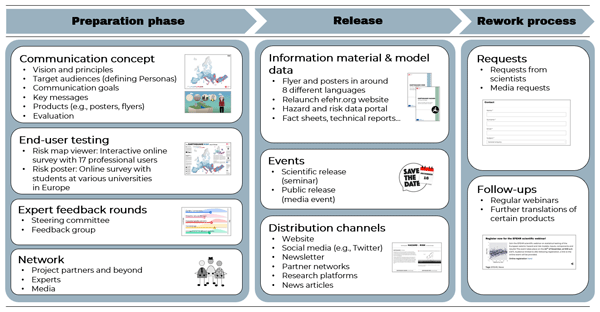
For the release of cross-country harmonised hazard and risk models, a communication strategy co-defined by the model developers and communication experts is needed. The strategy should consist of a communication concept, user testing, expert feedback mechanisms, and the establishment of a network with outreach specialists. Here we present our approach for the release of the European Seismic Hazard Model and European Seismic Risk Model and provide practical recommendations for similar efforts.
Konstantinos Michailos, György Hetényi, Matteo Scarponi, Josip Stipčević, Irene Bianchi, Luciana Bonatto, Wojciech Czuba, Massimo Di Bona, Aladino Govoni, Katrin Hannemann, Tomasz Janik, Dániel Kalmár, Rainer Kind, Frederik Link, Francesco Pio Lucente, Stephen Monna, Caterina Montuori, Stefan Mroczek, Anne Paul, Claudia Piromallo, Jaroslava Plomerová, Julia Rewers, Simone Salimbeni, Frederik Tilmann, Piotr Środa, Jérôme Vergne, and the AlpArray-PACASE Working Group
Earth Syst. Sci. Data, 15, 2117–2138, https://doi.org/10.5194/essd-15-2117-2023, https://doi.org/10.5194/essd-15-2117-2023, 2023
Short summary
Short summary
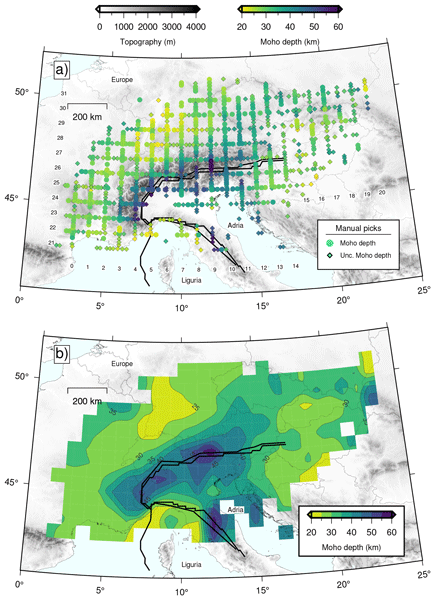
We examine the spatial variability of the crustal thickness beneath the broader European Alpine region by using teleseismic earthquake information (receiver functions) on a large amount of seismic waveform data. We compile a new Moho depth map of the broader European Alps and make our results freely available. We anticipate that our results can potentially provide helpful hints for interdisciplinary imaging and numerical modeling studies.

Jaroslava Plomerová, Helena Žlebčíková, György Hetényi, Luděk Vecsey, Vladislav Babuška, and AlpArray-EASI and AlpArray working
groups
Solid Earth, 13, 251–270, https://doi.org/10.5194/se-13-251-2022, https://doi.org/10.5194/se-13-251-2022, 2022
Short summary
Short summary
We present high-resolution tomography images of upper mantle structure beneath the E Alps and the adjacent Bohemian Massif. The northward-dipping lithosphere, imaged down to ∼200 km beneath the E Alps without signs of delamination, is probably formed by a mixture of a fragment of detached European plate and the Adriatic plate subductions. A detached high-velocity anomaly, sub-parallel to and distinct from the E Alps heterogeneity, is imaged at ∼100–200 km beneath the southern part of the BM.
Cited articles
Albris, K., Lauta, K. C., and Raju, E.: Disaster knowledge gaps: Exploring the interface between science and policy for disaster risk reduction in Europe, Int. J. Disaster Risk Sci., 11, 1–12, https://doi.org/10.1007/s13753-020-00250-5, 2020.
Ao, Y., Zhang, H., Yang, L., Wang, Y., Martek, I., and Wang, G.: Impacts of earthquake knowledge and risk perception on earthquake preparedness of rural residents, Nat. Hazards, 107, 1287–1310, https://doi.org/10.1007/s11069-021-04632-w, 2021.
Bilham, R.: Seismic hazard in the Himalaya: Perspectives on the current gap and future large earthquakes, Seismol. Res. Lett., 90, 1–11, https://doi.org/10.1785/0220180222, 2019.
Chaulagain, H., Rodrigues, H., Silva, V., Spacone, E., and Varum, H.: Seismic risk assessment and hazard mapping in Nepal, Nat. Hazards, 78, 583–602, https://doi.org/10.1007/s11069-015-1734-6, 2015.
Dal Zilio, L., Hetényi, G., Hubbard, J., and Bollinger, L.: Building the Himalaya from tectonic to earthquake scales, Nat. Rev. Earth Environ., 2, 251–268, https://doi.org/10.1038/s43017-021-00143-1, 2021.
Dixit, A., Dwelley-Samant, L., Nakarmi, M., Pradhanang, S. B., and Tucker, B.: The Kathmandu valley earthquake risk management project: an evaluation, Asia Disaster Preparedness Centre, https://doi.org/10.13140/2.1.4625.0244, 2000.
Hetényi, G. and Subedi, S.: A Call to Action for a Comprehensive Earthquake Education Policy in Nepal, Seismica, 2, 242, https://doi.org/10.26443/seismica.v2i2.242, 2023.
Ireton, F., Liepold, M., and Spaulding, K.: Seismic Sleuths: Earthquakes: A Teacher's Package on Earthquakes for Grades 7–12, American Geophysical Union/Federal Emergency Management Agency, ERIC No. ED423115, 1995.
JICA, M.: The study on earthquake disaster mitigation in the Kathmandu Valley, Kingdom of Nepal, Japan International Cooperation Agency (JICA) and Ministry of Home Affairs (MOHA), Tokyo, https://openjicareport.jica.go.jp/pdf/11685807_01.pdf (last access: 23 January 2026), 2002.
Maharjan, S. K., Devkota, B., Acharya, D., and Upreti, Y. R.: Integrating Health Education in Earthquake Preparedness and Response, J. Health Promot., 11, 1–3, https://doi.org/10.3126/jhp.v11i1.61195, 2023.
National Statistics Office: National population and housing census 2021 (National Report), National Planning Commission Secretariat, https://microdata.nsonepal.gov.np/index.php/catalog/124/related-materials (last access: 23 January 2026), 2023.
Scolobig, A. and Balsiger, J.: Emerging trends in disaster risk reduction and climate change adaptation higher education, Int. J. Disaster Risk Reduct., 105, 104383, https://doi.org/10.1016/j.ijdrr.2024.104383, 2024.
Shrestha, N. and Hough, S. E.: Destruction and Transformation: Lessons learned from the 2015 Gorkha, Nepal, earthquake, Temblor, https://doi.org/10.32858/temblor.363, 2025.
Subedi, S., Hetényi, G., Denton, P., and Sauron, A.: Seismology at school in Nepal: A program for educational and citizen seismology through a low-cost seismic network, Front. Earth Sci., 8, 73, https://doi.org/10.3389/feart.2020.00073, 2020a.
Subedi, S., Hetényi, G., and Shackleton, R.: Impact of an educational program on earthquake awareness and preparedness in Nepal, Geosci. Commun., 3, 279–290, https://doi.org/10.5194/gc-3-279-2020, 2020b.
Subedi, S., Denton, P., Michailos, K., and Hetényi, G.: Making seismology accessible to the public in Nepal: an earthquake location tutorial for education purposes, Bull. Nepal Geol. Soc., 38, 149–162, 2021.
UNDRR (United Nations Office for Disaster Risk Reduction): Global Assessment Report on Disaster Risk Reduction 2022: Our World at Risk: Transforming Governance for a Resilient Future, Geneva, https://www.undrr.org/media/79595 (last access: 23 January 2026), 2022.
UNDRR (United Nations Office for Disaster Risk Reduction): Global Assessment Report on Disaster Risk Reduction 2025: Resilience pays: Financing and investing for our future, https://www.undrr.org/gar/gar2025 (last access: 23 January 2026), 2025.
Short summary
An interactive exhibition in Pokhara, Nepal, held on the tenth anniversary of the 2015 earthquake, helped school students understand why earthquakes occur and how to protect themselves. After taking part, most felt more confident and prepared, and many planned to share safety tips with their families and friends. This ripple effect shows how hands-on learning can spread awareness, inspire action, and help entire communities build resilience for future earthquakes.
An interactive exhibition in Pokhara, Nepal, held on the tenth anniversary of the 2015...


Altmetrics
Final-revised paper
Preprint