
Articles | Volume 9, issue 1
https://doi.org/10.5194/gc-9-7-2026
© Author(s) 2026. This work is distributed under
the Creative Commons Attribution 4.0 License.
the Creative Commons Attribution 4.0 License.
https://doi.org/10.5194/gc-9-7-2026
© Author(s) 2026. This work is distributed under
the Creative Commons Attribution 4.0 License.
the Creative Commons Attribution 4.0 License.
Research article
| 
08 Jan 2026
Research article |
| 08 Jan 2026
| 08 Jan 2026
Students' sense of belonging and its impact on effectively teaching about environmental changes in high latitudes during a master's programme
Karoliina Särkelä
Institute for Atmospheric and Earth System Research (INAR), University of Helsinki, Helsinki, Finland
Janne J. Salovaara
Institute for Atmospheric and Earth System Research (INAR), University of Helsinki, Helsinki, Finland
Helsinki Institute of Sustainability Science (HELSUS), University of Helsinki, Helsinki, Finland
Veli-Matti Vesterinen
Faculty of Educational Sciences, University of Helsinki, Helsinki, Finland
Department of Chemistry, Faculty of Science, University of Turku, Turku, Finland
Joula Siponen
Institute for Atmospheric and Earth System Research (INAR), University of Helsinki, Helsinki, Finland
Helsinki Institute of Sustainability Science (HELSUS), University of Helsinki, Helsinki, Finland
Katariina Salmela-Aro
Faculty of Educational Sciences, University of Helsinki, Helsinki, Finland
deceased
Laura Riuttanen
Institute for Atmospheric and Earth System Research (INAR), University of Helsinki, Helsinki, Finland
Katja Anniina Lauri
CORRESPONDING AUTHOR

Institute for Atmospheric and Earth System Research (INAR), University of Helsinki, Helsinki, Finland
Related authors
Karoliina Särkelä, Timo Vesala, Torben R. Christensen, Juval Cohen, Angelika Kübert, Xuefei Li, Hannu Marttila, Jouni Pulliainen, Eeva-Stiina Tuittila, and Efrén López-Blanco
Biogeosciences, 23, 6037–6052, https://doi.org/10.5194/bg-23-6037-2026, https://doi.org/10.5194/bg-23-6037-2026, 2026
Short summary
Short summary
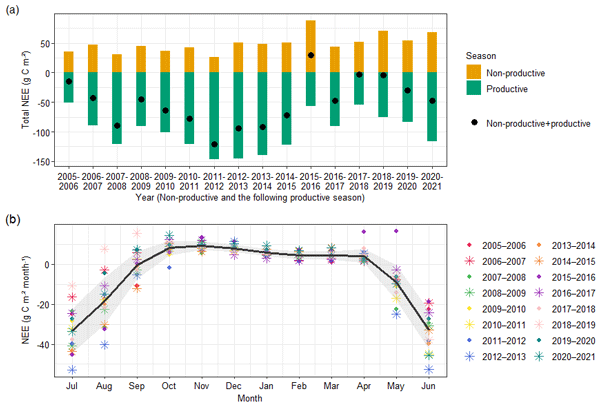
Using a 17-year record of year-round peatland carbon exchange, we found that over half of the carbon sequestrated during summer was released during winter. In one year, CO₂ emissions during snow melt and soil thaw in spring were large enough to shift the peatland from a net carbon sink to a source. These findings demonstrate that winter and early-spring processes have a strong impact over the annual carbon balance of northern peatlands.
Karoliina Särkelä, Timo Vesala, Torben R. Christensen, Juval Cohen, Angelika Kübert, Xuefei Li, Hannu Marttila, Jouni Pulliainen, Eeva-Stiina Tuittila, and Efrén López-Blanco
Biogeosciences, 23, 6037–6052, https://doi.org/10.5194/bg-23-6037-2026, https://doi.org/10.5194/bg-23-6037-2026, 2026
Short summary
Short summary
Using a 17-year record of year-round peatland carbon exchange, we found that over half of the carbon sequestrated during summer was released during winter. In one year, CO₂ emissions during snow melt and soil thaw in spring were large enough to shift the peatland from a net carbon sink to a source. These findings demonstrate that winter and early-spring processes have a strong impact over the annual carbon balance of northern peatlands.
Andrea Vajda, Hilppa Gregow, Natalia Korhonen, Jari Lavonen, Katja Anniina Lauri, Risto Makkonen, Joonas Merikanto, Antti Mäkelä, Petri Räisänen, Veli-Matti Vesterinen, Ilona Ylivinkka, Mikko Äijälä, Andrea Böhnisch, and Laura Riuttanen
EGUsphere, https://doi.org/10.5194/egusphere-2026-227, https://doi.org/10.5194/egusphere-2026-227, 2026
Short summary
Short summary
The paper describes the development of a new graduate course, Living with Changing Climate, designed to help future professionals apply climate information in real-world decisions. Created by experts from several fields, the course combines climate science, data use and real-word applications. Piloting with diverse students revealed challenges and improvements that strengthened the final course, showing how higher education can better prepare learners for climate adaptation and mitigation.
Joula Siponen, Janne J. Salovaara, Karoliina Särkelä, Inka Ronkainen, Salla Veijonaho, Veli-Matti Vesterinen, Isabel C. Barrio, Laura Riuttanen, and Katja Anniina Lauri
Geosci. Commun., 8, 357–370, https://doi.org/10.5194/gc-8-357-2025, https://doi.org/10.5194/gc-8-357-2025, 2025
Short summary
Short summary
This study explores a university course fostering transformative learning of geoscience students. Exposure to diverse Arctic perspectives, from Indigenous to geopolitical, and reflection of belonging to expert community broadened their understanding of Arctic challenges and shaped their professional identities. Our findings emphasise importance of facilitation of critical reflection and building of a supportive learning environment in developing responsible Arctic expertise.
Cited articles
Abu, L., Chipfuwamiti, C., Costea, A.-M., Kelly, A. F., Major, K., and Mulrooney, H. M.: Staff and student perspectives of online teaching and learning; implications for belonging and engagement at university – a qualitative exploration, Compass J. Learn. Teach., 14, https://doi.org/10.21100/compass.v14i3.1219, 2021.
Ahn, M. Y. and Davis, H. H.: Four domains of students' sense of belonging to university, Stud. High. Educ., 45, https://doi.org/10.1080/03075079.2018.1564902, 2020.
Allen, K.-A., Kern, M. L., Rozek, C. S., McInerney, D. M., and Slavich, G. M.: Belonging: A review of conceptual issues, an integrative framework, and directions for future research, Aust. J. Psychol., 73, https://doi.org/10.1080/00049530.2021.1883409, 2021.
Antonsich, M.: Searching for belonging–An analytical framework, Geogr. Compass, 4, https://doi.org/10.1111/j.1749-8198.2009.00317.x, 2010.
Braidotti, R.: TRANSPOSITIONS: ON NOMADIC ETHICS, Malden, MA, Polity Press, https://openlibrary.org/books/OL22720801M/TRANSPOSITIONS_ON_NOMADIC_ETHICS (last access: 11 December 2025), 2006.
Bryman, A. and Burgess, R. G.: Analyzing Qualitative Data, 11, Routledge, London, UK, https://openlibrary.org/books/OL38743815M/Analyzing_Qualitative_Data (last access: 11 December 2025), 1994.
Carlone, H. B. and Johnson, A.: Understanding the science experiences of successful women of color: Science identity as an analytic lens, J. Res. Sci. Teach., 44, 1187–1218, https://doi.org/10.1002/tea.20237, 2007.
Cohen, E. and Viola, J.: The role of pedagogy and the curriculum in university students' sense of belonging, J. Univ. Teach. Learn. Pract., 19, 6, https://search.informit.org/doi/10.3316/informit.T2024121200020601774838377 (last access: 11 December 2025), 2022.
Cohen, L., Manion, L., and Morrison, K.: Research Methods in Education, 8th edn., Routledge, London, UK, https://doi.org/10.4324/9780203224342, 2018.
Delors J.: Learning: the treasure within; report to UNESCO of the International Commission on Education for the Twenty-first Century (highlights), UNESCO, https://unesdoc.unesco.org/ark:/48223/pf0000109590 (last access: 11 December 2025), 1996.
Devine-Wright, P.: Think global, act local? The relevance of place attachments and place identities in a climate-changed world, Glob. Environ. Change, 23, 61–69, https://doi.org/10.1016/j.gloenvcha.2012.08.003, 2013.
Donaldson, T., Fore, G. A., Filippelli, G. M., and Hess, J. L.: A systematic review of the literature on situated learning in the geosciences: Beyond the classroom, Int. J. Sci. Educ., 42, 722–743, https://doi.org/10.1080/09500693.2020.1727060, 2020.
Dryzek, J. S.: The Politics of the Earth: Environmental discourses, Oxford university press, https://openlibrary.org/books/OL28494236M/Politics_of_the_Earth (last access: 11 December 2025), 2022
Edwards, J. D., Barthelemy, R. S., and Frey, R. F.: Relationship between course-level social belonging (sense of belonging and belonging uncertainty) and academic performance in general chemistry 1, J. Chem. Educ., 99, https://doi.org/10.1021/acs.jchemed.1c00405, 2022.
Geschwind, L. and Melin, G.: Stronger disciplinary identities in multidisciplinary research schools, Stud. Contin. Educ., 38, 16–28, https://doi.org/10.1080/0158037X.2014.1000848, 2016.
Gravett, K. and Ajjawi, R.: Belonging as situated practice, Stud. High. Educ., 47, https://doi.org/10.1080/03075079.2021.1894118, 2022.
Guyotte, K. W., Flint, M. A., and Latopolski, K. S.: Cartographies of belonging: mapping nomadic narratives of first-year students, Crit. Stud. Educ., 62, 543–558, https://doi.org/10.1080/17508487.2019.1657160, 2019.
Hagerty, B. M. and Patusky, K.: Developing a Measure of Sense of Belonging, Nurs. Res., 44, https://psycnet.apa.org/doi/10.1097/00006199-199501000-00003 (last access: 11 December 2025), 1995.
Hall, C. A., Illingworth, S., Mohadjer, S., Roxy, M. K., Poku, C., Otu-Larbi, F., Reano, D., Freilich, M., Veisaga, M.-L., Valencia, M., and Morales, J.: GC Insights: Diversifying the geosciences in higher education: a manifesto for change, Geosci. Commun., 5, 275–280, https://doi.org/10.5194/gc-5-275-2022, 2022.
Hazari, Z., Chari, D., Potvin, G., and Brewe, E.: The context dependence of physics identity: Examining the role of performance/competence, recognition, interest, and sense of belonging for lower and upper female physics undergraduates, J. Res. Sci. Teach., 57, 1583–1607, https://doi.org/10.1002/tea.21644, 2020.
Heron, P. J. and Williams, J. A.: Building confidence in STEM students through breaking (unseen) barriers, Geosci. Commun., 5, 355–361, https://doi.org/10.5194/gc-5-355-2022, 2022.
Heron, P. J., Crameri, F., Canaletti, E. F., Harrison, D., Hashemi, S., Leigh, P., Narayan, S., Osowski, K., Rantanen, R., and Williams, J. A.: Art, music, and play as a teaching aid: applying creative uses of Universal Design for Learning in a prison science class, Front. Educ., 10, 1524007, https://doi.org/10.3389/feduc.2025.1524007, 2025.
Hughes, R., Schellinger, J., and Roberts, K.: The role of recognition in disciplinary identity for girls, J. Res. Sci. Teach., 58, 420–455, https://doi.org/10.1002/tea.21665, 2021.
Kahu, E. R., Ashley, N., and Picton, C.: Exploring the complexity of first-year student belonging in higher education: Familiarity, interpersonal, and academic belonging, Stud. Success, 13, 10–20, https://doi.org/10.5204/ssj.2264, 2022.
King, C.: Geoscience education: an overview, Stud. Sci. Educ., 44, 187–222, https://doi.org/10.1080/03057260802264289, 2008.
Krippendorff, K.: Content Analysis: An Introduction to Its Methodology, Sage Publications, https://doi.org/10.4135/9781071878781, 2018.
Kubisch, S., Krimm, H., Liebhaber, N., Oberauer, K., Deisenrieder, V., Parth, S., Frick, M., Stötter, J., and Keller, L.: Rethinking quality science education for climate action: Transdisciplinary education for transformative learning and engagement, Frontiers in Education, 7, 838135, https://doi.org/10.3389/feduc.2022.838135, 2022.
Maestas, R., Vaquera, G. S., and Zehr, L. M.: Factors impacting sense of belonging at a Hispanic-Serving Institution, J. Hisp. High. Educ., 6, https://doi.org/10.1177/1538192707302801, 2007.
Mahar, A. L., Cobigo, V., and Stuart, H.: Conceptualizing belonging, Disabil. Rehabil., 35, https://doi.org/10.3109/09638288.2012.717584, 2013.
Maslow, A. H.: A theory of human motivation, Psychol. Rev., 50, 430–437, 1943.
McCright, A. M., O'shea, B. W., Sweeder, R. D., Urquhart, G. R., and Zeleke, A.: Promoting interdisciplinarity through climate change education, Nat. Clim. Change, 3, 713–716, https://doi.org/10.1038/nclimate1844, 2013.
Mercer, J.: The challenges of insider research in educational institutions: Wielding a double-edged sword and resolving delicate dilemmas, Oxf. Rev. Educ., 33, 1–17, https://doi.org/10.1080/03054980601094651, 2007.
Molthan-Hill, P., Worsfold, N., Nagy, G. J., Leal Filho, W., and Mifsud, M.: Climate change education for universities: A conceptual framework from an international study, J. Clean. Prod., 226, 1092–1101, https://doi.org/10.1016/j.jclepro.2019.04.053, 2019.
Monroe, M. C., Plate, R. R., Oxarart, A., Bowers, A., and Chaves, W. A.: Identifying effective climate change education strategies: A systematic review of the research, Environ. Educ. Res., 25, 791–812, https://doi.org/10.1080/13504622.2017.1360842, 2019.
Pedler, M. L., Willis, R., and Nieuwoudt, J. E.: A sense of belonging at university: Student retention, motivation and enjoyment, J. Furth. High. Educ., 46, https://doi.org/10.1080/0309877X.2021.1955844, 2022.
Perkins, K. M., Munguia, N., Moure-Eraso, R., Delakowitz, B., Giannetti, B. F., Liu, G., Nurunnabi, M., Will, M., and Velazquez, L.: International perspectives on the pedagogy of climate change, J. Clean. Prod., 200, 1043–1052, https://doi.org/10.1016/j.jclepro.2018.07.296, 2018.
Pittman, L. D. and Richmond, A.: Academic and psychological functioning in late adolescence: The importance of school belonging, J. Exp. Educ., 75, https://doi.org/10.3200/JEXE.75.4.270-292, 2007.
Ryan, R. M. and Deci, E. L.: Self-Determination Theory and the facilitation of intrinsic motivation, social development, and well-being, Am. Psychol., https://doi.org/10.1037/0003-066X.55.1.68, 2000.
Salovaara, J. J. and Soini, K.: Educated professionals of sustainability and the dimensions of practices, Int. J. Sustain. High. Educ., 22, 69–87, https://doi.org/10.1108/IJSHE-09-2020-0327, 2021.
Spaeth, E. and Pearson, A.: A reflective analysis on neurodiversity and student wellbeing: conceptualising practical strategies for inclusive practice, J. Perspect. Appl. Acad. Pract., 11, 109–120, https://doi.org/10.56433/jpaap.v11i2.517, 2023.
The Nordic Master in Environmental Changes at Higher Latitudes (EnCHiL): About Enchil, https://enchil.net/about-enchil/, last access: 2 May 2024.
Thomas, L.: Building student engagement and belonging in Higher Education at a time of change, Higher Education Academy, York, UK, https://hdl.voced.edu.au/10707/427066 (last access: 11 December 2025), 2012.
Thomas, L., Herbert, J., and Teras, M.: A sense of belonging to enhance participation, success and retention in online programs, Int. J. First Year High. Educ., 5, https://doi.org/10.5204/intjfyhe.v5i2.233, 2014.
Todd, W. F., Towne, C. E., and Clarke, J. B.: Importance of centering traditional knowledge and Indigenous culture in geoscience education, J. Geosci. Educ., 71, 403–414, https://doi.org/10.1080/10899995.2023.2172976, 2023.
Wamsler, C.: Education for sustainability: Fostering a more conscious society and transformation towards sustainability. International Journal of Sustainability in Higher Education, 21, 112–130, https://doi.org/10.1108/IJSHE-04-2019-0152, 2020.
Short summary
We examine students’ perceived sense of belonging, its conditions, and its impact on learning in a climate change context in the ‘Environmental Changes at Higher Latitudes’ master’s programme. With high degree of mobility and little physical co-presence, the programme lacks traditional belonging factors. Interviews reveal three key constructs: familiarity, recognition, and relevance, crucial for climate and geoscience education.
We examine students’ perceived sense of belonging, its conditions, and its impact on learning in...


Altmetrics
Final-revised paper
Preprint