Büntgen, U.: The importance of distinguishing climate science from climate activism, npj Clim. Action, 3, 1–2, https://doi.org/10.1038/s44168-024-00126-0, 2024.
Cairo, A.: How charts lie: getting smarter about visual information, F1st Edn., W. W. Norton & Company, New York, ISBN 9780393358421, 2019.
Capstick, S., Thierry, A., Cox, E., Berglund, O., Westlake, S., and Steinberger, J. K.: Civil disobedience by scientists helps press for urgent climate action, Nat. Clim. Chang., 12, 773–774, https://doi.org/10.1038/s41558-022-01461-y, 2022.
Cologna, V., Knutti, R., Oreskes, N., and Siegrist, M.: Majority of German citizens, US citizens and climate scientists support policy advocacy by climate researchers and expect greater political engagement, Environ. Res. Lett., 16, 024011, https://doi.org/10.1088/1748-9326/abd4ac, 2021.
Dablander, F., Sachisthal, M. S. M., Cologna, V., Strahm, N., Bosshard, A., Grüning, N.-M., Green, A. J. K., Brick, C., Aron, A. R., and Haslbeck, J. M. B.: Climate chang
e engagement of scientists, Nat. Clim. Chang., 14, 1033–1039, https://doi.org/10.1038/s41558-024-02091-2, 2024.
Dong, Y., Hu, S., and Zhu, J.: From source credibility to risk perception: How and when climate information matters to action, Resources, Conservation and Recycling, 136, 410–417, https://doi.org/10.1016/j.resconrec.2018.05.012, 2018.
Donner, S. D.: Finding your place on the science – advocacy continuum: an editorial essay, Climatic Change, 124, 1–8, https://doi.org/10.1007/s10584-014-1108-1, 2014.
Edelman Trust Institute: 2024 Edelman Trust Barometer,
https://www.edelman.com/trust/2024/trust-barometer (last access: 6 January 2026), 2024.
Fischhoff, B.: Nonpersuasive Communication about Matters of Greatest Urgency: Climate Change, Environ. Sci. Technol., 41, 7204–7208, https://doi.org/10.1021/es0726411, 2007.
Grzyb, T. and Dolinski, D.: The Field Study in Social Psychology: How to Conduct Research Outside of a Laboratory Setting?, Routledge, London, 216 pp., https://doi.org/10.4324/9781003092995, 2021.
Gundersen, T., Alinejad, D., Branch, T. Y., Duffy, B., Hewlett, K., Holst, C., Owens, S., Panizza, F., Tellmann, S. M., van Dijck, J., and Baghramian, M.: A New Dark Age? Truth, Trust, and Environmental Science, Annual Review of Environment and Resources, 47, 5–29, https://doi.org/10.1146/annurev-environ-120920-015909, 2022.
Heo, M., Kim, N., and Faith, M. S.: Statistical power as a function of Cronbach alpha of instrument questionnaire items, BMC Med. Res. Methodol., 15, 86, https://doi.org/10.1186/s12874-015-0070-6, 2015.
Heusinkveld, B. G., Steeneveld, G. J., van Hove, L. W. A., Jacobs, C. M. J., and Holtslag, A. A. M.: Spatial variability of the Rotterdam urban heat island as influenced by urban land use, Journal of Geophysical Research: Atmospheres, 119, 677–692, https://doi.org/10.1002/2012JD019399, 2014.
Holm, S.: A Simple Sequentially Rejective Multiple Test Procedure, Scandinavian Journal of Statistics, 6, 65–70, 1979.
Ibrahim, A. M., Lillemoe, K. D., Klingensmith, M. E., and Dimick, J. B.: Visual Abstracts to Disseminate Research on Social Media: A Prospective, Case-control Crossover Study, Annals of Surgery, 266, e46, https://doi.org/10.1097/SLA.0000000000002277, 2017.
Klok, L., Rood, N., Kluck, J., and Kleerekoper, L.: Assessment of thermally comfortable urban spaces in Amsterdam during hot summer days, Int. J. Biometeorol., 63, 129–141, https://doi.org/10.1007/s00484-018-1644-x, 2019.
Kotcher, J. E., Myers, T. A., Vraga, E. K., Stenhouse, N., and Maibach, E. W.: Does Engagement in Advocacy Hurt the Credibility of Scientists? Results from a Randomized National Survey Experiment, Environmental Communication, 11, 415–429, https://doi.org/10.1080/17524032.2016.1275736, 2017.
Lazard, A. and Atkinson, L.: Putting Environmental Infographics Center Stage: The Role of Visuals at the Elaboration Likelihood Model's Critical Point of Persuasion, Science Communication, 37, 6–33, https://doi.org/10.1177/1075547014555997, 2015.
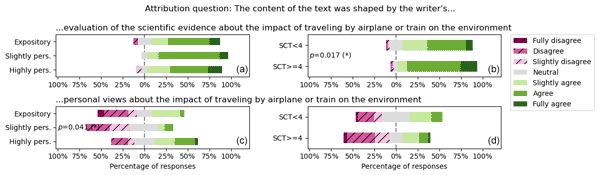
Leerink, A., Bos, M., Reijnders, D., and van Sebille, E.: The (non)effect of personalization in climate texts on the credibility of climate scientists: a case study on sustainable travel, Geosci. Commun., 7, 201–214, https://doi.org/10.5194/gc-7-201-2024, 2024.
León, B., Negredo, S., and Erviti, M. C.: Social Engagement with climate change: principles for effective visual representation on social media, Climate Policy, 22, 976–992, https://doi.org/10.1080/14693062.2022.2077292, 2022.
Li, N., Brossard, D., Scheufele, D. A., Wilson, P. H., and Rose, K. M.: Communicating data: interactive infographics, scientific data and credibility, JCOM, 17, A06, https://doi.org/10.22323/2.17020206, 2018.
Li, N., Villanueva, I. I., Jilk, T., Van Matre, B. R., and Brossard, D.: Artistic representations of data can help bridge the US political divide over climate change, Commun. Earth Environ., 4, 1–9, https://doi.org/10.1038/s43247-023-00856-9, 2023.
Li, Y. and Xie, Y.: Is a Picture Worth a Thousand Words? An Empirical Study of Image Content and Social Media Engagement, Journal of Marketing Research, 57, 1–19, https://doi.org/10.1177/0022243719881113, 2020.
McCabe, D. P. and Castel, A. D.: Seeing is believing: The effect of brain images on judgments of scientific reasoning, Cognition, 107, 343–352, https://doi.org/10.1016/j.cognition.2007.07.017, 2008.
McCroskey, J. C. and Teven, J. J.: Goodwill: A reexamination of the construct and its measurement, Communication Monographs, 66, 90–103, https://doi.org/10.1080/03637759909376464, 1999.
Messling, L., Lu, Y., and van Eck, C. W.: Advocacy – defending science or destroying it? Interviews with 47 climate scientists about their fundamental concerns, Public Underst. Sci., 09636625251314164, https://doi.org/10.1177/09636625251314164, 2025.
Metag, J.: Climate change visuals: a review of their effects on cognition, emotion and behaviour, in: Research Handbook on Communicating Climate Change, edited by: Holmes, D. C. and Richardson, L. M., Edward Elgar Publishing, https://doi.org/10.4337/9781789900408.00025, 2020.
Mooseder, A., Brantner, C., Zamith, R., and Pfeffer, J.: (Social) Media Logics and Visualizing Climate Change: 10 Years of #climatechange Images on Twitter, Social Media
+ Society, 9, 20563051231164310, https://doi.org/10.1177/20563051231164310, 2023.
Mosallaei, A. and Feldman, L.: Do You See What I See? Perceptions and Effects of Image–Text Congruency in Online Climate Change News, Journalism & Mass Communication Quarterly, https://doi.org/10.1177/10776990241284596, 2024.
Murchie, K. J. and Diomede, D.: Fundamentals of graphic design – essential tools for effective visual science communication, FACETS, 5, 409–422, https://doi.org/10.1139/facets-2018-0049, 2020.
Nelson, M. P. and Vucetich, J. A.: On Advocacy by Environmental Scientists: What, Whether, Why, and How, Conservation Biology, 23, 1090–1101, https://doi.org/10.1111/j.1523-1739.2009.01250.x, 2009.
nmalkin: plot-likert, Github [code],
https://github.com/nmalkin/plot-likert/, last access: 6 January 2026.
O'Neill, S., Hayes, S., Strauß, N., Doutreix, M., Steentjes, K., Ettinger, J., Westwood, N., and Painter, J.: Visual portrayals of fun in the sun in European news outlets misrepresent heatwave risks, Geographical Journal, 189, 90–103, https://doi.org/10.1111/geoj.12487, 2023.
Peeters, W., Land-Zandstra, A., and Strick, M.: Een nieuwe aanpak voor het meten van impact in d
e wetenschapscommunicatie: theoretisch kader en praktische uitwerking, Tijdschrift voor Communicatiewetenschap, 50, 231–250, https://doi.org/10.5117/TCW2022.3.006.PEET, 2022.
Pferschy-Wenzig, E.-M., Pferschy, U., Wang, D., Mocan, A., and Atanasov, A. G.: Does a Graphical Abstract Bring More Visibility to Your Paper?, Molecules, 21, 1247, https://doi.org/10.3390/molecules21091247, 2016.
Pielke Jr., R. A.: The Honest Broker: Making Sense of Science in Policy and Politics, Cambridge University Press, https://doi.org/10.1017/CBO9780511818110, 2007.
Pierson, S.: Science Advocacy: What Is It and What Is the Role of Professional Societies?, Amstat News,
https://magazine.amstat.org/blog/2012/01/01/science-advocacy/ (last access: 6 January 2026), 2012.
Post, S. and Bienzeisler, N.: The Honest Broker versus the Epistocrat: Attenuating Distrust in Science by Disentangling Science from Politics, Political Communication, 41, 763–785, https://doi.org/10.1080/10584609.2024.2317274, 2024.
Rabinovich, A., Morton, T. A., and Birney, M. E.: Communicating climate science: The role of perceived communicator's motives, Journal of Environmental Psychology, 32, 11–18, https://doi.org/10.1016/j.jenvp.2011.09.002, 2012.
Rodríguez Estrada, F. C. and Davis, L. S.: Improving Visual Communication of Science Through the Incorporation of Graphic Design Theories and Practices Into Science Communication, Science Communication, 37, 140–148, https://doi.org/10.1177/1075547014562914, 2015.
Smith, N. and Leiserowitz, A.: The Role of Emotion in Global Warming Policy Support and Opposition, Risk Analysis, 34, 937–948, https://doi.org/10.1111/risa.12140, 2014.
Steneck, N. H.: Responsible Advocacy in Science: Standards, Benefits, and Risks, AAAS Workshop on Advocacy in Science,
https://www.aaas.org/resources/report-responsible-advocacy-science-standards-benefits-and-risks (last access: 6 January 2026), 1–16, 2011.
Stichting KlimaatHelpdesk: Beleidsplan Stichting KlimaatHelpdesk 2023,
https://fd-cdn.nl/12602-klimaathelpdesk-prd/media/documents/Beleidsplan_Stichting_KlimaatHelpdesk_2023.pdf (last access: 6 January 2026), 2023a.
Stichting KlimaatHelpdesk: KlimaatHelpdesk Yearbook 2023,
https://anyflip.com/wmevr/eqgz/ (last access: 6 January 2026), 2023b.
Suldovsky, B., Landrum, A., and Stroud, N. J.: Public perceptions of who counts as a scientist for controversial science, Public Underst. Sci., 28, 797–811, https://doi.org/10.1177/0963662519856768, 2019.
Szafir, D. A.: The good, the bad, and the biased: five ways visualizations can mislead (and how to fix them), Interactions, 25, 26–33, https://doi.org/10.1145/3231772, 2018.
van den Broek, J. (Ed.): Visual language: perspectives for both makers and users, Eleven International Pub., Distributed in USA by International Specialized Book Services, Hague, Porland, OR, 320 pp., ISBN 9789490947729, 2012.
Van den Broek-Honingh, N., Glas, I., and Vennekens, A.: Vertrouwen van Nederlanders in wetenschap (enquête 2021), Rathenau Institute, The Hague,
https://www.rathenau.nl/sites/default/files/2021-07/Vertrouwen_van_Nederlanders_wetenschap_enquête_2021_Rathenau_Instituut.pdf (last access: 6 January 2026), 2021.
van Eck, C. W., Messling, L., and Hayhoe, K.: Challenging the neutrality myth in climate science and activism, npj Clim. Action, 3, 1–3, https://doi.org/10.1038/s44168-024-00171-9, 2024.
van Sebille, E.: erikvansebille/ActivismCredibilityArticle: First release of Activism Credibility Article (v0.1.0), Zenodo [code and data set], https://doi.org/10.5281/zenodo.15755647, 2025.
Wang, S., Corner, A., Chapman, D., and Markowitz, E.: Public engagement with climate imagery in a changing digital landscape, WIREs Climate Change, 9, e509, https://doi.org/10.1002/wcc.509, 2018.
Ware, C.: Visual thinking for design, Morgan Kaufmann Elsevier Science & Technology, Burlington, Mass. Amsterdam, ISBN 9780123708960, 2008.
Wijnen, F., Strick, M., Bos, M., and van Sebille, E.: Evaluating the impact of climate communication activities by scientists: what is known and necessary?, Geosci. Commun., 7, 91–100, https://doi.org/10.5194/gc-7-91-2024, 2024.
Wijnker, W., Smeets, I., Burger, P., and Willems, S.: Debunking strategies for misleading bar charts, JCOM, 21, A07, https://doi.org/10.22323/2.21070207, 2022.
Williams, L., Mulder, K. J., Charlton-Perez, A., Lickiss, M., Black, A., McCloy, R., McSorley, E., and Young, J.: Understanding representations of uncertainty, an eye-tracking study – Part 2: The effect of expertise, Geosci. Commun., 6, 111–123, https://doi.org/10.5194/gc-6-111-2023, 2023.
Yang, Y. and Hobbs, J. E.: The Power of Stories: Narratives and Information Framing Effects in Science Communication, American Journal of Agricultural Economics, 102, 1271–1296, https://doi.org/10.1002/ajae.12078, 2020.
Zhu, L., Davis, L. S., and Carr, A.: A picture is not always worth a thousand words: The visual quality of photographs affects the effectiveness of interpretive signage for science communication, Public Underst. Sci., 30, 258–273, https://doi.org/10.1177/0963662520982535, 2021.