
the Creative Commons Attribution 4.0 License.
the Creative Commons Attribution 4.0 License.
 | 06 Nov 2026
Exploring advocacy of Dutch government climate researchers: an interview study
Niels Koppelaar
Christel van Eck

The climate crisis is an existential threat to modern society. Climate researchers are in an important position, with their academic knowledge of climate, to engage with the issue of climate change through advocacy. It has been explored how climate researchers in academia navigate their engagement, but not how climate researchers affiliated with governmental institutes do so. Considering their unique position in the science and policymaking nexus, we conducted 14 interviews with researchers at different Dutch government-funded knowledge organizations that support policy-making with (scientific) knowledge to understand how they engage with climate change. Separating the responses into fundamental epistemological and ontological arguments for and against advocacy, we find that climate researchers at these government-funded knowledge organizations see opportunities for advocacy, but also see concerns. While some of these concerns are similar to those working in academia (including the dissonant tone of the action, pressure from managers and colleagues, and lack of time), we also find concerns unique to working at a government-funded knowledge organization – such as their role as civil servants including their independence and impartiality, the mismatch with the institutional identity, and unclear rules about what is allowed. We suggest that researchers at government-funded knowledge organizations delineate their roles and responsibilities within society more clearly, following a value-based approach.
- Article
(383 KB) - Full-text XML
- BibTeX
- EndNote


Climate scientists navigate an increasingly complex landscape as they seek to communicate their science to broader audiences. In doing so, they face challenges related to: (1) common barriers to public engagement (e.g., lack of time and fear of failure); (2) difficulties in translating highly complex scientific knowledge into accessible messages; (3) societies in which climate skepticism, misinformation, and harassment of scientists flourish; and, finally, (4) debates over whether scientists may, in fact, be considered “activists” (van Eck, 2023). Yet, given the imminent threat of the climate crisis (Calvin et al., 2023), a majority of climate scientists worldwide are willing to engage in societal action related to climate change (Dablander et al., 2024). Motivations to engage are worries about the climate, their perceived responsibility as a scientist, and the perceived ability to shape public discourse and influence climate-related policy (Dablander et al., 2024; van Eck, 2023; Messling et al., 2025). Scientists increasingly voice their concern through engaging in climate activism, such as participating in disruptive protests. These actions spark scholarly and public debates on the role(s) that scientists have in society and whether engaging in advocacy or activism is desired for researchers, as some argue that it hurts scientists' credibility and science reputation (Messling et al., 2025). While we acknowledge that communicative acts may be perceived as advocacy depending on the messenger, audience, and context, here we follow Finnerty et al. (2026) to define advocacy as the “act of persuading or arguing in support of a specific cause, policy, idea, or set of values” (Pezzullo and Cox, 2022). A recent literature review on this debate shows that the answer to this question is multifaceted and context-dependent (Finnerty et al., 2026). A growing number of studies demonstrate that climate advocacy by scientists does not necessarily undermine their credibility (e.g., Dablander et al., 2024; van Sebille et al., 2026). Rather, its effects depend on a range of factors, including the issue being advocated for (Kotcher et al., 2017), whether scientists employ a personal or scientific narrative (van Eck and van der Meer, 2025), and whether credibility or objectivity is used as the outcome of interest (Cologna et al., 2021). More research is therefore needed to further elucidate the conditions under which scientists can engage responsibly in advocacy for climate action.
This emerging body of research has not yet focused on researchers employed at government-funded knowledge organizations, despite their particularly interesting and distinctive position at the science–policy interface. Compared to researchers employed at universities, they operate in much closer proximity to policymaking processes, by providing an evidence base for governments to make informed decisions, which may amplify existing concerns about scientists abusing their position to influence policy decisions (Messling et al., 2025; Pielke, 2007). At the same time, these researchers employed at government-funded knowledge organizations are embedded within governmental institutions and are expected to balance scientific norms with the obligations and expectations associated with public service. As a result, questions surrounding independence, neutrality, credibility, and appropriate role conduct may take on a different meaning in this context than in academia. Drawing on a framework by Messling et al. (2025), our research therefore examines the fundamental epistemological and ontological concerns that shape climate researchers' decisions at government-funded knowledge organizations to engage in or refrain from climate advocacy.
We perform this research in the Dutch context, conducting 14 interviews with researchers employed at Dutch “Rijkskennisinstellingen” (government-funded knowledge organizations). Although the Dutch constitution guarantees freedom of speech, government employees often face pressure to refrain from publicly expressing views that might conflict with their official roles. The Netherlands has a complex government research landscape in which research is not embedded within ministries but provided by advisory councils, assessment agencies, and external partners, which support policy with scientific knowledge in areas such as health, the economy, education, climate, while remaining partially government-funded and linked to ministries (Diercks and Diederen, 2019). Employees at these government-funded knowledge organizations are civil servants subject to the Ambtenarenwet (Central and Local Government Personnel Act) and the civil service integrity code (Ministerie van Algemene Zaken, 2025), which demand avoidance of conflicts of interest and restraint in public expressions that could compromise their duties or the functioning of the civil service. The Gedragscode Integriteit Rijk extends this loyalty requirement to private behaviour and restricts personal expressions in one's own policy domain, a constraint reinforced by the Wet Open Overheid (WOO), which makes internal communication publicly accessible and may deter private expressions in a professional setting. These norms can clash with constitutional freedom of expression. In parallel, scientists must follow the Code of Conduct for Research Integrity – honesty, care, transparency, independence, responsibility – which applies to anyone with a doctorate acting as a scientist, though it does not explicitly regulate personal expressions or advocacy and is not formally underwritten by government agencies.
2.1 Design
In this study, we employed a qualitative, exploratory approach with individual semi-structured interviews. Fourteen climate researchers from KNMI (Royal Netherlands Meteorological Institute), Rijkswaterstaat (Directorate General for Public Works and Water Management), RIVM (National Institute for Public Health and the Environment), and PBL (Netherlands Environmental Assessment Agency) were interviewed to gain insight into their considerations concerning their views on climate advocacy. We used semi-structured interviews because this allowed us to gain a deep yet nuanced understanding of personal experiences and dilemmas. We collected the data in accordance with the ethical guidelines of the Geo-Science Ethics Board of Utrecht University.
2.2 Data collection
Participants were found using snowball sampling (Biernacki and Waldorf, 1981) through contacts at government-funded knowledge organizations of the first and last authors. These initial contacts were asked to suggest further potential participants – in order to ensure we could map the broad range of arguments and considerations of researchers working at government-funded knowledge organizations. From the suggested pool, a random selection of participants was contacted.
In total, the lead author conducted fourteen interviews between July and October 2025. All participants were employed by one of the government-funded knowledge organizations (specific distribution between the government-funded knowledge organizations not disclosed for anonymity reasons). All participants had job titles such as “researcher”, “advisor” and “scientific employee” and were involved in research, although some expressed uncertainty about whether their roles qualified them as government researchers, since the government-funded knowledge organizations do not always have clearly defined researcher roles. Some participants were also affiliated with a university through an academic title or had a doctorate.
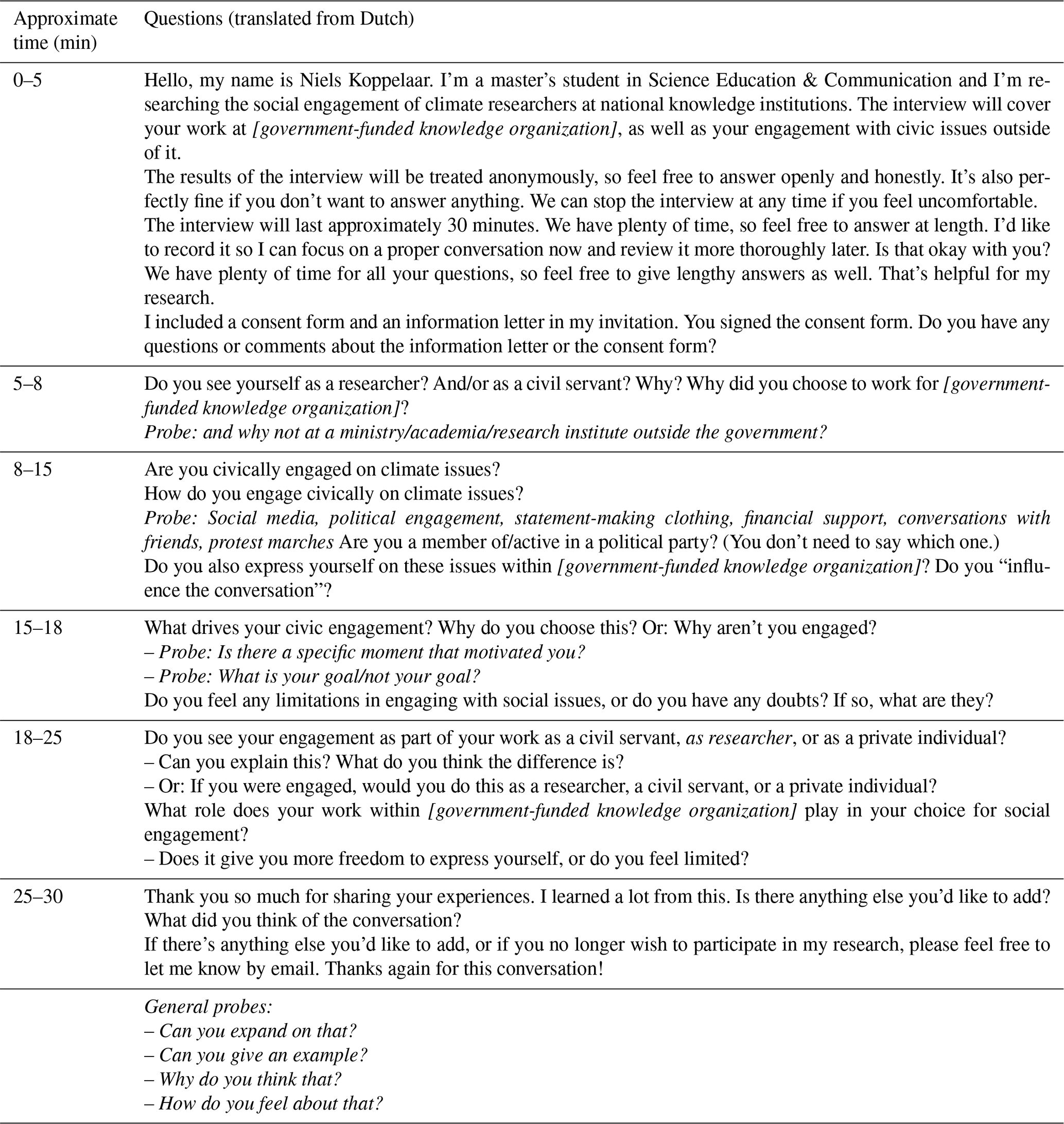
A semi-structured topic guide (Appendix A) was developed, inspired by Dablander et al. (2024), covering the following topics: (1) motivation for working at the government-funded knowledge organization; (2) types of advocacy undertaken; (3) personal motivations for engagement; and (4) perceived limitations related to their role at the government-funded knowledge organization. Probing questions were asked when appropriate (Rubin and Rubin, 2005). The interview guide was pre-tested with a fellow-student of the first author.
The interviews lasted an average of 40 min (minimum: 20 min; maximum 73 min) and were held in Dutch. All interviews were conducted face-to-face, with most at the offices of the government-funded knowledge organization and some at the participants' homes. All interviews were audio-recorded after obtaining written informed consent. Data collection ended when saturation (Saunders et al., 2018) was reached, which was after fourteen interviews: additional interviews yielded no new themes or insights relevant to the research question.
2.3 Data analysis
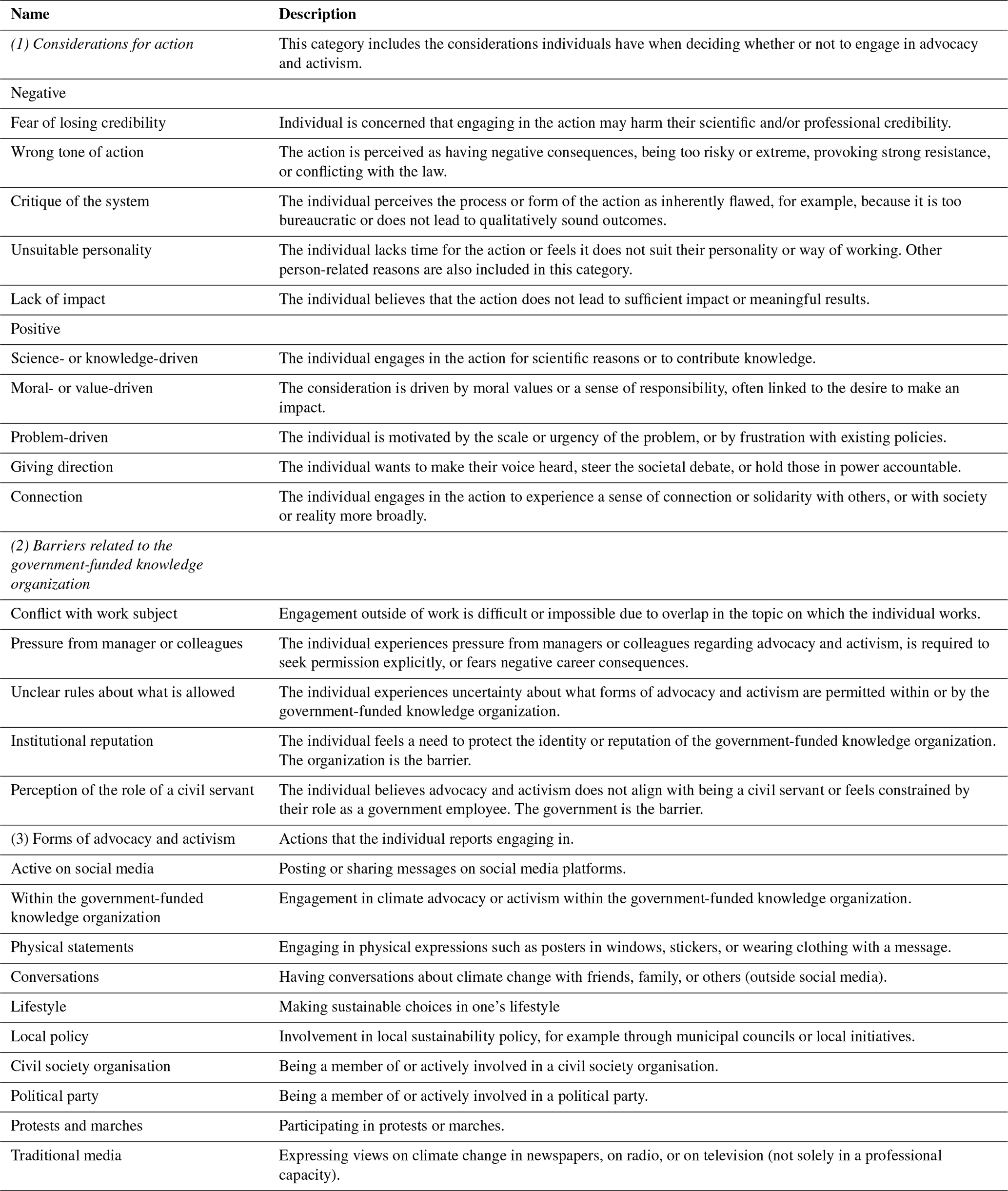
We started by transcribing the data verbatim using automatic transcription software (Amberscript), anonymizing the data, and familiarizing ourselves with the data (Bird, 2005). Next, we employed a combination of deductive and inductive coding, using NVivo software (version 15.3). Based on the topics of the interview guide, we started the analysis with three deductive main categories of “Motivations”, “Barriers”, and “Types of Engagement” and identified codes within these categories through a process of open coding. This process resulted in 17 codes within the Motivations code group, 26 in the Barriers code group, and 13 for the Types of engagement. Subsequently, we started merging codes to avoid having identical codes that were phrased slightly different and create a more insightful overview. Additionally, we added a new deductive coding category, “Barriers related to the government-funded knowledge organization”, to enable a more nuanced analysis of researchers working at government-funded knowledge organizations in comparison to researchers working at universities. This category also allowed us to distinguish between barriers related to interviewees' professional roles and those stemming from their personal, more general convictions (e.g., a perceived mismatch between their personality and activism). To ensure consistency and accuracy, we iteratively recoded the entire dataset and systematically applied the new categories and codes throughout all data. After this step, we ended up with 15 codes for motivations/barriers and 10 for types of engagement. The final codebook consisted of four themes: “Motivations”, “Barriers”, “The barriers related to the government-funded knowledge organization”, and “Types of advocacy and activism” (Appendix B).
In the meantime, to ensure reproducibility of the analysis and avoid personal biases, a second coder coded a section of the anonymized interviews with the established codebook (O'Connor and Joffe, 2020). After this first round, we compared the codes for each interview answer and refined the codebook based on the different interpretations, which in turn changed the coding. Subsequently, there was “sufficient” agreement. The agreement was calculated with the binary variant of Krippendorff's alpha per code theme, measuring consensus on the presence (or absence) of the themes (Hayes and Krippendorff, 2007). A minimum of α ≥ 0.80 was chosen as a measure of reliability, as is usual and recommended for exploratory studies (Philipp et al., 2023). After the first codebook refinement, the lowest Krippendorff's alpha was 0.82.
Table 1Participants considerations to avoid or engage in climate advocacy.

Finally, after these rounds, we inductively identified the higher-level themes concerning the fundamental ontological and epistemological considerations the participants voiced (for example “Defence of science and factual integrity”) and presented them in a table distinguishing between epistemological and ontological concerns and whether advocacy is needed or threatens (inspired by the Table of Messling et al., 2025). The identified themes (as presented in Table 1) were cross-checked with the data to ensure the reliability of themes. After this round, the table was further refined to accurately reflect nuances in interviewee's responses, for example by distinguishing between abuse of position as either a government representative or researcher representing the science.
Based on the interview data, we identified the fundamental concerns of researchers employed at government-funded knowledge organizations regarding whether to engage in or refrain from climate advocacy (see Table 1). Importantly, participants could not be neatly categorized into one position. Rather, they articulated arguments on both sides of the debate and at times even contradicted themselves, underscoring the contested and ambivalent nature of this issue.
Regarding epistemological concerns, participants expressed, on the one hand, that advocacy may threaten the integrity of knowledge production. In particular, they feared that advocacy could undermine organizational independence and impartiality. They also worried that advocacy might compromise objectivity, potentially resulting in biased knowledge production or, at the very least, in perceptions of bias. On the other hand, some argued that advocacy is necessary to safeguard knowledge production from precisely such external pressures, emphasizing that science should be defended against misinformation and that factual evidence ought to prevail. Regarding ontological concerns, participants raised concerns that engaging in advocacy could constitute a misuse of their position. This position was described in terms of two interconnected roles: that of a civil servant representing the government, and that of a researcher representing science. At the same time, participants also articulated a responsibility to engage in and shape public and political debate. From this perspective, advocacy was framed as part of their moral duty as both citizens and civil servants to act in the public interest.
In the following sections, we unpack each of these fundamental concerns in more detail.
3.1 The participants' considerations against advocacy
3.1.1 Epistemological concern: Independence and impartiality
Participants expressed concerns that engaging in advocacy could undermine their independence and impartiality. They feared that taking explicit positions or aligning with activist actors might expose them to undue influence or create the perception that their work is no longer neutral. This concern was not only about actual interference, but also about maintaining appropriate distance from political and societal actors in order to safeguard the legitimacy of their work.
Several participants reflected on the institutional conditions under which their work takes place, emphasizing that independence is not absolute but shaped by structural dependencies. In particular, reliance on government funding was mentioned as a potential constraint. As one participant noted, although the institute presents itself as independent, “the money still comes from The Hague”, which may influence how openly critical the organization can be. This was also linked to a perceived need for caution in public communication, especially in a polarized political climate.
Participants further highlighted that independence requires actively managing potential conflicts of interest. For example, one interviewee described being involved in the evaluation of political party programmes while personally knowing some of the actors involved. Rather than leading to bias, this situation prompted them to be “extra strict” and to adhere closely to factual and objective standards. At the same time, such situations were experienced as illustrating the tension inherent in maintaining impartiality.
More broadly, participants pointed to a structural tension between advocacy and independence. Some questioned whether it is possible to remain an independent researcher while pursuing activist goals, particularly when these involve a predefined normative stance. As one participant reflected, having a specific goal may make it more difficult to remain open to evidence that contradicts that position.
Others emphasized that independence must be maintained not only in practice, but also in perception. As one participant explained, researchers need to be “so independent that no one can doubt the facts”, as otherwise they risk being seen as just another advocacy organization. This concern extended to how and when knowledge is communicated, with some participants suggesting that being too outspoken could undermine the perceived neutrality of the institute.
Taken together, these accounts suggest that independence is not a fixed or clearly defined property, but an ongoing accomplishment that researchers must continuously negotiate in practice. It is shaped by institutional dependencies, role expectations, and strategic considerations, and requires active management of both relationships and perceptions.
3.1.2 Epistemological concern: Objectivity and unbiased science
Closely related to concerns about independence and impartiality, participants also worried that advocacy could compromise their objectivity and scientific integrity. However, whereas concerns about independence primarily relate to researchers' position vis-à-vis external actors, concerns about objectivity refer more directly to the process of knowledge production itself. Participants feared that engaging in advocacy, for instance by joining organizations such as Extinction Rebellion or adopting a more activist tone in public communication, could lead to biased science or, at the very least, to perceptions of bias.
Some participants explicitly reflected on objectivity as a core professional norm guiding their work. They emphasized the importance of adhering to scientific standards such as transparency, falsifiability, and openness, even within the constraints of a policy context. As one participant explained, their role is to ensure that all relevant facts are brought forward and that decisions are based on a rational and transparent process, regardless of personal views.
Another participant highlighted how considerations of objectivity also shape their behavior in public communication:
“I also delete my posts after a while with that in mind. I don't post things that directly relate to [topic of the institute]. That's also a matter of propriety, I think – it's part of being objective. (…) I once posted on LinkedIn that I had been at the climate march, and a colleague warned me that some people might take issue with that.” Participants thus not only emphasized the importance of producing unbiased knowledge, but also the need to avoid situations in which their objectivity could be questioned.
3.1.3 Ontological concern: Abuse of position as government representative
Participants also raised concerns that advocacy on a topic they did research on could constitute a misuse of their position as civil servants, because of role expectations of neutrality and loyalty. They thought it impossible to engage in advocacy as a private citizen, since it was deemed impossible to fully separate both roles. Participants referred to the Ambtenarenwet (Ministerie van Algemene Zaken, 2025), stating that civil servants must refrain from expressing opinions if doing so could compromise the proper performance of their duties and the functioning of the civil service. One interviewee shared: “As a civil servant, it is your job and your duty to be impartial, not overly idealistic, and not biased.”
These role expectations were often reinforced through hierarchical and institutional dynamics. Participants described how boundaries of acceptable engagement were communicated by managers or colleagues, shaping what they perceived as appropriate behavior within their role. As one participant explained: “And then my department head at the time told me, `Well, you had better tone that down a bit; it overlaps too much with what you are doing here'.” Participants were fearful that if they violated these expectations, it could lead to missing out on a promotion or having a serious conversation with the manager. It must also be noted that some participants found it unclear which forms of advocacy were deemed acceptable at their institution, and which actions were unacceptable. For example, one participant described how they wondered about how participating in disruptive protests would have implications on their career, illustrating the answer is not straightforward: “Those demonstrations are exciting, because you run the risk of being arrested. However, then you wonder, what will this mean for my job?”
The organization's identity was cited as another reason participants avoided advocacy, due to a perceived obligation to protect the organization's reputation. Participants felt that when they engaged in activist actions, these could be associated with their organization. Their organizations voiced that their credibility could be jeopardized by such actions and that invisibility was a more appropriate strategy: “It was basically conveyed to me that you shouldn't be too visible, because it could harm the image of [participants' organization]”. Some also described the organization as relatively strict, or as a context in which such actions were not considered fitting or open to challenge. This led some researchers to take actions anonymously, for example by attending protests without being publicly identifiable, or to refrain from engaging altogether. In some cases, participants contrasted their situation with that of universities or other government-funded knowledge organizations, where they expected fewer constraints related to institutional identity. As one participant explained: “I do not wish to harm [participant's organization] through my personal statements.”
Participants also questioned whether certain forms of advocacy were appropriate or effective given their role. For example, activities such as participating in protests, engaging in party politics, or adopting more confrontational forms of action were sometimes seen as misaligned with their professional identity or as unlikely to produce meaningful impact. Instead, participants emphasized that they could exert greater influence through their work within their government-funded knowledge organization. As one participant explained: “I think that in my job, I am in a position to have much more impact in other ways than by carrying a sign or shouting in the street.”
Practical considerations also played a role. Some participants described engagement in political processes as overly bureaucratic, time-consuming, or ineffective, which discouraged participation.
3.1.4 Ontological concern: Abuse of position as researcher representing science
Some participants argued that they primarily considered themselves as researchers that took on an advisory role, rather than civil servants. Participants reflected on their responsibility as researchers representing science. Some argued that engaging in advocacy could blur the boundary between science and activism, thereby undermining the authority of science itself. These concerns were closely tied to the importance that participants attached to maintaining scientific credibility.
Participants emphasized that being seen as objective and trustworthy is central to their role, and that certain forms of advocacy could jeopardize this. For instance, joining activist organizations or adopting a more activist stance in public communication was seen as potentially undermining both personal and institutional credibility. As one participant explained: “Because my scientific credibility is my most important social and professional capital, and I do not want it taken away from me.” Another participant added: “Scientists, unlike other authorities, are still held in high regard. There is still a great deal of trust in science, so why would you want to give that up?”
Participants also expressed concerns about being associated with activist groups in ways that could instrumentalize their scientific identity. Some argued that scientists risk being used to legitimize activist agendas, which they perceived as difficult to reconcile with their role. As one participant explained, it is “very difficult to be a credible scientist and an active member of Extinction Rebellion”, as such involvement could ultimately lead to tensions or reputational risks.
3.2 The participants' considerations in support of advocacy
3.2.1 Epistemological concern: Defence of science and factual integrity
Participants emphasized that advocacy can be necessary to safeguard the integrity of knowledge production against external pressures, particularly misinformation. Participants described a motivation to uphold scientific principles and ensure that facts are accurately represented in public and political debates. This included correcting misinformation, informing broader audiences, and ensuring that knowledge is used in fair and transparent ways in policymaking. For some, this took the form of engaging on social media or participating in public discussions; for others, it involved working more closely with policymakers or societal actors. One participant explained: “Well, my main goal is to bring my knowledge of climate, air pollution, the environment, and nature to the forefront.”
3.2.2 Ontological concern: Engaging in and shaping public and political debate
A key justification for advocacy was the perceived role of researchers in contributing to and, at times, shaping public and political debate. Participants described their involvement in terms of providing input, raising concerns, making their voices heard, and ensuring that knowledge is considered in decision-making processes. This included not only holding the government to account, but also more broadly steering public discussions and giving direction to societal debates.
These activities took various forms, including joining societal groups or political parties, participating in protests, engaging on social media, contributing to public discussions, and initiating conversations within their organizations about the boundaries of acceptable engagement. In this sense, advocacy was framed as an extension of their professional role, rather than as a personal or moral stance. As one participant noted: “I am not an activist in that regard, but I do have an opinion. Moreover, I make sure to voice it.” Some participants even mentioned that they felt advocacy was expected in their role. For example, one participant mentioned that “if you are a civil servant, the government expects you to have one foot in society and to stay connected with society. So that you are essentially societally engaged, and intrinsically this goes together with the fact that some civil servants will also want to express active societal engagement.”
3.2.3 Ontological concern: Moral duty as citizen and civil servant
Many participants additionally framed advocacy as a moral obligation, grounded in personal values and a sense of responsibility as both citizens and civil servants. These included motivations related to justice, human rights, and the perceived duty to act in the public interest.
Some participants explicitly connected their engagement to broader movements, including groups such as Extinction Rebellion, or referred to widely shared slogans such as “privilege to know, duty to act.” Advocacy was also reflected in everyday practices, such as sustainable lifestyle choices.
A sense of urgency further reinforced this moral framing. Participants frequently referred to the scale and immediacy of the climate crisis, as well as frustration with perceived inaction or misinformation, as reasons to act. As one participant described: “I felt the urgency of the problem warranted a louder alarm. If your house is on fire, you do not calmly say, `Well, maybe we should do something.' The house is on fire, so you run outside screaming.”
This study explored the fundamental epistemological and ontological concerns that shape whether researchers employed at Dutch government-funded knowledge organizations engage in or refrain from climate advocacy. Based on the interviews, we find that these researchers navigate a complex set of considerations, including scientific norms, role conceptions, moral motivations, and institutional constraints. Rather than adhering to a single position, participants articulated arguments both for and against engagement, often simultaneously, highlighting the contested and ambivalent nature of advocacy within this context. Notably, the same epistemic values, such as objectivity, credibility, and the integrity of knowledge, were mobilized both to argue against and in favour of advocacy, a pattern also identified by Messling et al. (2025).
A first key finding is a tension in how researchers employed at government-funded knowledge organizations understand their role in society. On the one hand, they position themselves as representatives of the government, bound by expectations of neutrality, independence, loyalty, and appropriate conduct. On the other hand, they also emphasize a responsibility to critically engage with and, where necessary, hold that same government to account. This dual positioning creates an inherent tension: researchers are simultaneously embedded within governmental structures and expected to maintain a degree of critical distance from them. This finding adds a new layer of understanding to discussions about which roles researchers should follow (Pielke, 2007; Post and Bienzeisler, 2024) as, in practice, researchers continuously negotiate roles and shift between them. This notion was also reflected in our findings in the sense that these researchers shifted between identities of civil servants shaping policy and researchers following scientific principles. Therefore, another relevant research avenue could be to investigate how individuals cross the boundary between academia and government – and what this means for their professional practice and communication.
A second key finding concerns the strong emphasis on independence. Compared to studies focusing on university-based researchers (Messling et al., 2025), participants in this study more frequently framed their considerations in terms of independence rather than bias or “biased science.” While concerns about objectivity and credibility were present, independence was often articulated in relation to institutional positioning, such as dependence on government funding or proximity to policy processes. This suggests a shift from viewing epistemic responsibility primarily in terms of the content of knowledge (e.g., absence of bias) to understanding it in terms of one's position within institutional and political structures. In this sense, independence emerges not as a fixed property, but as something that is continuously negotiated and enacted in practice (Hallström and Larsson, 2019). More generally, this finding suggests that epistemological expectations about knowledge production are not articulated in isolation, but are mediated through the role expectations associated with these institutes. These expectations lead researchers to actively manage their identities in practice (Finnerty et al., 2024b), for example by posting content and subsequently deleting it.
A third notable finding is that participants were highly concerned with the credibility and reputation of the institute they worked for. In comparison, while previous research has shown that scientists are concerned with the credibility of science as a whole, and the scientist themselves (e.g., Kotcher et al., 2017; Messling et al., 2025; van Sebille et al., 2026), researchers working for universities appear less concerned about their university's credibility. Therefore, this distinction is particularly characteristic of researchers working within government-funded knowledge organizations. This finding likely reflects their closer institutional embedding and helps explain why considerations such as visibility, tone, and association with activism are evaluated not only in terms of scientific norms, but also in terms of institutional consequences.
Beyond these key differences, this study also identified several similarities with existing literature on scientists' engagement. Positive drivers such as moral responsibility, concern about the urgency of the climate crisis, the desire to inform public debate, and the motivation to translate scientific knowledge into societal impact are widely documented (e.g., Agostini and Van Zomeren, 2021; Dablander et al., 2024; Finnerty et al., 2024b). Likewise, barriers such as concerns about credibility, the perceived tone of activism, lack of impact, and personal fit with certain forms of engagement align with previous findings (Dablander et al., 2024; van Eck, 2023; Finnerty et al., 2024a).
This study has several limitations. First, the definition of “researchers” varied across government-funded knowledge organizations. While some institutes employ clearly defined research roles, others use broader or more ambiguous job descriptions. To address this, we adopted an inclusive definition of researchers as individuals involved in producing, synthesizing, or translating knowledge. While this allowed for a broader sample, it also introduced heterogeneity that may limit comparability across organizations. Second, the study assumed a degree of homogeneity between organizations that, in practice, proved to be limited. Dutch government-funded knowledge organizations differ significantly in their positioning, ranging from institutes closely aligned with ministries to those identifying more strongly as independent scientific bodies. These differences likely influence how advocacy is perceived and practiced. Third, the use of snowball sampling may have introduced selection bias. Although efforts were made to include diverse perspectives, the topic may have attracted participants with a stronger interest in or opinion on advocacy, potentially leading to overrepresentation of certain views. Fourth, the study is limited to the Dutch context, which may reduce the transferability of the findings. Finally, only researchers currently employed at these organizations were included. As a result, the findings may underrepresent barriers that lead individuals to leave such institutions. Therefore, we encourage that similar studies be done in other national, institutional, and policy contexts, where the boundary arrangements may be different.
This study provides insight into how researchers within government-funded knowledge organizations navigate advocacy and highlights the importance of institutional context in shaping these considerations. For practice, these findings suggest that government-funded organizations could benefit from explicitly addressing the role of researchers in public and political debates. Clarifying expectations regarding advocacy and independence, discussing acceptable forms of engagement, and providing guidance may help reduce uncertainty and support researchers in navigating these tensions. Existing initiatives, such as internal discussions and guidelines on engagement, provide promising examples. Government-funded organizations could adopt a value-based perspective grounded in the philosophy of science to distinguish between “acceptable” and “unacceptable” forms of value influence in both their research (e.g., the formulation of research questions, choice of methods, and interpretation of findings) and their science communication (e.g., explicit policy advocacy, civil disobedience in lab coats), drawing on the fundamental concerns identified in the literature (Douglas, 2015; van Eck et al., 2024; Messling et al., 2025).
For future research, further studies could explore similar dynamics in other policy domains beyond climate change, or compare different national contexts to assess how institutional arrangements shape engagement. In addition, ethnographic research within individual organizations could provide further insight into how organizational culture influences the negotiation of roles and responsibilities at the science–policy interface, and how perceptions of independence are enacted in practice.
Anonymised transcripts of the interviews are available through the corresponding author, upon request.
NK designed the survey, analysed the data from the survey and wrote a thesis version of the manuscript. EvS and CvE then reworked that thesis into a draft of the manuscript. All authors edited the manuscript.
At least one of the (co-)authors is a member of the editorial board of Geoscience Communication. The peer-review process was guided by an independent editor, and the authors also have no other competing interests to declare.
The research proposal and protocol for this study was in line with the policies of the Utrecht University's Science-Geo Ethics Review Board.
Publisher's note: Copernicus Publications remains neutral with regard to jurisdictional claims made in the text, published maps, institutional affiliations, or any other geographical representation in this paper. The authors bear the ultimate responsibility for providing appropriate place names. Views expressed in the text are those of the authors and do not necessarily reflect the views of the publisher.
During the preparation of this manuscript, the authors used Amberscript for transcription of the interview data and ChatGPT (versions 4 and 5) for language editing purposes. All outputs were carefully reviewed and revised as necessary, and the authors take full responsibility for the content of the publication.
EvS was supported by the SUMMIT program of the Dutch Research Council (NWO) through the EMBRACER program, the Earth System Feedback Research Centre (SUMMIT.1.034, https://doi.org/10.61686/MRKGJ92420). CvE was supported by the Dutch Research Council (grant no. Vl.Veni.221S.065).
This paper was edited by Iain Stewart and reviewed by Kate Donovan and Courtney Jermyn.
Agostini, M. and Van Zomeren, M.: Toward a comprehensive and potentially cross-cultural model of why people engage in collective action: A quantitative research synthesis of four motivations and structural constraints, Psychol. Bull., 147, 667–700, https://doi.org/10.1037/bul0000256, 2021.
Biernacki, P. and Waldorf, D.: Snowball Sampling: Problems and Techniques of Chain Referral Sampling, Sociol. Meth. Res., 10, 141–163, https://doi.org/10.1177/004912418101000205, 1981.
Bird, C. M.: How I Stopped Dreading and Learned to Love Transcription, Qual. Inq., 11, 226–248, https://doi.org/10.1177/1077800404273413, 2005.
Calvin, K., Dasgupta, D., Krinner, G., Mukherji, A., Thorne, P. W., Trisos, C., Romero, J., Aldunce, P., Barrett, K., Blanco, G., Cheung, W. W. L., Connors, S., Denton, F., Diongue-Niang, A., Dodman, D., Garschagen, M., Geden, O., Hayward, B., Jones, C., Jotzo, F., Krug, T., Lasco, R., Lee, Y.-Y., Masson-Delmotte, V., Meinshausen, M., Mintenbeck, K., Mokssit, A., Otto, F. E. L., Pathak, M., Pirani, A., Poloczanska, E., Pörtner, H.-O., Revi, A., Roberts, D. C., Roy, J., Ruane, A. C., Skea, J., Shukla, P. R., Slade, R., Slangen, A., Sokona, Y., Sörensson, A. A., Tignor, M., Van Vuuren, D., Wei, Y.-M., Winkler, H., Zhai, P., Zommers, Z., Hourcade, J.-C., Johnson, F. X., Pachauri, S., Simpson, N. P., Singh, C., Thomas, A., Totin, E., Alegría, A., Armour, K., Bednar-Friedl, B., Blok, K., Cissé, G., Dentener, F., Eriksen, S., Fischer, E., Garner, G., Guivarch, C., Haasnoot, M., Hansen, G., Hauser, M., Hawkins, E., Hermans, T., Kopp, R., Leprince-Ringuet, N., Lewis, J., Ley, D., Ludden, C., Niamir, L., Nicholls, Z., Some, S., Szopa, S., Trewin, B., Van Der Wijst, K.-I., Winter, G., Witting, M., Birt, A., and Ha, M.: IPCC, 2023: Climate Change 2023: Synthesis Report. Contribution of Working Groups I, II and III to the Sixth Assessment Report of the Intergovernmental Panel on Climate Change, edited by: Lee, H. and Romero, J., IPCC, Geneva, Switzerland, Intergovernmental Panel on Climate Change (IPCC), https://doi.org/10.59327/IPCC/AR6-9789291691647, 2023.
Cologna, V., Knutti, R., Oreskes, N., and Siegrist, M.: Majority of German citizens, US citizens and climate scientists support policy advocacy by climate researchers and expect greater political engagement, Environ. Res. Lett., 16, https://doi.org/10.1088/1748-9326/abd4ac, 2021.
Dablander, F., Sachisthal, M. S. M., Cologna, V., Strahm, N., Bosshard, A., Grüning, N.-M., Green, A. J. K., Brick, C., Aron, A. R., and Haslbeck, J. M. B.: Climate change engagement of scientists, Nat. Clim. Change, 14, 1033–1039, https://doi.org/10.1038/s41558-024-02091-2, 2024.
Diercks, G. and Diederen, P.: Rijkskennisinstellingen op gepaste afstand, Justitiële Verkenningen, 45, 9, https://doi.org/10.5553/JV/016758502019045002002, 2019.
Douglas, H.: Values in Science, edited by: Humphreys, P., Oxford University Press, https://doi.org/10.1093/oxfordhb/9780199368815.013.28, 2015.
Finnerty, S., Piazza, J., and Levine, M.: Between two worlds: the scientist's dilemma in climate activism, npj Clim. Action, 3, 77, https://doi.org/10.1038/s44168-024-00161-x, 2024a.
Finnerty, S., Piazza, J., and Levine, M.: Scientists' identities shape engagement with environmental activism, Commun. Earth Environ., 5, 240, https://doi.org/10.1038/s43247-024-01412-9, 2024b.
Finnerty, S., Sachisthal, M. S. M., Cologna, V., Dablander, F., Messling, L., and Van Eck, C.: Climate Advocacy and Activism by Scientists: A Narrative Review, PLOS Clim., 5, e0000942, https://doi.org/10.1371/journal.pclm.0000942, 2026.
Hallström, K. T. and Larsson, O. S.: Promoting an image of independence: An institutional perspective on nonprofit organizational strategies, J. Ideol., 40, 1–21, 2019.
Hayes, A. F. and Krippendorff, K.: Answering the Call for a Standard Reliability Measure for Coding Data, Communication Methods and Measures, 1, 77–89, https://doi.org/10.1080/19312450709336664, 2007.
Kotcher, J. E., Myers, T. A., Vraga, E. K., Stenhouse, N., and Maibach, E. W.: Does Engagement in Advocacy Hurt the Credibility of Scientists? Results from a Randomized National Survey Experiment, Environ. Commun., 11, 415–429, https://doi.org/10.1080/17524032.2016.1275736, 2017.
Messling, L., Lu, Y., and van Eck, C. W.: Advocacy – defending science or destroying it? Interviews with 47 climate scientists about their fundamental concerns, Public Underst. Sci., 09636625251314164, https://doi.org/10.1177/09636625251314164, 2025.
Ministerie van Algemene Zaken: Civil servants' legal status, https://www.government.nl/topics/public-administration/civil-servants-legal-status (last access: 15 December 2025), 2025.
O'Connor, C. and Joffe, H.: Intercoder Reliability in Qualitative Research: Debates and Practical Guidelines, Int. J. Qual. Meth., 19, 1609406919899220, https://doi.org/10.1177/1609406919899220, 2020.
Pezzullo, P. C. and Cox, J. R.: Environmental communication and the public sphere, 6th Edn., SAGE Publications, Inc, Los Angeles, 358 pp., ISBN 978-1-5443-8703-1, 2022.
Philipp, D. A., Szczech, K., Hanson, N. L., O'Hara, G., and Puckett, J.: Virtual care delivery of whole family assessment and intervention with infants and preschoolers: a thematic analysis of clinician and family experiences, Aust. NZ. J. Fam. Ther., 44, 521–536, https://doi.org/10.1002/anzf.1557, 2023.
Pielke Jr., R. A.: The Honest Broker: Making Sense of Science in Policy and Politics, Cambridge University Press, Cambridge, https://doi.org/10.1017/CBO9780511818110, 2007.
Post, S. and Bienzeisler, N.: The Honest Broker versus the Epistocrat: Attenuating Distrust in Science by Disentangling Science from Politics, Polit. Commun., 41, 763–785, https://doi.org/10.1080/10584609.2024.2317274, 2024.
Rubin, H. J. and Rubin, I. S.: Qualitative Interviewing (2nd Edn.): The Art of Hearing Data, SAGE Publications, Inc., https://doi.org/10.4135/9781452226651, 2005.
Saunders, B., Sim, J., Kingstone, T., Baker, S., Waterfield, J., Bartlam, B., Burroughs, H., and Jinks, C.: Saturation in qualitative research: exploring its conceptualization and operationalization, Qual. Quant., 52, 1893–1907, https://doi.org/10.1007/s11135-017-0574-8, 2018.
van Eck, C. W.: The next generation of climate scientists as science communicators, Public Underst. Sci., 32, 969–984, https://doi.org/10.1177/09636625231176382, 2023.
van Eck, C. W. and van der Meer, T. G. L. A.: Narratives of hope and concern? Examining the impact of climate scientists' communication on credibility and engagement, Public Underst. Sci., 34, 734–751, https://doi.org/10.1177/09636625251314159, 2025.
van Eck, C. W., Messling, L., and Hayhoe, K.: Challenging the neutrality myth in climate science and activism, npj Clim. Action, 3, 1–3, https://doi.org/10.1038/s44168-024-00171-9, 2024.
van Sebille, E., Weel, C., Vliegenthart, R., and Bos, M.: The effect of advocacy on perceived credibility of climate scientists in a Dutch text on greening of gardens, Geosci. Commun., 9, 69–86, https://doi.org/10.5194/gc-9-69-2026, 2026.