
the Creative Commons Attribution 4.0 License.
the Creative Commons Attribution 4.0 License.
 | 13 Oct 2026
Interdisciplinary research in the Geosciences: a view from early career scientists
Inge Wiekenkamp
Valby van Schijndel

Jonas Kuppler
Ramesh Glückler
Izabella Baisheva
Patricio Yeste
Paul Einhäupl
Maria Rosa Scicchitano
Simeon Lisovski
Geosciences are often described as interdisciplinary, yet research and training remain fragmented across sub-disciplines and institutions. To understand how early career scientists (ECS) experience and practice interdisciplinarity, and which support structures actually help, we conducted an online survey within the German Geo.X research network. This yielded 151 valid responses that were included in the analysis. Participants broadly value interdisciplinarity for fostering the exchange of ideas across disciplines, providing novel perspectives, and enhancing their capacity to address complex problems. At the same time, they report recurrent barriers that directly affect research efficiency and career progression, including incompatible terminologies, different working speeds, and diverging publication strategies. The results indicate that strengthening interdisciplinary geosciences requires not only incentives for collaboration, but also training in cross-disciplinary communication, and transparent publication and evaluation pathways that acknowledge the increasing efforts to coordinate interdisciplinary work. Research networks such as Geo.X provide a strong foundation for initiating and advancing interdisciplinary collaboration and can serve as effective instruments. Network structures are particularly well-suited to this purpose, as they are flexible enough to test new formats and innovative ideas as pilot projects. This requires that their initiatives are clearly communicated, easily accessible, and well aligned with the working realities of early career scientists, while also reducing coordination costs by fostering continuity, shared reference frames, and trust across sub-disciplines.
- Article
(2498 KB) - Full-text XML
- BibTeX
- EndNote


Many of the emerging challenges confronting humanity today fall within the realm of the geosciences. Global warming and the growing demand for natural resources are altering flooding regimes, driving sea-level rise, and accelerating land degradation, droughts, and extreme weather events (Acocella, 2015; Baatz et al., 2025; Camps-Valls et al., 2025; Drüke et al., 2024; Fanzo et al., 2025; Hauer et al., 2020; Prăvălie, 2021). Understanding the underlying processes is essential to managing impacts and securing a liveable planet. Yet Earth is a complex system, and the many open research questions cannot be addressed by any single discipline, but require a multifaceted and integrated approach (Jones et al., 2010; Kim and Kotzé, 2021; Schellnhuber and Wenzel, 2012; Thomas et al., 2020). Accordingly, cross-disciplinary communication and collaboration have become central to academic debates, funding priorities, and science policies (Honeybun-Arnolda, 2023; Lyall et al., 2013; Pennington et al., 2020; Tress et al., 2007; Sun et al., 2021). Despite a growing number of concepts and labels for research beyond disciplinary boundaries, common training frameworks remain scarce (Vladova et al., 2024).
In Germany and other European countries, geosciences are inherently fragmented into small disciplinary units (German National Academy of Sciences Leopoldina, 2022). This fragmentation spans a broad spectrum of disciplines, from solid Earth and planetary sciences to research on the terrestrial surface, oceans, atmosphere, and cryosphere, across present and past states. They also include fields such as surveying (e.g., remote sensing), soil science, (paleo-)ecology, and human geography (Allen et al., 2014; Foerster et al., 2024; German National Academy of Sciences Leopoldina, 2022; Hägerstrand, 2019; Kleinhans, 2021; Steffen et al., 2020). Sometimes, notably in English-speaking countries, these disciplines or at least a subset are grouped under the umbrella of Earth Sciences, physical geography or geography (Orion, 2019; Orion and Libarkin, 2023). Beyond disciplinary fragmentation, universities and non-university research institutions are often structurally separated (Teichler, 2010). These sectors differ in their research orientation: universities typically enjoy greater autonomy in defining research agendas, whereas non-university institutes are more closely aligned with programmatic or strategic priorities set by their parent organizations. In addition, the labour market for geoscientists is similarly fragmented, with diverse pathways into industry and the public sector. Emerging fields such as sustainability, renewable energies (Clark and Dickson, 2003; Kothari et al., 2021), and the growing importance of “Big Data” (Guo, 2017) add pressure to shift priorities and educational offerings within geosciences. However, geoscience programs often reflect traditional disciplinary structures, which can limit their responsiveness to emerging fields, needs for interdisciplinary skills, and evolving professional opportunities.
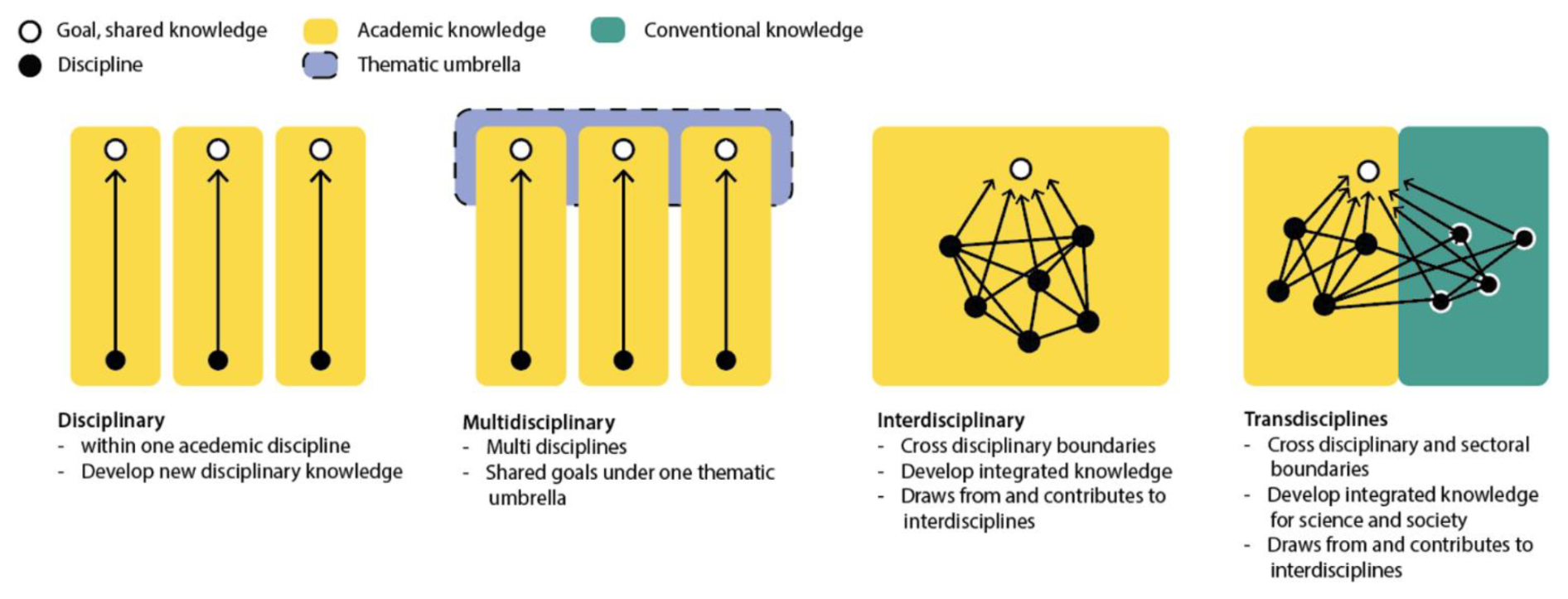
Figure 1Schematic representation of cross-disciplinary research, aiming to produce knowledge that goes beyond the existing disciplines. It regularly draws from and contributes to what can be called “interdisciplines”, which are hybrid fields that emerge around particular issues (e.g. ecohydrology, geomicrobiology, biogeochemistry or hydrogeophysics). While some concepts and definitions remain debated, there is a broad consensus on valuing and integrating knowledge from stakeholders and policymakers. Adapted from Morton et al. (2015) and Tress et al. (2005).
In the past, several initiatives were established to address these fragmented landscapes of disciplines in geoscience by promoting cross-disciplinary research (see Fig. 1) and improving communication between institutions. One such initiative is Geo.X (https://www.geo-x.net/, last access: 1 April 2026), the geoscientific research network in Berlin and Potsdam, a major cluster region of geoscientific research in Germany. Founded in 2010, the network integrates nine university and non-university research institutions: GFZ Helmholtz Centre for Geosciences, Freie Universität Berlin, Technische Universität Berlin, Humboldt-Universität zu Berlin, Universität Potsdam, Potsdam Institute for Climate Impact Research (PIK), the Alfred Wegener Institute Helmholtz Centre for Polar and Marine Research (AWI), DLR German Aerospace Center, and the Museum for Natural History Berlin. The Geo.X partners are committed to close collaboration across research, teaching, and shared infrastructure. The network has a strong focus on early career scientists (ECS), defined as researchers in the early stages of their professional careers who have not yet reached a permanent or fully independent research position. The Geo.X ECS section is a self-governed structure managed by doctoral and postdoctoral researchers (https://www.geo-x.net/ecs/, last access: 1 April 2026; The Research Network for Geosciences in Berlin and Potsdam, 2026a). During a Geo.X ECS science retreat held in October 2022 in Berlin-Schmöckwitz, participants exchanged experiences and perspectives on interdisciplinary research. These discussions uncovered considerable variation in both individual experiences and perceptions of the demands and expectations associated with working across sub-disciplines. This outcome highlighted the need for a broader and more structured overview of interdisciplinary perspectives and practices within the early career research community.
Given the growing emphasis on interdisciplinary research in geosciences, this study aims to understand how ECS perceive its relevance, challenges, and opportunities for their work and career development. We address this aim through an online survey of ECS within the Geo.X network, to answer the following associated questions:
-
How is interdisciplinarity understood by ECS within the Geo.X network?
-
How interdisciplinary are ECS collaborations within and beyond the Geo.X network?
-
Do (Geo.X) ECS work in interdisciplinary ways, and what benefits or challenges do they encounter?
-
What drivers and barriers shape interdisciplinary collaboration among ECS within the Geo.X network?
2.1 Questionnaire
This study is based on survey data collected from ECS within the Geo.X network. The survey was designed to explore how ECS perceive interdisciplinary research in the geosciences and related fields. To ensure meaningful results, a 45-item questionnaire was developed, including multiple-choice, Likert-scale, open-ended, and demographic questions (see Yeste et al., 2026). The questionnaire covered six subject areas: (1) definition of interdisciplinarity (six questions), (2) self-assessment of interdisciplinary collaborations (six questions), (3) scope and thematic entanglement of interdisciplinary work (14 questions), (4) geographical aspects and spatial distribution of collaboration partners (nine questions), (5) demographics (six questions), and (6) the role of the Geo.X network (four questions). Subject area (6) of the survey aimed to provide insights that help to critically reflect the offers and communication of Geo.X and was used exclusively to review internal processes within the network. The survey underwent several internal reviews, was tested within the author group, and was then approved by the Geo.X strategy team. Questions were revised and refined following the Harvard Questionnaire Design Tip Sheet (Harrison, 2007). The final version of the survey on interdisciplinarity was implemented and conducted using LimeSurvey software (Version 6.5, LimeSurvey GmbH) and is provided at GFZ Data Services (Yeste et al., 2026).
The survey was distributed via the Geo.X ECS email list (270 subscribers) and institutional email lists of all partner institutions. A voluntary raffle with a random draw was offered for additional incentives to participate. The survey remained open on LimeSurvey for roughly four and a half months, spanning the spring and summer of 2024. Data collection and processing complied with the German and European General Data Protection Regulation and the privacy and ethics agreement (in accordance with articles 12–14 GDPR) and followed standards at the GFZ Helmholtz Centre for Geosciences. The data privacy statement was developed with the help of the respective data protection officer. Participants were given the option to skip questions or withdraw from the survey at any time. Responses were pseudonymized prior to analysis to ensure participant confidentiality in this survey (see data processing) and potentially identifying questions, such as affiliations, were not publicly analysed and shared.
2.2 Data Processing
Prior to analysis, the survey data underwent several processing steps. A total of 181 participants completed the questionnaire. Responses by participants who had opened the questionnaire, but did not provide any answers were removed beforehand. Additionally, questionnaire responses were filtered by the academic age of the participants, defined as the number of years engaged in active research after attaining a master's degree. To ensure the survey reflected the views of ECS, academic age was used as an operational proxy for career stage. ECS are defined as researchers in the early stages of their professional careers who have not yet reached a permanent or fully independent research position. A maximum academic age of 20 years was set to ensure broad inclusion, based on the distribution of participants (Fig. 2). While the survey was aimed at ECS, some more experienced researchers also completed it. Nonetheless, the distribution was largely concentrated among ECS with an academic age of 0 to 10 years. As master's students do not yet have an academic age, they were not included in Fig. 2. Nonetheless, they were considered ECS, and their responses were incorporated into subsequent analyses. Responses lacking an academic age indication were excluded, resulting in a final dataset of 151 valid responses.
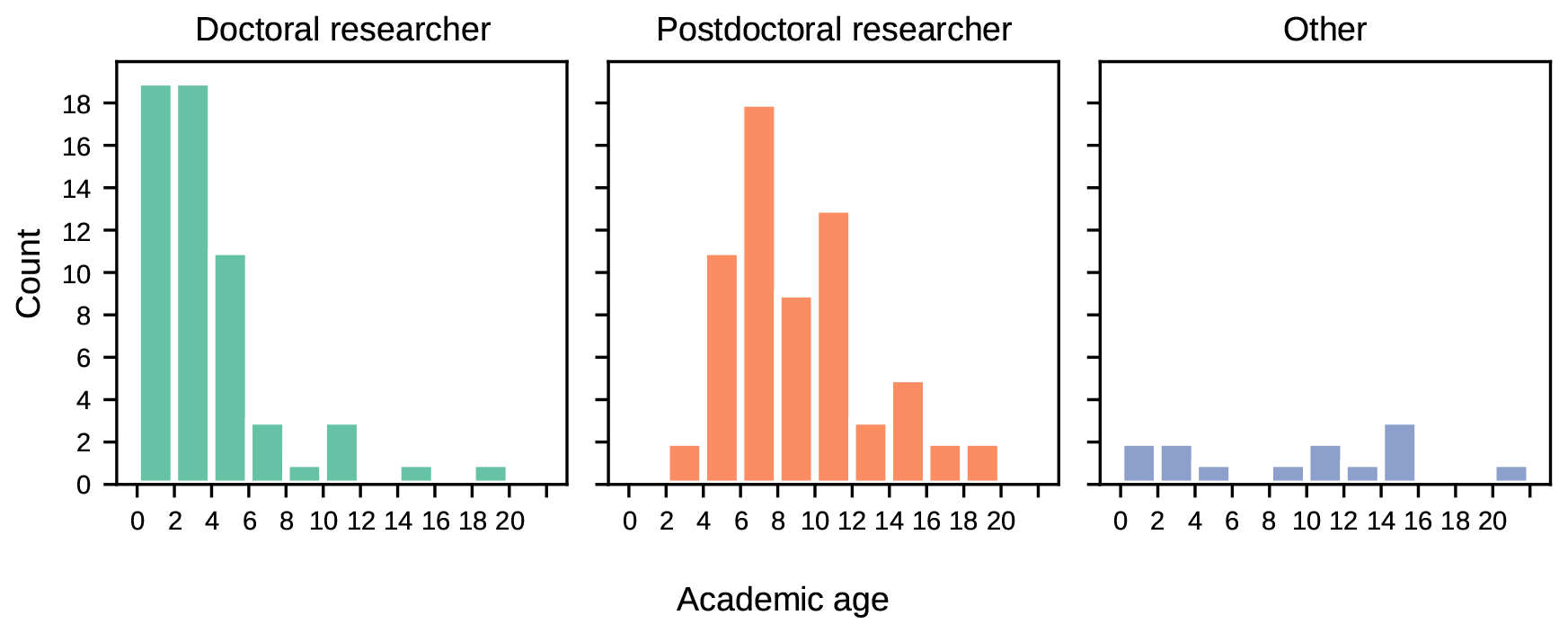
Figure 2Distribution of academic age after discarding outliers (age > 20 years), shown for doctoral researchers (n=58), postdoctoral researchers (n=65), and others (n=13). Note that master's students (15) are not included in this plot as they do not yet have an academic age. The distribution of the academic age is left-skewed, indicating that most of the researchers that participated have been active in academia for less than 10 years. This questionnaire only contained several individuals with a higher academic age (1–3 cases per academic age for ages > 10 years).
Free-text responses to questions concerning the aspects that the participants most strongly associated with interdisciplinarity were manually harmonized into 113 categories to facilitate subsequent analysis (see Yeste et al., 2026). Free-text responses regarding the benefits and disadvantages of interdisciplinarity were not harmonized, as participants could also choose among potential benefits and disadvantages in two closed-ended questions. The survey responses were pseudonymized by separating demographic information from the rest of the questionnaire, including information on the age of the participants, academic age, the type of contract of the researchers, funding resources, and gender.
Data processing was carried out using several Python libraries: data handling was performed with pandas (McKinney, 2011) and visualizations were created using matplotlib (Barrett et al., 2005), plotly (Plotly Technologies Inc., 2024) and Wordcloud (Mueller, 2026). The final dataset of 151 responses as well as all Python scripts developed for this study are accessible via GFZ Data Services (Yeste et al., 2026). Before publication, questions and answers that would potentially allow identification of the participants and that have been included for internal purposes only, were removed.
3.1 Demographics
The survey was completed by a diverse group of participants, capturing perspectives from younger individuals working within academia and research (early career scientists; ECS). The majority of respondents (95 of 151) were aged 25–34, with six aged 18–24, 44 aged 35–44, and six aged 45–54. In terms of academic experience, most participants were in the early stages of their careers, with an academic age of zero to five years since completing their PhD or equivalent qualification (Fig. 2, Doctoral Researchers). A second peak was an academic age of seven and ten years, reflecting the group of postdoctoral researchers (Fig. 2, Postdoctoral Researchers). Employment conditions reflected the current nature of many research positions: 131 out of 137 participants were on fixed-term contracts, while only 6 out of 137 held permanent positions. Funding sources were predominantly external research grants (90 out of 138 responses), while all other participants relied on institutional funding.
The gender distribution among participants showed a higher representation of women (n=95), alongside a smaller proportion of men (n=55) and individuals identifying as non-binary gender (n=5), or no response (n=6). Overall, the survey captured the perspectives of a predominantly early-career, grant-funded academic workforce, offering valuable insights into the demographics and employment conditions characteristic of this group.
3.2 How is interdisciplinarity defined from an ECS perspective?
In the survey, the ECS participants were asked to name up to three aspects that they strongly associated with the term “interdisciplinarity”. This question was open-ended (no predefined response options), yielding 445 individual entries from 144 participants (not all survey respondents answered this item). We subsequently synthesized these entries into 113 distinct aspects. One way to visualize this corpus is a word cloud, where the frequency of the term is reflected by its font size (Fig. 3).

Figure 3A word cloud visualising the aspects that ECS most strongly associated with the term “interdisciplinarity”. Font size is set relative to the number of mentions across all responses.
A small number of terms were mentioned by a comparatively large share of respondents. The most frequent associations were “collaboration” (44 %), “multiple disciplines” (36 %), and “different perspectives” (19 %). Even these leading terms, however, were only considered noteworthy by less than half to a fifth of the group. Further commonly cited aspects included “knowledge transfer” (13 %) and “communication” (10 %). The top 10 also featured “exchange” (9 %), “challenging” (9 %), “multiple methods” (9 %), “new knowledge” (8 %), and “new ideas” (7 %). Beyond these, the responses quickly dispersed into a long tail: many aspects were mentioned by only a small number of participants, and more than half of all aspects were mentioned by a single individual. That “collaboration” and “multiple disciplines” dominate is unsurprising, as both aspects are closely implied by the term interdisciplinarity itself: work across disciplines necessarily involves interactions beyond one's own field. In contrast, terms such as “different perspectives,” “new knowledge”, or “new ideas” are more interpretative, linking interdisciplinarity to core scientific aims and highlighting its perceived added value.
Among all terms mentioned, explicitly negatively associated aspects were very rare (n=2; “low outcome” and “misguided”; each mentioned once). Although potential drawbacks of interdisciplinary research are addressed later in the survey, respondents' spontaneous associations suggest an overall positive framing. At the same time, the pronounced fragmentation of responses indicates that ECS understand and experience interdisciplinarity in highly diverse, and often very individual, ways. The comparatively positive perception may also be influenced by the fact that people who have experience with Geo.X, whose explicit mission is to promote interdisciplinary cooperation between institutions, are more willing to participate in this study than people who have no experience with it.
Based on the word cloud, ECS predominantly associate interdisciplinarity with “collaborations across disciplines”. While the associated terms in the word cloud connect to interdisciplinary, they are conceptually quite broadly spread and do not, in themselves, always clearly distinguish interdisciplinarity from other forms of cross-disciplinary collaboration. Notably, few responses explicitly referred to integration or synthesis of disciplinary perspectives, suggesting that respondents may primarily conceptualize interdisciplinarity in terms of collaboration across fields rather than epistemic integration, often regarded as a defining feature of interdisciplinarity (e.g., Repko and Szostak, 2020). Associations such as “different perspectives”, “knowledge transfer”, “new knowledge”, and “new ideas” may more closely approximate notions of epistemic integration, although they remain unspecific with regard to how such integration would occur.
This ambiguity in perceptions is consistent with previous findings. Cooke et al. (2020) report that researchers engaged in interdisciplinary research hold widely varying views of interdisciplinarity, ranging from considering it a “meaningless academic buzzword” to valuing it as an enrichment of knowledge, relationships, and approaches to problem-solving. Similarly, Schmitt et al. (2023) show that researchers (digital transformation research) often exhibit vague and inconsistent understandings of interdisciplinarity, frequently describing it as co-existent or framed in a multidisciplinary way rather than as deeply integrative. Their qualitative analysis indicates that even actively engaged researchers often lack a clear conceptual distinction between collaboration and epistemic integration, supporting the interpretation that spontaneous associations with interdisciplinarity tend to emphasize interaction rather than synthesis. This diversity of understanding is important, as it can shape how interdisciplinary research is conducted and interpreted (Huutoniemi and Rafols, 2017; Madsen, 2018). This reinforces that, in practice, interdisciplinarity is often experienced as collaborative engagement rather than as integrative knowledge synthesis. Additionally, it also shows that there is a clear need for more training on working interdisciplinarity in research.
3.3 How interdisciplinary are early career scientists collaborating?
To assess the degree of interdisciplinarity among ECS, participants were asked to indicate the scientific fields of their collaborators within interdisciplinary projects. Scientific fields were classified into five broad categories: life sciences, humanities and social sciences, natural sciences, engineering sciences, and other fields. Each category included more specific subject areas: for example, geosciences, physics, chemistry, and mathematics for the scientific field natural sciences. As shown in Fig. 4, a substantial proportion of collaborators were reported to come from outside the respondent's own field, suggesting a broad engagement in interdisciplinary work. Specifically, 55.2 % of natural sciences researchers indicated that their collaborators were from fields outside natural sciences. In the engineering sciences, 67.3 % of participants reported working with collaborators outside their own field. Among humanities and social sciences researchers, 61.4 % indicated collaboration with non-humanities disciplines, while the life sciences showed the highest level of cross-field engagement, with 73.1 % of respondents reporting such collaborations. These results highlight varying levels of interdisciplinary engagement across scientific fields, with life sciences and engineering sciences exhibiting the highest degrees of collaboration beyond their own domain.

Figure 4Sankey diagram visualizing the degree of interdisciplinarity among scientific fields. Note that the ECS participants' own scientific background (fields) are shown on the left and the collaborating scientific fields are shown on the right.
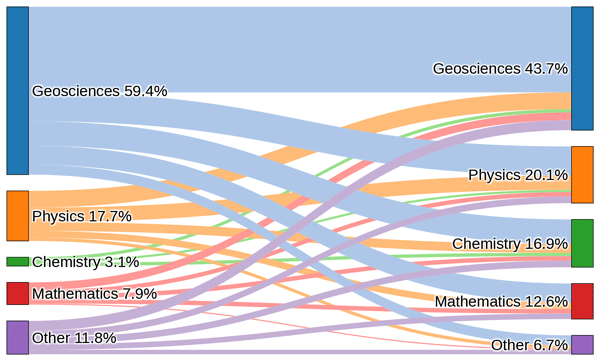
To further explore the nature of interdisciplinary collaboration, participants were also asked to specify the subject areas within each scientific field in which their collaborators work. This allowed us to assess not only interdisciplinarity across fields, but also within fields. Due to its larger sample size, we focus here on the natural sciences, where participants were distributed across four main subject areas: geosciences, physics, mathematics, and chemistry (Fig. 5). A considerable share of respondents reported collaborating with colleagues outside their own subject area. Specifically, 49 % of researchers in geosciences collaborated with scientists in other natural science disciplines. The proportion was higher in other disciplines, with 71.1 % in physics, 80 % in mathematics, and 62.5 % in chemistry. These findings indicate substantial internal interdisciplinarity within the natural sciences, particularly among researchers in mathematics and physics.

Figure 5Sankey diagram visualizing the degree of interdisciplinarity among subject areas within the field of natural sciences. Note that the participants' own subject areas are shown on the left and the collaborating areas are shown on the right.
It should be noted, however, that the distribution of participants across scientific fields and subject areas was uneven. Natural sciences accounted for 58.7 % of all responses, and within this group, 59.4 % were affiliated with geosciences. This overrepresentation was anticipated, as the survey targeted ECS within the Geo.X network. Moreover, it is possible that some respondents interpreted collaboration within the same subject area as interdisciplinary, such as among geoscientists from different subfields (e.g., geophysics and geochemistry). Despite these considerations, the patterns of interdisciplinary collaboration observed within natural sciences were broadly mirrored in the other scientific fields (results not shown), suggesting that the results provide a meaningful basis for assessing interdisciplinarity across the full range of disciplines represented in the survey.
While the present analysis captures the extent of cross-field collaboration, it does not differentiate between multidisciplinary arrangements and fully integrative interdisciplinary collaboration involving conceptual or methodological synthesis (Klein, 2010, 2019). For future work, it would be important to map the type or manner of collaboration (e.g., Hofmann et al., 2025). Future research should, for example, examine the modes and styles of collaboration in greater detail, including the degree of epistemic integration, co-development of methods, and shared problem framing. Another way to look at the nature of collaborations is to look at publications (co-authorship) and evaluate the problem framing and method integration. It is also important to note that fields such as the life sciences frequently operate in large teams (e.g., Gazni et al., 2012; Wuchty et al., 2007), which may partly explain the higher reported rates of cross-field collaboration observed in our survey.
It should also be noted that ECS may have limited autonomy in selecting collaborators, which means that interdisciplinary engagement can often be shaped by external factors. For example, if geoscience ECS are embedded within larger, pre-established scientific projects or consortia (Wuchty et al., 2007; Gazni et al., 2012), our survey results may largely reflect the structural design of these collaborations rather than the ECS's independent initiative. Such arrangements can influence patterns of cross-field engagement, emphasizing the role of project structure in shaping interdisciplinary activity. Greater autonomy in project design, which is more typical for established researchers, may enable more self-directed interdisciplinary collaboration, although this cannot be tested with the present dataset. Additionally, collaboration data were self-reported, so the degree of methodological or conceptual integration may be under- or overestimated, affecting the reported level of interdisciplinarity. Taken together, these factors suggest that the observed patterns of cross-field and cross-subject collaboration reflect both the structure of ECS collaborations and self-reported perceptions, and should be interpreted accordingly. Future work could complement survey data with network analyses, co-authorship mapping, or longitudinal studies to capture both structural and epistemic dimensions of interdisciplinary collaboration.
3.4 Advantages and disadvantages of interdisciplinarity
Interdisciplinary research in geosciences is viewed in a rather positive light by survey participants, with more selecting options from the predefined advantages (488 times) compared to disadvantages (341 times). Survey participants commonly highlighted similar main advantages of interdisciplinary research in the geosciences, although various disadvantages were identified as well (Fig. 6). Over 83 % of respondents identified three main advantages, respectively: (1) productive exchange with researchers from other fields, (2) enhanced capacity for complex problem-solving, and (3) advancing the field with unconventional approaches. Two proposed advantages were less frequently considered as beneficial, with only 21 %–27 % of respondents highlighting them: (1) improved funding opportunities, and (2) effective distribution of the workload. The main disadvantage of interdisciplinarity, selected by 69 % of respondents, was the use of different terminologies across fields. Additionally, about half of the respondents identified two further challenges: (1) differing working speeds between disciplines (48 %), making synchronization difficult, and (2) varying publishing practices (42 %), which complicate finding common ground for publication. Other reported disadvantages included challenges in data management (28 %) and difficulties in selecting suitable journals for publishing results from interdisciplinary research (27 %). One respondent refrained from answering to advantages, compared to nine respondents not answering for disadvantages.

Figure 6Barplot showing the share of agreement to predefined advantages and disadvantages response options among all survey participants, in order of appearance in the survey, as well as the share of survey participants without answers.
Free-form answers for advantages (n=12) mostly mention improved and more creative problem-solving skills, obtaining new perspectives, and mutual benefit. One survey participant mentions that a consistent interpretation from different perspectives leads to more robust and reliable results, while another stresses that the exchange can only sometimes be fruitful. Other free-form responses highlight the advantage of challenging the intellectual mind, and that interdisciplinary research usually poses the most exciting research questions. Free-form answers for disadvantages, on the other hand, were more numerous (n=25) and included various negative perceptions, such as difficulties of communicating across fields leading to lower research efficiency and requiring compromises. Multiple participants state that interdisciplinary research puts additional strain on time management, and express that time is already scarce as an academic. Reluctance to engage in interdisciplinary research may thus partially be a consequence of the increasing “strain on scientific publishing” (Hanson et al., 2024). These views may further be related to other answers regarding the lack of funding opportunities, specifically also for non-academic colleagues. Other concerns include balancing interdisciplinary research without compromising the own specialized research expertise, and more technical disadvantages such as the need to overcome differing authorship conventions, aims, and geographic work locations.
While interdisciplinary research offers intellectual rewards, strategic benefits such as increased funding or workload efficiency appear less salient for ECS, possibly reflecting structural constraints and the early-career stage. Despite the intellectual benefits of interdisciplinary research, ECS often face practical and structural challenges that can limit the effectiveness of cross-field engagement. These include steep learning curves for mastering unfamiliar methodologies or conceptual frameworks, difficulties in coordinating work across disciplines and teams, and reconciling differing publication norms or authorship conventions (Klein, 2010, 2019; MacLeod, 2018; Huutoniemi et al., 2010). These types of barriers can require additional time demand and cognitive load. Our survey data clearly show that intellectual benefits were much more frequently selected than strategic benefits (funding, workload distribution), which aligns with previous research suggesting ECS prioritize learning and knowledge gains over strategic rewards. This agrees with earlier findings by Vantard et al. (2023), who also found that involvement in interdisciplinary projects in many cases starts at the ECS stage. In interdisciplinary projects, ECS can directly benefit from knowledge acquisition, network building, and obtaining collaborative skills (Vladova et al., 2024). Altogether, these results highlight that while interdisciplinary research offers ECS valuable intellectual and collaborative opportunities, structural and practical challenges can limit the efficiency and accessibility of such projects. Future efforts to support ECS in interdisciplinary work may require further investigation into support mechanisms such as training, mentorship, or institutional recognition.
Interdisciplinary research is widely promoted across the geosciences, yet our findings show that it remains unevenly understood and variably practiced among early career scientists (ECS) within the geoscience domain and connecting disciplines. Even when respondents strongly value interdisciplinarity, their definitions and associations span a wide range, suggesting that “interdisciplinarity” functions less as a single, shared concept and more as an umbrella term for different motivations, practices, and expectations. This raises important questions for research policy: to what extent does it remain useful to label work as interdisciplinary, and when does the label become a buzzword that obscures rather than clarifies the underlying scientific and institutional needs? At the same time, many contemporary geoscience challenges are inherently coupled across Earth system components and societal domains, making a strict disciplinary organisation increasingly difficult to sustain. In practice, researchers cannot fully “opt out” of cross-disciplinary interaction; the question is therefore not whether interdisciplinarity is needed, but how it can be enabled without imposing disproportionate costs on individuals, particularly those at early career stages.
A central implication is that enabling interdisciplinary research requires more than incentives to collaborate. It also requires institutions to recognise and reduce the structural disadvantages that ECS experience when working across disciplinary and institutional boundaries. Interdisciplinary projects often demand additional time for coordination, translation across terminologies and methods, and negotiation of publication strategies, which can delay outputs compared to more disciplinary work. Funding schemes and evaluation practices that implicitly reward speed and discipline-specific publication pathways may therefore discourage interdisciplinary engagement, even when it is rhetorically encouraged. One practical lever is to align support structures with the realities of interdisciplinary work: longer project durations, dedicated resources for coordination and facilitation, resources for education on interdisciplinarity and knowledge transfer, and assessment criteria that acknowledge process outputs (e.g., shared protocols, integrated datasets, or co-produced tools) alongside traditional publications.
Furthermore, while many ECS actively expand their methodological and conceptual breadth, interdisciplinarity cannot be reduced to “adding more methods” to one's own work. Effective interdisciplinarity often depends on collaboration, learning how to work with specialists from other fields, integrating different forms of expertise, and developing shared problem framings. This suggests a need for universities and graduate programmes to adapt, not only by offering interdisciplinary content, but by explicitly teaching the theory and practice of interdisciplinary collaboration: communicating across cultures, managing expectations and timelines, and navigating publication and authorship conventions. Examples of structured interdisciplinary teaching formats (e.g., case-based courses, joint problem studios, or cross-departmental training schools) could provide practical models for building these competencies.
Finally, research networks such as Geo.X can function as relevant instruments for enabling interdisciplinarity, particularly when they combine concrete support beyond a single institution, such as cross-institutional and interdisciplinary seed funding, infrastructure access or exchange and networking formats, with effective communication and low-barrier entry points for ECS. For example, in Geo.X approximately 50 % of submissions to the seed funding programme “Grow Your Idea!” come from ECS. In addition, with the “ECS community grant” Geo.X has a specific funding program to support interdisciplinary workshops, exchanges or seminars, providing ECS with several possibilities to connect beyond their institution and discipline on their own terms. Taken together, our findings suggest that the most effective path forward is not simply to call for more interdisciplinarity, but to make it easier to do well: by aligning incentives, timeframes, training, and evaluation with the additional coordination and integration work that interdisciplinary research entails. Supporting ECS in navigating these challenges not only benefits individual career development, but also strengthens the broader scientific ecosystem by ensuring that interdisciplinary projects achieve both intellectual depth and practical impact. Additionally, providing ECS with the opportunity to identify and lead their own training formats, as well as a protected space to experiment with interdisciplinary approaches, further empowers them to navigate and innovate within complex research networks.
All data and code generated in this study are accessible via GFZ Data Services (https://doi.org/10.5880/GFZ.RDOQ.2026.001, Yeste et al., 2026). Before publication, questions and answers that would potentially allow identification of the participants and that have been included for internal purposes only, have been removed.
All authors worked on the conceptualization of the manuscript. Data curation was led by PY and was supported by all co-authors. All authors worked on the analysis of the data and on the methodology of the data. The questionnaire was set up by IW, JH and PE, with support by all co-authors. PY created the scripts for the data analyses with the support of all co-authors. IW and SL led the writing of the original draft and were supported by all co-authors. All authors were responsible for editing and reviewing of the manuscript.
The following authors work for Geo.X: Jonas Kuppler. All authors actively engaged within the Geo.X network.
This study was conducted in accordance with the German and European general data protection regulation and the privacy and ethics regulations of the GFZ Helmholtz Centre for Geosciences. The data protection concept and participant information were prepared with support from the GFZ data protection officer. Participation in the survey was voluntary, and participants could omit individual questions or withdraw from the survey at any time. Survey data were collected and processed solely for the purposes of this study. To protect confidentiality and ensure compliance with applicable data protection regulations, responses were pseudonymised before analysis.
Publisher's note: Copernicus Publications remains neutral with regard to jurisdictional claims made in the text, published maps, institutional affiliations, or any other geographical representation in this paper. The authors bear the ultimate responsibility for providing appropriate place names. Views expressed in the text are those of the authors and do not necessarily reflect the views of the publisher.
We gratefully acknowledge Geo.X, the geoscientific competence network in Berlin and Potsdam (Germany), and its partner institutions for their sustained support of the network and, in particular, for the continued backing of the Geo.X Early Career Scientists (ECS) section. Geo.X integrates the following partner institutions: GFZ Helmholtz Centre for Geosciences; Freie Universität Berlin; Technische Universität Berlin; Humboldt-Universität zu Berlin; Universität Potsdam; Potsdam Institute for Climate Impact Research (PIK); Alfred Wegener Institute, Helmholtz Centre for Polar and Marine Research (AWI); DLR German Aerospace Center; Museum für Naturkunde Berlin; and the Research Institute for Sustainability (RIFS) at GFZ. We also thank all participants of the Geo.X ECS science retreat 2022 for their open discussions and valuable perspectives that helped motivate this study.
The article processing charges for this open-access publication were covered by the Freie Universität Berlin.
This paper was edited by Heather Sangster and reviewed by two anonymous referees.
Acocella, V.: Grand challenges in Earth science: research toward a sustainable environment, Front. Earth Sci., 3, https://doi.org/10.3389/feart.2015.00068, 2015.
Allen, D. C., Cardinale, B. J., and Wynn-Thompson, T.: Toward a Better Integration of Ecological Principles into Ecogeoscience Research, BioScience, 64, 444–454, https://doi.org/10.1093/biosci/biu046, 2014.
Baatz, R., Ghazaryan, G., Hagenlocher, M., Nendel, C., Toreti, A., and Rezaei, E. E.: Drought research priorities, trends, and geographic patterns, Hydrol. Earth Syst. Sci., 29, 1379–1393, https://doi.org/10.5194/hess-29-1379-2025, 2025.
Barrett, P., Hunter, J., Miller, J. T., Hsu, J. C., and Greenfield, P.: matplotlib–A Portable Python Plotting Package, Astr. Soc. P. XIV, 347, 91–95, 2005.
Camps-Valls, G., Fernández-Torres, M.-Á., Cohrs, K.-H., Höhl, A., Castelletti, A., Pacal, A., Robin, C., Martinuzzi, F., Papoutsis, I., Prapas, I., Pérez-Aracil, J., Weigel, K., Gonzalez-Calabuig, M., Reichstein, M., Rabel, M., Giuliani, M., Mahecha, M. D., Popescu, O.-I., Pellicer-Valero, O. J., Ouala, S., Salcedo-Sanz, S., Sippel, S., Kondylatos, S., Happé, T., and Williams, T.: Artificial intelligence for modeling and understanding extreme weather and climate events, Nat. Commun., 16, 1919, https://doi.org/10.1038/s41467-025-56573-8, 2025.
Clark, W. C. and Dickson, N. M.: Sustainability science: The emerging research program, P. Natl. Acad. Sci., 100, 8059–8061, https://doi.org/10.1073/pnas.1231333100, 2003.
Cooke, S. J., Nguyen, V. M., Anastakis, D., et al.: Diverse perspectives on interdisciplinarity from Members of the College of the Royal Society of Canada, FACETS, 5, 138–165, https://doi.org/10.1139/facets-2019-0044, 2020.
Drüke, M., Lucht, W., von Bloh, W., Petri, S., Sakschewski, B., Tobian, A., Loriani, S., Schaphoff, S., Feulner, G., and Thonicke, K.: The long-term impact of transgressing planetary boundaries on biophysical atmosphere–land interactions, Earth Syst. Dynam., 15, 467–483, https://doi.org/10.5194/esd-15-467-2024, 2024.
Fanzo, J., Carducci, B., Louis-Jean, J., Herrero, M., Karl, K., and Rosenzweig, C.: Climate Change, Extreme Weather Events, Food Security, and Nutrition: Evolving Relationships and Critical Challenges, Annu. Rev. Nutr., 45, 335–360, https://doi.org/10.1146/annurev-nutr-111324-111252, 2025.
Foerster, S., Brosinsky, A., Koch, K., and Eckardt, R.: Hyperedu online learning program for hyperspectral remote sensing: Concept, implementation and lessons learned, Int. J. Appl. Earth Obs., 131, 103983, https://doi.org/10.1016/j.jag.2024.103983, 2024.
Gazni, A., Sugimoto, C. R., and Didegah, F.: Mapping world scientific collaboration: Authors, institutions, and countries, J. Am. Soc. Inf. Sci. Tec., 63, 323–335, https://doi.org/10.1002/asi.21688, 2012.
German National Academy of Sciences Leopoldina: Report on Tomorrow's Science. Earth System Science – Discovery, Diagnosis, and Solutions in Times of Global Change, German National Academy of Sciences Leopoldina [Deutsche Akademie der Naturforscher Leopoldina e.V.], https://doi.org/10.26164/leopoldina_03_00591, 2022.
Guo, H.: Big Earth data: A new frontier in Earth and information sciences, Big Earth Data, 1, 4–20, https://doi.org/10.1080/20964471.2017.1403062, 2017.
Hägerstrand, T.: The domain of human geography, in: Directions in geography, Methuen & Co., London, 67–88, https://doi.org/10.4324/9780429273292-4, 2019.
Hanson, M. A., Barreiro, P. G., Crosetto, P., and Brockington, D.: The strain on scientific publishing, Quantitative Science Studies, 5, 823–843, https://doi.org/10.1162/qss_a_00327, 2024.
Harrison, C.: Tip sheet on question wording, Harvard University Program on survey research, 17, https://psr.iq.harvard.edu/sites/g/files/omnuum11131/files/psr/files/PSRQuestionnaireTipSheet_0.pdf (last access: 1 April 2026), 2007.
Hauer, M. E., Fussell, E., Mueller, V., Burkett, M., Call, M., Abel, K., McLeman, R., and Wrathall, D.: Sea-level rise and human migration, Nat. Rev. Earth Environ., 1, 28–39, https://doi.org/10.1038/s43017-019-0002-9, 2020.
Hofmann, B., Reber, U., Ammann, P., Dötzer, J., Mark, J., McCallum, C., Wiget, M., and Zachmann, L.: A typology of interdisciplinary collaborations: insights from agri-food transformation research, Sustain. Sci., 20, 1791–1808, https://doi.org/10.1007/s11625-025-01702-x, 2025.
Honeybun-Arnolda, E.: Science in the trading zone: interdisciplinarity and the “environment”, Sociology Lens, 36, 414–428, 2023.
Huutoniemi, K., Klein, J. T., Bruun, H., and Hukkinen, J.: Analyzing interdisciplinarity: Typology and indicators, Res. Policy, 39, 79–88, https://doi.org/10.1016/j.respol.2009.09.011, 2010.
Huutoniemi, K. I. and Rafols, I.: Interdisciplinarity in research evaluation, in: The Oxford Handbook of Interdisciplinarity, edited by: Frodeman, R., Klein, J. T., and Pacheco, R. C. D. S., 2nd edn., 498–512, Oxford University Press, https://doi.org/10.1093/oxfordhb/9780198733522.013.40, 2017.
Jones, P., Selby, D., and Sterling, S.: More than the sum of their parts? Interdisciplinarity and sustainability, in: Sustainability education, Routledge, 17–37, ISBN 978-1-84407-877-6, 2010.
Kim, R. E. and Kotzé, L. J.: Planetary boundaries at the intersection of Earth system law, science and governance: A state-of-the-art review, Review of European, Comparative & International Environmental Law, 30, 3–15, https://doi.org/10.1111/reel.12383, 2021.
Klein, J. T.: A taxonomy of interdisciplinarity, The Oxford handbook of interdisciplinarity, Oxford University Press, 15, ISBN 9780199643967, 2010.
Klein, J. T.: Interdisciplinarity, Oxford University Press, https://doi.org/10.1093/acrefore/9780190201098.013.988, 2019.
Kleinhans, M. G.: Down to Earth: History and philosophy of geoscience in practice for undergraduate education, Eur. J. Philos. Sci., 11, 81, https://doi.org/10.1007/s13194-021-00402-4, 2021.
Kothari, D. P., Ranjan, R., and Singal, K.: Renewable energy sources and emerging technologies, PHI Learning Pvt. Ltd. (Prentice Hall of India Learning), ISBN 9789389347890, 2021.
Lyall, C., Bruce, A., Marsden, W., and Meagher, L.: The role of funding agencies in creating interdisciplinary knowledge, Sci. Publ. Policy, 40, 62–71, https://doi.org/10.1093/scipol/scs121, 2013.
MacLeod, M.: What makes interdisciplinarity difficult? Some consequences of domain specificity in interdisciplinary practice, Synthese, 195, 697–720, https://doi.org/10.1007/s11229-016-1236-4, 2018.
Madsen, D.: Epistemological or Political? Unpacking Ambiguities in the Field of Interdisciplinarity Studies, Minerva, 56, 453–477, https://doi.org/10.1007/s11024-018-9353-5, 2018.
McKinney, W.: Pandas: a foundational Python library for data analysis and statistics, Python for high performance and scientific computing, Taylor and Francis, 1–9, https://doi.org/10.1080/09537287.2024.2320790, 2011.
Morton, L. W., Eigenbrode, S. D., and Martin, T. A.: Architectures of adaptive integration in large collaborative projects, Ecol. Soc., 20, https://doi.org/10.5751/ES-07788-200405, 2015.
Mueller, A. C.: Wordcloud, Zenodo, https://doi.org/10.5281/zenodo.18332568, 2026.
Orion, N.: The future challenge of Earth science education research, Disciplinary and Interdisciplinary Science Education Research, 1, 3, https://doi.org/10.1186/s43031-019-0003-z, 2019.
Orion, N. and Libarkin, J.: Earth Science Education, Routledge, 692–716, https://doi.org/10.4324/9780367855758-26, 2023.
Pennington, D., Ebert-Uphoff, I., Freed, N., Martin, J., and Pierce, S.: Bridging sustainability science, earth science, and data science through interdisciplinary education, Sustain. Sci., 15, https://doi.org/10.1007/s11625-019-00735-3, 2020.
Plotly Technologies Inc.: Plotly PY, Zenodo, https://doi.org/10.5281/zenodo.14503524, 2024.
Prăvălie, R.: Exploring the multiple land degradation pathways across the planet, Earth-Sci. Rev., 220, 103689, https://doi.org/10.1016/j.earscirev.2021.103689, 2021.
Repko, A. F. and Szostak, R.: Interdisciplinary research: Process and theory, Sage publications, ISBN 978-1544398600, 2020.
Schellnhuber, H.-J. and Wenzel, V.: Earth system analysis: Integrating science for sustainability, Springer Science & Business Media, https://doi.org/10.1007/978-3-642-52354-0, 2012.
Schmitt, J. B., Goldmann, A., Simon, S. T., and Bieber, C.: Conception and Interpretation of Interdisciplinarity in Research Practice: Findings from Group Discussions in the Emerging Field of Digital Transformation, Minerva, 61, 199–220, https://doi.org/10.1007/s11024-023-09489-w, 2023.
Steffen, W., Richardson, K., Rockström, J., Schellnhuber, H., Dube, O. P., Dutreuil, S., Lenton, T., and Lubchenco, J.: The emergence and evolution of Earth System Science, Nat. Rev. Earth Environ., 1, 54–63, https://doi.org/10.1038/s43017-019-0005-6, 2020.
Sun, Y., Livan, G., Ma, A., and Latora, V.: Interdisciplinary researchers attain better long-term funding performance, Commun. Phys., 4, 263, https://doi.org/10.1038/s42005-021-00769-z, 2021.
Teichler, U.: Teaching and Research in Germany: Narrowing the Gaps between Institutional Types and Staff Categories?, Research Institute for Higher Education (RIHE), Hiroshima University, 41–60, ISBN 978-4-9028-0860-5, 2010.
The Research Network for Geosciences in Berlin and Potsdam: Geo.X Early Career Scientists (ECS) Section, https://www.geo-x.net/ecs/ (last access: 27 January 2026), 2026a.
Thomas, J. A., Williams, M., and Zalasiewicz, J.: The anthropocene: A multidisciplinary approach, John Wiley & Sons, ISBN 978-1-5095-3460-9, 2020.
Tress, G., Tress, B., and Fry, G.: Clarifying Integrative Research Concepts in Landscape Ecology, Landscape Ecol., 20, 479–493, https://doi.org/10.1007/s10980-004-3290-4, 2005.
Tress, G., Tress, B., and Fry, G.: Analysis of the barriers to integration in landscape research projects, Land Use Policy, 24, 374–385, https://doi.org/10.1016/j.landusepol.2006.05.001, 2007.
Vantard, M., Galland, C., and Knoop, M.: Interdisciplinary research: Motivations and challenges for researcher careers, Quantitative Science Studies, 4, 711–727, https://doi.org/10.1162/qss_a_00265, 2023.
Vladova, G., Haase, J., and Friesike, S.: Why, with whom, and how to conduct interdisciplinary research? A review from a researcher's perspective, Sci. Publ. Policy, 52, 165–180, https://doi.org/10.1093/scipol/scae070, 2024.
Wuchty, S., Jones, B. F., and Uzzi, B.: The Increasing Dominance of Teams in Production of Knowledge, Science, 316, 1036–1039, https://doi.org/10.1126/science.1136099, 2007.
Yeste, P., Wiekenkamp, I., van Schijndel, V., Hardt , J., Kuppler, J., Glückler, R., Baisheva, I., Einhäupl, P., Scicchitano, M. R., and Lisovski, S.: Survey Data and Code on Interdisciplinary Research in Geosciences for Early Career Scientists, GFZ Data Services [data set, code], https://doi.org/10.5880/GFZ.RDOQ.2026.001, 2026.