the Creative Commons Attribution 4.0 License.
the Creative Commons Attribution 4.0 License.
 | 26 Aug 2026
Between expertise and engagement: a qualitative study of Namibian geoscientists' views, attitudes, motivations, and objectives regarding public engagement with science
Josephine Naambo Uushona
Marina Joubert
Geoscientists are increasingly expected to engage with society on issues such as mining, groundwater management, energy transitions, and environmental sustainability, yet public engagement in the geosciences remains limited. This is largely due to reliance on one-way communication models and the tendency for geoscientists to communicate primarily within their own discipline. Drawing on qualitative interviews with Namibian geoscientists from government, industry, and academia, this study examines how geoscientists understand public engagement, how they perceive public audiences, and what motivates or constrains their participation. The findings reveal a strong reliance on deficit-model assumptions, including the belief that public resistance to geoscientific issues stems mainly from a lack of knowledge and that education plays a central role in fostering public trust and support. While participants expressed positive attitudes toward public engagement and confidence in their communication abilities, engagement was largely framed as informing and educating rather than listening, collaboration, or shared knowledge production. Structural barriers, including limited institutional support, lack of training, time constraints, and minimal incentives, further restrict meaningful engagement. At the same time, the study identifies emerging recognition of the importance of trust-building, mutual learning, and community involvement, particularly in contexts affected by resource extraction. The study argues that strengthening the role of geoscience in Namibian society requires moving beyond deficit-based communication toward dialogic, context-sensitive, and participatory engagement approaches.
- Article
(394 KB) - Full-text XML
- BibTeX
- EndNote


1.1 The Namibian context
Namibia, a country in southwestern Africa with a population of about 3 million people, features an ancient geological landscape that includes some of the oldest rocks on Earth and abundant mineral resources. The nation is one of the leading producers of uranium and has significant deposits of diamonds, gold, zinc, copper, and rare earth elements. Since mining is a vital part of Namibia's economy, contributing significantly to its GDP, export earnings, and employment, geosciences play an essential role in guiding mineral exploration, land-use planning, water resource management, and sustainable development. Together, the mining and geoscience sectors are crucial in driving economic growth, attracting foreign investment, and supporting infrastructure development, making them vital to Namibia's socio-economic progress. Despite the country's rich geological heritage and the vital role geoscience plays in national development, public engagement in geoscience remains limited.
Historically, Namibian geology was developed within a colonial extractivist framework in which Indigenous peoples were often regarded either as collaborators to be controlled or exploited, rather than as knowledge holders or rights-bearing stakeholders. Historical expeditions relied heavily on local guides for survival and for identifying mineral occurrences such as copper outcrops, yet many geologists simultaneously promoted racial and cultural prejudices that shaped how subsequent geologists engaged with these communities. This legacy has continued to influence the trajectory of geoscientific research and the relationships between scientific institutions and local communities (Hearth, 2024).
1.2 Increased calls for scientists around the world to engage with society
As science drives important discoveries and enhances economic growth, scientists worldwide are increasingly expected to communicate their research to the public and engage in public dialogue about their work, as well as its societal applications and policy-relevant implications, aligning with global trends towards science becoming more open and socially responsive (Besley et al., 2016; Scheufele, 2014; Thai et al., 2023). Consequently, many science policies and funding agreements now require scientists to incorporate public engagement activities into their research – a shift recognising that effective communication, societal dialogue, and collaboration between scientists and the public are vital for fostering and maintaining a mutually beneficial relationship between science and society (Weingart et al., 2021).
1.3 Public engagement in the geosciences
Public engagement in geosciences covers a wide range of activities that enable geoscientists to interact with individuals, communities, and societal stakeholders outside academic environments to share knowledge, discuss the implications of geoscientific research, and collaboratively explore solutions to societal issues such as climate change, natural hazards, groundwater management and mining (Illingworth, 2023). Importantly, these activities extend beyond merely sharing facts to include dialogue, listening to public concerns, meaningful participation, co-production of knowledge, and public involvement in decision-making processes. For effective public engagement in geosciences, careful planning and thorough evaluation are essential, supported by current insights from social science research and appropriate training for scientists and science communicators involved (Hillier et al., 2021).
Geoscience has traditionally operated as an isolated discipline, with communication primarily within the professional community and little outreach to the wider public (Illingworth, 2023). As a result, geoscientists have faced criticism for their insufficient or ineffective efforts to make geoscience visible, accessible, and relevant to society and science policy (Broome, 2005; Gani et al., 2024; Liverman and Jaramillo, 2011). A related challenge is the dominance of one-way, deficit-style communication that presumes the public lacks knowledge and concentrates on “informing” rather than fostering dialogue and participatory processes in science communication (Rodrigues et al., 2025).
However, while geoscientists recognise the importance of public communication and engagement, they often lack the skills, resources, and structured strategies to participate effectively (Liverman and Jaramillo, 2011). Although there has been extensive research on science communication practices among geneticists, nanoscientists, astronomers, and climate scientists, geoscience communication in particular remains a developing field, and we have limited evidence about geoscientists' communication and engagement behaviours (Rodrigues et al., 2023).
Recent global challenges have heightened the need for geoscientists to move beyond academic silos and actively collaborate with key societal stakeholders, such as policymakers, journalists, and advocacy groups. They are encouraged to ensure that geoscience becomes visible, relevant, and influential in guiding sustainable futures (Rodrigues et al., 2023). Issues like energy transitions, groundwater management, climate change, natural disasters, urban planning, and conservation directly impact communities worldwide, highlighting the importance of communicating geoscientific information clearly and convincingly, and integrating it into decision-making processes.
1.4 Public engagement with geosciences in Namibia
A UNESCO report from 2024 shows that, in Namibia, the gap between geoscientists and the public is evident (UNESCO, 2024), with a lack of institutional support, outreach programmes, funding, and incentives adding to low public understanding of geosciences. Although the National Commission on Research, Science and Technology (NCRST) is mandated under the Research, Science and Technology Act (2004) to advance science, technology, and innovation (STI), there is limited emphasis on public engagement as a requirement of publicly funded research. Also, research funders in Namibia do not currently mandate or incentivise public engagement activities, unlike South Africa's National Research Foundation (NRF), which has integrated public participation into its funding criteria and strategic objectives (Riley et al., 2022). Consequently, despite geoscientists playing a vital role in Namibian society through resource management, geohazard assessment, energy production, water management, and environmental policy development, their communication efforts are largely confined to technical circles and peers, with limited outreach to the public (Mocke and Mhopjeni, 2020).
1.5 Study rationale
Understanding how Namibian geoscientists perceive public engagement, as well as the factors that shape their participation, is essential for developing future policies and support structures that foster effective, mutually beneficial dialogue between science and society. This will not only make geoscientific knowledge more accessible to the public but also facilitate crucial public input into policymaking, environmental management, and sustainable development initiatives, ensuring that public concerns are addressed while also helping scientists align their research with society's needs and priorities.
Below, we provide a concise literature background related to the research questions that guided this study.
2.1 Scientists' views of public audiences
Scientists' perceptions of the priority audiences they should engage with, as well as their views about how much people know about science and how interested they are in learning more about their field of research, influence their willingness to engage in public engagement (Besley et al., 2013; Dudo and Besley, 2016). Public discourse about geoscience may be limited, as geoscientists generally perceive their work as complex, inaccessible, and culturally distant (Liverman and Jaramillo, 2011; Stewart and Lewis, 2017). For their part, Namibians are mostly unfamiliar with the role of geosciences in everyday life and generally perceive the topic as abstract, technical, and only relevant to specialists (Mocke and Mhopjeni, 2020). Importantly, the perceived view that the public is uninformed may lead scientists to assume that public resistance to geoscientific projects such as fracking, radioactive waste disposal, and carbon storage stems from a lack of understanding, rather than from social, emotional, or cultural concerns. Consequently, they assume that addressing this knowledge gap will result in increased public acceptance and support (Siipi and Marko, 2011; Stewart and Lewis, 2017).
2.2 Scientists' views of public engagement
Many scientists communicate about their work as a goodwill gesture to educate the public, rather than as a genuine attempt to foster dialogue (Rodrigues et al., 2023; Thai et al., 2023). This means they rely on the so-called “deficit model” of science communication, assuming that public misunderstandings arise from a lack of scientific knowledge and that they can solve this problem by providing information (Besley et al., 2013; Siipi and Marko, 2011). However, while scientists need to provide information to public audiences, having more knowledge does not necessarily translate to greater public support. Instead, values, worldviews, and trust may play a more important role in shaping attitudes (Kahan, 2010; Scheufele, 2013). Furthermore, in Global South contexts, scientists' perceptions of publics are often shaped by socio-economic inequalities, historical marginalisation, and varying levels of public trust in science, scientists and scientific institutions, including concerns about transparency and the unequal distribution of the benefits of science (South African Department of Science and Innovation, 2024; Tindana et al., 2015; Van Lill et al., 2026). Therefore, Illingworth (2023) calls on geoscientists to adopt trust-building engagement methods that focus on interaction, dialogue, and participation, and that recognise the value of local and indigenous knowledge. Asking scientists how they define public engagement offers insight into their perceptions of these activities. It helps us understand whether they see it mainly as a one-way flow of information to educate the public or whether they also recognise the importance of dialogue, listening to the public, and public participation in science.
2.3 Scientists' attitudes towards public engagement
Scientists generally have a positive attitude towards public engagement and may even enjoy participating in engagement activities (Besley et al., 2018b; Yuan et al., 2019). Around the world, most scientists agree that they should communicate with the public and play an active role in science in policymaking and societal dialogue (Cologna et al., 2025). Those who support public engagement, whether in terms of its overall value, perceived rewards, or a feeling of moral responsibility, are more likely to participate (Yuan et al., 2019). Around the world, however, scholars have highlighted that deficit-oriented approaches (one-way and top-down communication) remain common despite growing emphasis on dialogue and participation, for example in this study from Latin America by Massarani and Moreira (2016). Therefore, we wanted to explore the attitudes of Namibian geoscientists towards public engagement and gain insight about how they perceive its value to citizens and themselves.
2.4 Scientists' motivations to participate in public engagement
As discussed above, scientists generally agree that they have a responsibility to communicate and engage with society. However, scientists may also be driven by other motives to engage with society, such as enhancing their reputations and attracting funding through increased media visibility (Massarani and Peters, 2016). Additionally, there may be country-specific factors that influence or restrict scientists' involvement in public engagement with science. For example, Joubert (2018) demonstrated that scientists' engagement with the public in South Africa is influenced by specific historical, political, cultural, and socio-economic factors, with motivations including a desire to give back to society, improve people's lives and correct historical imbalances. Comparative studies including African and Latin American scientists suggest that positive attitudes toward engagement are widespread but often coexist with uncertainty about professional roles and expectations (Entradas et al., 2020; Gavhi-Molefe et al., 2021; Riley et al., 2022). Furthermore, in African and Latin American contexts, scientists' motivations for engaging with public audiences often extend beyond knowledge sharing to include social justice, redressing inequalities, and contributing to national development, focusing on the role of scientists in policy, democracy, and social justice (Aguirre Ríos and de Régules, 2022; Rasekoala, 2022).
2.5 Scientists' objectives when participating in public engagement
The primary goal of scientists conducting public engagement activities is often to inform and educate the public, particularly policymakers and political leaders, about scientific facts and principles to correct what they perceive to be widespread misinformation (Ivani and Novaes, 2022). Many scientists believe that the public's lack of scientific knowledge contributes to poor decision-making, resistance to scientific advances, and exposure to misleading information or fear-based reactions (Bucchi and Trench, 2016, p. 155). This view has led to concerns about “knowledge gaps”, where scientists see it as their responsibility to fill these gaps through education and outreach, with the goal of promoting more rational, evidence-based attitudes toward science among citizens and decision-makers and defending science from misinformation (Besley et al., 2018b; Dudo and Besley, 2016).
2.6 Scientists' confidence in participating in public engagement
Scientists' perceptions of their (own) communication skills influence their intention and willingness to engage with public groups (Poliakoff and Webb, 2007; Dunwoody et al., 2009). While most scientists are confident in their communication skills, a lack of communication skills and training has been proven to be a barrier to participation in public engagement (Mathews et al., 2005; Poliakoff and Webb, 2007; Swords et al., 2023). In an African context, many university-based scientists report a significant gap in self-perceived skills and confidence regarding public communication and a general lack of experience and opportunities in public engagement (Joubert et al., 2016), but scientists often possess latent capacities (e.g., multilingualism) that are often underutilised due to limited institutional support and training (Parker and Gastrow, 2026).
2.7 Challenges and barriers that constrain scientists' involvement in public engagement
Scientists may find public engagement challenging due to barriers such as a lack of time, training, institutional support, and concerns about the misinterpretation of scientific information (Besley et al., 2018a; Donnelly, 2008; Karikari and Yawson, 2017; Murunga et al., 2022; Stewart and Lewis, 2017; Thai et al., 2023). These barriers are especially apparent in fields such as geoscience, engineering, and mathematics, which, unlike disciplines like genetics, nanoscience, astronomy, biology, climate science, or marine science, lack a long tradition of public engagement (Rodrigues et al., 2023). Researchers in these latter fields tend to engage more frequently with the public, mainly because their work has immediate and tangible societal impacts (Rodrigues et al., 2023). Notably, Entradas and Bauer (2019) found that astronomers are more active in public communication and engagement compared to scientists in other fields, and that they are motivated by personal factors and contextual influences, such as institutional support and national culture, to engage with society.
Recent Southern African studies highlight persistent challenges to participatory and engaged research, despite growing policy support. Analyses of engaged research in South Africa point to enduring power asymmetries between universities and communities, misalignment between short-term funding cycles and the long-term relational work required for meaningful participation, and limited institutional recognition of engaged research practices (Khumalo et al., 2026). These structural constraints are echoed by emerging researchers, who report difficulties in building trust, navigating positionality and sustaining community relationships in contexts shaped by historical inequalities and limited mentoring or institutional support (James et al., 2025). Together, these findings suggest that participatory intentions may be undermined by uneven power-sharing and insufficient structural support, risking the reproduction of extractive dynamics in practice.
Furthermore, in terms of geosciences as a research field, the work of geoscientists is often field-based and highly technical, focusing on abstract topics that are difficult to relate to everyday life (Rodrigues et al., 2023). Additional challenges for Namibian geoscientists include geography, language barriers, cultural and historical factors (Mocke and Mhopjeni, 2020). These authors explain that Namibia's vast landscape makes it challenging to reach rural, under-resourced communities, where geoscience information is often most urgently needed, particularly on topics such as groundwater, mining impacts, and land degradation. Additionally, English is the dominant language of geoscience, but local populations may struggle to understand materials presented to them in English. Namibia's colonial history and post-independence inequalities have shaped mistrust of state institutions and technocratic knowledge, especially in communities affected by extractive industries. Finally, some geoscientists may avoid public engagement due to concerns about entering politically sensitive debates (e.g., those related to land use, mining rights, or environmental justice).
Institutional policies significantly influence how scientists, including geoscientists, engage with the public. Although many scientific institutions promote and support science communication and public engagement, these activities are still not considered vital parts of scientific careers. It lacks proper support, incentives and recognition, constraining scientists' participation (Neresini and Bucchi, 2011). Other barriers stem from issues related to time and funding that may be allocated to public engagement (Donnelly, 2008; Stewart and Lewis, 2017; Thai et al., 2023).
While much of the existing literature on scientists' public engagement originates from Europe and North America, a growing body of work from Africa, Latin America, and Asia (as cited above) highlights how engagement is shaped by distinct socio-political, cultural, and institutional contexts. These studies point to the importance of considering historical inequalities, development priorities, and diverse knowledge systems when analysing science–society interactions. This study contributes to this expanding Global South scholarship by providing empirical insights from Namibia.
Based on the factors discussed above that affect scientists' public communication and engagement behaviour, we posed the following research questions:
-
How do Namibian geoscientists view the public? (RQ1)
-
How do Namibian geoscientists view (or define) public engagement with science? (RQ2)
-
What are the attitudes of Namibian geoscientists towards public engagement with science? (RQ3)
-
What motivates Namibian geoscientists to participate in public engagement? (RQ4)
-
What objectives do Namibian geoscientists have in mind when they engage with public audiences? (RQ5)
-
How confident are Namibian geoscientists when it comes to public engagement with science? (RQ6)
-
What barriers or challenges affect the involvement of Namibian geoscientists in public engagement? (RQ7)
This study utilised a qualitative research approach, employing semi-structured interviews as the primary data collection method. Since this is the first in-depth exploration of this topic in the Namibian context, the use of open-ended questions provided greater flexibility to capture participants' experiences, thoughts, and feelings (Hyman and Sierra, 2016; Weller et al., 2018).
4.1 Data collection and analysis
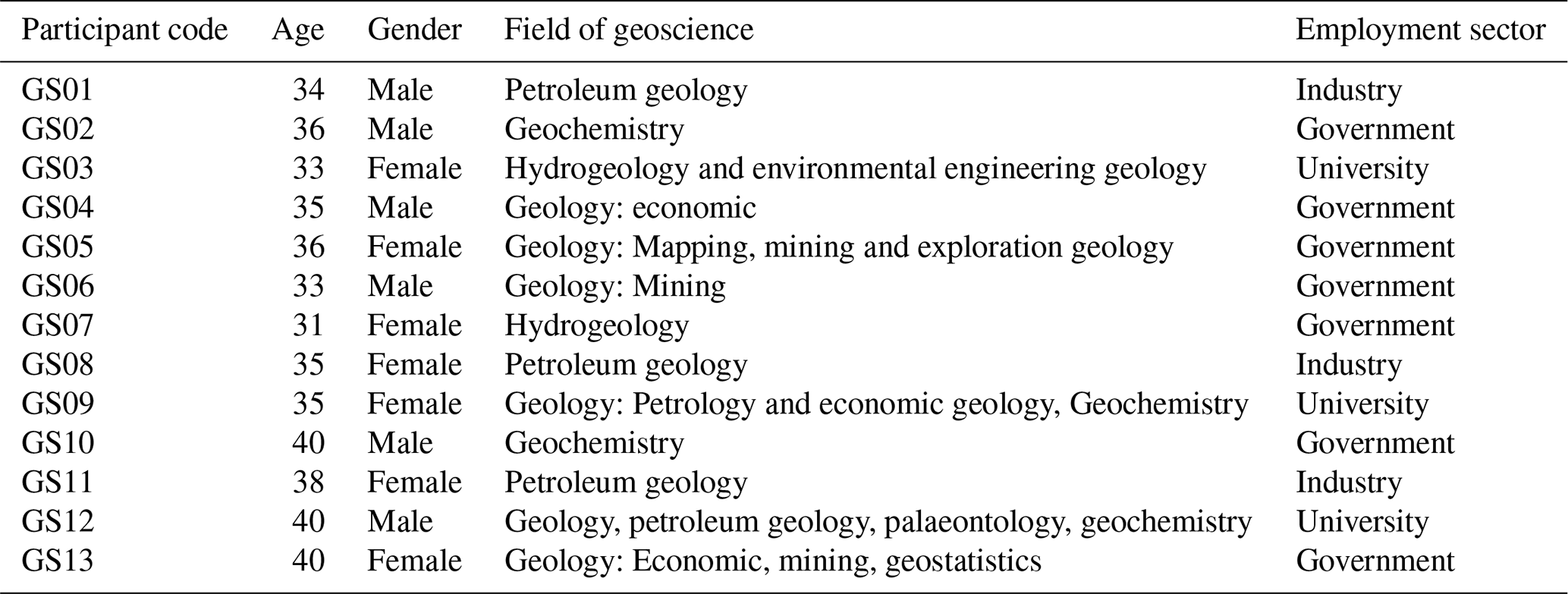
A total of 25 geoscientists were invited to participate in the study, of whom 13 (aged 30–40 years) agreed to take part. The participants came from various geoscience disciplines, including exploration geology, economic geology, hydrogeology, petroleum geology, palaeontology, geochemistry, geological mapping, and academic research. To protect their anonymity, each participant was assigned a unique identifier (or code), labelled from (GS01) to (GS13). Table 1 provides details of all 13 participants, including their age, gender, geoscience field, and employment sector.
Participants were initially contacted by email or telephone to obtain their consent to participate in the study. The interviews took place between August and October 2023. Of the 13 interviews, 10 were held face-to-face in office environments and recorded with participants' permission, while the other three were conducted and recorded via Zoom.
Table 1Participants' information in terms of age, gender, geoscience field, career stage and employment sector.
All interviews were transcribed and analysed using ATLAS.ti software to organise, retrieve, and interpret the qualitative data effectively, guided by the seven research questions and using an inductive coding approach. Only one researcher (the lead author of this paper) was involved in the coding, but the authors met several times to discuss the data and resolve any uncertainties.
Below, we present our findings for each research question, along with illustrative quotes from participants.
5.1 Namibian geoscientists' views of the public (RQ1)
When asked to define “the public” in the context of public engagement, most respondents offered broad interpretations, referring to the general population as “everyone in society” or “people on the street”, while others described the public as individuals within their networks, such as family members and neighbours. Notably, some participants characterised the public as stakeholders or sectors with whom they interact regularly and whom they consider most relevant to their work. For instance, hydrogeologists identified farmers, local authorities, and municipalities as key audiences, whereas petroleum geoscientists highlighted the energy and mining sectors. Similarly, mining geoscientists pointed to mineral investors, small-scale miners, and farmers as priority groups for engagement.
Participants largely agreed that most people have a basic understanding of science but need further education to participate effectively in geoscientific discussions. For instance, one participant noted that the perception that public audiences would not be able to understand the science hampers participation in public engagement.
I believe scientists often think that the general public will not understand actual science other than its products, thus they do not participate in engagement activities. (GS02)
Therefore, the Namibian geoscientists who participated in this study view public education as a necessary prerequisite for meaningful public engagement and input.
5.2 Namibian geoscientists' definition of public engagement with science (RQ2)
The most common definition of public engagement among participants was about informing and educating, with five participants specifically describing it in this way. Four participants described public engagement as a way to promote public awareness about the importance and benefits of research, as well as to provide a forum for scientists to explain scientific topics effectively. Only two participants offered definitions that incorporated the dialogic aspect of the public engagement model.
Public engagement is an effective way for scientists to simplify complex scientific topics, allowing the general people to comprehend and participate in science discourse. (GS01)
5.3 Attitudes of Namibian geoscientists towards public engagement with science (RQ3)
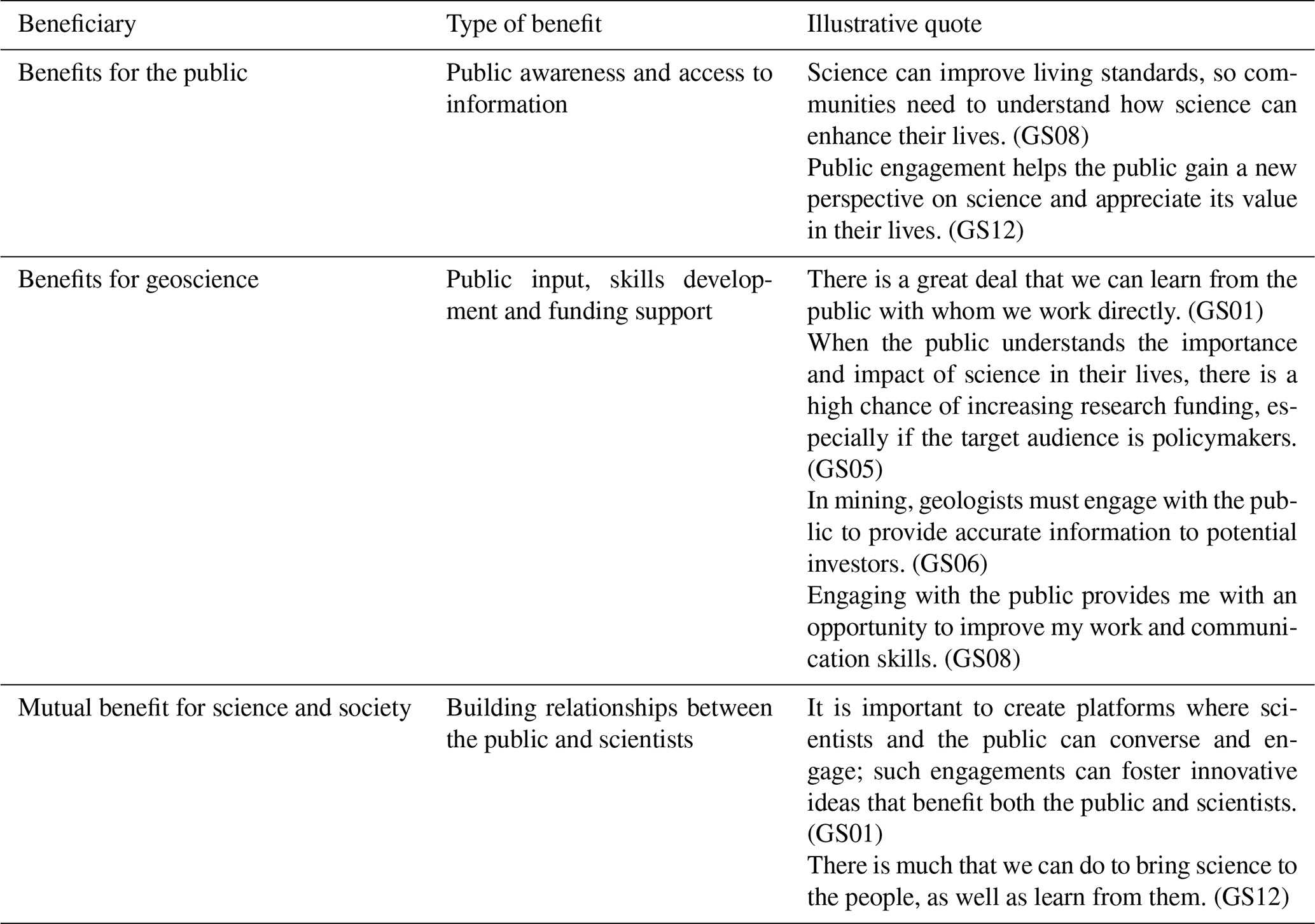
Most participants agreed that it was important for geoscientists to engage proactively with society and expressed a desire to increase their involvement. They viewed public engagement positively, describing it as an enjoyable activity that could provide specific benefits for the public, as well as for science and scientists.
Table 2 offers an overview of the perceived benefits of public engagement with science as described by participants.
Table 2Perceived benefits of public engagement as described by participants.
Although there was a shared view that public engagement can benefit science and society, one participant felt that geoscience is among the least understood scientific disciplines and thus requires strategic and deliberate public engagement. At least one participant spoke about geoscientists' reluctance to participate in public engagement unless explicitly directed by supervisors.
Geoscientists are not forthcoming, and not willing to participate … even when they do, it is done reluctantly. (GS02)
5.4 Motivations for Namibian geoscientists to participate in public engagement (RQ4)
Generally, participants acknowledged that geoscientific research influences people's lives, particularly in mining and its environmental impacts, leading to various motivations for public engagement. These included a wish to fill knowledge gaps, combat misinformation, give back to society, and support community development. Importantly, they recognised the responsibility of geoscientists to inform communities about both the positive and (potentially) adverse effects of geological activities.
It is the responsibility of geoscientists to inform communities about the impact of mining on the environment, to present both sides of the story. If not us, who? (GS02)
Three participants described public engagement as a personal duty, expressing a strong sense of responsibility to inform the public about the value and relevance of geoscience. One participant emphasised a commitment to inspiring young people to pursue careers in science, particularly in geoscience.
It is the duty of geoscientists to contribute to community development. We can inspire children and the youth to take up science as a career path, and our participation is especially impactful for those who may not have encountered a geoscientist who looks like them. (GS01)
5.5 Namibian geoscientists' objectives concerning public engagement (RQ5)
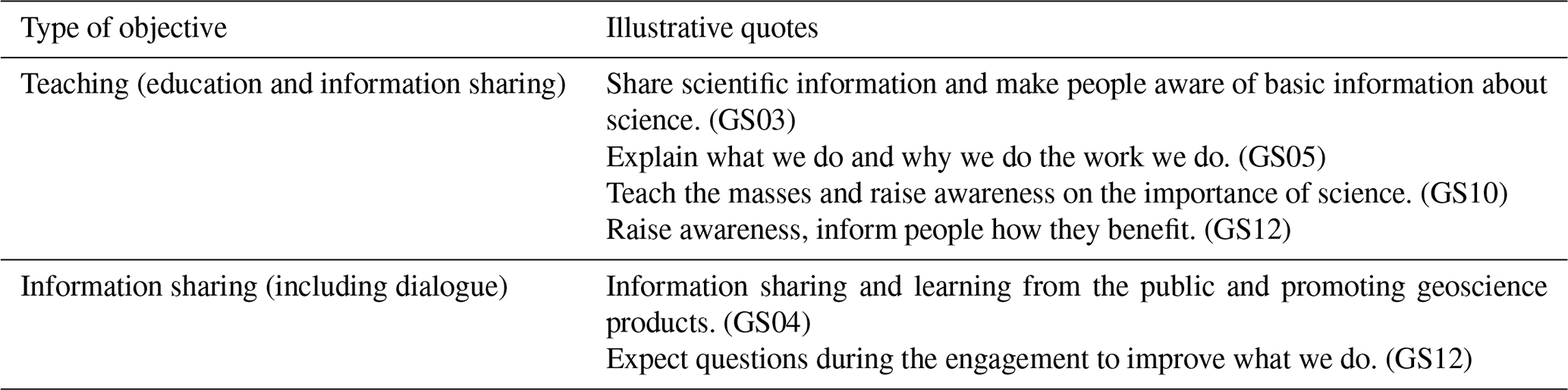
Participants generally viewed the primary aim of public engagement as educating and informing the public about geosciences, placing a strong emphasis on knowledge dissemination and transmission rather than dialogue or collaborative knowledge production. Notably, only two participants referenced a bidirectional exchange of information, where geoscientists could also learn from the public, suggesting a limited shift away from dissemination toward more participatory forms of engagement. However, even in these cases, learning was framed as a response to public questions rather than as a recognition of the public's own expertise or local knowledge.
When interacting with the public and responding to their questions, we use those inquiries to enhance our work and develop better ways to explain what we do. (GS09)
One participant observed that while public sector geoscientists typically focus on educating the public, private sector geoscientists tend to engage with communities primarily to build trust, particularly in areas affected by exploration or mining activities. They highlighted that informing the public about geoscience could foster public understanding, trust, and support for research. This trust is particularly vital for field-based work, which often involves access to private land.
Public trust is essential for securing community cooperation and avoiding resistance during field data collection. (GS11)
Participants linked public trust with broader support for scientific research, including funding and policy influence. Eight participants emphasised that, because geoscience affects people's daily lives through activities such as mining and resource exploration, the public should have a voice in related policy decisions. One participant cited the Stampriet community, where uranium exploration and drilling near a major groundwater supply have raised concerns, to underscore the importance of community involvement in decisions with direct environmental and socioeconomic impacts.
Table 3 presents an overview of the objectives that participants had in mind when participating in public engagement activities.
5.6 Namibian geoscientists' confidence and participation in relation to public engagement activities (RQ6)
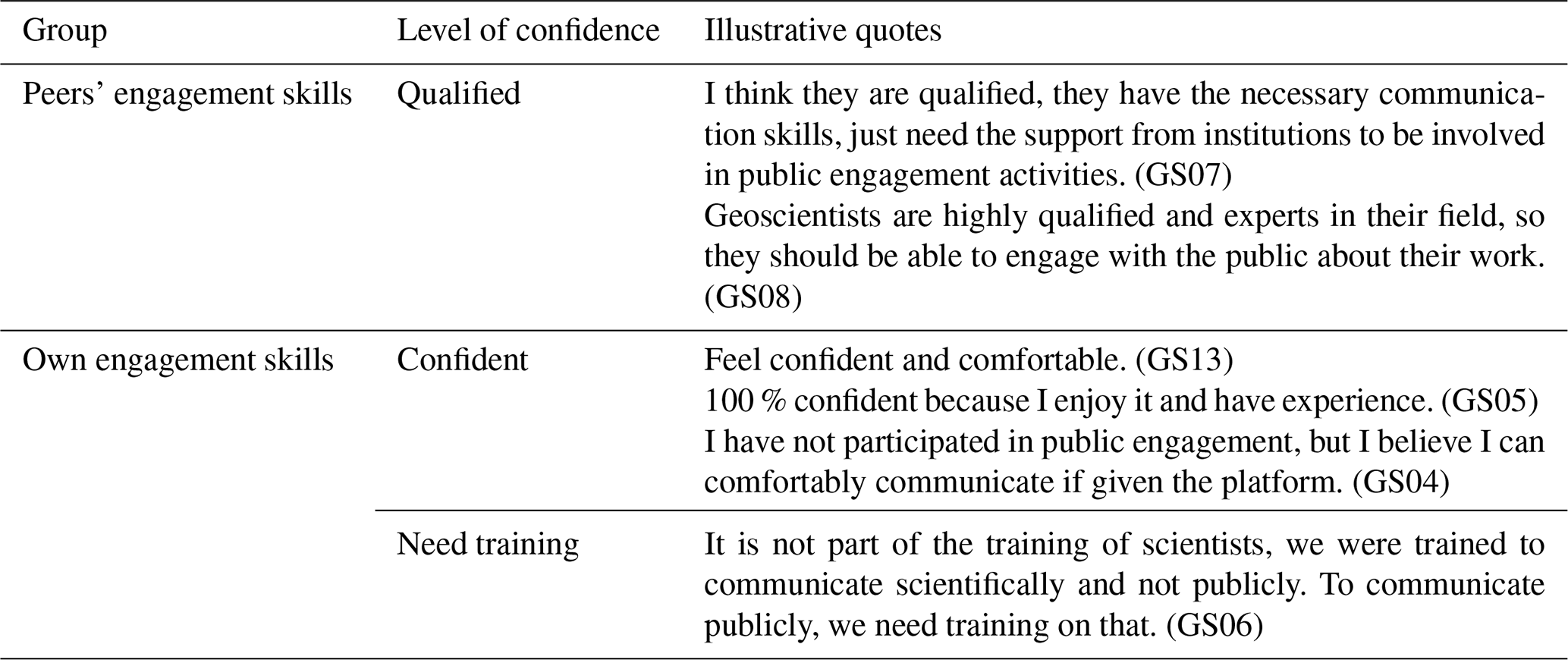
All 13 participants expressed confidence in their ability to engage with public groups, with 11 participants noting that they had actively participated in public engagement activities, such as career fairs, radio interviews, and outreach programmes, which contributed to their sense of competence in this area. Similarly, participants believed that their peers were also capable of engaging the public, attributing this confidence to their peers' scientific qualifications and expertise rather than to formal training or prior experience in public engagement.
Despite this confidence, participants acknowledged that participation in public engagement among Namibian geoscientists remains limited, particularly in the public sector. Seven participants described current engagement efforts as minimal or virtually non-existent. Across both sectors, public and private participants felt that more consistent and proactive engagement was needed and that geoscientists should be willing to allocate time and effort to such initiatives.
Table 4 outlines participants' views on their own and their peers' levels of confidence regarding public engagement activities.
Table 4Namibian geoscientists' views on their confidence in public engagement.
5.7 Barriers or challenges to the involvement of Namibian geoscientists in public engagement (RQ7)
Geoscientists in Namibia often operate in settings where public communication is not structurally embedded in their job descriptions, performance evaluations, or funding models. There is no formal science communication training within most geoscience education or professional development pathways. Much outreach depends on individual passion and ad hoc initiatives rather than institutionalised strategies. Furthermore, outreach efforts are rarely monitored or evaluated, making it difficult to learn from past engagement or adapt approaches based on community needs and responses. Despite confidence in their own and their peers' communication skills, most participants acknowledged that effective public engagement requires specific skills not usually covered in scientific training.
Most of us cannot express ourselves publicly; we need training on how to engage effectively. (GS05)
Therefore, they unanimously endorsed targeted skills development initiatives, such as workshops on public speaking, writing for non-scientific audiences, media engagement, and presentation skills. This type of training could be provided by institutions as part of professional development programmes or incorporated into undergraduate science curricula to prepare future scientists better.
I would have appreciated a short course on the basic communication skills outside a scientific context. (GS04)
Peer support was vital for sustaining public engagement, with at least 5 participants mentioning a lack of support from colleagues, including explicit statements that public engagement was not part of their formal duties.
They do not encourage me to do public engagement, since they believe it is not their responsibility to teach people; therefore, they would think I should not do it either. (GS01)
Two participants said they would join public groups only if they had enough time and were persuaded that the activity would offer real benefits.
Geoscientists need to know if these efforts are effective, as this knowledge will motivate them to participate and ensure their time and work are valued. (GS07)
Financial constraints were identified as a significant barrier to participating in public engagement events and organising related activities. One participant highlighted the public's right to access scientific information, arguing that it is the government's duty to fund such initiatives. Other commonly cited barriers included confidentiality restrictions, time constraints, and administrative burdens. Remote locations might also limit the participation of certain geoscientists.
Because of where I work, my efforts in public engagement are limited, finances and logistics from my location are a nightmare. (GS03)
When asked about support and incentives, most participants reported receiving no formal institutional rewards or recognition for engaging in public-facing activities. However, seven participants indicated that public engagement was included, at least to some extent, in their performance assessments, offering a degree of formal recognition. Some also mentioned informal recognition, such as mentions in departmental newsletters, appreciation emails, or applause during office meetings.
I know my institution does not appreciate such efforts, but appreciation from the public is more fulfilling. (GS01)
In terms of institutional support, the most common assistance provided was funding for materials and transportation to attend engagement events. However, this support was generally limited to participation in high-profile events, such as Water Day or Environment Awareness Day, as well as for mining expos and oil and gas conferences, which are typically regarded as part of official job responsibilities rather than public-oriented events.
Below, we discuss the current study's findings and how they align with the broader body of knowledge on scientists' views and attitudes toward public science communication and engagement.
6.1 Namibian geoscientists' views of the public
While some participants viewed the public as a single homogeneous group, others were more specific, describing particular communities, audiences, or stakeholders with whom they regularly collaborate. These sector-specific definitions indicate that these geoscientists prioritise engagement with audiences already professionally connected to their field, increasing the likelihood that they will understand and value their work. It also suggests they may recognise that, to be effective, public engagement activities should be tailored to specific audiences rather than employing a one-size-fits-all approach.
Their primary view of public knowledge about science is that the public knows very little, and that this gap can be bridged through education to build public trust and support. These findings are consistent with those of other studies worldwide (e.g., Wintterlin et al., 2022; Sinatra and Hofer, 2016). For example, Calice et al. (2022) found that faculty at a large Midwestern US land-grant university frequently identified public education as a key goal of public engagement, often to provide access to information on specific issues or to foster a broader appreciation of science. This suggests that scientists, including geoscientists, often adopt an engagement approach centred on informing the public and defending science.
However, the idea that a lack of support for science stems from a lack of knowledge (i.e., the so-called “deficit model” of science communication) has been widely discredited (Grant, 2023; Toomey, 2023). We now understand that simply providing more scientific information does not automatically boost public trust or improve decision-making. Instead, it can lead to greater distrust, especially when communicators ignore their audiences' values, contexts, and concerns (Grant, 2023; Dudo and Besley, 2016). Therefore, assuming that people lack knowledge is often mistaken. We know now that facts don't necessarily change minds, and that values and identity shape how people respond to science-related content (Toomey, 2023). Effective science communication and public engagement require a nuanced understanding of audience groups, along with tailoring strategies and messages to their values and beliefs (Cormick, 2019). Merely presenting facts is insufficient; communicators must connect through emotions, narratives, and trust-building techniques to make science accessible and persuasive.
6.2 How Namibian geoscientists view and define public engagement
Most participants viewed public engagement as a one-way process, emphasising the distribution of information rather than promoting two-way communication, as noted by Weingart et al. (2021). Similar findings were reported in studies of university communicators in Germany (Biermann et al., 2025) and of science communication trainers in North America (Yuan et al., 2017). These studies indicate that scientists and science communicators recognise the value of two-way communication but seldom use dialogic strategies such as listening to their audiences or adjusting messages based on audience feedback. This highlights a common challenge: engagement is still often regarded as merely “telling” rather than “talking with”, and public audiences are seen as passive recipients of information rather than active participants. It appears much more challenging for scientists to engage in meaningful dialogue with the public than simply to provide information.
However, scholars highlight that geoscientists need to move away from “matters of fact” to “matters of concern”, since geoscientific issues often provoke public anxiety rooted in values, trust, equity, and place-based concerns (Stewart and Lewis, 2017). It calls on geoscientists to move away from simply being information providers and towards becoming facilitators of meaningful dialogue, engaging with public concerns to co-develop trust and informed decisions, empower communities, and support socially responsive science (Illingworth, 2023).
Notably, the current study provided some evidence that Namibian geoscientists are moving towards a more interactive and dialogic approach when engaging with public audiences. While only two participants directly mentioned engagement as a two-way communication, eight others stated that it can be mutually beneficial, recognising that scientists could learn from the public, especially from communities living in the areas being studied. In these cases, local knowledge was seen as a valuable resource that could enhance research. Additionally, one participant noted that public questions helped them explain their work more effectively and even improve it. This suggests that even when people do not see engagement as a formal two-way process, they may already be engaging in it in practice. These examples reflect what Metcalfe (2022) and Brossard and Lewenstein (2010) state, that science communication rarely fits just one model. In reality, different ways of engaging with the public often co-exist and overlap.
6.3 Namibian geoscientists' attitudes towards public engagement
This study shows that geoscientists in Namibia generally have a positive attitude toward public engagement and recognise its importance in raising public awareness of geoscience, improving public understanding of the field, and combating misinformation. While geoscientists in this study generally viewed public engagement as valuable, they did not necessarily consider it their responsibility or that of scientists in general. This aligns with the findings of Riley et al. (2022), who highlighted that scientists often remain uncertain or ambivalent about how public engagement fits into their scientific identities, and with those of Rodrigues et al. (2023), who found that some geoscientists do not view science communication as part of their core responsibilities.
6.4 Namibian geoscientists' motivations for participating in public engagement
In the current study, many participants were personally motivated to engage. Their reasons included a sense of duty, the desire to inspire the next generation, and the goal of building public trust in science. This resonates with studies worldwide that have found that scientists perceive a moral duty to share their findings with society (e.g., Calice et al., 2022) and feel accountable to society (e.g., Rose et al., 2020; Alperin et al., 2019).
6.5 Namibian geoscientists' objectives with public communication and engagement
Namibian geoscientists prioritised objectives related to informing and educating the public, which resonates with earlier studies, e.g., Besley et al. (2018b). In addition to the broad educational aims, some participants highlighted more context-specific goals. One participant, for example, emphasised the importance of informing communities about the impacts of mining operations, noting that such engagement enables community members to understand potential effects better, participate in constructive dialogue, and make informed decisions about issues affecting their communities. This perspective was illustrated through concerns raised within the Stampriet community, where uranium exploration and drilling near a major groundwater resource have prompted concerns about potential environmental risks, particularly groundwater contamination. This example underscores the perceived importance of engaging communities in decisions with direct local impacts, especially where natural resources and livelihoods are at stake.
Despite these insights, relatively few participants identified objectives that extend beyond public education and consultation. One participant pointed to the professional value of public engagement, describing how it contributed to her career development by enhancing her visibility, expanding her professional networks, and strengthening her identity as a geoscientist. Together, these findings suggest that while educational goals remain dominant, there is an emerging recognition among some Namibian geoscientists of the broader democratic and professional dimensions of public engagement.
6.6 Namibian geoscientists' confidence in their own communication and engagement skills
Participants in this study felt confident in their own and their colleagues' abilities to engage with the public, mainly because of their scientific knowledge and experience. However, most also recognised that having expertise in geoscience doesn't automatically make someone a good communicator. As a result, they expressed a strong need for formal training in areas like public speaking, science communication, and effective engagement techniques. This finding is echoed by Calice et al. (2022), who note that while scientists may feel prepared to communicate, they often require specific communication skills and training that are not typically included in scientific curricula. Calice et al. highlight that a lack of communication skills and training can be considered a barrier to participation.
6.7 Barriers and challenges that constrain the involvement of Namibian geoscientists in public engagement
Participants mentioned several challenges that complicate or constrain their participation in public engagement, including limited time, lack of financial or logistical support, and few opportunities for structured outreach, especially in rural or remote areas. In Namibia, additional barriers, such as the country's diverse language landscape and generally low public understanding of science, were also noted. These challenges underscore the need for tailored strategies that account for local context. Moreover, several participants emphasised the need for tools to help measure the impact of their engagement efforts, as well as more support and recognition from their institutions for the time and effort these activities require.
These findings align closely with studies by Alperin et al. (2019) and Calice et al. (2022), which conclude that public engagement is often undervalued or even overlooked in institutional performance review and promotion processes. Therefore, scientists perceive a lack of institutional incentives to engage and expressed a clear need for a cultural shift that explicitly values and supports engagement. Accordingly, Namibian geoscientists' concerns about a lack of real support, incentives, or recognition from their institutions directly mirror the prominent institutional barriers discussed by Calice et al. (2022). In essence, while many scientists may feel a duty to engage with society, institutional structures often discourage this by failing to reward such efforts in career advancement systems.
6.8 Similarities and differences between Namibia and other geoscience communities
Many of our findings resonate with international research indicating that geoscientists tend to prioritise one-way dissemination, view public knowledge as limited, and feel positive, yet uncertain, about their role in engagement (e.g., Rodrigues et al., 2023; Liverman and Jaramillo, 2011). However, the Namibian context differs in several ways. First, national institutions currently offer minimal policy incentives, creating an environment in which engagement relies heavily on individual motivation rather than formal structures. This contrasts with countries where funding bodies mandate public communication and societal engagement, for example through the EU's Horizon 2020 programme (European Commission, 2020; Mazzitelli, 2019; Salnikova and Brandstetter-Kunc, 2023) and South Africa's revised NRF legislation (Republic of South Africa, 2018). Second, linguistic diversity and rural geography play a more substantial role in shaping engagement barriers than reported in many high-income settings. Third, Namibian geoscientists work within a socio-political context where suspicion toward extractive activities can be high, making trust-building an essential component of engagement. These contextual distinctions suggest that geoscientists in low- and middle-income countries (LMICs) may need different forms of support, particularly in relationship-building, cultural competence, and long-term community dialogue, than their peers elsewhere.
6.9 Contradictions in participants' views: confidence, responsibility, and practice
A notable contribution of this study is its identification of contradictions in how geoscientists understand their roles in engagement. For example, participants frequently expressed high confidence in their ability to communicate yet simultaneously emphasised the need for formal communication training. This tension shows that confidence is often equated with technical expertise rather than with actual communication competence, a pattern also observed in earlier geoscience communication literature (Illingworth et al., 2018, 2023). Similarly, participants described public engagement as important and morally meaningful yet also reported discouragement or indifference from colleagues and institutions. This indicates that while individual motivation exists, it is undermined by professional cultures that still position engagement as peripheral. Another contradiction emerged in participants' stated belief that engagement can be mutually beneficial, while their descriptions of engagement objectives centred almost entirely on educating and informing the public. This demonstrates a persistent reliance on deficit-model assumptions even when participants verbally endorsed dialogic principles.
6.10 Deficit-model persistence as a central finding
Across all seven research questions, deficit-oriented thinking emerged as a dominant thread. Participants commonly viewed public audiences as lacking knowledge, needing education, and requiring scientific correction before they could participate meaningfully in geoscience-related issues. This aligns with global evidence that deficit-model assumptions remain deeply embedded in geoscience communication (Stewart and Lewis, 2017; Hillier et al., 2021). However, in Namibia, the persistence of this model appears to intersect with broader structural conditions, including limited public science literacy programmes, minimal institutional mandates for engagement, and communities that have historically been excluded from science decision-making. Taken together, these factors help explain why information transmission remains the default mode of engagement but also highlight the need for more dialogic and participatory engagement as Namibia expands its energy, mineral, and groundwater sectors.
This study offers one of the first empirically grounded analyses of how geoscientists in Africa perceive and practise public engagement. While most existing geoscience communication literature draws heavily on experiences in Europe, North America, and Australasia (e.g., Illingworth et al., 2018; Hillier et al., 2021), far less is known about how geoscientists in LMICs conceptualise their societal responsibilities, especially within contexts shaped by extractive industries, linguistic diversity, colonial histories, and structural resource constraints. Our findings highlight that, although Namibian geoscientists share several engagement attitudes and challenges identified globally, their perspectives are strongly shaped by the country's socio-political context, infrastructure limitations, and the realities of working closely with rural communities affected by mining, groundwater pressures, and land-use decisions. This study, therefore, adds a geographically underrepresented perspective to GEO-COMM discourse and responds directly to calls for greater attention to the diversity of geoscience engagement practices worldwide (Gani et al., 2024).
In summary, the divide and disconnect between geoscientists and public audiences in Namibia call for new policies, support and incentives to bridge this gap. This issue is becoming more urgent as the country advances in oil, gas and mineral exploration, as well as green energy initiatives. Effective, clear, and transparent public communication and societal engagement in these fields are essential for fostering trust, promoting informed community participation, and supporting evidence-based decision-making. Overall, the findings show that geoscientists in Namibia are interested in engaging with the public and understand its importance. However, a range of cultural and structural barriers limits their active involvement. Therefore, to encourage and sustain meaningful public engagement, it will require strategic and structured support, targeted engagement and evaluation training, and clear institutional incentives.
Firstly, it is essential to recognise that public engagement with science encompasses a diverse range of activities, including disseminating information and actively collaborating with communities to co-create mutually beneficial new knowledge. Accordingly, Namibian geoscientists need to understand the importance of going beyond providing information to listening to and collaborating with public groups, taking into account their concerns and expectations. Active listening and trust-building through participatory engagement can help to make geoscience more socially relevant, inclusive, and responsive to the real-world needs of Namibians. Therefore, we need to provide scientists with an understanding of the different ways to communicate and engage, and help them understand the value of dialogic engagement, along with the tools and skills to plan, implement and evaluate these activities. This training should be adapted to fit Namibia's unique social and cultural context and based on an understanding of locally relevant audiences.
Additionally, a more supportive institutional environment must be created where public engagement is positioned as a vital part of a scientist's role, rather than an optional extra. This implies that the institutions and companies where scientists are employed must include public engagement with science in their policies and promotion procedures, and provide scientists with the time, training, tools and resources they need to engage meaningfully with relevant public groups.
Beyond these broad recommendations, we also suggest some concrete targets to encourage and support Namibian geoscientists in terms of public communication and societal engagement. For example, the Geological Survey of Namibia and the NCRST could establish a formal public engagement award or recognition scheme to celebrate geoscientists who invest meaningfully in community outreach, thereby signalling institutional value for this work. Research funding for geosciences could be linked to a top-up funding scheme with support specifically allocated for communication and engagement. Another practical pathway would be a context-sensitive science communication and engagement course designed for geoscience students and researchers in the field. Such a training course should be co-developed and pilot-tested with local geoscientists, science communicators and relevant community leaders, with a focus on planning and implementing locally relevant dialogues in local languages and using local communication channels such as national and community radio stations broadcasting in diverse languages.
Funding, training and institutional recognition will help to shift the perception that public engagement is an optional extra rather than a core professional responsibility, but this will require buy-in and support from local universities, funders and science policymakers. For geoscientists in particular, it could be meaningful to strengthen their communicative and dialogic roles in Environmental Impact Assessments. Mining companies, through their corporate social responsibility mandates, represent another potential partner, as they have existing infrastructure for community relations that geoscientists could work alongside. Civil society organisations and NGOs working on environmental justice, land rights, and water access could serve as trusted intermediaries, helping geoscientists connect with communities that may be sceptical of state institutions or extractive industry actors.
Overall, national organisations such as the Geological Survey of Namibia, the NCRST, and the Geoscience Council of Namibia are well-positioned to lead the development of public engagement with science policies and support structures, including funding incentives. More broadly, at the national government level, there is a need for a multidisciplinary science engagement strategy designed to make science visible and accessible to all Namibians and to foster societal dialogue about science.
8.1 Clarifying the goals of communication and engagement
A question that cuts across all of the above recommendations is what public engagement is ultimately meant to achieve. It is crucial to identify clear goals and objectives for communication and engagement. Without a clear sense of what it is meant to accomplish, these activities are likely to be neither well-targeted nor meaningfully evaluated. Clear goals and objectives help institutions, scientists and communicators to work together more purposefully and meaningfully.
Science communication and public engagement are motivated by several broad goals that are all relevant to geoscientists in Namibia. These include the public's right to know about research done with public money and the public's right to have a say in science in a democratic society. For geoscientists, there may also be very specific contexts where communication and engagement may have very specific goals, depending on the geoscientific context, the communities involved, and the nature of the relationship between science and the specific communities.
In some contexts, the immediate and practical goal may be to build sufficient trust to enable geoscientists to carry out their work. For example, scientists may need to gain access to private or communal land for field surveys, drilling, or data collection, or to secure community cooperation in areas where historical associations between geoscience and extractive industry have generated suspicion. While this instrumental goal is legitimate, it is worth noting that engagement motivated primarily by operational necessity risks being perceived as transactional by communities and may undermine the very trust it seeks to build if community members feel they are being informed rather than genuinely consulted. The findings of this study reflect this tension, as participants simultaneously described trust-building as a goal while framing their engagement objectives largely in terms of information transmission.
A second and broader goal is influencing the policy environment, in other words, persuading decision-makers, regulators, and funding bodies to take geoscientific knowledge seriously in areas such as groundwater management, land-use planning, energy transitions, and environmental protection. In a country where geoscience underpins critical national development decisions, this kind of policy-oriented engagement is arguably among the highest-impact forms of outreach that geoscientists can undertake. Here, the target audience is not the general public but a smaller group of actors with formal decision-making authority, and the communication strategy would need to prioritise clarity, credibility, and the translation of technical findings into policy-relevant language. Importantly, effective policy engagement also requires geoscientists to listen so that they understand what questions decision-makers are actually asking, what trade-offs they are navigating, and what forms of evidence they find persuasive.
A third and more transformative goal would be the co-production of knowledge through citizen science and civic science initiatives, in which community members are not merely recipients of geoscientific information but active contributors, collaborators and co-creators of new knowledge. In the Namibian context, this holds particular promise in areas where communities have long-standing, granular knowledge of local landscapes, water sources, and environmental change, since this is the kind of embedded local knowledge that formal geoscientific surveys may miss. Community-based groundwater monitoring programmes, for example, could simultaneously build scientific capacity among community members, generate locally grounded data of value to researchers, and foster the sense of shared ownership over geoscientific knowledge that is currently absent. While this model requires sustained investment and genuine power-sharing between scientists and communities, it represents the kind of participatory ideal that the broader literature calls for and that Namibia's emerging resource and environmental challenges make increasingly urgent.
These three goals, i.e. operational trust, policy influence, and co-creation with citizens, could co-exist in a well-designed communication and engagement strategy, with different activities oriented toward different audiences and purposes. What matters is that geoscientists and their institutions are explicit and transparent about which goals are being pursued in a given context, since this will shape the choice of communication approach, the selection of partners, the design of activities, and the criteria used to evaluate success.
8.2 Study limitations
A key limitation of this study is the relatively uniform age range of the participating scientists, spanning from 30 to 40 years. This demographic restriction might limit the findings, as it does not fully capture the perspectives of more seasoned and older professionals who may have engaged in different forms of public engagement or encountered unique institutional barriers. To enhance the depth and representativeness of future research, it is recommended that subsequent studies include participants from a wider variety of age groups, career stages, and professional backgrounds to better reflect the diversity of public engagement experiences in Namibia's geoscience sector.
The qualitative data generated and analysed during this study are not publicly available because they consist of interview transcripts obtained under informed consent agreements that guarantee participant confidentiality. Although personal identifiers have been removed, the relatively small professional community from which participants were recruited increases the risk of indirect identification. For this reason, the data cannot be deposited in a public repository. Requests for access to appropriately anonymised data may be considered by the corresponding author on reasonable request, subject to ethical approval, participant consent, and applicable institutional policies.
JNU, in collaboration with MJ, designed the research protocol and JNU conducted the interviews. The manuscript was written by JNU under the supervision of MJ. MJ was involved in the editing process of the manuscript.
The contact author has declared that neither of the authors has any competing interests.
Publisher's note: Copernicus Publications remains neutral with regard to jurisdictional claims made in the text, published maps, institutional affiliations, or any other geographical representation in this paper. The authors bear the ultimate responsibility for providing appropriate place names. Views expressed in the text are those of the authors and do not necessarily reflect the views of the publisher.
This study was approved by the Research Ethics Committee: Social Behavioural and Education Research (REC: SBE) at Stellenbosch University on 7 July 2023, with the project number 28275.
The authors gratefully acknowledge Prof. Marina Joubert of Stellenbosch University, a co-author of this study, for her invaluable guidance, mentorship, and scholarly contributions throughout the research process. Her expertise in science communication and public engagement was instrumental in shaping the conceptual framing and analysis of the research. We also extend our sincere thanks to the geoscientists who shared their time, experiences, and perspectives by participating in the interviews. Without their openness and willingness to reflect on their professional practice, this research would not have been possible. The authors further acknowledge the institutions and organisations that supported this research, including the Geological Survey of Namibia and Stellenbosch University (Centre for Research on Evaluation, Science and Technology (CREST)).
This paper was edited by Stephanie Zihms and reviewed by Kombada Mhopjeni and Omar Rafael Reglado Fernandez.
Aguirre Ríos, C. and De Régules, S.: Responsible science communication in Latin America: Reflections on challenges, Journal of Science Communication, 21, https://doi.org/10.22323/2.21040303, 2022.
Alperin, J. P., Muñoz Nieves, C., Schimanski, L. A., Fischman, G. E., Niles, M. T., and McKiernan, E. C.: How significant are the public dimensions of faculty work in review, promotion and tenure documents?, eLife, https://doi.org/10.7554/eLife.42254, 2019.
Besley, J. C., Oh, S. H., and Nisbet, M.: Predicting scientists' participation in public life, Public Underst. Sci., 22, 971–987, https://doi.org/10.1177/0963662512459315, 2013.
Besley, J. C., Dudo, A., Yuan, S., and Abi Ghannam, N.: Qualitative interviews with science communication trainers about communication objectives and goals, Sci. Commun., 38, 356–381, https://doi.org/10.1177/1075547016645640, 2016.
Besley, J. C., Dudo, A., and Yuan, S.: Scientists' views about communication objectives, Public Underst. Sci., 27, 708–730, https://doi.org/10.1177/0963662517728478, 2018a.
Besley, J. C., Dudo, A., Yuan, S., and Lawrence, F.: Understanding Scientists' Willingness to Engage, Sci. Commun., 40, 1–32, https://doi.org/10.1177/1075547018786561, 2018b.
Biermann, K., Banse, L., and Taddicken, M.: “It's mostly a one-way street, to be honest”: The subjective relevance of public engagement in the science communication of professional university communicators, Journal of Science Communication, 24, https://doi.org/10.22323/2.24010203, 2025.
Broome, J.: The Future of Geoscience in the 21st Century: Art, Science, or Resource?, in: The Current Role of Geological Mapping in Geosciences, NATO Science Series IV: Earth and Environmental Sciences, Vol. 56, edited by: Ostaficzuk, S. R., 51–58, ISBN 978-1-4020-3551-7, https://doi.org/10.1007/1-4020-3551-9_6, 2005.
Brossard, D. and Lewenstein, B. V.: A Critical Appraisal of Models of Public Understanding of Science: Using Practice to Inform Theory, in: Communicating Science: New Agendas in Communication, edited by: Kahlor, L. A., and Stout, P., Routledge, New York, 11–39, https://doi.org/10.4324/9780203867631, 2010.
Bucchi, M. and Trench, B.: Science communication and science in society: a conceptual review in ten keywords, Tecnoscienza – Italian Journal of Science & Technology Studies, 7, 151–168, 2016.
Calice, M. N., Beets, B., Bao, L., Scheufele, D. A., Freiling, I., Brossard, D., Feinstein, N. W., Heisler, L., Tangen, T., and Handelsman, J.: Public engagement: Faculty lived experiences and perspectives underscore barriers and a changing culture in academia, PLoS ONE, 17, https://doi.org/10.1371/journal.pone.0269949, 2022.
Cologna, V., Mede, N. G., Berger, S., Besley, J. C., Brick, C., Joubert, M., Maibach, E. W., and Zwaan, R. A.: Trust in scientists and their role in society across 68 countries, Nat. Hum. Behav., 9, 713–730, https://doi.org/10.1038/s41562-024-02090-5, 2025.
Cormick, C.: The Science of Communicating Science: The Ultimate Guide, CSIRO Publishing, ISBN 978-1-78924-514-1, 2019.
Donnelly, L. J.: Communication in geology: a personal perspective and lessons from volcanic, mining, exploration, geotechnical, police and geoforensic investigations, Geol. Soc. Lond. Spec. Publ., 305, 107–121, https://doi.org/10.1144/SP305.11, 2008.
Dudo, A. and Besley, J.: Scientists' Prioritization of Communication Objectives for Public Engagement, PLoS ONE, 11, https://doi.org/10.1371/journal.pone.0148867, 2016.
Dunwoody, S., Brossard, D., and Dudo, A.: Socialization or rewards? Predicting US scientist-media interactions, J. Mass Commun. Q., 86, 299–314, https://doi.org/10.1177/107769900908600203, 2009.
Entradas, M. and Bauer, M. W.: Bustling public communication by astronomers around the world driven by personal and contextual factors, Nat. Astron., 3, 183–187, https://doi.org/10.1038/s41550-018-0633-7, 2019.
Entradas, M., Bauer, M. W., O'Muircheartaigh, C., Marcinkowski, F., Okamura, A., Pellegrini, G., and Besley, J. C.: Public communication by research institutes compared across countries and sciences: Building capacity for engagement or competing for visibility?, PLoS ONE, 15, https://doi.org/10.1371/journal.pone.0235191, 2020.
European Commission: Science with and for society in Horizon 2020: Achievements and recommendations for Horizon Europe, Publications Office of the European Union, https://doi.org/10.2777/32018, 2020.
Gani, S., Arnal, L., Beattie, L., Hillier, J., Illingworth, S., Lanza, T., Mohadjer, S., Pulkkinen, K., Roop, H., Stewart, I., von Elverfeldt, K., and Zihms, S.: Editorial: The shadowlands of (geo)science communication in academia – definitions, problems, and possible solutions, Geosci. Commun., 7, 251–266, https://doi.org/10.5194/gc-7-251-2024, 2024.
Gavhi-Molefe, R., Jensen, E., and Joubert, M.: Why scientists agree to participate in science festivals: A perspective from Scifest Africa, Int. J. Sci. Educ. Part B, 11, https://doi.org/10.1080/21548455.2021.1905904, 127–142, 2021.
Grant, W. J.: The Knowledge Deficit Model and Science Communication, Oxford Research Encyclopedia of Communication, https://doi.org/10.1093/acrefore/9780190228613.013.1396, 2023.
Hearth, S.: Geologists as Colonial Scouts: The Rogers Expedition to Otavi and Tsumeb, Namibia, 1892–1895, Earth Sci. Hist., 42, 385–415, https://doi.org/10.17704/1944-6187-42.2.385, 2024.
Hillier, J. K., Welsh, K. E., Stiller-Reeve, M., Priestley, R. K., Roop, H. A., Lanza, T., and Illingworth, S.: Editorial: Geoscience communication – planning to make it publishable, Geosci. Commun., 4, 493–506, https://doi.org/10.5194/gc-4-493-2021, 2021.
Hyman, M. R. and Sierra, J. J.: Open- versus Close-Ended Survey Questions, Business Outlook, 14, 1–6, 2016.
Illingworth, S.: A spectrum of geoscience communication: from dissemination to participation, Geosci. Commun., 6, 131–139, https://doi.org/10.5194/gc-6-131-2023, 2023.
Illingworth, S., Stewart, I., Tennant, J., and von Elverfeldt, K.: Editorial: Geoscience Communication – Building bridges, not walls, Geosci. Commun., 1, 1–7, https://doi.org/10.5194/gc-1-1-2018, 2018.
Ivani, S. and Novaes, C. D.: Public engagement and argumentation in science, Eur. J. Philos. Sci., 12, 1–29, https://doi.org/10.1007/s13194-022-00480-y, 2022.
James, S., Morkel, J. M., and Ngwenya, N.: Traversing the Challenges of Community Engagement in South Africa: Emerging Researchers' Perspectives, Social and Health Sciences, 23, https://doi.org/10.25159/2957-3645/13877, 2025.
Joubert, M.: Country-specific factors that compel South African scientists to engage with public audiences, Journal of Science Communication, 17, https://doi.org/10.22323/2.17040304, 2018.
Joubert, M., Ndlovu, H., and Boshoff, N.: Public science communication in Africa: views and practices of academics at the National University of Science and Technology in Zimbabwe, Journal of Science Communication, 15, https://doi.org/10.22323/2.15060205, 2016.
Kahan, D. M.: Fixing the communications failure, Nature, 463, 296–297, https://doi.org/10.1038/463296a, 2010.
Karikari, T. K. and Yawson, N. A.: A Model Approach to Public Engagement Training for Students in Developing Countries, J. Microbiol. Biol. Educ., 18, 1–4, https://doi.org/10.1128/jmbe.v18i1.1244, 2017.
Khumalo, L., Ellis, M., and Limson, J.: A relational lens to community-based participatory research: An analysis of case studies of Engaged Research in South Africa, S. Afr. J. Sci., 122, https://doi.org/10.17159/sajs.2026/18141, 2026.
Liverman, D. and Jaramillo, M.: Communicating environmental geoscience – An International Survey, Episodes, 34, 25–31, 2011.
Massarani, L. and Moreira, I. C.: Science communication in Brazil: A historical review and considerations about the current situation, An. Acad. Bras. Ciênc., 88, 1165–1175, https://doi.org/10.1590/0001-3765201620150338, 2016.
Massarani, L. and Peters, H. P.: Scientists in the public sphere: Interactions of scientists and journalists in Brazil, An. Acad. Bras. Ciênc., 88, 1165–1175, https://doi.org/10.1590/0001-3765201620150558, 2016.
Mathews, D. J., Kalfoglou, A., and Hudson, K.: Geneticists' views on science policy formation and public outreach, Am. J. Med. Genet., 137A, 161–169, https://doi.org/10.1002/ajmg.a.30849, 2005.
Mazzitelli, G.: Science communication: A new frontier of researcher's job, arXiv [preprint], https://doi.org/10.48550/arXiv.1905.02936, 2019.
Metcalfe, J. E.: Science communication: a messy conundrum of practice, research and theory, Journal of Science Communication, 21, 1–8, https://doi.org/10.22323/2.21070307, 2022.
Mocke, H. and Mhopjeni, K.: Twelve Years of Outreach at the Geological Survey of Namibia, Communications of the Geological Survey of Namibia, 22, 116–134, 2020.
Murunga, M., Pecl, G. T., Ogier, E., Leith, P., Macleod, C., Kelly, R., and Nettlefold, J.: More than just information: what does the public want to know about climate change?, Ecol. Soc., 27, https://doi.org/10.5751/ES-13147-270214, 2022.
Neresini, F. and Bucchi, M.: Which indicators for the new public engagement activities? An exploratory study of European research institutions, Public Underst. Sci., 20, 64–79, https://doi.org/10.1177/0963662510388363, 2011.
Parker, S. and Gastrow, M.: Language, learning and engagement: Science communication skills among scientists in South Africa, S. Afr. J. Sci., 122, https://doi.org/10.17159/sajs.2026/18084, 2026.
Poliakoff, E. and Webb, T. F.: What Factors Predict Scientists' Intentions to Participate in Public Engagement of Science Activities?, Sci. Commun., 29, 242–263, https://doi.org/10.1177/1075547007308009, 2007.
Rasekoala, E.: Responsible science communication in Africa: Rethinking drivers of policy, Afrocentricity and public engagement, Journal of Science Communication, 21, https://doi.org/10.22323/2.21040301, 2022.
Republic of South Africa: National Research Foundation Amendment Act 19 of 2018, Government Gazette No. 42441, 2018.
Riley, J., Joubert, M., and Guenther, L.: Motivations and barriers for young scientists to engage with society: perspectives from South Africa, Int. J. Sci. Educ. Part B, 12, 157–173, https://doi.org/10.1080/21548455.2022.2049392, 2022.
Rodrigues, J., Costa e Silva, E., and Pereira, D. I.: How Can Geoscience Communication Foster Public Engagement with Geoconservation?, Geoheritage, 15, 1–15, https://doi.org/10.1007/s12371-023-00800-5, 2023.
Rodrigues, J., Castro, C., Costa e Silva, E., and Pereira, D. I.: Profiling the geoscience community: exploring patterns of science communication and public engagement, Journal of Science Communication, 24, https://doi.org/10.22323/149720250607090243, 2025.
Rose, K. M., Holesovsky, C. M., Bao, L., Brossard, D., and Markowitz, E. M.: Faculty Public Engagement Attitudes and Practices at Land-Grant Universities in the United States, Department of Life Sciences Communication, University of Wisconsin-Madison, Madison, WI, http://scimep.wisc.edu/projects/reports/ (last access: 20 November 2025), 2020.
Salnikova, A. and Brandstetter-Kunc, A.: D4.1 State-of-the-art Analysis: mapping of the policy landscape for learning opportunities for researchers on open and responsible research and innovation (Version 1.0), Zenodo, https://doi.org/10.5281/zenodo.10411163, 2023.
Scheufele, D. A.: Communicating science in social settings, P. Natl. Acad. Sci. USA, 110, 14040–14047, https://doi.org/10.1073/pnas.1213275110, 2013.
Scheufele, D. A.: Science communication as political communication, P. Natl. Acad. Sci. USA, 111, 13585–13592, https://doi.org/10.1073/pnas.1317516111, 2014.
Siipi, H., and Marko, A.: The Deficit Model and the Forgotten Moral Values, Nordicum-Mediterraneum, 6, https://doi.org/10.33112/nm.6.1.8, 2011.
Sinatra, G. and Hofer, B.: Public Understanding of Science, Policy Insights from the Behavioral and Brain Sciences, 3, 245–253, https://doi.org/10.1177/2372732216656870, 2016.
South African Department of Science and Innovation: The South African public relationship with science: 2022 survey results, Human Sciences Research Council (HSRC) Press, ISBN 13 978-0-7969-2685-2, 2024.
Stewart, I. S. and Lewis, D.: Communicating contested geoscience to the public: Moving from `matters of fact' to `matters of concern', Earth-Sci. Rev., 174, 122–133, https://doi.org/10.1016/j.earscirev.2017.09.003, 2017.
Swords, C. M., Porter, J. S., Hawkins, A. J., Li, E., Rowland-Goldsmith, M., Koci, M. D., Tansey, J. T., and Woitowich, N. C.: Science communication training imparts confidence and influences public engagement activity, J. Microbiol. Biol. Educ., 24, https://doi.org/10.1128/jmbe.00037-23, 2023.
Thai, H. T. D., Qui, H. V. T., Duy, T. V., Fisher, J., and Chambers, M.: A study on biomedical researchers' perspectives on public engagement in Southeast Asia, Journal of Public Engagement in Science, 10, 123–145, https://doi.org/10.12688/wellcomeopenres.19040.1, 2023.
Tindana, P., de Vries, J., Campbell, M., Littler, K., Seeley, J., Marshall, P., Troyer, J., Ogundipe, M., Alibu, V. P., Yakubu, A., and Parker, M.: Community engagement strategies for genomic studies in Africa: a review of the literature, BMC Med. Ethics, 16, https://doi.org/10.1186/s12910-015-0014-z, 2015.
Toomey, A. H.: Why facts don't change minds: Insights from cognitive science for the improved communication of conservation research, Biol. Conserv., 278, 1–8, https://doi.org/10.1016/j.biocon.2022.109886, 2023.
UNESCO: Geoscience in action: advancing sustainable development, UNESCO, https://unesdoc.unesco.org/ark:/48223/pf0000384826.locale=en (last access: 5 May 2025), 2024.
Van Lill, M., Joubert, M., Botes, M., Mede, N. G., Guenther, L., Rödder, S., and Cologna, V.: Honesty, transparency and rigour: A study of public trust in scientists in South Africa, S. Afr. J. Sci., 122, https://doi.org/10.17159/sajs.2026/21970, 2026.
Weingart, P., Joubert, M., and Connoway, K.: Public engagement with science – Origins, motives and impact in academic literature and science policy, PLoS ONE, 16, 1–30, https://doi.org/10.1371/journal.pone.0254201, 2021.
Weller, S. C., Vickers, B., Bernard, H. R., Blackburn, A. M., Borgatti, S., Gravlee, C. C., and Johnson, J. C.: Open-ended interview questions and saturation, PLoS ONE, 13, 1–18, https://doi.org/10.1371/journal.pone.0198606, 2018.
Wintterlin, F., Hendriks, F., Mede, N., Bromme, R., Metag, J., and Schäfer, M.: Predicting Public Trust in Science: The Role of Basic Orientations Toward Science, Perceived Trustworthiness of Scientists, and Experiences with Science, Front. Commun., 6, https://doi.org/10.3389/fcomm.2021.822757, 2022.
Yuan, S., Oshita, T., AbiGhannam, N., Dudo, A., Besley, J. C., and Koh, H. E.: Two-way communication between scientists and the public: a view from science communication trainers in North America, Int. J. Sci. Educ. Part B, 7, 341–355, https://doi.org/10.1080/21548455.2017.1350789, 2017.
Yuan, S., Besley, J. C., and Dudo, A.: A comparison between scientists' and communication scholars' views about scientists' public engagement activities, Public Underst. Sci., 28, 101–118, https://doi.org/10.1177/0963662518797002, 2019.