Articles | Volume 9, issue 3
https://doi.org/10.5194/gc-9-311-2026
© Author(s) 2026. This work is distributed under
the Creative Commons Attribution 4.0 License.
the Creative Commons Attribution 4.0 License.
https://doi.org/10.5194/gc-9-311-2026
© Author(s) 2026. This work is distributed under
the Creative Commons Attribution 4.0 License.
the Creative Commons Attribution 4.0 License.
Research article
| 
21 Jul 2026
Research article |
| 21 Jul 2026
| 21 Jul 2026
Digital field representations as a holistic approach to experiential learning in High Arctic geoscience field education
Department of Arctic Geology, The University Centre in Svalbard, Longyearbyen, 9171 PO box 156, Norway
Department of Earth Science, University of Bergen, Bergen, 5020 Postboks 7803, Norway
Christian H. Eide
Department of Earth Science, University of Bergen, Bergen, 5020 Postboks 7803, Norway
Kim Senger
Department of Arctic Geology, The University Centre in Svalbard, Longyearbyen, 9171 PO box 156, Norway
Marius O. Jonassen
Department of Arctic Geophysics, The University Centre in Svalbard, Longyearbyen, 9171 PO box 156, Norway
Department of Geophysics, University of Bergen, Bergen, 5020 Postboks 7803, Norway
Marie A. Vander Kloet
Department of Arctic Geology, The University Centre in Svalbard, Longyearbyen, 9171 PO box 156, Norway
Department of Education, University of Bergen, Bergen, 5020 Postboks 7807, Norway
Related authors
Kim Senger, Grace Shephard, Fenna Ammerlaan, Owen Anfinson, Pascal Audet, Bernard Coakley, Victoria Ershova, Jan Inge Faleide, Sten-Andreas Grundvåg, Rafael Kenji Horota, Karthik Iyer, Julian Janocha, Morgan Jones, Alexander Minakov, Margaret Odlum, Anna Sartell, Andrew Schaeffer, Daniel Stockli, Marie Annette Vander Kloet, and Carmen Gaina
Geosci. Commun., 7, 267–295, https://doi.org/10.5194/gc-7-267-2024, https://doi.org/10.5194/gc-7-267-2024, 2024
Short summary
Short summary
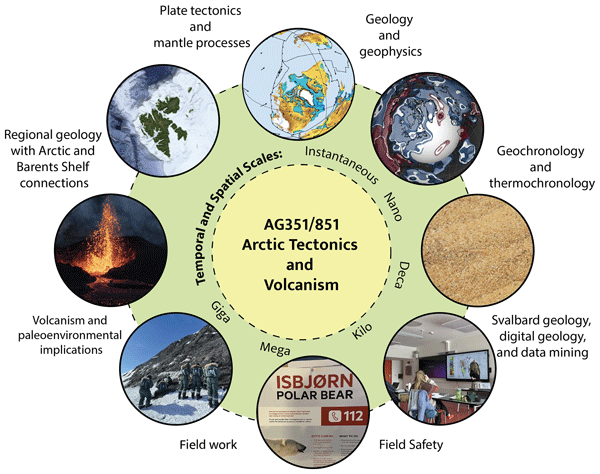
The article describes a course that we have developed at the University Centre in Svalbard that covers many aspects of Arctic geology. The students experience this course through a wide range of lecturers, focussing both on the small and larger scales and covering many geoscientific disciplines.
Simon M. Schad, Denise K. Kulhanek, Jiří Bárta, Stella Z. Buchwald, Sten-Andreas Grundvåg, William J. Foster, Mads E. Jelby, Morgan T. Jones, Luke Marsden, Sverre Planke, Kasia K. Śliwińska, Aleksandra Smyrak-Sikora, Lidya G. Tarhan, Madeleine L. Vickers, Valentin Zuchuat, and Kim Senger
Earth Syst. Sci. Data Discuss., https://doi.org/10.5194/essd-2026-487, https://doi.org/10.5194/essd-2026-487, 2026
Preprint under review for ESSD
Short summary
Short summary
This study gathers ancient climate data from Svalbard, a Norwegian Arctic archipelago. Its rocks preserve a 540-million-year record of major extinctions and warming events. Researchers compiled scattered data into organized, open-access packages covering chemical markers and fossils. These resources help scientists understand Arctic responses to rapid climate change, which is vital for improving future predictions and supporting new research.
Andrew W. Seidl, Aina Johannessen, Alena Dekhtyareva, Jannis M. Huss, Marius O. Jonassen, Alexander Schulz, Ove Hermansen, Christoph K. Thomas, and Harald Sodemann
Earth Syst. Sci. Data, 18, 1969–1993, https://doi.org/10.5194/essd-18-1969-2026, https://doi.org/10.5194/essd-18-1969-2026, 2026
Short summary
Short summary
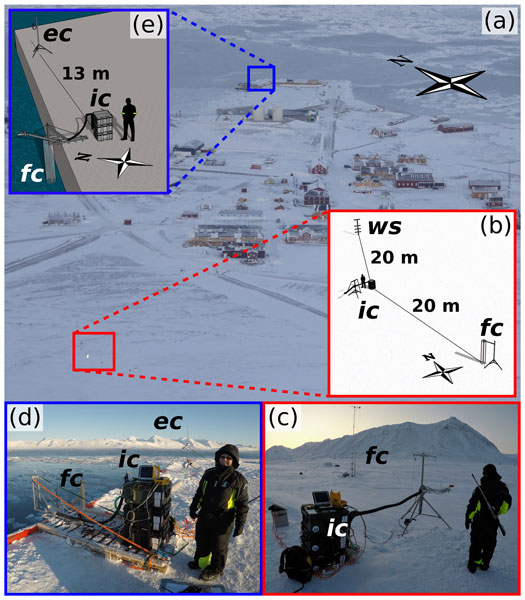
ISLAS2020 set out to measure the stable water isotopic composition of Arctic moisture. By not only measuring at different sites around Ny-Ålesund, Svalbard, but also measuring at variable heights above surface level, we aim to characterize processes that produce or modify the isotopic composition. We also collect precipitation samples from sites that were typically downstream of Ny-Ålesund, so as to capture the isotopic composition during removal from the atmospheric water cycle.
Aleksandra Smyrak-Sikora, Peter Betlem, Victoria S. Engelschiøn, William J. Foster, Sten-Andreas Grundvåg, Mads E. Jelby, Morgan T. Jones, Grace E. Shephard, Kasia K. Śliwińska, Madeleine L. Vickers, Valentin Zuchuat, Lars Eivind Augland, Jan Inge Faleide, Jennifer M. Galloway, William Helland-Hansen, Maria A. Jensen, Erik P. Johannessen, Maayke Koevoets, Denise Kulhanek, Gareth S. Lord, Tereza Mosociova, Snorre Olaussen, Sverre Planke, Gregory D. Price, Lars Stemmerik, and Kim Senger
Clim. Past, 21, 2133–2187, https://doi.org/10.5194/cp-21-2133-2025, https://doi.org/10.5194/cp-21-2133-2025, 2025
Short summary
Short summary
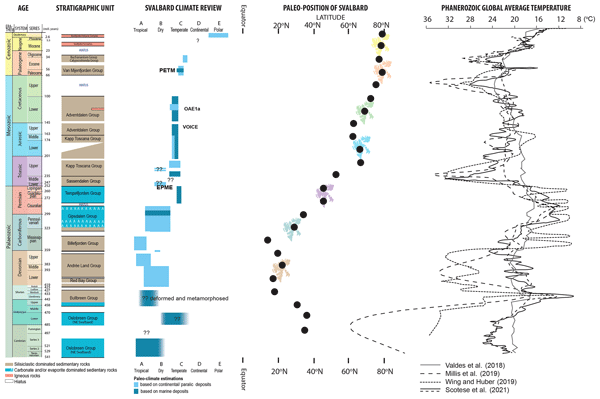
In this review article we present Svalbard’s unique geological archive, revealing its climate history over the last 540 million years. We uncover how this Arctic region recorded key global events, including the End-Permian Mass Extinction, and climate crises like the Paleocene–Eocene Thermal Maximum. The overall climate trend recorded in sedimentary successions in Svalbard is discussed in the context of global climate fluctuations and continuous drift of Svalbard from near equatorial to Arctic latitudes.
Lukas Frank, Jon Albretsen, Ragnheid Skogseth, Frank Nilsen, and Marius O. Jonassen
Ocean Sci., 21, 2419–2442, https://doi.org/10.5194/os-21-2419-2025, https://doi.org/10.5194/os-21-2419-2025, 2025
Short summary
Short summary
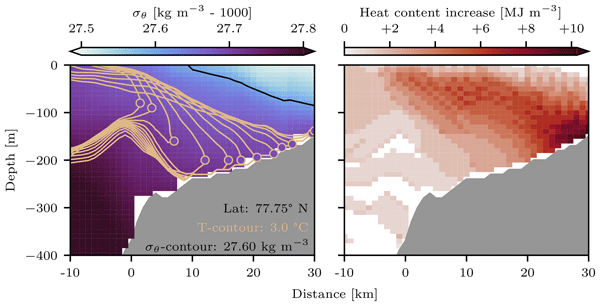
West of Svalbard, warm Atlantic Water frequently deviates from the West Spitsbergen Current onto shallow shelf areas, with significant implications for the regional climate system. The intrusions can be triggered by different processes, but their depths ultimately depend on the density difference between the intruding water and the ambient shelf water. These findings are an important step toward a better understanding of how warm Atlantic Water eventually reaches the fjords of Svalbard.
Peter Betlem, Nil Rodes, Sara Mollie Cohen, and Marie A. Vander Kloet
Geosci. Commun., 8, 51–65, https://doi.org/10.5194/gc-8-51-2025, https://doi.org/10.5194/gc-8-51-2025, 2025
Short summary
Short summary
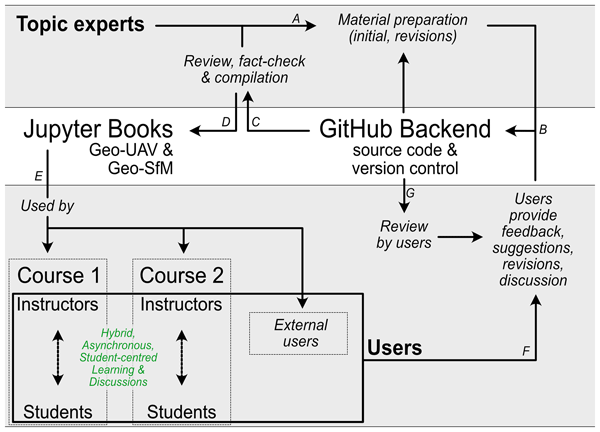
Together with our students, we co-created two open geoscientific course modules using the Jupyter Book framework. Students were happy with the framework's accessibility, inclusivity, interactivity, and multimedia content and eagerly contributed to the educational materials through the GitHub backend when given the opportunity. Our efforts are an important step in the development of geoscientific open educational content co-created by technical experts, social scientists, and students alike.
Kim Senger, Grace Shephard, Fenna Ammerlaan, Owen Anfinson, Pascal Audet, Bernard Coakley, Victoria Ershova, Jan Inge Faleide, Sten-Andreas Grundvåg, Rafael Kenji Horota, Karthik Iyer, Julian Janocha, Morgan Jones, Alexander Minakov, Margaret Odlum, Anna Sartell, Andrew Schaeffer, Daniel Stockli, Marie Annette Vander Kloet, and Carmen Gaina
Geosci. Commun., 7, 267–295, https://doi.org/10.5194/gc-7-267-2024, https://doi.org/10.5194/gc-7-267-2024, 2024
Short summary
Short summary
The article describes a course that we have developed at the University Centre in Svalbard that covers many aspects of Arctic geology. The students experience this course through a wide range of lecturers, focussing both on the small and larger scales and covering many geoscientific disciplines.
Peter Betlem, Thomas Birchall, Gareth Lord, Simon Oldfield, Lise Nakken, Kei Ogata, and Kim Senger
Earth Syst. Sci. Data, 16, 985–1006, https://doi.org/10.5194/essd-16-985-2024, https://doi.org/10.5194/essd-16-985-2024, 2024
Short summary
Short summary
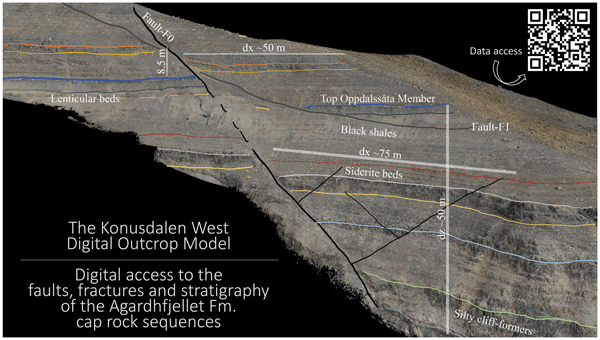
We present the digitalisation (i.e. textured outcrop and terrain models) of the Agardhfjellet Fm. cliffs exposed in Konusdalen West, Svalbard, which forms the seal of a carbon capture site in Longyearbyen, where several boreholes cover the exposed interval. Outcrop data feature centimetre-scale accuracies and a maximum resolution of 8 mm and have been correlated with the boreholes through structural–stratigraphic annotations that form the basis of various numerical modelling scenarios.
Kim Senger, Denise Kulhanek, Morgan T. Jones, Aleksandra Smyrak-Sikora, Sverre Planke, Valentin Zuchuat, William J. Foster, Sten-Andreas Grundvåg, Henning Lorenz, Micha Ruhl, Kasia K. Sliwinska, Madeleine L. Vickers, and Weimu Xu
Sci. Dril., 32, 113–135, https://doi.org/10.5194/sd-32-113-2023, https://doi.org/10.5194/sd-32-113-2023, 2023
Short summary
Short summary
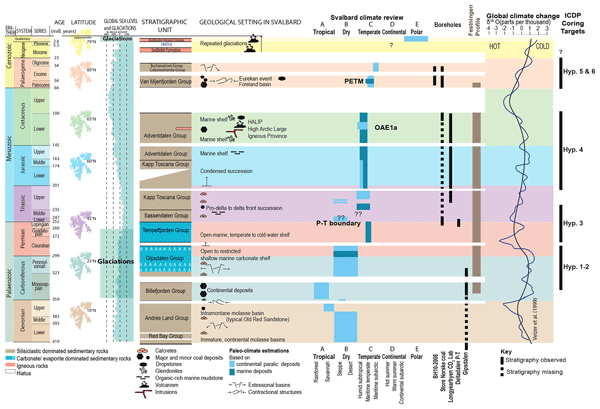
Geologists can decipher the past climates and thus better understand how future climate change may affect the Earth's complex systems. In this paper, we report on a workshop held in Longyearbyen, Svalbard, to better understand how rocks in Svalbard (an Arctic archipelago) can be used to quantify major climatic shifts recorded in the past.
Lukas Frank, Marius Opsanger Jonassen, Teresa Remes, Florina Roana Schalamon, and Agnes Stenlund
Earth Syst. Sci. Data, 15, 4219–4234, https://doi.org/10.5194/essd-15-4219-2023, https://doi.org/10.5194/essd-15-4219-2023, 2023
Short summary
Short summary
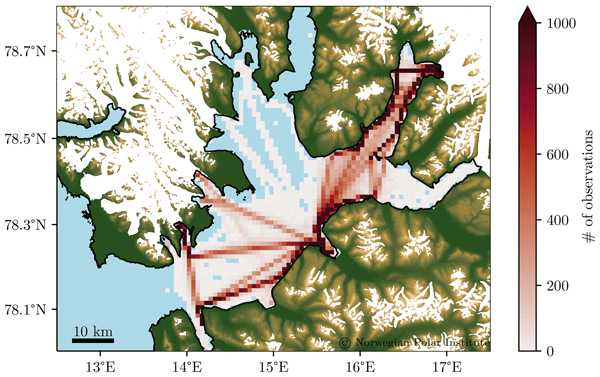
The Isfjorden Weather Information Network (IWIN) provides continuous meteorological near-surface observations from Isfjorden in Svalbard. The network combines permanent automatic weather stations on lighthouses along the coast line with mobile stations on board small tourist cruise ships regularly trafficking the fjord during spring to autumn. All data are available online in near-real time. Besides their scientific value, IWIN data crucially enhance the safety of field activities in the region.

Thomas Goelles, Tobias Hammer, Stefan Muckenhuber, Birgit Schlager, Jakob Abermann, Christian Bauer, Víctor J. Expósito Jiménez, Wolfgang Schöner, Markus Schratter, Benjamin Schrei, and Kim Senger
Geosci. Instrum. Method. Data Syst., 11, 247–261, https://doi.org/10.5194/gi-11-247-2022, https://doi.org/10.5194/gi-11-247-2022, 2022
Short summary
Short summary
We propose a newly developed modular MObile LIdar SENsor System (MOLISENS) to enable new applications for small industrial light detection and ranging (lidar) sensors. MOLISENS supports both monitoring of dynamic processes and mobile mapping applications. The mobile mapping application of MOLISENS has been tested under various conditions, and results are shown from two surveys in the Lurgrotte cave system in Austria and a glacier cave in Longyearbreen on Svalbard.
Kim Senger, Peter Betlem, Sten-Andreas Grundvåg, Rafael Kenji Horota, Simon John Buckley, Aleksandra Smyrak-Sikora, Malte Michel Jochmann, Thomas Birchall, Julian Janocha, Kei Ogata, Lilith Kuckero, Rakul Maria Johannessen, Isabelle Lecomte, Sara Mollie Cohen, and Snorre Olaussen
Geosci. Commun., 4, 399–420, https://doi.org/10.5194/gc-4-399-2021, https://doi.org/10.5194/gc-4-399-2021, 2021
Short summary
Short summary
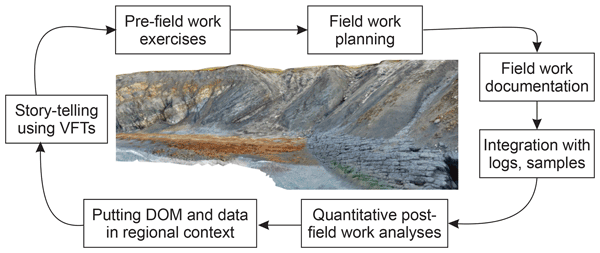
At UNIS, located at 78° N in Longyearbyen in Arctic Norway, we use digital outcrop models (DOMs) actively in a new course (
AG222 Integrated Geological Methods: From Outcrop To Geomodel) to solve authentic geoscientific challenges. DOMs are shared through the open-access Svalbox geoscientific portal, along with 360° imagery, subsurface data and published geoscientific data from Svalbard. Here we share experiences from the AG222 course and Svalbox, both before and during the Covid-19 pandemic.
Cited articles
Betlem, P., Rodés, N., Birchall, T., Dahlin, A., Smyrak-Sikora, A., and Senger, K.: Svalbox Digital Model Database: a geoscientific window into the High Arctic, Geosphere, 19, 1640–1666, https://doi.org/10.1130/GES02606.1, 2023.
Bimba, A. T., Idris, N., Al-Hunaiyyan, A., Ibrahim, S. U., Mustafa, N., Supa'at, I., Zainal, N., and Ahmad, M. Y.: The effects of adaptive feedback on student's learning gains, International Journal of Advanced Computer Science and Applications, 12, 68–80, https://doi.org/10.14569/IJACSA.2021.0120709, 2021.
Bonali, F. L., Russo, E., Vitello, F., Antoniou, V., Marchese, F., Fallati, L., Bracchi, V., Corti, N., Savini, A., Whitworth, M., Drymoni, K., Pasquaré Mariotto, F., Nomikou, P., Sciacca, E., Bressan, S., Falsaperla, S., Reitano, D., van Wyk de Vries, B., Krokos, M., Panieri, G., Stiller-Reeve, M. A., Vizzari, G., Becciani, U., and Tibaldi, A.: How academics and the public experienced immersive virtual reality for geo-education, Geosciences, 12, 9, https://doi.org/10.3390/geosciences12010009, 2022.
Bond, C. E. and Cawood, A. J.: A role for virtual outcrop models in blended learning – improved 3D thinking and positive perceptions of learning, Geosci. Commun., 4, 233–244, https://doi.org/10.5194/gc-4-233-2021, 2021.
Boyle, A., Maguire, S., Martin, A., Milsom, C., Nash, R., Rawlinson, S., Turner, A., Wurthmann, S., and Conchie, S.: Fieldwork is good: the student perception and the affective domain, J. Geogr. Higher Educ., 31, 299–317, https://doi.org/10.1080/03098260601063628, 2007.
Carabajal, I. G., Marshall, A. M., and Atchison, C. L.: A synthesis of instructional strategies in geoscience education literature that address barriers to inclusion for students with disabilities, Journal of Geoscience Education, 65, 531–541, https://doi.org/10.5408/16-211.1, 2017.
Cliffe, A. D.: A review of the benefits and drawbacks to virtual field guides in today's Geoscience higher education environment, International Journal of Educational Technology in Higher Education, 14, 28, https://doi.org/10.1186/s41239-017-0066-x, 2017.
Davis, F. D.: Perceived usefulness, perceived ease of use, and user acceptance of information technology, MIS Quarterly, 13, 319–340, https://doi.org/10.2307/249008, 1989.
Dolphin, G., Dutchak, A., Karchewski, B., and Cooper, J.: Virtual field experiences in introductory geology: addressing a capacity problem, but finding a pedagogical one, Journal of Geoscience Education, 67, 114–130, https://doi.org/10.1080/10899995.2018.1547034, 2019.
Evelpidou, N., Karkani, A., Saitis, G., and Spyrou, E.: Virtual field trips as a tool for indirect geomorphological experience: a case study from the southeastern part of the Gulf of Corinth, Greece, Geosci. Commun., 4, 351–360, https://doi.org/10.5194/gc-4-351-2021, 2021.
Feig, A. D., Atchison, C., Stokes, A., and Gilley, B.: Achieving inclusive field-based education: results and recommendations from an accessible geoscience field trip, Journal of the Scholarship of Teaching and Learning, 19, 66–87, https://doi.org/10.14434/josotl.v19i1.23455, 2019.
Giles, S., Jackson, C., and Stephen, N.: Barriers to fieldwork in undergraduate geoscience degrees, Nature Reviews Earth and Environment, 1, 77–78, https://doi.org/10.1038/s43017-020-0022-5, 2020.
Gray, C. A. and Garand, J. D.: Social stories: improving responses of students with autism with accurate social information, Focus on Autistic Behavior, 8, 1–10, https://doi.org/10.1177/108835769300800101, 1993.
Guillaume, L., Laurent, V., and Genge, M. J.: Immersive and interactive three-dimensional virtual fieldwork: assessing the student learning experience and value to improve inclusivity of geosciences degrees, Journal of Geoscience Education, 71, 462–475, https://doi.org/10.1080/10899995.2023.2200361, 2023.
Hassan, M. A., Habiba, U., Khalid, H., Shoaib, M., and Arshad, S.: An adaptive feedback system to improve student performance based on collaborative behavior, IEEE Access, 7, 107171–107178, https://doi.org/10.1109/ACCESS.2019.2931565, 2019.
Hay, K. E., Marlino, M., and Holschuh, D. R.: The virtual exploratorium: foundational research and theory on the integration of 5-D modeling and visualization in undergraduate geoscience education, in: Proceedings of the International Conference of the Learning Sciences, 14–17 June 2000, Ann Arbor, Michigan, USA, 214–220, https://doi.org/10.4324/9780203763865-48, 2013.
Heimann, S. and Johansson, K.: Gendered work in geoscience: hard work in a masculine field, Gend. Work Organ., 31, 16–35, https://doi.org/10.1111/gwao.13052, 2024.
Horota, R. K., Rossa, P., Marques, A., Gonzaga, L., Senger, K., Cazarin, C. L., Spigolon, A., and Veronez, M. R.: An immersive virtual field experience structuring method for geoscience education, IEEE T. Learn. Technol., 16, 121–132, https://doi.org/10.1109/TLT.2022.3207089, 2022.
Horota, R. K., Senger, K., Rodés, N., Betlem, P., Smyrak-Sikora, A., Jonassen, M. O., Kramer, D., and Braathen, A.: West Spitsbergen fold and thrust belt: a digital educational data package for teaching structural geology, J. Struct. Geol., 167, 104781, https://doi.org/10.1016/j.jsg.2022.104781, 2023.
Horota, R. K., Senger, K., Smyrak-Sikora, A., Furze, M., Retelle, M., Vander Kloet, M. A., and Jonassen, M. O.: VR Svalbard – a photosphere-based atlas of a High Arctic geo-landscape, First Break, 42, 35–42, https://doi.org/10.3997/1365-2397.fb2024029, 2024.
Howell, J. A., Martinius, A. W., and Good, T. R.: The application of outcrop analogues in geological modelling: a review, present status and future outlook, Special Publications, Geological Society, London, 387, 1–25, https://doi.org/10.1144/SP387.12, 2014.
Jakobsson, M., Macnab, R., Mayer, L. A., Anderson, R., Edwards, M., Hatzky, J., Schenke, H. W., and Johnson, P.: An improved bathymetric portrayal of the Arctic Ocean: implications for ocean modeling and geological, geophysical and oceanographic analyses, Geophys. Res. Lett., 35, L07602, https://doi.org/10.1029/2008GL033520, 2008.
Kolb, D. A.: Experiential learning: experience as the source of learning and development, Prentice-Hall, Englewood Cliffs, New Jersey, ISBN 978-0-13-295261-3, 1984.
Lonergan, N. and Andresen, L. W.: Field-based education: some theoretical considerations, High. Educ. Res. Dev., 7, 63–77, https://doi.org/10.1080/0729436880070106, 1988.
Malm, R. H.: What is fieldwork for? Exploring roles of fieldwork in higher education earth science, PhD thesis, University of Oslo, Oslo, Norway, http://hdl.handle.net/10852/82828, 2020.
Malm, R. H., Madsen, L. M., and Lundmark, A. M.: Students' negotiations of belonging in geoscience: experiences of faculty-student interactions when entering university, J. Geogr. Higher Educ., 44, 532–549, https://doi.org/10.1080/03098265.2020.1771683, 2020.
Marín-Spiotta, E., Barnes, R. T., Berhe, A. A., Hastings, M. G., Mattheis, A., Schneider, B., and Williams, B. M.: Hostile climates are barriers to diversifying the geosciences, Adv. Geosci., 53, 117–127, https://doi.org/10.5194/adgeo-53-117-2020, 2020.
Mattheis, A., Marín-Spiotta, E., Nandihalli, S., Schneider, B., and Barnes, R. T.: “Maybe this is just not the place for me”: gender harassment and discrimination in the geosciences, PLoS One, 17, e0268562, https://doi.org/10.1371/journal.pone.0268562, 2022.
Mead, C., Buxner, S., Bruce, G., Taylor, W., Semken, S., and Anbar, A. D.: Immersive, interactive virtual field trips promote science learning, Journal of Geoscience Education, 67, 131–142, https://doi.org/10.1080/10899995.2019.1565285, 2019.
Metzger, E. P.: Reimagining geoscience education for sustainability, Earth Science, Systems and Society, 4, 10116, https://doi.org/10.3389/esss.2024.10116, 2024.
Mol, L. and Atchison, C.: Image is everything: educator awareness of perceived barriers for students with physical disabilities in geoscience degree programs, J. Geogr. Higher Educ., 43, 544–567, https://doi.org/10.1080/03098265.2019.1660862, 2019.
Moysey, S. M. J. and Lazar, K. B.: Using virtual reality as a tool for field-based learning in the earth sciences, in: Interdisciplinary Perspectives on Virtual Place-Based Learning, edited by: Lansiquot, R. D. and MacDonald, S. P., Palgrave Pivot, Cham, 99–126, https://doi.org/10.1007/978-3-030-32471-1_7, 2019.
Núñez, A. M., Posselt, J. R., Hallmark, T., Rivera, J., and Southern, D.: The organization of learning in geoscience fieldwork and implications for inclusion, Journal of Women and Minorities in Science and Engineering, 27, 33–60, https://doi.org/10.1615/JWomenMinorScienEng.2021031264, 2021.
Olaussen, S., Grundvåg, S. A., Senger, K., Anell, I., Betlem, P., Birchall, T., Braathen, A., Dallmann, W., Jochmann, M., Johannessen, E. P., and Lord, G.: Svalbard Composite Tectono-Sedimentary Element, Barents Sea, Geological Society, London, Memoirs, 57, https://doi.org/10.1144/M57-2021-36, 2025.
Posselt, J. R. and Nuñez, A.-M.: Learning in the wild: fieldwork, gender, and the social construction of disciplinary culture, J. High. Educ., 93, 163–194, https://doi.org/10.1080/00221546.2021.1971505, 2022.
Pugsley, J. H., Howell, J. A., Hartley, A., Buckley, S. J., Brackenridge, R., Schofield, N., Maxwell, G., Chmielewska, M., Ringdal, K., Naumann, N., and Vanbiervliet, J.: Virtual field trips utilizing virtual outcrop: construction, delivery and implications for the future, Geosci. Commun., 5, 227–249, https://doi.org/10.5194/gc-5-227-2022, 2022.
Pugsley, J. H., Howell, J. A., Hartley, A. J., Buckley, S. J., Chmielewska, M., Naumann, N., Schofield, N. J., and Brackenridge, R.: Quantifying virtual field trip efficiency, PFG – Journal of Photogrammetry, Remote Sensing and Geoinformation Science, 92, 679–690, https://doi.org/10.1007/s41064-024-00321-y, 2024.
Senger, K., Betlem, P., Grundvåg, S.-A., Horota, R. K., Buckley, S. J., Smyrak-Sikora, A., Jochmann, M. M., Birchall, T., Janocha, J., Ogata, K., Kuckero, L., Johannessen, R. M., Lecomte, I., Cohen, S. M., and Olaussen, S.: Teaching with digital geology in the high Arctic: opportunities and challenges, Geosci. Commun., 4, 399–420, https://doi.org/10.5194/gc-4-399-2021, 2021.
Senger, K., Ammerlaan, F., Betlem, P., Dumais, M.-A., Eagles, G., Foster, W., Geissler, W. H., Grundvåg, S.-A., Hudson, A., Horota, R. K., Hurum, J. H., Jones, M., Kierulf, H. P., Majka, J., Marsden, L., Michalski, K., Minakov, A., Ogata, K., Olaussen, S., Osmundsen, P. T., Planke, S., Ruppel, A., Sartell, A. M. R., Shephard, G., Śliwińska, K. K., Smeraglia, L., Smyrak-Sikora, A., Spiegel-Behnke, C., and Zuchuat, V.: Geology of Svalbard: Deep-time and Deep-Earth (SVALGEOL), in: SESS Report 2024: The State of Environmental Science in Svalbard – an annual report, edited by: Runge, E., Neuber, R., Łupikasza, E., Hübner, C., and Holmén, K., Svalbard Integrated Arctic Earth Observing System, Longyearbyen, https://doi.org/10.5281/zenodo.14425478, 2025.
Stainfield, J., Fisher, P., Ford, B., and Solem, M.: International virtual field trips: a new direction?, J. Geogr. Higher Educ., 24, 255–262, https://doi.org/10.1080/713677387, 2000.
Stokes, A., Feig, A. D., Atchison, C. L., and Gilley, B.: Making geoscience fieldwork inclusive and accessible for students with disabilities, Geosphere, 15, 1809–1825, https://doi.org/10.1130/GES02006.1, 2019.
Stokes, P. J., Levine, R., and Flessa, K. W.: Choosing the geoscience major: important factors, race/ethnicity, and gender, Journal of Geoscience Education, 63, 250–263, https://doi.org/10.5408/14-038.1, 2015.
Stott, T., Litherland, K., Carmichael, P., and Nuttall, A. M.: Using interactive virtual field guides and linked data in geoscience teaching and learning, in: Geoscience Research and Education: Teaching at Universities, edited by: Tong, V. C. H., Springer, Dordrecht, 163–188, https://doi.org/10.1007/978-94-007-6946-5_13, 2014.
Suthren, R. J.: Virtual posters and virtual essays in geoscience courses, Comput. Geosci.-UK, 24, 665–671, https://doi.org/10.1016/S0098-3004(98)00045-4, 1998.
Venkatesh, V. and Bala, H.: Technology Acceptance Model 3 and a research agenda on interventions, Decision Sci., 39, 273–315, https://doi.org/10.1111/j.1540-5915.2008.00192.x, 2008.
Westoby, M. J., Brasington, J., Glasser, N. F., Hambrey, M. J., and Reynolds, J. M.: “Structure-from-Motion” photogrammetry: a low-cost, effective tool for geoscience applications, Geomorphology, 179, 300–314, https://doi.org/10.1016/j.geomorph.2012.08.021, 2012.
Whitmeyer, S., Atchison, C., and Collins, T.: Using mobile technologies to enhance accessibility and inclusion in field-based learning, GSA Today, 30, 4–10, https://doi.org/10.1130/GSATG462A.1, 2020.
Short summary
We explored how virtual tools can help students prepare for and reflect on outdoor learning in the Arctic. Using surveys from university courses in Svalbard, we found that digital field visits helped students feel more confident, better understand the landscape, and learn more effectively. These tools do not replace real fieldwork but make it more accessible and inclusive. Our research shows how technology can support hands-on learning in remote environments.
We explored how virtual tools can help students prepare for and reflect on outdoor learning in...


Altmetrics
Final-revised paper
Preprint