Articles | Volume 9, issue 2
https://doi.org/10.5194/gc-9-185-2026
© Author(s) 2026. This work is distributed under
the Creative Commons Attribution 4.0 License.

https://doi.org/10.5194/gc-9-185-2026
© Author(s) 2026. This work is distributed under
the Creative Commons Attribution 4.0 License.
Multi-hazard risk assessment and management: pathways for the Sendai Framework and beyond
Timothy Tiggeloven

CORRESPONDING AUTHOR
Institute for Environmental Studies, Vrije Universiteit Amsterdam, Amsterdam, the Netherlands
CMCC Foundation – Euro-Mediterranean Center on Climate Change, Venice, Italy
Colin Raymond
Joint Institute for Regional Earth System Science and Engineering, University of California, Los Angeles, California, USA
Marleen C. de Ruiter
Institute for Environmental Studies, Vrije Universiteit Amsterdam, Amsterdam, the Netherlands
Jana Sillmann
Research Unit Sustainability and Climate Risk, Center for Earth System Research and Sustainability (CEN), Universität Hamburg, 20144 Hamburg, Germany
CICERO, Center for International Climate Research, Oslo, Norway
Annegret H. Thieken
Institute of Environmental Science and Geography, University of Potsdam, Potsdam, Germany
Sophie L. Buijs
Institute for Environmental Studies, Vrije Universiteit Amsterdam, Amsterdam, the Netherlands
Roxana Ciurean
British Geological Survey, NG12 5GG, Keyworth, UK
Emma Cordier
Wetlands International Europe, Brussels, Belgium
Julia M. Crummy
British Geological Survey, NG12 5GG, Keyworth, UK
Lydia Cumiskey
MaREI Centre, Sustainability Institute, University College Cork, Cork, Ireland
Kelley De Polt
Department of Biogeochemical Integration, Max Planck Institute for Biogeochemistry, Jena, Germany
Institute for Environmental Studies, Vrije Universiteit Amsterdam, Amsterdam, the Netherlands
Melanie Duncan
British Geological Survey, NG12 5GG, Keyworth, UK
Davide M. Ferrario
CMCC Foundation – Euro-Mediterranean Center on Climate Change, Venice, Italy
Wiebke S. Jäger
Institute for Environmental Studies, Vrije Universiteit Amsterdam, Amsterdam, the Netherlands
Elco E. Koks
Institute for Environmental Studies, Vrije Universiteit Amsterdam, Amsterdam, the Netherlands
Nicole van Maanen
Institute for Environmental Studies, Vrije Universiteit Amsterdam, Amsterdam, the Netherlands
Heather J. Murdock
Institute of Environmental Science and Geography, University of Potsdam, Potsdam, Germany
Jaroslav Mysiak
CMCC Foundation – Euro-Mediterranean Center on Climate Change, Venice, Italy
Sadhana Nirandjan
Institute for Environmental Studies, Vrije Universiteit Amsterdam, Amsterdam, the Netherlands
Benjamin Poschlod
Research Unit Sustainability and Climate Risk, Center for Earth System Research and Sustainability (CEN), Universität Hamburg, 20144 Hamburg, Germany
Peter Priesmeier
Institute for the Protection of Terrestrial Infrastructures, German Aerospace Center (DLR), Sankt Augustin, Germany
Nivedita Sairam
Section 4.4 Hydrology, GFZ German Research Centre for Geosciences, Potsdam, Germany
Pia-Johanna Schweizer
RIFS Research Institute for Sustainability at GFZ Helmholtz Centre for Geosciences, Potsdam, Germany
Tristian R. Stolte
Institute for Environmental Studies, Vrije Universiteit Amsterdam, Amsterdam, the Netherlands
Marie-Luise Zenker
Institute of Environmental Science and Geography, University of Potsdam, Potsdam, Germany
James E. Daniell
Risklayer GmbH, Karlsruhe, Germany
Alexander Fekete
Institute of Rescue Engineering and Civil Protection, TH Köln – University of Applied Sciences, Cologne, Germany
Christian M. Geiß
German Remote Sensing Data Center, German Aerospace Center (DLR), Oberpfaffenhofen, Germany
Department of Geography, University of Bonn, 53115 Bonn, Germany
Marc J. C. van den Homberg
Netherlands Red Cross' data and digital team 510, The Hague, the Netherlands
ITC/Faculty of Geo-Information Science and Earth Observation, University of Twente, Twente, the Netherlands
Sirkku K. Juhola
University of Helsinki, Helsinki, Finland
Christian Kuhlicke
Helmholtz Centre for Environmental Research – UFZ, Department Urban and Environmental Sociology, Leipzig, Germany
Karen Lebek
Institute of Environmental Science and Geography, University of Potsdam, Potsdam, Germany
Robert Šakić Trogrlić
International Institute for Applied Systems Analysis (IIASA), Laxenburg, Austria
Stefan Schneiderbauer
United Nations University – Institute for Environment and Human Security, Bonn, Germany
Eurac Research, Bolzano, Italy
Department of Geography, Qwaqwa Campus, University of the Free State, Bloemfontein, South Africa
International Research Institute of Disaster Science, Tohoku University, Sendai, Japan
Silvia Torresan
CMCC Foundation – Euro-Mediterranean Center on Climate Change, Venice, Italy
Cees J. van Westen
ITC/Faculty of Geo-Information Science and Earth Observation, University of Twente, Twente, the Netherlands
Judith N. Claassen
Institute for Environmental Studies, Vrije Universiteit Amsterdam, Amsterdam, the Netherlands
Bijan Khazai
Risklayer GmbH, Karlsruhe, Germany
Virginia Murray
UK Health Security Agency, London, UK
Julius Schlumberger
Institute for Environmental Studies, Vrije Universiteit Amsterdam, Amsterdam, the Netherlands
Deltares, Delft, the Netherlands
Philip J. Ward
Institute for Environmental Studies, Vrije Universiteit Amsterdam, Amsterdam, the Netherlands
Deltares, Delft, the Netherlands
Related authors
Philip J. Ward, Sophie L. Buijs, Roxana Ciurean, Judith N. Claassen, James Daniell, Kelley De Polt, Melanie Duncan, Stefania Gottardo, Stefan Hochrainer-Stigler, Robert Šakić Trogrlić, Julius Schlumberger, Timothy Tiggeloven, Silvia Torresan, Nicole van Maanen, Andrew Warren, Carmen D. Álvarez-Albelo, Vanessa Banks, Benjamin Blanz, Veronica Casartelli, Jordan Correa, Julia Crummy, Anne Sophie Daloz, Marleen C. de Ruiter, Juan José Díaz-Hernández, Jaime Díaz-Pacheco, Pedro Dorta Antequera, Davide Ferrario, David Geurts, Sara García-González, Joel C. Gill, Raúl Hernández-Martín, Wiebke S. Jäger, Abel López-Díez, Lin Ma, Jaroslav Mysiak, Diep Ngoc Nguyen, Noemi Padrón Fumero, Eva-Cristina Petrescu, Karina Reiter, Jana Sillmann, Lara Smale, and Tristian Stolte
Nat. Hazards Earth Syst. Sci., 26, 1325–1345, https://doi.org/10.5194/nhess-26-1325-2026, https://doi.org/10.5194/nhess-26-1325-2026, 2026
Short summary
Short summary
Disasters often result from interactions between different hazards, like floods triggering landslides, or earthquakes followed by tropical cyclones, so-called multi-hazards. People and societies are increasingly exposed and vulnerable to these multi-hazards. Assessing these aspects is referred to as multi-risk assessment and management. In this paper we synthesise key learnings from the MYRIAD-EU (Multi-hazard and sYstemic framework for enhancing Risk-Informed mAnagement and Decision-making in the E.U.) project, reflecting on progress and challenges faced in addressing multi-hazards and multi-risk.
Gwendoline Ducros, Timothy Tiggeloven, Lin Ma, Anne Sophie Daloz, Nina Schuhen, Judith Claassen, and Marleen C. de Ruiter
Nat. Hazards Earth Syst. Sci., 25, 4693–4712, https://doi.org/10.5194/nhess-25-4693-2025, https://doi.org/10.5194/nhess-25-4693-2025, 2025
Short summary
Short summary
Our study finds that heatwave, drought and wildfire events occurring simultaneously in Scandinavia are pronounced in the summer months; and the heat-drought 2018 event led to a drop in gross domestic product, affecting agriculture and forestry imports, further impacting Europe's trade balance. This research shows the importance of ripple effects of multi-hazard, and that forest management and adaptation measures are vital to reducing the risks of heat-related multi-hazards in vulnerable areas.
Tim H. J. Hermans, Chiheb Ben Hammouda, Simon Treu, Timothy Tiggeloven, Anaïs Couasnon, Julius J. M. Busecke, and Roderik S. W. van de Wal
Nat. Hazards Earth Syst. Sci., 25, 4593–4612, https://doi.org/10.5194/nhess-25-4593-2025, https://doi.org/10.5194/nhess-25-4593-2025, 2025
Short summary
Short summary
We studied the performance of different types of neural networks at predicting extreme storm surges. We found that that performance improves when during model training, storm surges that are rarer are given a higher weight than moderate storm surges. Additionally, we found that the performance of some of the neural networks approaches that of a state-of-the-art hydrodynamic model. This is promising for the future application of neural networks to climate model simulations.
Wiebke S. Jäger, Marleen C. de Ruiter, Timothy Tiggeloven, and Philip J. Ward
Nat. Hazards Earth Syst. Sci., 25, 2751–2769, https://doi.org/10.5194/nhess-25-2751-2025, https://doi.org/10.5194/nhess-25-2751-2025, 2025
Short summary
Short summary
Multiple hazards, occurring simultaneously or consecutively, can have more extreme impacts than single hazards. We examined the disaster records in the global emergency events database EM-DAT to better understand this phenomenon. We developed a method to identify such multi-hazards and analysed their reported impacts using statistics. Multi-hazards have accounted for a disproportionate number of the impacts, but there appear to be different archetypal patterns in which the impacts compound.
Nicole van Maanen, Joël J.-F. G. De Plaen, Timothy Tiggeloven, Maria Luisa Colmenares, Philip J. Ward, Paolo Scussolini, and Elco Koks
Nat. Hazards Earth Syst. Sci., 25, 2075–2080, https://doi.org/10.5194/nhess-25-2075-2025, https://doi.org/10.5194/nhess-25-2075-2025, 2025
Short summary
Short summary
Understanding coastal flood protection is vital for assessing risks from natural disasters and climate change. However, current global data on coastal flood protection are limited and based on simplified assumptions, leading to potential uncertainties in risk estimates. As a step in this direction, we propose a comprehensive dataset, COASTtal flood PROtection Standards within EUrope (COASTPROS-EU), which compiles coastal flood protection standards in Europe.
Eric Mortensen, Timothy Tiggeloven, Toon Haer, Bas van Bemmel, Dewi Le Bars, Sanne Muis, Dirk Eilander, Frederiek Sperna Weiland, Arno Bouwman, Willem Ligtvoet, and Philip J. Ward
Nat. Hazards Earth Syst. Sci., 24, 1381–1400, https://doi.org/10.5194/nhess-24-1381-2024, https://doi.org/10.5194/nhess-24-1381-2024, 2024
Short summary
Short summary
Current levels of coastal flood risk are projected to increase in coming decades due to various reasons, e.g. sea-level rise, land subsidence, and coastal urbanization: action is needed to minimize this future risk. We evaluate dykes and coastal levees, foreshore vegetation, zoning restrictions, and dry-proofing on a global scale to estimate what levels of risk reductions are possible. We demonstrate that there are several potential adaptation pathways forward for certain areas of the world.
Philip J. Ward, James Daniell, Melanie Duncan, Anna Dunne, Cédric Hananel, Stefan Hochrainer-Stigler, Annegien Tijssen, Silvia Torresan, Roxana Ciurean, Joel C. Gill, Jana Sillmann, Anaïs Couasnon, Elco Koks, Noemi Padrón-Fumero, Sharon Tatman, Marianne Tronstad Lund, Adewole Adesiyun, Jeroen C. J. H. Aerts, Alexander Alabaster, Bernard Bulder, Carlos Campillo Torres, Andrea Critto, Raúl Hernández-Martín, Marta Machado, Jaroslav Mysiak, Rene Orth, Irene Palomino Antolín, Eva-Cristina Petrescu, Markus Reichstein, Timothy Tiggeloven, Anne F. Van Loon, Hung Vuong Pham, and Marleen C. de Ruiter
Nat. Hazards Earth Syst. Sci., 22, 1487–1497, https://doi.org/10.5194/nhess-22-1487-2022, https://doi.org/10.5194/nhess-22-1487-2022, 2022
Short summary
Short summary
The majority of natural-hazard risk research focuses on single hazards (a flood, a drought, a volcanic eruption, an earthquake, etc.). In the international research and policy community it is recognised that risk management could benefit from a more systemic approach. In this perspective paper, we argue for an approach that addresses multi-hazard, multi-risk management through the lens of sustainability challenges that cut across sectors, regions, and hazards.
Michel Bechtold, Benjamin Poschlod, Christian Otto, Jan Volkholz, Matthias Büchner, and Florian Zabel
Earth Syst. Sci. Data Discuss., https://doi.org/10.5194/essd-2026-227, https://doi.org/10.5194/essd-2026-227, 2026
Preprint under review for ESSD
Short summary
Short summary
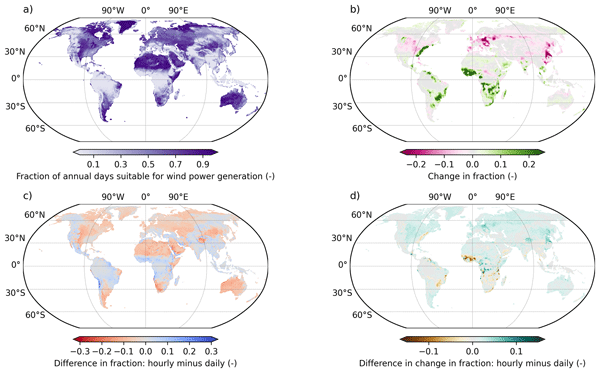
Many climate impacts depend on weather changes within a single day, but most studies still use daily averages. We created a new global hourly climate data set by disaggregating established daily records while keeping them physically consistent. The data reveal clearer patterns in rainfall timing, dangerous heat exposure, and wind and sunlight for energy, and are also very important for land surface modeling, where hourly input improves water and energy balance simulations.
Federico Moss, Yelena Mejova, Andreas Kaltenbrunner, Tristan Downing, Marc van den Homberg, Pauline Ndirangu, Leonardo Milano, and Kyriaki Kalimeri
EGUsphere, https://doi.org/10.5194/egusphere-2026-1996, https://doi.org/10.5194/egusphere-2026-1996, 2026
This preprint is open for discussion and under review for Natural Hazards and Earth System Sciences (NHESS).
Short summary
Short summary
This study explores how to better predict the real impacts of tropical cyclones on people, not just the strength of the storm. Using openly available global data, we developed a method to estimate how many people may be affected in different areas. We find that combining data-driven models with simple rules gives the most reliable results. This approach can help improve early warnings and support faster, more targeted disaster response, potentially reducing harm to vulnerable communities.
Detlef P. Van Vuuren, Brian C. O'Neill, Claudia Tebaldi, Benjamin M. Sanderson, Louise P. Chini, Pierre Friedlingstein, Tomoko Hasegawa, Keywan Riahi, Bala Govindasamy, Nico Bauer, Veronika Eyring, Cheikh M. N. Fall, Katja Frieler, Matthew J. Gidden, Laila K. Gohar, Annika Högner, Andrew D. Jones, Jarmo Kikstra, Andrew King, Reto Knutti, Elmar Kriegler, Peter Lawrence, Chris Lennard, Jason Lowe, Camilla Mathison, Shahbaz Mehmood, Zebedee Nicholls, Luciana F. Prado, Qiang Zhang, Steven K. Rose, Alex C. Ruane, Marit Sandstad, Carl-Friedrich Schleussner, Roland Seferian, Jana Sillmann, Chris Smith, Anna A. Sörensson, Swapna Panickal, Kaoru Tachiiri, Naomi Vaughan, Saritha S. Vishwanathan, Tokuta Yokohata, Marco Zecchetto, and Tilo Ziehn
Geosci. Model Dev., 19, 2627–2656, https://doi.org/10.5194/gmd-19-2627-2026, https://doi.org/10.5194/gmd-19-2627-2026, 2026
Short summary
Short summary
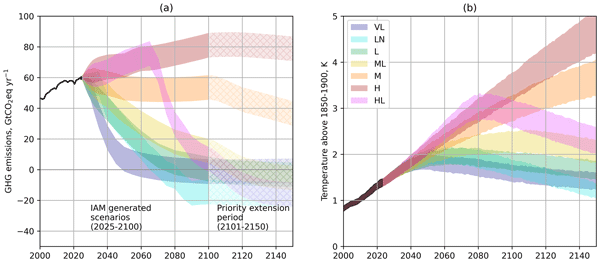
We propose a set of seven plausible 21st century emission scenarios, and their multi-century extensions, that will be used by the international community of climate modeling centers to produce the next generation of climate projections. These projections will support climate, impact and mitigation researchers, provide information to practitioners to address future risks from climate change, and contribute to policymakers’ considerations of the trade-offs among various levels of mitigation.
Philip J. Ward, Marleen C. de Ruiter, Kees Boersma, Tomris Cesuroglu, Nathan Clark, Tina Comes, Ashok Dahal, Sonja Fransen, Jasper Verschuur, Carmen Anthonj, Srijith Balakrishnan, Jens de Bruijn, Eefje Hendriks, Rodrigo Mena Fluhmann, Goda Perlaviciute, Linda Steg, Marc van den Homberg, Cees van Westen, Funda Atun, Anja Schreijer, and Nicole van Maanen
EGUsphere, https://doi.org/10.5194/egusphere-2026-1331, https://doi.org/10.5194/egusphere-2026-1331, 2026
This preprint is open for discussion and under review for Natural Hazards and Earth System Sciences (NHESS).
Short summary
Short summary
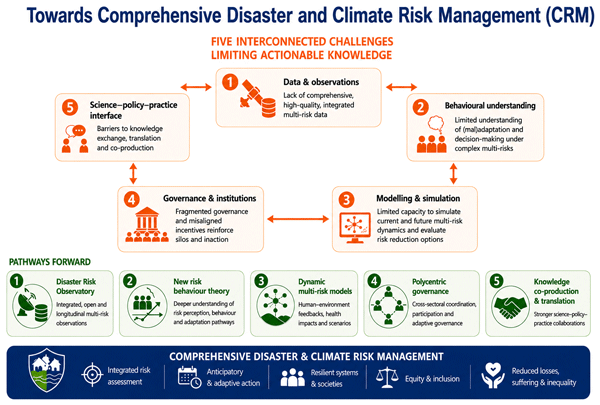
We explore five core challenges that need to be addressed in order to move towards the Comprehensive Disaster and Climate Risk Management approach. This approach has been proposed within the newly emerging paradigm of a more holistic approach to managing the risks associated with climatic and/or non-climatic hazards and non-climatic risk drivers. We elaborate on each challenge, discuss why they matter for comprehensive disaster risk management, and provide ideas of how to overcome them.
Tim Busker, Daniela Rodriguez Castro, Sergiy Vorogushyn, Jaap Kwadijk, Davide Zoccatelli, Rafaella G. L. Oliveira, Heather J. Murdock, Laurent Pfister, Benjamin Dewals, Kymo Slager, Annegret H. Thieken, Jan Verkade, Patrick Willems, and Jeroen C. J. H. Aerts
Nat. Hazards Earth Syst. Sci., 26, 1457–1478, https://doi.org/10.5194/nhess-26-1457-2026, https://doi.org/10.5194/nhess-26-1457-2026, 2026
Short summary
Short summary
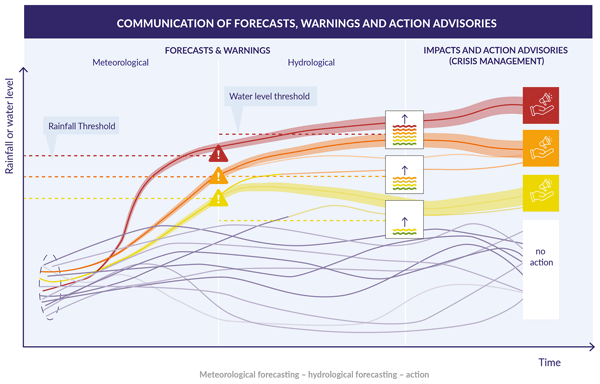
In July 2021, the Netherlands, Luxembourg, Germany, and Belgium were hit by an extreme flood event with over 200 fatalities. Our study provides, for the first time, critical insights into the operational flood early-warning systems in this entire region. Based on 14 expert interviews, we conclude that the systems strongly improved in all countries. Interviewees stressed the need for operational impact-based forecasts, but emphasized that its operational implementation is challenging.
Philip J. Ward, Sophie L. Buijs, Roxana Ciurean, Judith N. Claassen, James Daniell, Kelley De Polt, Melanie Duncan, Stefania Gottardo, Stefan Hochrainer-Stigler, Robert Šakić Trogrlić, Julius Schlumberger, Timothy Tiggeloven, Silvia Torresan, Nicole van Maanen, Andrew Warren, Carmen D. Álvarez-Albelo, Vanessa Banks, Benjamin Blanz, Veronica Casartelli, Jordan Correa, Julia Crummy, Anne Sophie Daloz, Marleen C. de Ruiter, Juan José Díaz-Hernández, Jaime Díaz-Pacheco, Pedro Dorta Antequera, Davide Ferrario, David Geurts, Sara García-González, Joel C. Gill, Raúl Hernández-Martín, Wiebke S. Jäger, Abel López-Díez, Lin Ma, Jaroslav Mysiak, Diep Ngoc Nguyen, Noemi Padrón Fumero, Eva-Cristina Petrescu, Karina Reiter, Jana Sillmann, Lara Smale, and Tristian Stolte
Nat. Hazards Earth Syst. Sci., 26, 1325–1345, https://doi.org/10.5194/nhess-26-1325-2026, https://doi.org/10.5194/nhess-26-1325-2026, 2026
Short summary
Short summary
Disasters often result from interactions between different hazards, like floods triggering landslides, or earthquakes followed by tropical cyclones, so-called multi-hazards. People and societies are increasingly exposed and vulnerable to these multi-hazards. Assessing these aspects is referred to as multi-risk assessment and management. In this paper we synthesise key learnings from the MYRIAD-EU (Multi-hazard and sYstemic framework for enhancing Risk-Informed mAnagement and Decision-making in the E.U.) project, reflecting on progress and challenges faced in addressing multi-hazards and multi-risk.
Thi Dieu My Pham, Paul Hudson, Annegret H. Thieken, and Philip Bubeck
Nat. Hazards Earth Syst. Sci., 26, 1207–1230, https://doi.org/10.5194/nhess-26-1207-2026, https://doi.org/10.5194/nhess-26-1207-2026, 2026
Short summary
Short summary
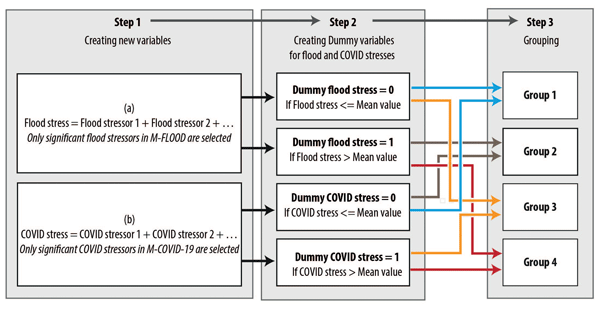
Experiencing severe flooding and COVID-19 together adversely affects mental health. A 2020 survey in Vietnam found that 20 % of participants experienced mental distress, whereas 80 % did not. Flood risk factors include livelihood difficulties, seeing dead human bodies, and being rescued; COVID-19 stressors relate to individual health impacts and interrupted education. These findings highlight the need to address health risks from multiple sources and provide more support for at-risk communities.
Benjamin Poschlod, Laura Sailer, Alexander Sasse, Anastasia Vogelbacher, and Ralf Ludwig
Hydrol. Earth Syst. Sci., 30, 1165–1188, https://doi.org/10.5194/hess-30-1165-2026, https://doi.org/10.5194/hess-30-1165-2026, 2026
Short summary
Short summary
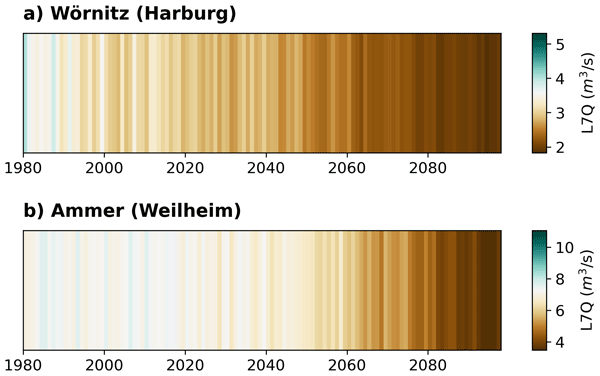
Europe was hit by severe droughts in recent years resulting in extreme low flow conditions in rivers. Here, we investigate future climate change effects on river droughts in Bavaria. We find increasing severity for the low peak discharge and low flow duration in a warmer climate. This is caused by hotter and drier summers, where the joint occurrence of heat and drought intensifies. Further, we show that conditions in the year before the drought gain more importance in a warmer climate.
Alina Bill-Weilandt, Nivedita Sairam, Dennis Wagenaar, Kasra Rafiezadeh Shahi, Heidi Kreibich, Perrine Hamel, and David Lallemant
Nat. Hazards Earth Syst. Sci., 26, 925–942, https://doi.org/10.5194/nhess-26-925-2026, https://doi.org/10.5194/nhess-26-925-2026, 2026
Short summary
Short summary
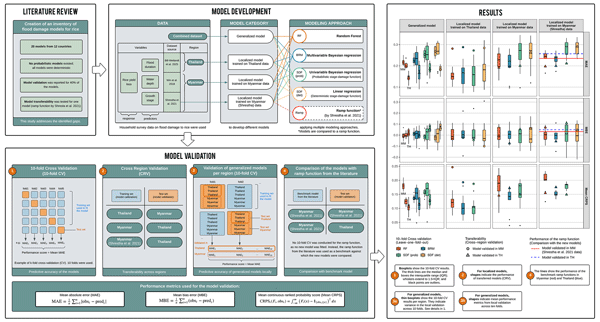
Flooding is a major cause of agricultural loss globally. This study evaluates and compares flood damage models for rice crops. We present an inventory with 20 models from 12 countries, representing the most comprehensive review of such models for rice to date. The study offers practical guidance on model selection and expected errors when transferring models across regions. We provide models and lookup tables that can be used in flood risk assessments in rice-producing regions.
Karen Eva Lebek and Annegret Henriette Thieken
EGUsphere, https://doi.org/10.5194/egusphere-2026-645, https://doi.org/10.5194/egusphere-2026-645, 2026
This preprint is open for discussion and under review for Geoscience Communication (GC).
Short summary
Short summary
As disasters worsen worldwide, "forensic" analysis is vital to uncover their root causes. This study evaluates a program at the University of Potsdam where PhD candidates formed rapid-response Task Forces to investigate recent events. We found this approach serves a dual purpose: it offers students hands-on, "real-world" training while providing the expert workforce needed for quick post-disaster research. To succeed, we suggest using diverse teams and providing early, targeted support.
Yamile Villafani, Heiko Apel, Laurens J. N. Oostwegel, Thi Thao Nguyen Huynh, Hong Quan Nguyen, Nigel K. Downes, Andrea Cominola, and Nivedita Sairam
EGUsphere, https://doi.org/10.5194/egusphere-2026-850, https://doi.org/10.5194/egusphere-2026-850, 2026
This preprint is open for discussion and under review for Natural Hazards and Earth System Sciences (NHESS).
Short summary
Short summary
Flooding is an increasing threat in fast-growing cities, disrupting daily life, damaging homes, and raising disease risks from contaminated water. In Can Tho City, Vietnam, this study estimates household financial damage and the spread of harmful pathogens in floodwaters, then combines these impacts to identify neighborhoods at greatest risk. The results help planners target protection and support where it is most needed.
Maša Ann, Jörn Behrens, and Jana Sillmann
Nonlin. Processes Geophys., 33, 85–102, https://doi.org/10.5194/npg-33-85-2026, https://doi.org/10.5194/npg-33-85-2026, 2026
Short summary
Short summary
We present a new framework based on Dynamic Mode Decomposition (DMD) to better detect outliers and model extremes. Unlike standard DMD, which focuses on average system behaviour, our approach targets rare, exceptional dynamics. Applied to climate data, it improves extreme event approximation and reveals meaningful spatiotemporal patterns. The method may generalise to other types of extremes.
Nina Schuhen, Carley E. Iles, Marit Sandstad, Viktor Ananiev, and Jana Sillmann
Nat. Hazards Earth Syst. Sci., 26, 753–773, https://doi.org/10.5194/nhess-26-753-2026, https://doi.org/10.5194/nhess-26-753-2026, 2026
Short summary
Short summary
As climate changes, extremes are becoming increasingly frequent. We investigate the time of emergence for a large range of different extremes, meaning the earliest time when a significant change in these extremes can be detected beyond natural variability, whether in the past or in the future. The results are based on 21 global climate models and show considerable differences between regions, types of indices and emissions scenarios, as well as between temperature and precipitation extremes.
Heather J. Murdock, Daniela Rodriguez Castro, Benjamin Dewals, Anna Heidenreich, and Annegret H. Thieken
EGUsphere, https://doi.org/10.5194/egusphere-2025-6376, https://doi.org/10.5194/egusphere-2025-6376, 2026
This preprint is open for discussion and under review for Natural Hazards and Earth System Sciences (NHESS).
Short summary
Short summary
In July 2021, a severe flood occurred in the Walloon Region of Belgium, causing tragic losses and raising concerns about the warning system. With household survey data, we find that many affected people did not receive warnings and did not know how to respond. Statistical models show that information reception and demographic variables among other factors influence response behaviour. These findings highlight the importance of considering behaviour to enhance flood warning and response.
Huazhi Li, Robert A. Jane, Dirk Eilander, Alejandra R. Enríquez, Toon Haer, and Philip J. Ward
Nat. Hazards Earth Syst. Sci., 26, 391–409, https://doi.org/10.5194/nhess-26-391-2026, https://doi.org/10.5194/nhess-26-391-2026, 2026
Short summary
Short summary
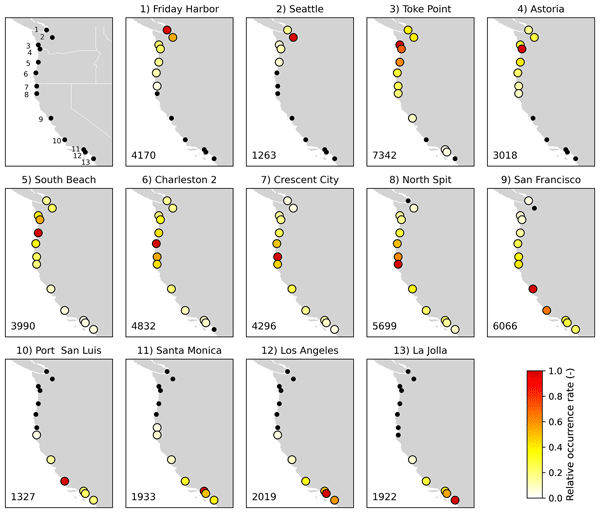
We assess the likelihood of widespread compound flooding along the U.S. coastline. Using a large set of generated plausible events preserving observed dependence, we find that nearly half of compound floods on the West coast affect multiple sites. Such events are rarer on the East coast while most compound events affect single sites on the Gulf coast. Our results underscore the importance of including spatial dependence in compound flood risk assessment and can help in better risk management.
Ravikumar Guntu, Guilherme Samprogna Mohor, Annegret H. Thieken, Meike Müller, and Heidi Kreibich
Nat. Hazards Earth Syst. Sci., 26, 163–186, https://doi.org/10.5194/nhess-26-163-2026, https://doi.org/10.5194/nhess-26-163-2026, 2026
Short summary
Short summary
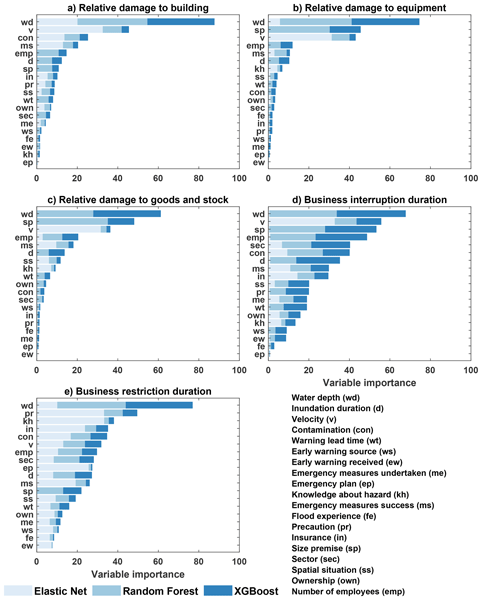
The 2021 flood in Germany caused severe damage to companies, with over half reporting losses above € 100 000. Using probabilistic models, we identify key factors driving direct damage and business interruption. Water depth, flow velocity and company exposure were key factors, but preparedness played a crucial role. Companies that took good precaution recovered faster. Our findings stress the value of early warnings and risk communication to reduce damage from unprecedented flood events.
Nivedita Sairam and Marleen C. de Ruiter
Nat. Hazards Earth Syst. Sci., 26, 119–130, https://doi.org/10.5194/nhess-26-119-2026, https://doi.org/10.5194/nhess-26-119-2026, 2026
Short summary
Short summary
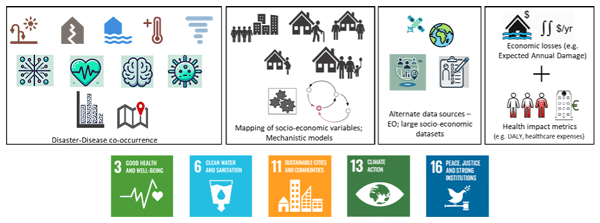
This paper highlights gaps in disaster risk assessments, particularly regarding disease outbreaks after natural hazards. It calls for: (1) learning from compound risk models to understand disaster and disease probabilities, (2) including health metrics in risk frameworks, and (3) improving data and modeling for health impacts. The authors propose a research agenda to enhance disaster risk management.
Yiting Zhu, Marleen de Ruiter, Sophie Buijs, and Nicole van Maanen
EGUsphere, https://doi.org/10.5194/egusphere-2026-94, https://doi.org/10.5194/egusphere-2026-94, 2026
This preprint is open for discussion and under review for Natural Hazards and Earth System Sciences (NHESS).
Short summary
Short summary
Restoring wetlands mitigates climate change, yet fears persist that they spread mosquito-borne diseases. We mapped environmental data across Indonesia to test this. Surprisingly, we found no significant link between high conservation value and disease risk. This proves that protecting nature does not necessarily endanger public health. Our results identify safe areas for conservation, demonstrating that we can safeguard both ecosystems and human communities simultaneously.
Apoorva Singh, Ravikumar Guntu, Nivedita Sairam, Kasra Rafiezadeh Shahi, Anna Buch, Melanie Fischer, Chandrika Thulaseedharan Dhanya, and Heidi Kreibich
Nat. Hazards Earth Syst. Sci., 26, 103–118, https://doi.org/10.5194/nhess-26-103-2026, https://doi.org/10.5194/nhess-26-103-2026, 2026
Short summary
Short summary
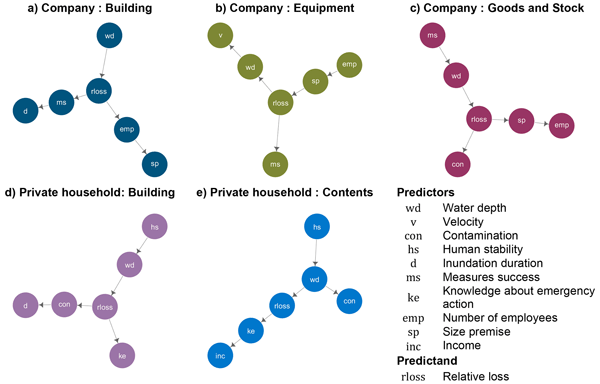
We develop novel probabilistic models to estimate flash flood losses of companies and households in Germany. Using multiple flash flood events, we identify key drivers of flash floods loss. FLEMO flash model reveals that for companies, the effectiveness of emergency measures is crucial in mitigating losses. In contrast, household benefit more from knowledge about emergency action, suggesting adaptation strategies can effectively reduce flash flood losses.
Anastasia Vogelbacher, Malte von Szombathely, Marc Lennartz, Benjamin Poschlod, and Jana Sillmann
EGUsphere, https://doi.org/10.5194/egusphere-2025-6362, https://doi.org/10.5194/egusphere-2025-6362, 2026
Short summary
Short summary
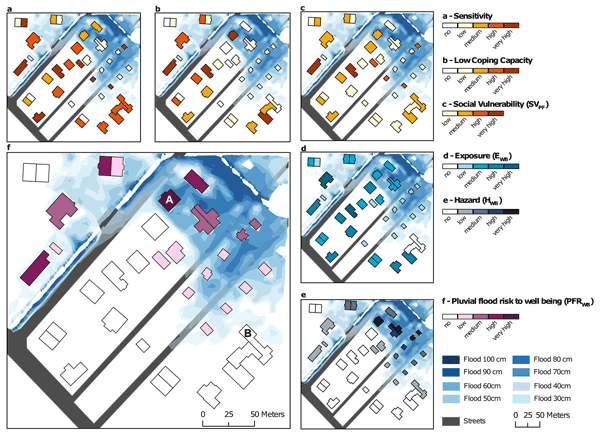
In this study we address risk to pluvial floods by following the risk definition of the Intergovernmental Panel on Climate Change (IPCC), developed in co-operation with stakeholders. We identify buildings in urban areas where residents face higher flood risk due to greater social vulnerability, increased exposure, or elevated flood hazard. We present the development and application of a Python-based ArcGIS toolbox for estimating pluvial flood risk at building scale.
Marc Lennartz, Benjamin Poschlod, and Bruno Merz
EGUsphere, https://doi.org/10.5194/egusphere-2025-6419, https://doi.org/10.5194/egusphere-2025-6419, 2026
Short summary
Short summary
Predicting hourly rainfall extremes under climate change is crucial yet highly uncertain. Using convection-permitting climate model data over Germany, we compare stationary and non-stationary GEV and sMEV methods. Results show that the sMEV approach exhibits lower uncertainty across return periods. Moreover, the non-stationary sMEV better captures climate-change-induced changes, though care is needed when projecting future extremes.
Julius Schlumberger, Tristian R. Stolte, Helena M. Garcia, Antonia Sebastian, Wiebke Jäger, Philip J. Ward, Marleen C. de Ruiter, Robert Šakić Trogrlić, Annegien Tijssen, and Mariana Madruga de Brito
EGUsphere, https://doi.org/10.5194/egusphere-2025-6132, https://doi.org/10.5194/egusphere-2025-6132, 2026
Short summary
Short summary
Flood vulnerability is too often analysed for one moment in time (static), whereas vulnerability is highly dynamic. We reviewed 67 articles for their flood vulnerability methodologies and found that traditional methods for unraveling flood vulnerability deal differently with dynamic vulnerability. Each method seems to lend itself well for specific concepts of dynamics and different aspects of vulnerability. We recommend to use the complementary strengths of these approaches to improve the field.
Alexander Lee Rischmuller, Benjamin Poschlod, and Jana Sillmann
Adv. Stat. Clim. Meteorol. Oceanogr., 12, 1–19, https://doi.org/10.5194/ascmo-12-1-2026, https://doi.org/10.5194/ascmo-12-1-2026, 2026
Short summary
Short summary
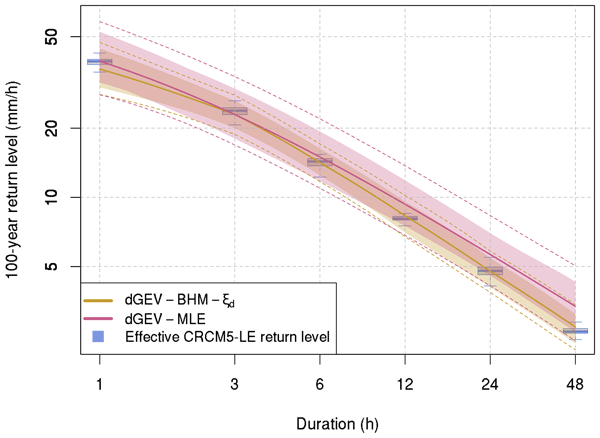
Extreme precipitation probability estimation is vital for hazard protection design but has high uncertainty. We tested six statistical models using 2000 years of climate data. Our Bayesian hierarchical duration-dependent Generalized Extreme Value model shows the highest accuracy and robustness for sample sizes between 30 and 100 years, making it highly promising for use with limited observational records.
Nicole van Maanen, Marleen de Ruiter, Wiebke Jäger, Veronica Casartelli, Roxana Ciurean, Noemi Padrón-Fumero, Anne Sophie Daloz, David Geurts, Stefania Gottardo, Stefan Hochrainer-Stigler, Abel López Diez, Jaime Díaz Pacheco, Pedro Dorta Antequera, Tamara Febles Arévalo, Sara García González, Raúl Hernández-Martín, Carmen Alvarez-Albelo, Juan José Diaz-Hernandez, Lin Ma, Letizia Monteleone, Karina Reiter, Tristian Stolte, Robert Šakić Trogrlić, Silvia Torresan, Sharon Tatman, David Romero Manrique de Lara, Yeray Hernández González, and Philip J. Ward
Earth Syst. Dynam., 16, 2295–2311, https://doi.org/10.5194/esd-16-2295-2025, https://doi.org/10.5194/esd-16-2295-2025, 2025
Short summary
Short summary
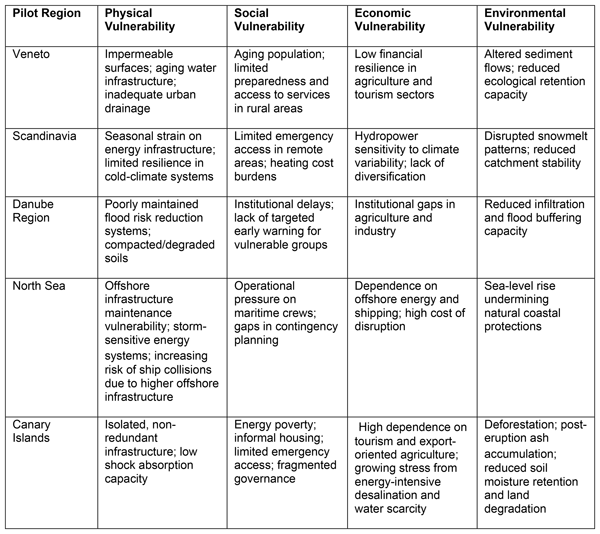
Disaster risk management faces growing challenges from multiple, changing hazards. Interviews with stakeholders in five European regions reveal that climate change, urban growth, and socio-economic shifts increase vulnerability and exposure. Measures to reduce one risk can worsen others, highlighting the need for better coordination. The study calls for flexible, context-specific strategies that connect scientific risk assessments with real-world decision-making.
Wei Li, Philip J. Ward, and Lia van Wesenbeeck
EGUsphere, https://doi.org/10.5194/egusphere-2025-4663, https://doi.org/10.5194/egusphere-2025-4663, 2025
This preprint is open for discussion and under review for Hydrology and Earth System Sciences (HESS).
Short summary
Short summary
This study presents a novel model that captures the interactions among water, energy, and food, revealing how human activities and natural processes mutually shape one another. It shows how human activities alter water quantity and quality, and how these changes reshape resource availability and subsequent human resource use. The Beijing-Tianjin-Hebei case study demonstrates the model's value for advancing hydrological science and informing sustainable and equitable resource management.
Lisa Köhler, Torsten Masson, Sungju Han, and Christian Kuhlicke
Nat. Hazards Earth Syst. Sci., 25, 4983–5015, https://doi.org/10.5194/nhess-25-4983-2025, https://doi.org/10.5194/nhess-25-4983-2025, 2025
Short summary
Short summary
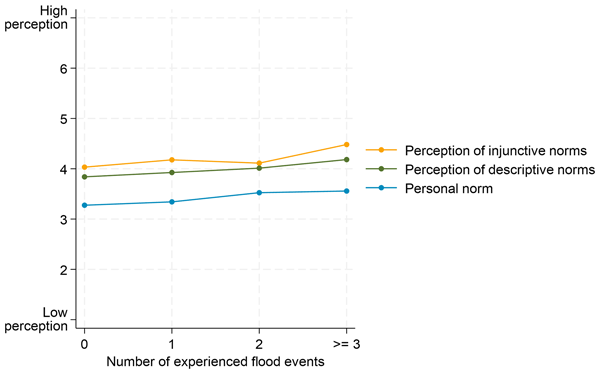
This study examines how frequent flood experience relate to social norms and responsibility attribution. Using survey data from Saxony (Germany), we find that respondents with multiple flood experience are more likely to perceive social norms supporting individual protective behavior, ascribe more responsibility to public authorities and less to their community. This suggests a "we" vs. "them" polarization, potentially harming individual preparedness.
Iris Mužić, Øivind Hodnebrog, Yeliz A. Yilmaz, Terje K. Berntsen, Jana Sillmann, David M. Lawrence, and Paul A. Dirmeyer
Adv. Stat. Clim. Meteorol. Oceanogr., 11, 273–292, https://doi.org/10.5194/ascmo-11-273-2025, https://doi.org/10.5194/ascmo-11-273-2025, 2025
Short summary
Short summary
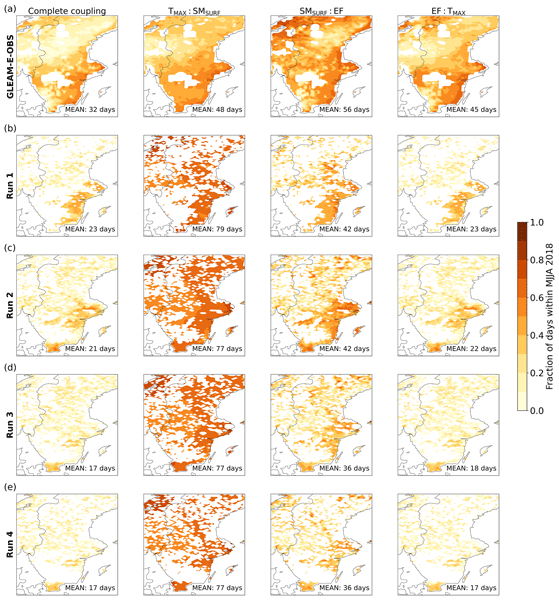
This study investigates soil moisture–temperature coupling during the extreme warm conditions in May–August 2018 in southern and central Sweden using the merged GLEAM-E-OBS dataset and four simulations from the Weather Research and Forecasting model coupled with the Community Terrestrial Systems Model (WRF-CTSM). Based on changes in surface soil moisture, evaporative fraction, and daily maximum 2 m temperature, on average across the region and five datasets, the coupling lasted for 22 d.
Gwendoline Ducros, Timothy Tiggeloven, Lin Ma, Anne Sophie Daloz, Nina Schuhen, Judith Claassen, and Marleen C. de Ruiter
Nat. Hazards Earth Syst. Sci., 25, 4693–4712, https://doi.org/10.5194/nhess-25-4693-2025, https://doi.org/10.5194/nhess-25-4693-2025, 2025
Short summary
Short summary
Our study finds that heatwave, drought and wildfire events occurring simultaneously in Scandinavia are pronounced in the summer months; and the heat-drought 2018 event led to a drop in gross domestic product, affecting agriculture and forestry imports, further impacting Europe's trade balance. This research shows the importance of ripple effects of multi-hazard, and that forest management and adaptation measures are vital to reducing the risks of heat-related multi-hazards in vulnerable areas.
Tim H. J. Hermans, Chiheb Ben Hammouda, Simon Treu, Timothy Tiggeloven, Anaïs Couasnon, Julius J. M. Busecke, and Roderik S. W. van de Wal
Nat. Hazards Earth Syst. Sci., 25, 4593–4612, https://doi.org/10.5194/nhess-25-4593-2025, https://doi.org/10.5194/nhess-25-4593-2025, 2025
Short summary
Short summary
We studied the performance of different types of neural networks at predicting extreme storm surges. We found that that performance improves when during model training, storm surges that are rarer are given a higher weight than moderate storm surges. Additionally, we found that the performance of some of the neural networks approaches that of a state-of-the-art hydrodynamic model. This is promising for the future application of neural networks to climate model simulations.
Aaron Buhrmann, Cecilia I. Nievas, Nivedita Sairam, James E. Daniell, Heidi Kreibich, and Seth Bryant
EGUsphere, https://doi.org/10.5194/egusphere-2025-5172, https://doi.org/10.5194/egusphere-2025-5172, 2025
Short summary
Short summary
Our research lays the groundwork for the next generation of disaster risk modelling by improving how building-level value and use are estimated across Germany. By testing multiple data sources and methods, we identify a transparent, adaptable approach that enhances forecasts of damage and recovery—helping protect lives, property, and communities.
Kai Kornuber, Emanuele Bevacqua, Mariana Madruga de Brito, Wiebke S. Jäger, Pauline Rivoire, Cassandra D. W. Rogers, Fabiola Banfi, Fulden Batibeniz, James Carruthers, Carlo de Michele, Silvia de Angeli, Cristina Deidda, Marleen C. de Ruiter, Andreas H. Fink, Henrique M. D. Goulart, Katharina Küpfer, Patrick Ludwig, Douglas Maraun, Gabriele Messori, Shruti Nath, Fiachra O’Loughlin, Joaquim G. Pinto, Benjamin Poschlod, Alexandre M. Ramos, Colin Raymond, Andreia F. S. Ribeiro, Deepti Singh, Laura Suarez Gutierrez, Philip J. Ward, and Christopher J. White
EGUsphere, https://doi.org/10.5194/egusphere-2025-4683, https://doi.org/10.5194/egusphere-2025-4683, 2025
Short summary
Short summary
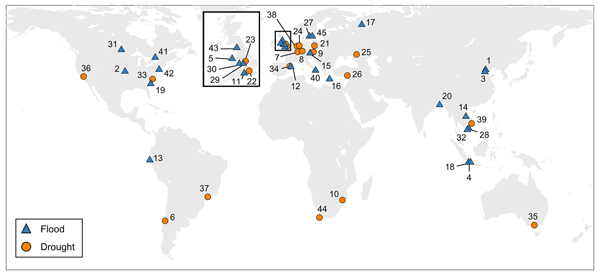
Impacts from extreme weather events are becoming increasingly severe under global warming, in particular when events occur simultaneously or successively. While these complex event combinations are often difficult to analyse as impact data, early warning schemes or modelling frameworks might not be fit for purpose. In this perspective we reflect on the usability of compound event research to bridge the gap between academic research and real-world applications, by formulating a set of guidelines.
Udo Nehren, Ali Cara Barrett, Paola Saenz Quiros, and Alexander Fekete
EGUsphere, https://doi.org/10.5194/egusphere-2025-4888, https://doi.org/10.5194/egusphere-2025-4888, 2025
Short summary
Short summary
The Cologne District in Germany faces frequent flooding from the Rhine and its tributaries. This study maps existing and planned nature-based solutions (NbS) to reduce flood risks. While many NbS exist along the Rhine, more efforts are needed for smaller rivers. The study recommends targeting slopes and urban areas to better manage increased flood risks linked to extreme weather and climate change.
Natalia Castillo Bautista, Marco Gaetani, Leonard F. Borchert, Benjamin Poschlod, Lukas Brunner, Jana Sillmann, and Mario L. V. Martina
EGUsphere, https://doi.org/10.5194/egusphere-2025-5073, https://doi.org/10.5194/egusphere-2025-5073, 2025
Short summary
Short summary
When hot temperatures and drought occur together (compound events), they can cause harmful impacts on crops and society. Using six decades of climate data, we show that such compound events repeatedly occurred in three breadbaskets of the Northern Hemisphere. These events are linked to atmospheric circulation patterns that favor heat and dryness, which in turn interact to amplify the impact. Our study contributes to understand the drivers of these events to support climate impact assessment.
Christopher J. White, Mohammed Sarfaraz Gani Adnan, Marcello Arosio, Stephanie Buller, YoungHwa Cha, Roxana Ciurean, Julia M. Crummy, Melanie Duncan, Joel Gill, Claire Kennedy, Elisa Nobile, Lara Smale, and Philip J. Ward
Nat. Hazards Earth Syst. Sci., 25, 4263–4281, https://doi.org/10.5194/nhess-25-4263-2025, https://doi.org/10.5194/nhess-25-4263-2025, 2025
Short summary
Short summary
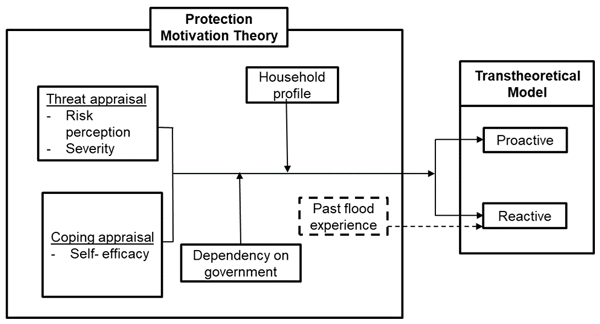
Indicators contain observable and measurable characteristics to understand the state of a concept or phenomenon and/or monitor it over time. There have been limited efforts to understand how indicators are being used in multi-hazard and multi-risk contexts. We find most of existing indicators do not include the interactions between hazards or risks. We propose a set of recommendations to enable the development and uptake of multi-hazard and multi-risk indicators.
Julius Schlumberger, Robert Šakić Trogrlić, Jeroen C. J. H. Aerts, Jung-Hee Hyun, Stefan Hochrainer-Stigler, Marleen de Ruiter, and Marjolijn Haasnoot
Nat. Hazards Earth Syst. Sci., 25, 4089–4113, https://doi.org/10.5194/nhess-25-4089-2025, https://doi.org/10.5194/nhess-25-4089-2025, 2025
Short summary
Short summary
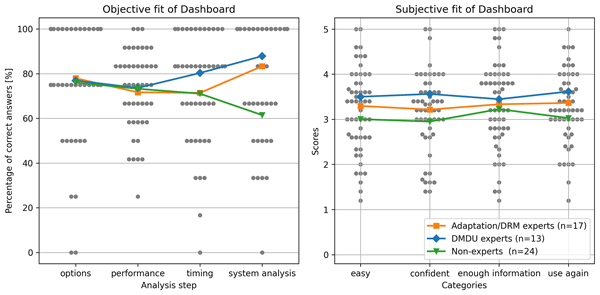
This study presents a dashboard to help decision-makers manage risks in a changing climate. Using interactive visualizations, it simplifies complex choices, even with uncertain information. Tested with 54 users of varying expertise, it enabled accurate responses to 71–80 % of questions. Users valued its scenario exploration and detailed data features. While effective, the guidance and set of visualizations could be extended and the prototype could be adapted for broader applications.
Friedrich J. Bohn, Giles B. Sioen, Ana Bastos, Yolandi Ernst, Marcin P. Jarzebski, Niak S. Koh, Romina Martin, Anja Rammig, Alex Godoy-Faúndez, Alexandros Gasparatos, Alvaro G. Gutiérrez, Amanda J. Aceituno, Andra-Ioana Horcea-Milcu, Andrea Marais-Potgieter, Ayyoob Sharifi, Caroline Howe, Cornelia B. Krug, Eduardo E. Acosta, Emmanuel F. Nzunda, Erik Andersson, Hans-Otto Pörtner, Helen Sooväli-Sepping, Ishihara Hiroe, Ivan Palmegiani, Kaera Coetzer, Kirsten Thonike, Krizler Tanalgo, Lisa Biber-Freudenberger, Nicholas O. Oguge, Mi S. Park, Milena Gross, Pablo De La Cruz, Paula R. Prist, Peng Bi, Rivera Diego, Roman Isaac, Rosemary McFarlane, Sinikka J. Paulus, Stefanie Burkhart, Sung-Ching Lee, Susanne Müller, Uchi D. Terhile, Wan-Yu Shih, William K. Smith, Viola Hakkarainen, Virginia Murray, Yuki Yoshida, Yohannes T. Damtew, and Zeenat Niazi
EGUsphere, https://doi.org/10.5194/egusphere-2025-3619, https://doi.org/10.5194/egusphere-2025-3619, 2025
Short summary
Short summary
The aim of this series is to provide decision-makers with valuable insights into the current state of biosphere research. Firstly, it is intended to ensure the flow of information between the comprehensive assessment reports of the IPCC and IPBES. On the other hand, it is intended to support economic and political decisions closely related to the biosphere with scientifically sound findings – including uncertainties – and comprehensive polysolutions, helping to solve the earth system polycrisis.
Lisa Dillenardt and Annegret H. Thieken
Nat. Hazards Earth Syst. Sci., 25, 3257–3278, https://doi.org/10.5194/nhess-25-3257-2025, https://doi.org/10.5194/nhess-25-3257-2025, 2025
Short summary
Short summary
The influence of flood types, i.e., fluvial, flash, and urban pluvial floods, on whether and how flood-affected people prepare for flooding is unclear but relevant for effective risk communication. Survey data revealed the influence of flood type on the adaptive behavior of households recently affected by flooding. Most respondents were motivated to protect themselves, but flood-type-specific differences have been identified to enhance future risk communication strategies.
Kai Schröter, Pia-Johanna Schweizer, Benedikt Gräler, Lydia Cumiskey, Sukaina Bharwani, Janne Parviainen, Chahan M. Kropf, Viktor Wattin Håkansson, Martin Drews, Tracy Irvine, Clarissa Dondi, Heiko Apel, Jana Löhrlein, Stefan Hochrainer-Stigler, Stefano Bagli, Levente Huszti, Christopher Genillard, Silvia Unguendoli, Fred Hattermann, and Max Steinhausen
Nat. Hazards Earth Syst. Sci., 25, 3055–3073, https://doi.org/10.5194/nhess-25-3055-2025, https://doi.org/10.5194/nhess-25-3055-2025, 2025
Short summary
Short summary
With the increasing negative impacts of extreme weather events globally, it is crucial to align efforts to manage disasters with measures to adapt to climate change. We identify challenges in systems and organizations working together. We suggest that collaboration across various fields is essential and propose an approach to improve collaboration, including a framework for better stakeholder engagement and an open-source data system that helps gather and connect important information.
Kasra Rafiezadeh Shahi, Nivedita Sairam, Lukas Schoppa, Le Thanh Sang, Do Ly Hoai Tan, and Heidi Kreibich
Nat. Hazards Earth Syst. Sci., 25, 2845–2861, https://doi.org/10.5194/nhess-25-2845-2025, https://doi.org/10.5194/nhess-25-2845-2025, 2025
Short summary
Short summary
Ho Chi Minh City (HCMC) faces severe flood risks from climatic and socio-economic changes, requiring effective adaptation solutions. Flood loss estimation is crucial, but advanced probabilistic models accounting for key drivers and uncertainty are lacking. This study presents a probabilistic flood loss model with a feature selection paradigm for HCMC’s residential sector. Experiments using new survey data from flood-affected households demonstrate the model's superior performance.
Sophie L. Buijs, Inga J. Sauer, Chahan M. Kropf, Samuel Juhel, Zélie Stalhandske, and Marleen C. De Ruiter
EGUsphere, https://doi.org/10.5194/egusphere-2025-3200, https://doi.org/10.5194/egusphere-2025-3200, 2025
Short summary
Short summary
We studied how repeated disasters affect recovery across housing, health, economic systems, and governance. Our findings show that failing to recover fully between events can increase long-term risks but also offers opportunities for learning and adaptation. Understanding these dynamics can help societies plan better, reduce vulnerability, and build resilience to increasingly frequent and severe hazards.
Wiebke S. Jäger, Marleen C. de Ruiter, Timothy Tiggeloven, and Philip J. Ward
Nat. Hazards Earth Syst. Sci., 25, 2751–2769, https://doi.org/10.5194/nhess-25-2751-2025, https://doi.org/10.5194/nhess-25-2751-2025, 2025
Short summary
Short summary
Multiple hazards, occurring simultaneously or consecutively, can have more extreme impacts than single hazards. We examined the disaster records in the global emergency events database EM-DAT to better understand this phenomenon. We developed a method to identify such multi-hazards and analysed their reported impacts using statistics. Multi-hazards have accounted for a disproportionate number of the impacts, but there appear to be different archetypal patterns in which the impacts compound.
Lou Brett, Christopher J. White, Daniela I. V. Domeisen, Bart van den Hurk, Philip Ward, and Jakob Zscheischler
Nat. Hazards Earth Syst. Sci., 25, 2591–2611, https://doi.org/10.5194/nhess-25-2591-2025, https://doi.org/10.5194/nhess-25-2591-2025, 2025
Short summary
Short summary
Compound events, where multiple weather or climate hazards occur together, pose significant risks to both society and the environment. These events, like simultaneous wind and rain, can have more severe impacts than single hazards. Our review of compound event research from 2012–2022 reveals a rise in studies, especially on events that occur concurrently, hot and dry events, and compounding flooding. The review also highlights opportunities for research in the coming years.
Anna Buch, Dominik Paprotny, Kasra Rafiezadeh Shahi, Heidi Kreibich, and Nivedita Sairam
Nat. Hazards Earth Syst. Sci., 25, 2437–2453, https://doi.org/10.5194/nhess-25-2437-2025, https://doi.org/10.5194/nhess-25-2437-2025, 2025
Short summary
Short summary
Many households in Vietnam depend on revenue from micro-businesses (shop houses). However, losses caused by regular flooding are not modelled. Business turnover, building age, and water depth were found to be the main drivers of flood losses of micro-businesses. We built and validated probabilistic models (non-parametric Bayesian networks) that estimate flood losses of micro-businesses. The results help with flood risk management and adaption decision making for micro-businesses.
Irene Benito, Jeroen C. J. H. Aerts, Philip J. Ward, Dirk Eilander, and Sanne Muis
Nat. Hazards Earth Syst. Sci., 25, 2287–2315, https://doi.org/10.5194/nhess-25-2287-2025, https://doi.org/10.5194/nhess-25-2287-2025, 2025
Short summary
Short summary
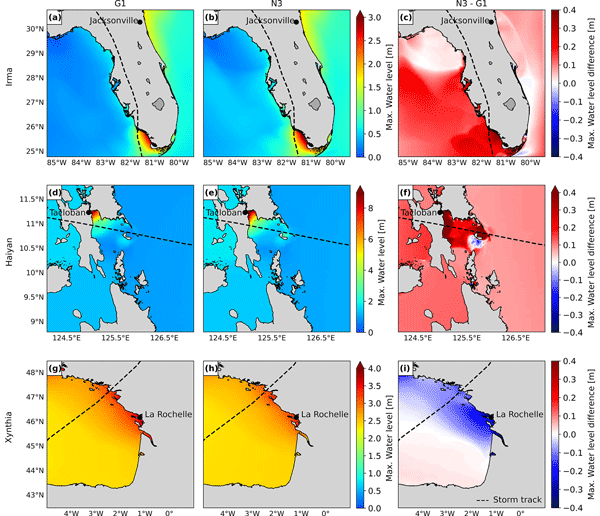
Global flood models are key to the mitigation of coastal flooding impacts, yet they still have limitations when providing actionable insights locally. We present a multiscale framework that couples dynamic water level and flood models and bridges the fully global and local modelling approaches. We apply it to three historical storms. Our findings reveal that the importance of model refinements varies based on the study area characteristics and the storm’s nature.
Hunter C. Quintal, Antonia Sebastian, Marc L. Serre, Wiebke S. Jäger, and Marleen C. de Ruiter
EGUsphere, https://doi.org/10.5194/egusphere-2025-2870, https://doi.org/10.5194/egusphere-2025-2870, 2025
Short summary
Short summary
High quality weather event datasets are crucial to community preparedness and resilience. Researchers create such datasets using clustering methods, which we advance by addressing current limitation in the relationship between space and time. We propose a method to determine the appropriate factor by which to resample the spatial resolution of the data prior to clustering. Ultimately, our approach increases the ability to detect historic heatwaves over current methods.
Nicole van Maanen, Joël J.-F. G. De Plaen, Timothy Tiggeloven, Maria Luisa Colmenares, Philip J. Ward, Paolo Scussolini, and Elco Koks
Nat. Hazards Earth Syst. Sci., 25, 2075–2080, https://doi.org/10.5194/nhess-25-2075-2025, https://doi.org/10.5194/nhess-25-2075-2025, 2025
Short summary
Short summary
Understanding coastal flood protection is vital for assessing risks from natural disasters and climate change. However, current global data on coastal flood protection are limited and based on simplified assumptions, leading to potential uncertainties in risk estimates. As a step in this direction, we propose a comprehensive dataset, COASTtal flood PROtection Standards within EUrope (COASTPROS-EU), which compiles coastal flood protection standards in Europe.
Sophie Kaashoek, Žiga Malek, Nadia Bloemendaal, and Marleen C. de Ruiter
Nat. Hazards Earth Syst. Sci., 25, 1963–1974, https://doi.org/10.5194/nhess-25-1963-2025, https://doi.org/10.5194/nhess-25-1963-2025, 2025
Short summary
Short summary
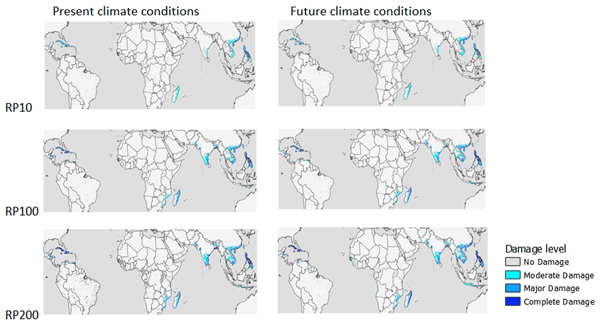
Tropical storms are expected to get stronger all over the world, and this will have a big impact on people, buildings and important activities like growing bananas. Already, in different parts of the world, banana farms are being hurt by these storms, which makes banana prices go up and affects the people who grow them. We are not sure how these storms will affect bananas everywhere in the future. We assessed what happened to banana farms during storms in different parts of the world.
Yigit Uckan, Melissa Ruiz-Vásquez, Kelley De Polt, and René Orth
Earth Syst. Dynam., 16, 869–889, https://doi.org/10.5194/esd-16-869-2025, https://doi.org/10.5194/esd-16-869-2025, 2025
Short summary
Short summary
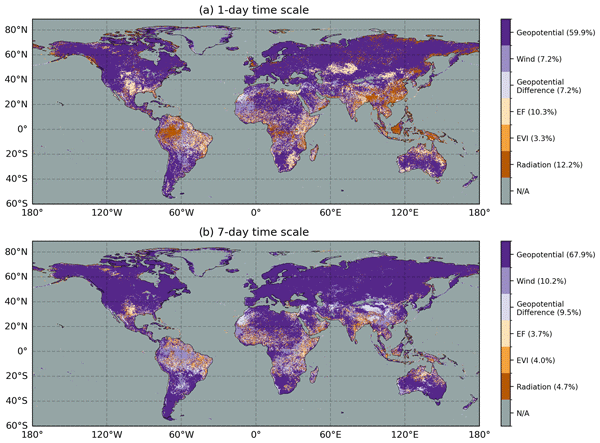
We analyze drivers of hot temperature extremes, focusing on both atmospheric and land-surface factors. Using observation-based data and an analogue-based approach, we find that geopotential height at 500 hPa is the most significant driver worldwide at daily and weekly timescales. Surface net radiation and evaporative fraction play relevant roles at the daily scale and wind at the weekly timescale. The driver influence varies by region, related to differences in climate regimes and land cover.
Danhua Xin, James Edward Daniell, Zhenguo Zhang, Friedemann Wenzel, Shaun Shuxun Wang, and Xiaofei Chen
Nat. Hazards Earth Syst. Sci., 25, 1597–1620, https://doi.org/10.5194/nhess-25-1597-2025, https://doi.org/10.5194/nhess-25-1597-2025, 2025
Short summary
Short summary
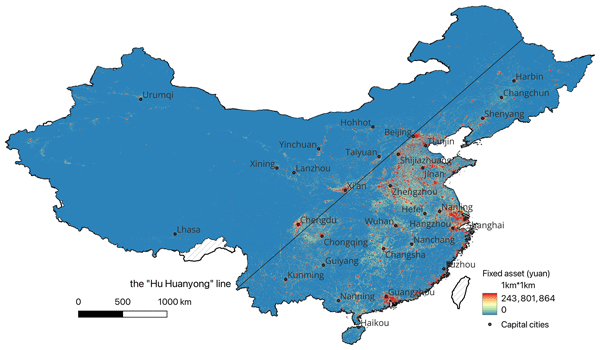
A high-resolution fixed-asset model can help improve the accuracy of earthquake loss assessment. We develop a grid-level fixed-asset model for China from 1951 to 2020. We first compile the provincial-level fixed asset from yearbook-related statistics. Then, this dataset is disaggregated into 1 km × 1 km grids by using multiple remote sensing data as the weight indicator. We find that the fixed-asset value increased rapidly after the 1980s and reached CNY 589.31 trillion in 2020.
Sarah Lindenlaub, Guilherme Samprogna Mohor, and Annegret Thieken
Abstr. Int. Cartogr. Assoc., 9, 22, https://doi.org/10.5194/ica-abs-9-22-2025, https://doi.org/10.5194/ica-abs-9-22-2025, 2025
Ekta Aggarwal, Marleen C. de Ruiter, Kartikeya S. Sangwan, Rajiv Sinha, Sophie Buijs, Ranjay Shrestha, Sanjeev Gupta, and Alexander C. Whittaker
EGUsphere, https://doi.org/10.5194/egusphere-2024-3901, https://doi.org/10.5194/egusphere-2024-3901, 2025
Preprint archived
Short summary
Short summary
The occurrence of frequent floods in recent years due to changing weather, heavy rainfall, and the natural landscape, has caused major damage to lives and property. This study looks at flood risks in the Ganga Basin, focusing on the factors that cause floods, the areas affected, and the vulnerability of people. The study uses NASA's night-time lights to track human activities. This helps to show how risks are connected to expanding human activities, and changing resilience to floods.
Julius Schlumberger, Tristian Stolte, Helena Margaret Garcia, Antonia Sebastian, Wiebke Jäger, Philip Ward, Marleen de Ruiter, Robert Šakić Trogrlić, Annegien Tijssen, and Mariana Madruga de Brito
EGUsphere, https://doi.org/10.5194/egusphere-2025-850, https://doi.org/10.5194/egusphere-2025-850, 2025
Preprint archived
Short summary
Short summary
The risk flood of flood impacts is dynamic as society continuously responds to specific events or ongoing developments. We analyzed 28 studies that assess such dynamics of vulnerability. Most research uses surveys and basic statistics data, while integrated, flexible models are seldom used. The studies struggle to link specific events or developments to the observed changes. Our findings highlight needs and possible directions towards a better assessment of vulnerability dynamics.
Davide Mauro Ferrario, Marcello Sanò, Margherita Maraschini, Andrea Critto, and Silvia Torresan
EGUsphere, https://doi.org/10.5194/egusphere-2025-670, https://doi.org/10.5194/egusphere-2025-670, 2025
Short summary
Short summary
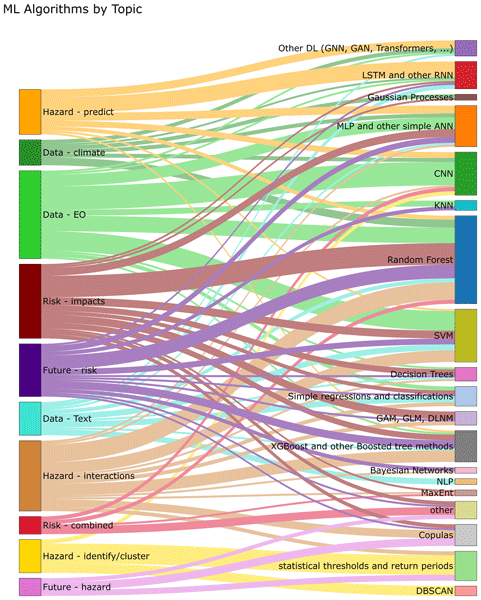
This review explores how Machine Learning (ML) can advance multi-hazard and multi-risk going through four main themes: data processing, hazard prediction, risk assessment, and future climate scenarios. It shows how ML is widely used for Earth observations and climate data processing, with Deep Learning applied for hazard prediction and ensemble ML methods for risks, and how future research moving towards analysis of multi-hazard interactions, dynamic vulnerability and early warning systems.
Florian Zabel, Matthias Knüttel, and Benjamin Poschlod
Geosci. Model Dev., 18, 1067–1087, https://doi.org/10.5194/gmd-18-1067-2025, https://doi.org/10.5194/gmd-18-1067-2025, 2025
Short summary
Short summary
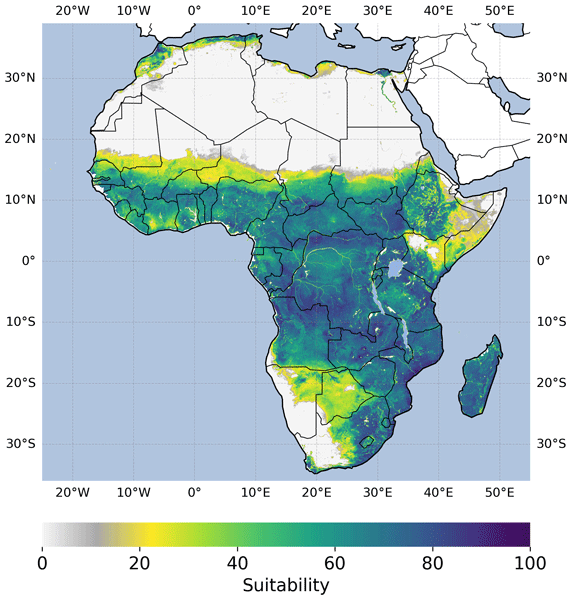
CropSuite is a new open-source crop suitability model. It provides a GUI and a wide range of options, including a spatial downscaling of climate data. We apply CropSuite to 48 staple and opportunity crops at a 1 km spatial resolution in Africa. We find that climate variability significantly impacts suitable areas but also affects optimal sowing dates and multiple cropping potential. The results provide valuable information for climate impact assessments, adaptation, and land-use planning.
Joshua Green, Ivan D. Haigh, Niall Quinn, Jeff Neal, Thomas Wahl, Melissa Wood, Dirk Eilander, Marleen de Ruiter, Philip Ward, and Paula Camus
Nat. Hazards Earth Syst. Sci., 25, 747–816, https://doi.org/10.5194/nhess-25-747-2025, https://doi.org/10.5194/nhess-25-747-2025, 2025
Short summary
Short summary
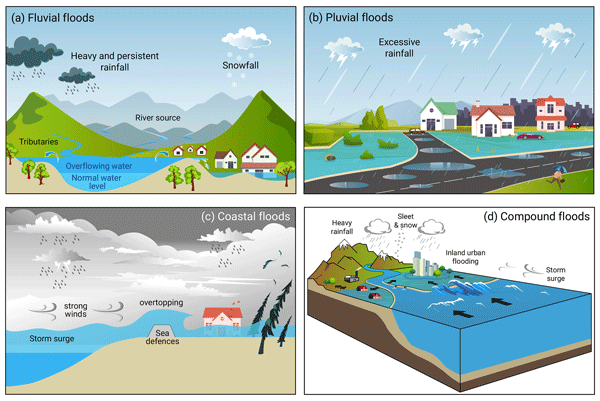
Compound flooding, involving the combination or successive occurrence of two or more flood drivers, can amplify flood impacts in coastal/estuarine regions. This paper reviews the practices, trends, methodologies, applications, and findings of coastal compound flooding literature at regional to global scales. We explore the types of compound flood events, their mechanistic processes, and the range of terminology. Lastly, this review highlights knowledge gaps and implications for future practices.
Harriet E. Thompson, Joel C. Gill, Robert Šakić Trogrlić, Faith E. Taylor, and Bruce D. Malamud
Nat. Hazards Earth Syst. Sci., 25, 353–381, https://doi.org/10.5194/nhess-25-353-2025, https://doi.org/10.5194/nhess-25-353-2025, 2025
Short summary
Short summary
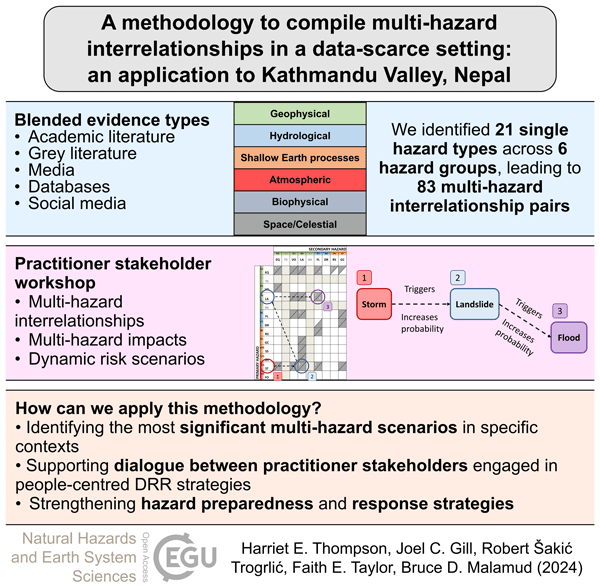
We present a methodology to compile single hazards and multi-hazard interrelationships in data-scarce urban settings, which we apply to the Kathmandu Valley, Nepal. Using blended sources, we collate evidence of 21 single natural hazard types and 83 multi-hazard interrelationships that could impact the Kathmandu Valley. We supplement these exemplars with multi-hazard scenarios developed by practitioner stakeholders, emphasising the need for inclusive disaster preparedness and response approaches.
Sadhana Nirandjan, Elco E. Koks, Mengqi Ye, Raghav Pant, Kees C. H. Van Ginkel, Jeroen C. J. H. Aerts, and Philip J. Ward
Nat. Hazards Earth Syst. Sci., 24, 4341–4368, https://doi.org/10.5194/nhess-24-4341-2024, https://doi.org/10.5194/nhess-24-4341-2024, 2024
Short summary
Short summary
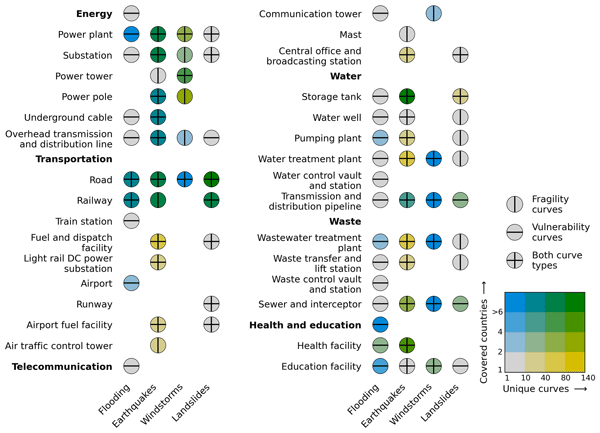
Critical infrastructures (CIs) are exposed to natural hazards, which may result in significant damage and burden society. Vulnerability is a key determinant for reducing these risks, yet crucial information is scattered in the literature. Our study reviews over 1510 fragility and vulnerability curves for CI assets, creating a unique publicly available physical vulnerability database that can be directly used for hazard risk assessments, including floods, earthquakes, windstorms, and landslides.
Cassiano Bastos Moroz and Annegret H. Thieken
Nat. Hazards Earth Syst. Sci., 24, 3299–3314, https://doi.org/10.5194/nhess-24-3299-2024, https://doi.org/10.5194/nhess-24-3299-2024, 2024
Short summary
Short summary
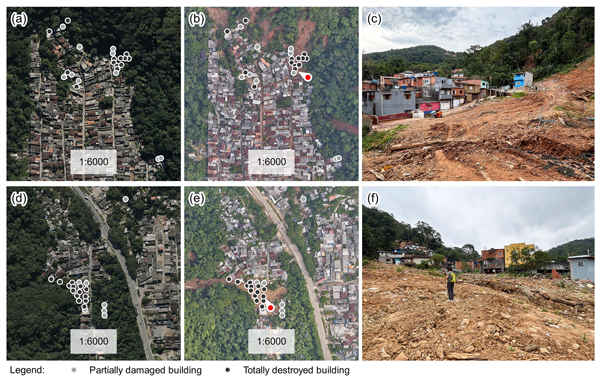
We evaluate the influence of urban processes on the impacts of the 2023 disaster that hit the North Coast of São Paulo, Brazil. The impacts of the disaster were largely associated with rapid urban expansion over the last 3 decades, with a recent occupation of risky areas. Moreover, lower-income neighborhoods were considerably more severely impacted, which evidences their increased exposure to such events. These results highlight the strong association between disaster risk and urban poverty.
Viktoria Spaiser, Sirkku Juhola, Sara M. Constantino, Weisi Guo, Tabitha Watson, Jana Sillmann, Alessandro Craparo, Ashleigh Basel, John T. Bruun, Krishna Krishnamurthy, Jürgen Scheffran, Patricia Pinho, Uche T. Okpara, Jonathan F. Donges, Avit Bhowmik, Taha Yasseri, Ricardo Safra de Campos, Graeme S. Cumming, Hugues Chenet, Florian Krampe, Jesse F. Abrams, James G. Dyke, Stefanie Rynders, Yevgeny Aksenov, and Bryan M. Spears
Earth Syst. Dynam., 15, 1179–1206, https://doi.org/10.5194/esd-15-1179-2024, https://doi.org/10.5194/esd-15-1179-2024, 2024
Short summary
Short summary
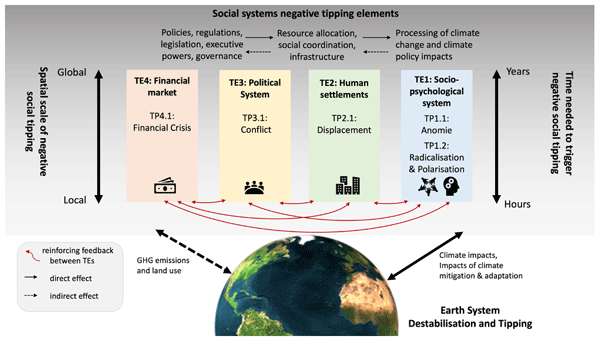
In this paper, we identify potential negative social tipping points linked to Earth system destabilization and draw on related research to understand the drivers and likelihood of these negative social tipping dynamics, their potential effects on human societies and the Earth system, and the potential for cascading interactions and contribution to systemic risks.
Marie-Luise Zenker, Philip Bubeck, and Annegret H. Thieken
Nat. Hazards Earth Syst. Sci., 24, 2837–2856, https://doi.org/10.5194/nhess-24-2837-2024, https://doi.org/10.5194/nhess-24-2837-2024, 2024
Short summary
Short summary
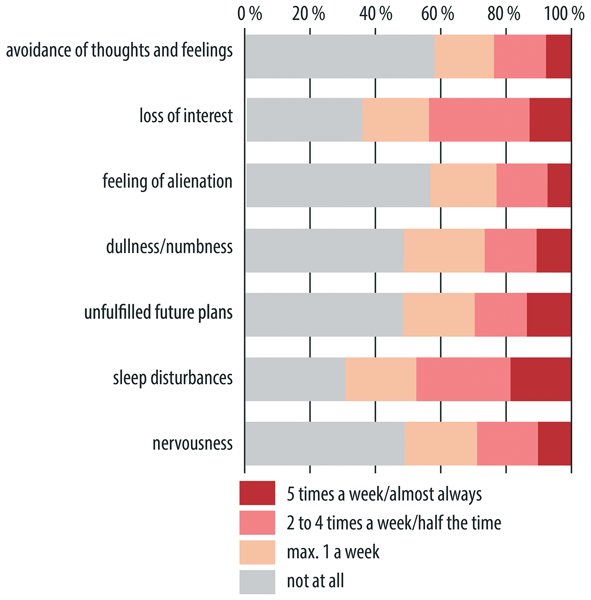
Despite the visible flood damage, mental health is a growing concern. Yet, there is limited data in Germany on mental health impacts after floods. A survey in a heavily affected region revealed that 28 % of respondents showed signs of post-traumatic stress disorder 1 year later. Risk factors include gender, serious injury or illness due to flooding, and feeling left alone to cope with impacts. The study highlights the need for tailored mental health support for flood-affected populations.
Jan Sodoge, Christian Kuhlicke, Miguel D. Mahecha, and Mariana Madruga de Brito
Nat. Hazards Earth Syst. Sci., 24, 1757–1777, https://doi.org/10.5194/nhess-24-1757-2024, https://doi.org/10.5194/nhess-24-1757-2024, 2024
Short summary
Short summary
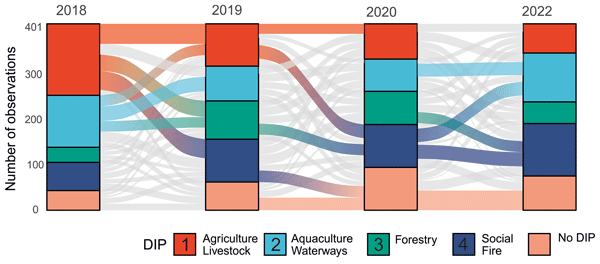
We delved into the socio-economic impacts of the 2018–2022 drought in Germany. We derived a dataset covering the impacts of droughts in Germany between 2000 and 2022 on sectors such as agriculture and forestry based on newspaper articles. Notably, our study illustrated that the longer drought had a wider reach and more varied effects. We show that dealing with longer droughts requires different plans compared to shorter ones, and it is crucial to be ready for the challenges they bring.
Benjamin Poschlod and Anne Sophie Daloz
The Cryosphere, 18, 1959–1981, https://doi.org/10.5194/tc-18-1959-2024, https://doi.org/10.5194/tc-18-1959-2024, 2024
Short summary
Short summary
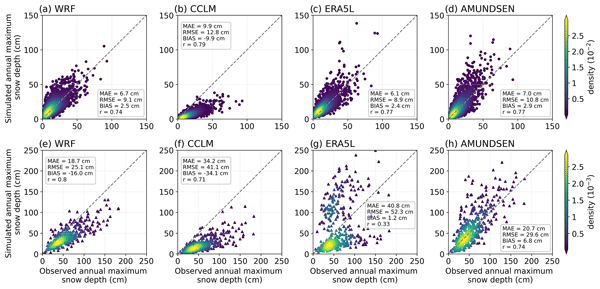
Information about snow depth is important within climate research but also many other sectors, such as tourism, mobility, civil engineering, and ecology. Climate models often feature a spatial resolution which is too coarse to investigate snow depth. Here, we analyse high-resolution simulations and identify added value compared to a coarser-resolution state-of-the-art product. Also, daily snow depth extremes are well reproduced by two models.
Eric Mortensen, Timothy Tiggeloven, Toon Haer, Bas van Bemmel, Dewi Le Bars, Sanne Muis, Dirk Eilander, Frederiek Sperna Weiland, Arno Bouwman, Willem Ligtvoet, and Philip J. Ward
Nat. Hazards Earth Syst. Sci., 24, 1381–1400, https://doi.org/10.5194/nhess-24-1381-2024, https://doi.org/10.5194/nhess-24-1381-2024, 2024
Short summary
Short summary
Current levels of coastal flood risk are projected to increase in coming decades due to various reasons, e.g. sea-level rise, land subsidence, and coastal urbanization: action is needed to minimize this future risk. We evaluate dykes and coastal levees, foreshore vegetation, zoning restrictions, and dry-proofing on a global scale to estimate what levels of risk reductions are possible. We demonstrate that there are several potential adaptation pathways forward for certain areas of the world.
Ashok Dahal, Hakan Tanyas, Cees van Westen, Mark van der Meijde, Paul Martin Mai, Raphaël Huser, and Luigi Lombardo
Nat. Hazards Earth Syst. Sci., 24, 823–845, https://doi.org/10.5194/nhess-24-823-2024, https://doi.org/10.5194/nhess-24-823-2024, 2024
Short summary
Short summary
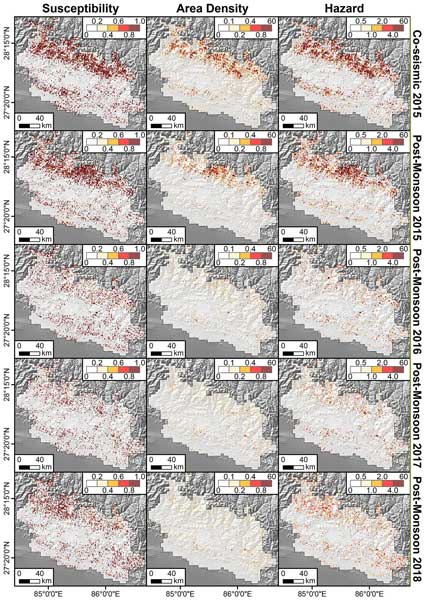
We propose a modeling approach capable of recognizing slopes that may generate landslides, as well as how large these mass movements may be. This protocol is implemented, tested, and validated with data that change in both space and time via an Ensemble Neural Network architecture.
Colin Raymond, Anamika Shreevastava, Emily Slinskey, and Duane Waliser
Nat. Hazards Earth Syst. Sci., 24, 791–801, https://doi.org/10.5194/nhess-24-791-2024, https://doi.org/10.5194/nhess-24-791-2024, 2024
Short summary
Short summary
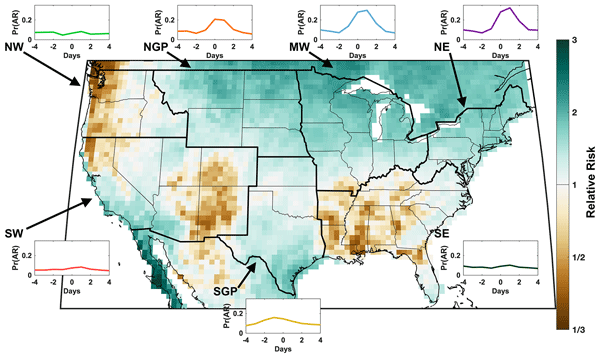
How can we systematically understand what causes high levels of atmospheric humidity and thus heat stress? Here we argue that atmospheric rivers can be a useful tool, based on our finding that in several US regions, atmospheric rivers and humid heat occur close together in space and time. Most typically, an atmospheric river transports moisture which heightens heat stress, with precipitation following a day later. These effects tend to be larger for stronger and more extensive systems.
Clemens Schwingshackl, Anne Sophie Daloz, Carley Iles, Kristin Aunan, and Jana Sillmann
Nat. Hazards Earth Syst. Sci., 24, 331–354, https://doi.org/10.5194/nhess-24-331-2024, https://doi.org/10.5194/nhess-24-331-2024, 2024
Short summary
Short summary
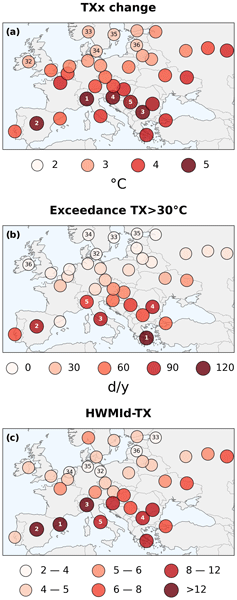
Ambient heat in European cities will substantially increase under global warming, as projected by three heat metrics calculated from high-resolution climate model simulations. While the heat metrics consistently project high levels of ambient heat for several cities, in other cities the projected heat levels vary considerably across the three heat metrics. Using complementary heat metrics for projections of ambient heat is thus important for assessments of future risks from heat stress.
Mersedeh Kooshki Forooshani, Marc van den Homberg, Kyriaki Kalimeri, Andreas Kaltenbrunner, Yelena Mejova, Leonardo Milano, Pauline Ndirangu, Daniela Paolotti, Aklilu Teklesadik, and Monica L. Turner
Nat. Hazards Earth Syst. Sci., 24, 309–329, https://doi.org/10.5194/nhess-24-309-2024, https://doi.org/10.5194/nhess-24-309-2024, 2024
Short summary
Short summary
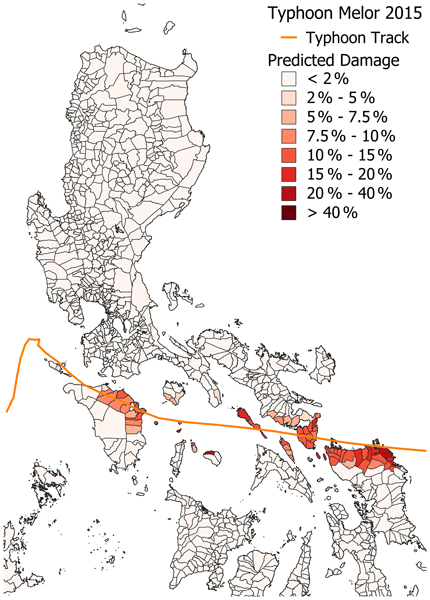
We improve an existing impact forecasting model for the Philippines by transforming the target variable (percentage of damaged houses) to a fine grid, using only features which are globally available. We show that our two-stage model conserves the performance of the original and even has the potential to introduce savings in anticipatory action resources. Such model generalizability is important in increasing the applicability of such tools around the world.
Henrique M. D. Goulart, Irene Benito Lazaro, Linda van Garderen, Karin van der Wiel, Dewi Le Bars, Elco Koks, and Bart van den Hurk
Nat. Hazards Earth Syst. Sci., 24, 29–45, https://doi.org/10.5194/nhess-24-29-2024, https://doi.org/10.5194/nhess-24-29-2024, 2024
Short summary
Short summary
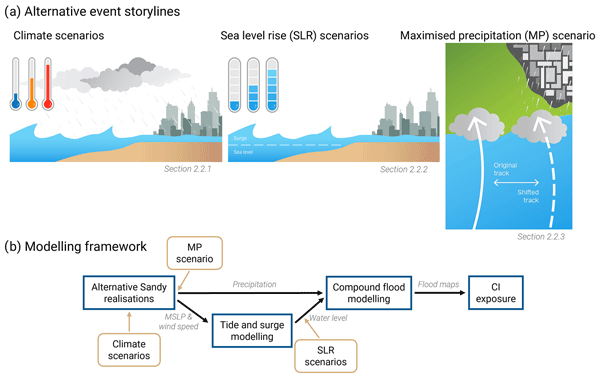
We explore how Hurricane Sandy (2012) could flood New York City under different scenarios, including climate change and internal variability. We find that sea level rise can quadruple coastal flood volumes, while changes in Sandy's landfall location can double flood volumes. Our results show the need for diverse scenarios that include climate change and internal variability and for integrating climate information into a modelling framework, offering insights for high-impact event assessments.
Florian Zabel and Benjamin Poschlod
Geosci. Model Dev., 16, 5383–5399, https://doi.org/10.5194/gmd-16-5383-2023, https://doi.org/10.5194/gmd-16-5383-2023, 2023
Short summary
Short summary
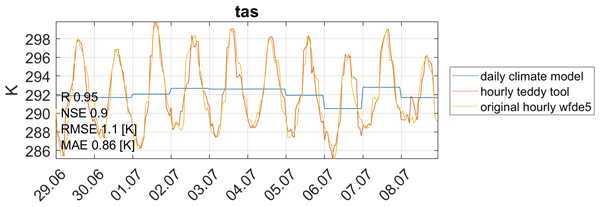
Today, most climate model data are provided at daily time steps. However, more and more models from different sectors, such as energy, water, agriculture, and health, require climate information at a sub-daily temporal resolution for a more robust and reliable climate impact assessment. Here we describe and validate the Teddy tool, a new model for the temporal disaggregation of daily climate model data for climate impact analysis.
Marleen R. Lam, Alessia Matanó, Anne F. Van Loon, Rhoda A. Odongo, Aklilu D. Teklesadik, Charles N. Wamucii, Marc J. C. van den Homberg, Shamton Waruru, and Adriaan J. Teuling
Nat. Hazards Earth Syst. Sci., 23, 2915–2936, https://doi.org/10.5194/nhess-23-2915-2023, https://doi.org/10.5194/nhess-23-2915-2023, 2023
Short summary
Short summary
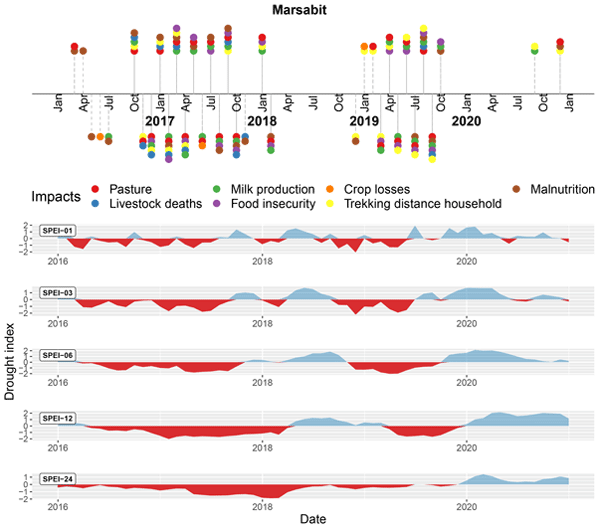
There is still no full understanding of the relation between drought impacts and drought indices in the Horn of Africa where water scarcity and arid regions are also present. This study assesses their relation in Kenya. A random forest model reveals that each region, aggregated by aridity, has its own set of predictors for every impact category. Water scarcity was not found to be related to aridity. Understanding these relations contributes to the development of drought early warning systems.
Lisa Köhler, Torsten Masson, Sabrina Köhler, and Christian Kuhlicke
Nat. Hazards Earth Syst. Sci., 23, 2787–2806, https://doi.org/10.5194/nhess-23-2787-2023, https://doi.org/10.5194/nhess-23-2787-2023, 2023
Short summary
Short summary
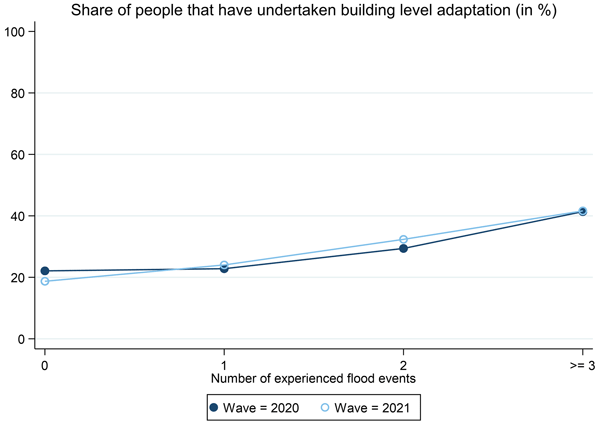
We analyzed the impact of flood experience on adaptive behavior and self-reported resilience. The outcomes draw a paradoxical picture: the most experienced people are the most adapted but the least resilient. We find evidence for non-linear relationships between the number of floods experienced and resilience. We contribute to existing knowledge by focusing specifically on the number of floods experienced and extending the rare scientific literature on the influence of experience on resilience.
Max Schneider, Fabrice Cotton, and Pia-Johanna Schweizer
Nat. Hazards Earth Syst. Sci., 23, 2505–2521, https://doi.org/10.5194/nhess-23-2505-2023, https://doi.org/10.5194/nhess-23-2505-2023, 2023
Short summary
Short summary
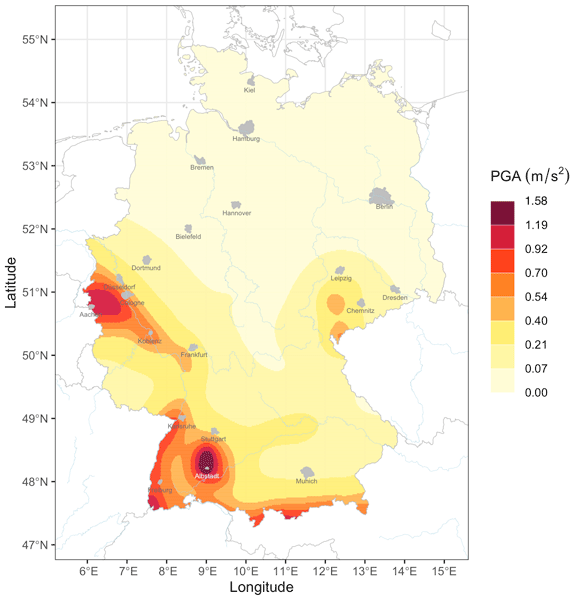
Hazard maps are fundamental to earthquake risk reduction, but research is missing on how to design them. We review the visualization literature to identify evidence-based criteria for color and classification schemes for hazard maps. We implement these for the German seismic hazard map, focusing on communicating four properties of seismic hazard. Our evaluation finds that the redesigned map successfully communicates seismic hazard in Germany, improving on the baseline map for two key properties.
Dirk Eilander, Anaïs Couasnon, Frederiek C. Sperna Weiland, Willem Ligtvoet, Arno Bouwman, Hessel C. Winsemius, and Philip J. Ward
Nat. Hazards Earth Syst. Sci., 23, 2251–2272, https://doi.org/10.5194/nhess-23-2251-2023, https://doi.org/10.5194/nhess-23-2251-2023, 2023
Short summary
Short summary
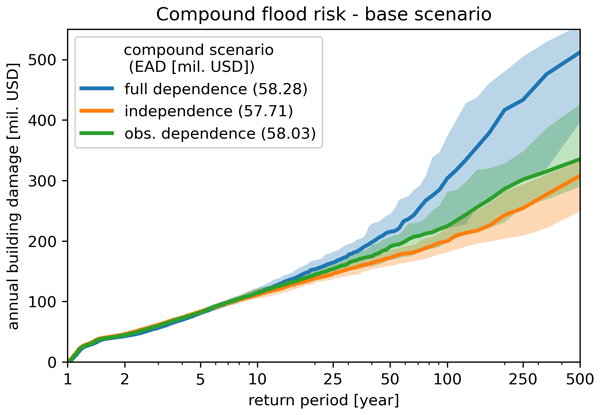
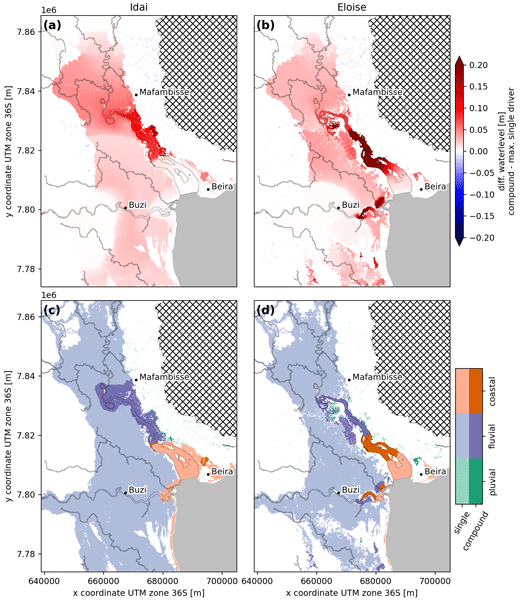
This study presents a framework for assessing compound flood risk using hydrodynamic, impact, and statistical modeling. A pilot in Mozambique shows the importance of accounting for compound events in risk assessments. We also show how the framework can be used to assess the effectiveness of different risk reduction measures. As the framework is based on global datasets and is largely automated, it can easily be applied in other areas for first-order assessments of compound flood risk.
Job C. M. Dullaart, Sanne Muis, Hans de Moel, Philip J. Ward, Dirk Eilander, and Jeroen C. J. H. Aerts
Nat. Hazards Earth Syst. Sci., 23, 1847–1862, https://doi.org/10.5194/nhess-23-1847-2023, https://doi.org/10.5194/nhess-23-1847-2023, 2023
Short summary
Short summary
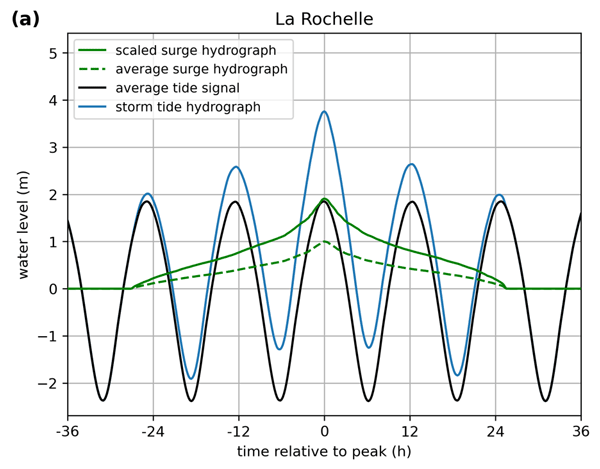
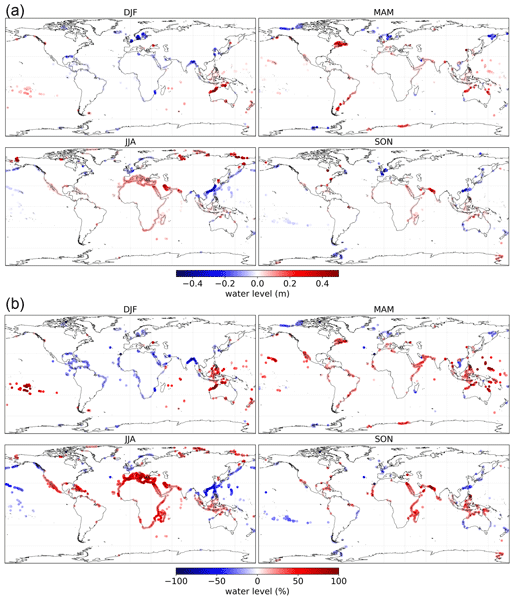
Coastal flooding is driven by storm surges and high tides and can be devastating. To gain an understanding of the threat posed by coastal flooding and to identify areas that are especially at risk, now and in the future, it is crucial to accurately model coastal inundation and assess the coastal flood hazard. Here, we present a global dataset with hydrographs that represent the typical evolution of an extreme sea level. These can be used to model coastal inundation more accurately.
Heidi Kreibich, Kai Schröter, Giuliano Di Baldassarre, Anne F. Van Loon, Maurizio Mazzoleni, Guta Wakbulcho Abeshu, Svetlana Agafonova, Amir AghaKouchak, Hafzullah Aksoy, Camila Alvarez-Garreton, Blanca Aznar, Laila Balkhi, Marlies H. Barendrecht, Sylvain Biancamaria, Liduin Bos-Burgering, Chris Bradley, Yus Budiyono, Wouter Buytaert, Lucinda Capewell, Hayley Carlson, Yonca Cavus, Anaïs Couasnon, Gemma Coxon, Ioannis Daliakopoulos, Marleen C. de Ruiter, Claire Delus, Mathilde Erfurt, Giuseppe Esposito, Didier François, Frédéric Frappart, Jim Freer, Natalia Frolova, Animesh K. Gain, Manolis Grillakis, Jordi Oriol Grima, Diego A. Guzmán, Laurie S. Huning, Monica Ionita, Maxim Kharlamov, Dao Nguyen Khoi, Natalie Kieboom, Maria Kireeva, Aristeidis Koutroulis, Waldo Lavado-Casimiro, Hong-Yi Li, Maria Carmen LLasat, David Macdonald, Johanna Mård, Hannah Mathew-Richards, Andrew McKenzie, Alfonso Mejia, Eduardo Mario Mendiondo, Marjolein Mens, Shifteh Mobini, Guilherme Samprogna Mohor, Viorica Nagavciuc, Thanh Ngo-Duc, Huynh Thi Thao Nguyen, Pham Thi Thao Nhi, Olga Petrucci, Nguyen Hong Quan, Pere Quintana-Seguí, Saman Razavi, Elena Ridolfi, Jannik Riegel, Md Shibly Sadik, Nivedita Sairam, Elisa Savelli, Alexey Sazonov, Sanjib Sharma, Johanna Sörensen, Felipe Augusto Arguello Souza, Kerstin Stahl, Max Steinhausen, Michael Stoelzle, Wiwiana Szalińska, Qiuhong Tang, Fuqiang Tian, Tamara Tokarczyk, Carolina Tovar, Thi Van Thu Tran, Marjolein H. J. van Huijgevoort, Michelle T. H. van Vliet, Sergiy Vorogushyn, Thorsten Wagener, Yueling Wang, Doris E. Wendt, Elliot Wickham, Long Yang, Mauricio Zambrano-Bigiarini, and Philip J. Ward
Earth Syst. Sci. Data, 15, 2009–2023, https://doi.org/10.5194/essd-15-2009-2023, https://doi.org/10.5194/essd-15-2009-2023, 2023
Short summary
Short summary
As the adverse impacts of hydrological extremes increase in many regions of the world, a better understanding of the drivers of changes in risk and impacts is essential for effective flood and drought risk management. We present a dataset containing data of paired events, i.e. two floods or two droughts that occurred in the same area. The dataset enables comparative analyses and allows detailed context-specific assessments. Additionally, it supports the testing of socio-hydrological models.
Patrick Ludwig, Florian Ehmele, Mário J. Franca, Susanna Mohr, Alberto Caldas-Alvarez, James E. Daniell, Uwe Ehret, Hendrik Feldmann, Marie Hundhausen, Peter Knippertz, Katharina Küpfer, Michael Kunz, Bernhard Mühr, Joaquim G. Pinto, Julian Quinting, Andreas M. Schäfer, Frank Seidel, and Christina Wisotzky
Nat. Hazards Earth Syst. Sci., 23, 1287–1311, https://doi.org/10.5194/nhess-23-1287-2023, https://doi.org/10.5194/nhess-23-1287-2023, 2023
Short summary
Short summary
Heavy precipitation in July 2021 led to widespread floods in western Germany and neighboring countries. The event was among the five heaviest precipitation events of the past 70 years in Germany, and the river discharges exceeded by far the statistical 100-year return values. Simulations of the event under future climate conditions revealed a strong and non-linear effect on flood peaks: for +2 K global warming, an 18 % increase in rainfall led to a 39 % increase of the flood peak in the Ahr river.
Thulasi Vishwanath Harish, Nivedita Sairam, Liang Emlyn Yang, Matthias Garschagen, and Heidi Kreibich
Nat. Hazards Earth Syst. Sci., 23, 1125–1138, https://doi.org/10.5194/nhess-23-1125-2023, https://doi.org/10.5194/nhess-23-1125-2023, 2023
Short summary
Short summary
Coastal Asian cities are becoming more vulnerable to flooding. In this study we analyse the data collected from flood-prone houses in Ho Chi Minh City to identify what motivates the households to adopt flood precautionary measures. The results revealed that educating the households about the available flood precautionary measures and communicating the flood protection measures taken by the government encourage the households to adopt measures without having to experience multiple flood events.
Annegret H. Thieken, Philip Bubeck, Anna Heidenreich, Jennifer von Keyserlingk, Lisa Dillenardt, and Antje Otto
Nat. Hazards Earth Syst. Sci., 23, 973–990, https://doi.org/10.5194/nhess-23-973-2023, https://doi.org/10.5194/nhess-23-973-2023, 2023
Short summary
Short summary
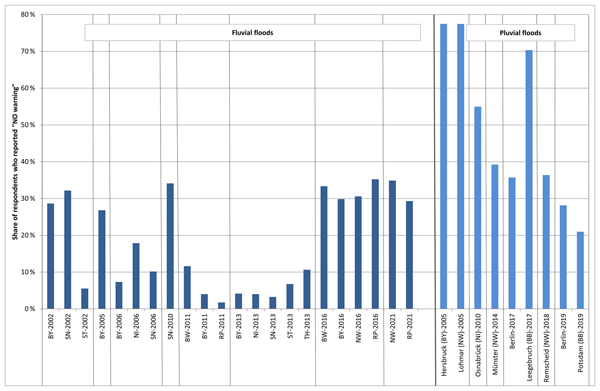
In July 2021 intense rainfall caused devastating floods in western Europe with 184 fatalities in the German federal states of North Rhine-Westphalia (NW) and Rhineland-Palatinate (RP), calling their warning system into question. An online survey revealed that 35 % of respondents from NW and 29 % from RP did not receive any warning. Many of those who were warned did not expect severe flooding, nor did they know how to react. The study provides entry points for improving Germany's warning system.
Dirk Eilander, Anaïs Couasnon, Tim Leijnse, Hiroaki Ikeuchi, Dai Yamazaki, Sanne Muis, Job Dullaart, Arjen Haag, Hessel C. Winsemius, and Philip J. Ward
Nat. Hazards Earth Syst. Sci., 23, 823–846, https://doi.org/10.5194/nhess-23-823-2023, https://doi.org/10.5194/nhess-23-823-2023, 2023
Short summary
Short summary
In coastal deltas, flooding can occur from interactions between coastal, riverine, and pluvial drivers, so-called compound flooding. Global models however ignore these interactions. We present a framework for automated and reproducible compound flood modeling anywhere globally and validate it for two historical events in Mozambique with good results. The analysis reveals differences in compound flood dynamics between both events related to the magnitude of and time lag between drivers.
Susanna Mohr, Uwe Ehret, Michael Kunz, Patrick Ludwig, Alberto Caldas-Alvarez, James E. Daniell, Florian Ehmele, Hendrik Feldmann, Mário J. Franca, Christian Gattke, Marie Hundhausen, Peter Knippertz, Katharina Küpfer, Bernhard Mühr, Joaquim G. Pinto, Julian Quinting, Andreas M. Schäfer, Marc Scheibel, Frank Seidel, and Christina Wisotzky
Nat. Hazards Earth Syst. Sci., 23, 525–551, https://doi.org/10.5194/nhess-23-525-2023, https://doi.org/10.5194/nhess-23-525-2023, 2023
Short summary
Short summary
The flood event in July 2021 was one of the most severe disasters in Europe in the last half century. The objective of this two-part study is a multi-disciplinary assessment that examines the complex process interactions in different compartments, from meteorology to hydrological conditions to hydro-morphological processes to impacts on assets and environment. In addition, we address the question of what measures are possible to generate added value to early response management.
Paolo Scussolini, Job Dullaart, Sanne Muis, Alessio Rovere, Pepijn Bakker, Dim Coumou, Hans Renssen, Philip J. Ward, and Jeroen C. J. H. Aerts
Clim. Past, 19, 141–157, https://doi.org/10.5194/cp-19-141-2023, https://doi.org/10.5194/cp-19-141-2023, 2023
Short summary
Short summary
We reconstruct sea level extremes due to storm surges in a past warmer climate. We employ a novel combination of paleoclimate modeling and global ocean hydrodynamic modeling. We find that during the Last Interglacial, about 127 000 years ago, seasonal sea level extremes were indeed significantly different – higher or lower – on long stretches of the global coast. These changes are associated with different patterns of atmospheric storminess linked with meridional shifts in wind bands.
Elco E. Koks, Kees C. H. van Ginkel, Margreet J. E. van Marle, and Anne Lemnitzer
Nat. Hazards Earth Syst. Sci., 22, 3831–3838, https://doi.org/10.5194/nhess-22-3831-2022, https://doi.org/10.5194/nhess-22-3831-2022, 2022
Short summary
Short summary
This study provides an overview of the impacts to critical infrastructure and how recovery has progressed after the July 2021 flood event in Germany, Belgium and the Netherlands. The results show that Germany and Belgium were particularly affected, with many infrastructure assets severely damaged or completely destroyed. This study helps to better understand how infrastructure can be affected by flooding and can be used for validation purposes for future studies.
Alberto Caldas-Alvarez, Markus Augenstein, Georgy Ayzel, Klemens Barfus, Ribu Cherian, Lisa Dillenardt, Felix Fauer, Hendrik Feldmann, Maik Heistermann, Alexia Karwat, Frank Kaspar, Heidi Kreibich, Etor Emanuel Lucio-Eceiza, Edmund P. Meredith, Susanna Mohr, Deborah Niermann, Stephan Pfahl, Florian Ruff, Henning W. Rust, Lukas Schoppa, Thomas Schwitalla, Stella Steidl, Annegret H. Thieken, Jordis S. Tradowsky, Volker Wulfmeyer, and Johannes Quaas
Nat. Hazards Earth Syst. Sci., 22, 3701–3724, https://doi.org/10.5194/nhess-22-3701-2022, https://doi.org/10.5194/nhess-22-3701-2022, 2022
Short summary
Short summary
In a warming climate, extreme precipitation events are becoming more frequent. To advance our knowledge on such phenomena, we present a multidisciplinary analysis of a selected case study that took place on 29 June 2017 in the Berlin metropolitan area. Our analysis provides evidence of the extremeness of the case from the atmospheric and the impacts perspectives as well as new insights on the physical mechanisms of the event at the meteorological and climate scales.
Bastian van den Bout, Chenxiao Tang, Cees van Westen, and Victor Jetten
Nat. Hazards Earth Syst. Sci., 22, 3183–3209, https://doi.org/10.5194/nhess-22-3183-2022, https://doi.org/10.5194/nhess-22-3183-2022, 2022
Short summary
Short summary
Natural hazards such as earthquakes, landslides, and flooding do not always occur as stand-alone events. After the 2008 Wenchuan earthquake, a co-seismic landslide blocked a stream in Hongchun. Two years later, a debris flow breached the material, blocked the Min River, and resulted in flooding of a small town. We developed a multi-process model that captures the full cascade. Despite input and process uncertainties, probability of flooding was high due to topography and trigger intensities.
Robert Šakić Trogrlić, Amy Donovan, and Bruce D. Malamud
Nat. Hazards Earth Syst. Sci., 22, 2771–2790, https://doi.org/10.5194/nhess-22-2771-2022, https://doi.org/10.5194/nhess-22-2771-2022, 2022
Short summary
Short summary
Here we present survey responses of 350 natural hazard community members to key challenges in natural hazards research and step changes to achieve the Sustainable Development Goals. Challenges identified range from technical (e.g. model development, early warning) to governance (e.g. co-production with community members). Step changes needed are equally broad; however, the majority of answers showed a need for wider stakeholder engagement, increased risk management and interdisciplinary work.
Samuel Rufat, Mariana Madruga de Brito, Alexander Fekete, Emeline Comby, Peter J. Robinson, Iuliana Armaş, W. J. Wouter Botzen, and Christian Kuhlicke
Nat. Hazards Earth Syst. Sci., 22, 2655–2672, https://doi.org/10.5194/nhess-22-2655-2022, https://doi.org/10.5194/nhess-22-2655-2022, 2022
Short summary
Short summary
It remains unclear why people fail to act adaptively to reduce future losses, even when there is ever-richer information available. To improve the ability of researchers to build cumulative knowledge, we conducted an international survey – the Risk Perception and Behaviour Survey of Surveyors (Risk-SoS). We find that most studies are exploratory and often overlook theoretical efforts that would enable the accumulation of evidence. We offer several recommendations for future studies.
Julius Schlumberger, Christian Ferrarin, Sebastiaan N. Jonkman, Manuel Andres Diaz Loaiza, Alessandro Antonini, and Sandra Fatorić
Nat. Hazards Earth Syst. Sci., 22, 2381–2400, https://doi.org/10.5194/nhess-22-2381-2022, https://doi.org/10.5194/nhess-22-2381-2022, 2022
Short summary
Short summary
Flooding has serious impacts on the old town of Venice. This paper presents a framework combining a flood model with a flood-impact model to support improving protection against future floods in Venice despite the recently built MOSE barrier. Applying the framework to seven plausible flood scenarios, it was found that individual protection has a significant damage-mediating effect if the MOSE barrier does not operate as anticipated. Contingency planning thus remains important in Venice.
Michael Dietze, Rainer Bell, Ugur Ozturk, Kristen L. Cook, Christoff Andermann, Alexander R. Beer, Bodo Damm, Ana Lucia, Felix S. Fauer, Katrin M. Nissen, Tobias Sieg, and Annegret H. Thieken
Nat. Hazards Earth Syst. Sci., 22, 1845–1856, https://doi.org/10.5194/nhess-22-1845-2022, https://doi.org/10.5194/nhess-22-1845-2022, 2022
Short summary
Short summary
The flood that hit Europe in July 2021, specifically the Eifel, Germany, was more than a lot of fast-flowing water. The heavy rain that fell during the 3 d before also caused the slope to fail, recruited tree trunks that clogged bridges, and routed debris across the landscape. Especially in the upper parts of the catchments the flood was able to gain momentum. Here, we discuss how different landscape elements interacted and highlight the challenges of holistic future flood anticipation.
Weihua Zhu, Kai Liu, Ming Wang, Philip J. Ward, and Elco E. Koks
Nat. Hazards Earth Syst. Sci., 22, 1519–1540, https://doi.org/10.5194/nhess-22-1519-2022, https://doi.org/10.5194/nhess-22-1519-2022, 2022
Short summary
Short summary
We present a simulation framework to analyse the system vulnerability and risk of the Chinese railway system to floods. To do so, we develop a method for generating flood events at both the national and river basin scale. Results show flood system vulnerability and risk of the railway system are spatially heterogeneous. The event-based approach shows how we can identify critical hotspots, taking the first steps in developing climate-resilient infrastructure.
Philip J. Ward, James Daniell, Melanie Duncan, Anna Dunne, Cédric Hananel, Stefan Hochrainer-Stigler, Annegien Tijssen, Silvia Torresan, Roxana Ciurean, Joel C. Gill, Jana Sillmann, Anaïs Couasnon, Elco Koks, Noemi Padrón-Fumero, Sharon Tatman, Marianne Tronstad Lund, Adewole Adesiyun, Jeroen C. J. H. Aerts, Alexander Alabaster, Bernard Bulder, Carlos Campillo Torres, Andrea Critto, Raúl Hernández-Martín, Marta Machado, Jaroslav Mysiak, Rene Orth, Irene Palomino Antolín, Eva-Cristina Petrescu, Markus Reichstein, Timothy Tiggeloven, Anne F. Van Loon, Hung Vuong Pham, and Marleen C. de Ruiter
Nat. Hazards Earth Syst. Sci., 22, 1487–1497, https://doi.org/10.5194/nhess-22-1487-2022, https://doi.org/10.5194/nhess-22-1487-2022, 2022
Short summary
Short summary
The majority of natural-hazard risk research focuses on single hazards (a flood, a drought, a volcanic eruption, an earthquake, etc.). In the international research and policy community it is recognised that risk management could benefit from a more systemic approach. In this perspective paper, we argue for an approach that addresses multi-hazard, multi-risk management through the lens of sustainability challenges that cut across sectors, regions, and hazards.
Hanna K. Lappalainen, Tuukka Petäjä, Timo Vihma, Jouni Räisänen, Alexander Baklanov, Sergey Chalov, Igor Esau, Ekaterina Ezhova, Matti Leppäranta, Dmitry Pozdnyakov, Jukka Pumpanen, Meinrat O. Andreae, Mikhail Arshinov, Eija Asmi, Jianhui Bai, Igor Bashmachnikov, Boris Belan, Federico Bianchi, Boris Biskaborn, Michael Boy, Jaana Bäck, Bin Cheng, Natalia Chubarova, Jonathan Duplissy, Egor Dyukarev, Konstantinos Eleftheriadis, Martin Forsius, Martin Heimann, Sirkku Juhola, Vladimir Konovalov, Igor Konovalov, Pavel Konstantinov, Kajar Köster, Elena Lapshina, Anna Lintunen, Alexander Mahura, Risto Makkonen, Svetlana Malkhazova, Ivan Mammarella, Stefano Mammola, Stephany Buenrostro Mazon, Outi Meinander, Eugene Mikhailov, Victoria Miles, Stanislav Myslenkov, Dmitry Orlov, Jean-Daniel Paris, Roberta Pirazzini, Olga Popovicheva, Jouni Pulliainen, Kimmo Rautiainen, Torsten Sachs, Vladimir Shevchenko, Andrey Skorokhod, Andreas Stohl, Elli Suhonen, Erik S. Thomson, Marina Tsidilina, Veli-Pekka Tynkkynen, Petteri Uotila, Aki Virkkula, Nadezhda Voropay, Tobias Wolf, Sayaka Yasunaka, Jiahua Zhang, Yubao Qiu, Aijun Ding, Huadong Guo, Valery Bondur, Nikolay Kasimov, Sergej Zilitinkevich, Veli-Matti Kerminen, and Markku Kulmala
Atmos. Chem. Phys., 22, 4413–4469, https://doi.org/10.5194/acp-22-4413-2022, https://doi.org/10.5194/acp-22-4413-2022, 2022
Short summary
Short summary
We summarize results during the last 5 years in the northern Eurasian region, especially from Russia, and introduce recent observations of the air quality in the urban environments in China. Although the scientific knowledge in these regions has increased, there are still gaps in our understanding of large-scale climate–Earth surface interactions and feedbacks. This arises from limitations in research infrastructures and integrative data analyses, hindering a comprehensive system analysis.
Agathe Bucherie, Micha Werner, Marc van den Homberg, and Simon Tembo
Nat. Hazards Earth Syst. Sci., 22, 461–480, https://doi.org/10.5194/nhess-22-461-2022, https://doi.org/10.5194/nhess-22-461-2022, 2022
Short summary
Short summary
Local communities in northern Malawi have well-developed knowledge of the conditions leading to flash floods, spatially and temporally. Scientific analysis of catchment geomorphology and global reanalysis datasets corroborates this local knowledge, underlining the potential of these large-scale scientific datasets. Combining local knowledge with contemporary scientific datasets provides a common understanding of flash flood events, contributing to a more people-centred warning to flash floods.
Mattia Amadio, Arthur H. Essenfelder, Stefano Bagli, Sepehr Marzi, Paolo Mazzoli, Jaroslav Mysiak, and Stephen Roberts
Nat. Hazards Earth Syst. Sci., 22, 265–286, https://doi.org/10.5194/nhess-22-265-2022, https://doi.org/10.5194/nhess-22-265-2022, 2022
Short summary
Short summary
We estimate the risk associated with storm surge events at two case study locations along the North Adriatic Italian coast, considering sea level rise up to the year 2100, and perform a cost–benefit analysis of planned or proposed coastal renovation projects. The study uses nearshore hydrodynamic modelling. Our findings represent a useful indication for disaster risk management, helping to understand the importance of investing in adaptation and estimating the economic return on investments.
Annegret H. Thieken, Guilherme Samprogna Mohor, Heidi Kreibich, and Meike Müller
Nat. Hazards Earth Syst. Sci., 22, 165–185, https://doi.org/10.5194/nhess-22-165-2022, https://doi.org/10.5194/nhess-22-165-2022, 2022
Short summary
Short summary
Various floods hit Germany recently. While there was a river flood with some dike breaches in 2013, flooding in 2016 resulted directly from heavy rainfall, causing overflowing drainage systems in urban areas and destructive flash floods in steep catchments. Based on survey data, we analysed how residents coped with these different floods. We observed significantly different flood impacts, warnings, behaviour and recovery, offering entry points for tailored risk communication and support.
Stefano Terzi, Janez Sušnik, Stefan Schneiderbauer, Silvia Torresan, and Andrea Critto
Nat. Hazards Earth Syst. Sci., 21, 3519–3537, https://doi.org/10.5194/nhess-21-3519-2021, https://doi.org/10.5194/nhess-21-3519-2021, 2021
Short summary
Short summary
This study combines outputs from multiple models with statistical assessments of past and future water availability and demand for the Santa Giustina reservoir (Autonomous Province of Trento, Italy). Considering future climate change scenarios, results show high reductions for stored volume and turbined water, with increasing frequency, duration and severity. These results call for the need to adapt to reductions in water availability and effects on the Santa Giustina reservoir management.
Lucas Wouters, Anaïs Couasnon, Marleen C. de Ruiter, Marc J. C. van den Homberg, Aklilu Teklesadik, and Hans de Moel
Nat. Hazards Earth Syst. Sci., 21, 3199–3218, https://doi.org/10.5194/nhess-21-3199-2021, https://doi.org/10.5194/nhess-21-3199-2021, 2021
Short summary
Short summary
This research introduces a novel approach to estimate flood damage in Malawi by applying a machine learning model to UAV imagery. We think that the development of such a model is an essential step to enable the swift allocation of resources for recovery by humanitarian decision-makers. By comparing this method (EUR 10 140) to a conventional land-use-based approach (EUR 15 782) for a specific flood event, recommendations are made for future assessments.
Weihua Zhu, Kai Liu, Ming Wang, Sadhana Nirandjan, and Elco Koks
Nat. Hazards Earth Syst. Sci. Discuss., https://doi.org/10.5194/nhess-2021-277, https://doi.org/10.5194/nhess-2021-277, 2021
Manuscript not accepted for further review
Short summary
Short summary
We use multi-source empirical damage data to generate vulnerability curves and assess the risk of transportation infrastructure to rainfall-induced hazards. The results show large variations in the shape of the vulnerability curves and risk of railway infrastructure in China across the different regions. The usage of multi-source empirical data offer opportunities to perform risk assessments that include spatial detail among regions.
Danhua Xin, James Edward Daniell, Hing-Ho Tsang, and Friedemann Wenzel
Nat. Hazards Earth Syst. Sci., 21, 3031–3056, https://doi.org/10.5194/nhess-21-3031-2021, https://doi.org/10.5194/nhess-21-3031-2021, 2021
Short summary
Short summary
A grid-level residential building stock model (in terms of floor area and replacement value) targeted for seismic risk analysis for mainland China is developed by using census and population density data. Comparisons with previous studies and yearbook records indicate the reliability of our model. The modelled results are openly accessible and can be conveniently updated when more detailed census or statistics data are available.
Dirk Eilander, Willem van Verseveld, Dai Yamazaki, Albrecht Weerts, Hessel C. Winsemius, and Philip J. Ward
Hydrol. Earth Syst. Sci., 25, 5287–5313, https://doi.org/10.5194/hess-25-5287-2021, https://doi.org/10.5194/hess-25-5287-2021, 2021
Short summary
Short summary
Digital elevation models and derived flow directions are crucial to distributed hydrological modeling. As the spatial resolution of models is typically coarser than these data, we need methods to upscale flow direction data while preserving the river structure. We propose the Iterative Hydrography Upscaling (IHU) method and show it outperforms other often-applied methods. We publish the multi-resolution MERIT Hydro IHU hydrography dataset and the algorithm as part of the pyflwdir Python package.
Marleen Carolijn de Ruiter, Anaïs Couasnon, and Philip James Ward
Geosci. Commun., 4, 383–397, https://doi.org/10.5194/gc-4-383-2021, https://doi.org/10.5194/gc-4-383-2021, 2021
Short summary
Short summary
Many countries can get hit by different hazards, such as earthquakes and floods. Generally, measures and policies are aimed at decreasing the potential damages of one particular hazard type despite their potential of having unwanted effects on other hazard types. We designed a serious game that helps professionals to improve their understanding of these potential negative effects of measures and policies that reduce the impacts of disasters across many different hazard types.
Stephen Jewson, Giuliana Barbato, Paola Mercogliano, Jaroslav Mysiak, and Maximiliano Sassi
Nonlin. Processes Geophys., 28, 329–346, https://doi.org/10.5194/npg-28-329-2021, https://doi.org/10.5194/npg-28-329-2021, 2021
Short summary
Short summary
Climate model simulations are uncertain. In some cases this makes it difficult to know how to use them. Significance testing is often used to deal with this issue but has various shortcomings. We describe two alternative ways to manage uncertainty in climate model simulations that avoid these shortcomings. We test them on simulations of future rainfall over Europe and show they produce more accurate projections than either using unadjusted climate model output or statistical testing.
Katja Weigel, Lisa Bock, Bettina K. Gier, Axel Lauer, Mattia Righi, Manuel Schlund, Kemisola Adeniyi, Bouwe Andela, Enrico Arnone, Peter Berg, Louis-Philippe Caron, Irene Cionni, Susanna Corti, Niels Drost, Alasdair Hunter, Llorenç Lledó, Christian Wilhelm Mohr, Aytaç Paçal, Núria Pérez-Zanón, Valeriu Predoi, Marit Sandstad, Jana Sillmann, Andreas Sterl, Javier Vegas-Regidor, Jost von Hardenberg, and Veronika Eyring
Geosci. Model Dev., 14, 3159–3184, https://doi.org/10.5194/gmd-14-3159-2021, https://doi.org/10.5194/gmd-14-3159-2021, 2021
Short summary
Short summary
This work presents new diagnostics for the Earth System Model Evaluation Tool (ESMValTool) v2.0 on the hydrological cycle, extreme events, impact assessment, regional evaluations, and ensemble member selection. The ESMValTool v2.0 diagnostics are developed by a large community of scientists aiming to facilitate the evaluation and comparison of Earth system models (ESMs) with a focus on the ESMs participating in the Coupled Model Intercomparison Project (CMIP).
Guilherme S. Mohor, Annegret H. Thieken, and Oliver Korup
Nat. Hazards Earth Syst. Sci., 21, 1599–1614, https://doi.org/10.5194/nhess-21-1599-2021, https://doi.org/10.5194/nhess-21-1599-2021, 2021
Short summary
Short summary
We explored differences in the damaging process across different flood types, regions within Germany, and six flood events through a numerical model in which the groups can learn from each other. Differences were found mostly across flood types, indicating the importance of identifying them, but there is great overlap across regions and flood events, indicating either that socioeconomic or temporal information was not well represented or that they are in fact less different within our cases.
Cited articles
Aerts, J. C. J. H.: Integrating agent-based approaches with flood risk models: A review and perspective, Water Secur., 11, 100076, https://doi.org/10.1016/j.wasec.2020.100076, 2020.
AghaKouchak, A., Huning, L. S., Sadegh, M., Qin, Y., Markonis, Y., Vahedifard, F., Love, C. A., Mishra, A., Mehran, A., Obringer, R., Hjelmstad, A., Pallickara, S., Jiwa, S., Hanel, M., Zhao, Y., Pendergrass, A. G., Arabi, M., Davis, S. J., Ward, P. J., Svoboda, M., Pulwarty, R., and Kreibich, H.: Toward impact-based monitoring of drought and its cascading hazards, Nat. Rev. Earth Environ., 4, 582–595, https://doi.org/10.1038/s43017-023-00457-2, 2023.
Aldunce, P., Beilin, R., Howden, M., and Handmer, J.: Resilience for disaster risk management in a changing climate: Practitioners' frames and practices, Global Environ. Change, 30, 1–11, https://doi.org/10.1016/j.gloenvcha.2014.10.010, 2015.
Allen, C., Malekpour, S., and Mintrom, M.: Cross-scale, cross-level and multi-actor governance of transformations toward the Sustainable Development Goals: A review of common challenges and solutions, Sustain. Dev., 31, 1250–1267, https://doi.org/10.1002/sd.2495, 2023.
Alzubaidi, L., Bai, J., Al-Sabaawi, A., Santamaría, J., Albahri, A. S., Al-dabbagh, B. S. N., Fadhel, M. A., Manoufali, M., Zhang, J., Al-Timemy, A. H., Duan, Y., Abdullah, A., Farhan, L., Lu, Y., Gupta, A., Albu, F., Abbosh, A., and Gu, Y.: A survey on deep learning tools dealing with data scarcity: definitions, challenges, solutions, tips, and applications, J. Big Data, 10, 46, https://doi.org/10.1186/s40537-023-00727-2, 2023.
Amaliya, V. F., Lakudo, H., Ulum, A. H., Destarina, L., Seno, S., Rakhmadi, F., Aminah, N. S., Evita, M., and Djamal, M.: Development of IoT-Based Volcano Early Warning System, J. Phys.: Conf. Ser., 1772, 012009, https://doi.org/10.1088/1742-6596/1772/1/012009, 2021.
Aravena Pelizari, P., Geiß, C., Aguirre, P., Santa María, H., Merino Peña, Y., and Taubenböck, H.: Automated building characterization for seismic risk assessment using street-level imagery and deep learning, ISPRS J. Photogram. Remote Sens., 180, 370–386, https://doi.org/10.1016/j.isprsjprs.2021.07.004, 2021.
Arctik: D7.4 Serious Game, Zenodo [data set], https://doi.org/10.5281/zenodo.16366986, 2025.
Ariyachandra, M. R. M. F. and Wedawatta, G.: Digital Twin Smart Cities for Disaster Risk Management: A Review of Evolving Concepts, Sustainability, 15, 11910, https://doi.org/10.3390/su151511910, 2023.
Bakhtiari, S., Najafi, M. R., Goda, K., and Peerhossaini, H.: A dynamic Bayesian network approach to characterize multi-hazard risks and resilience in interconnected critical infrastructures, Reliabil. Eng. Syst. Safe., 257, 110815, https://doi.org/10.1016/j.ress.2025.110815, 2025.
Bastos Moroz, C. and Thieken, A. H.: Urban growth and spatial segregation increase disaster risk: lessons learned from the 2023 disaster on the North Coast of São Paulo, Brazil, Nat. Hazards Earth Syst. Sci., 24, 3299–3314, https://doi.org/10.5194/nhess-24-3299-2024, 2024.
Baulenas, E., Versteeg, G., Terrado, M., Mindlin, J., and Bojovic, D.: Assembling the climate story: use of storyline approaches in climate-related science, Global Challeng., 7, 2200183, https://doi.org/10.1002/gch2.202200183, 2023.
Becker, S. L. and Reusser, D. E.: Disasters as opportunities for social change: Using the multi-level perspective to consider the barriers to disaster-related transitions, Int. J. Disast. Risk Reduct., 18, 75–88, https://doi.org/10.1016/j.ijdrr.2016.05.005, 2016.
Bellini, P., Nesi, P., Pantaleo, G., Bellini, P., Nesi, P., and Pantaleo, G.: IoT-Enabled Smart Cities: A Review of Concepts, Frameworks and Key Technologies, Appl. Sci., 12, https://doi.org/10.3390/app12031607, 2022.
Bertoldo, R.: A comparative frame for a contextualised analysis of local natural risk management, Int. J. Disast. Risk Reduct., 52, 101945, https://doi.org/10.1016/j.ijdrr.2020.101945, 2021.
Birkmann, J., Cardona, O. D., Carreño, M. L., Barbat, A. H., Pelling, M., Schneiderbauer, S., Kienberger, S., Keiler, M., Alexander, D., Zeil, P., and Welle, T.: Framing vulnerability, risk and societal responses: the MOVE framework, Nat. Hazards, 67, 193–211, https://doi.org/10.1007/s11069-013-0558-5, 2013.
Bonfanti, R. C., Oberti, B., Ravazzoli, E., Rinaldi, A., Ruggieri, S., Schimmenti, A., Bonfanti, R. C., Oberti, B., Ravazzoli, E., Rinaldi, A., Ruggieri, S., and Schimmenti, A.: The Role of Trust in Disaster Risk Reduction: A Critical Review, Int. J. Environ. Res. Publ. Health, 21, https://doi.org/10.3390/ijerph21010029, 2023.
Bossut, M. and Tyagi, A.: Financial recovery after a flood event: Evidence from French manufacturing SMEs, in: Abstract booklet – 3rd International Conference Natural Hazards and Risks in a Changing World: Addressing Compound and Multi-Hazard Risk, edited by: Mirenzi, V. and Pijpen, I., https://doi.org/10.5281/zenodo.12744934, 2024.
Bou Nassar, J. A., Malard, J. J., Adamowski, J. F., Ramírez Ramírez, M., Medema, W., and Tuy, H.: Multi-level storylines for participatory modeling – involving marginalized communities in Tz'olöj Ya', Mayan Guatemala, Hydrol. Earth Syst. Sci., 25, 1283–1306, https://doi.org/10.5194/hess-25-1283-2021, 2021.
Brett, L., White, C. J., Domeisen, D. I. V., van den Hurk, B., Ward, P., and Zscheischler, J.: Review article: The growth in compound weather and climate event research in the decade since SREX, Nat. Hazards Earth Syst. Sci., 25, 2591–2611, https://doi.org/10.5194/nhess-25-2591-2025, 2025a.
Brett, L., Bloomfield, H. C., Bradley, A., Calvet, T., Champion, A., De Angeli, S., de Ruiter, M. C., Guerreiro, S. B., Hillier, J., Jaroszweski, D., Kamranzad, B., Keinänen-Toivola, M. M., Kornhuber, K., Küpfer, K., Manning, C., Mattu, K., Murtagh, E., Murray, V., Bhreasail, Á. N., O'Loughlin, F., Parker, C., Pregnolato, M., Ramos, A. M., Schlumberger, J., Theochari, D., Ward, P., Wessels, A., and White, C. J.: Science–policy–practice insights for compound and multi-hazard risks, Meteorol. Appl., 32, e70043, https://doi.org/10.1002/met.70043, 2025b.
British Geological Survey: Online repository of storylines on multi-risk decision-making, Zenodo, https://doi.org/10.5281/zenodo.16366883, 2025.
Bronstert, A., Agarwal, A., Boessenkool, B., Crisologo, I., Fischer, M., Heistermann, M., Köhn-Reich, L., López-Tarazón, J. A., Moran, T., Ozturk, U., Reinhardt-Imjela, C., and Wendi, D.: Forensic hydro-meteorological analysis of an extreme flash flood: The 2016-05-29 event in Braunsbach, SW Germany, Sci. Total Environ., 630, 977–991, https://doi.org/10.1016/j.scitotenv.2018.02.241, 2018.
Brown, S., Budimir, M., Sneddon, A., Clements, R. and Upadhyay Crawford, S.: Missing Voices Approach Manual: Executive Summary, Practical Action Publishing, Rugby, UK, https://practicalaction.org/knowledge-centre/resources/missing-voices-approach-manual-executive-summary/ (last access: 2 April 2026), 2022.
Bubeck, P., Berghäuser, L., Hudson, P., and Thieken, A. H.: Using Panel Data to Understand the Dynamics of Human Behavior in Response to Flooding, Risk Anal., 40, 2340–2359, https://doi.org/10.1111/risa.13548, 2020.
Budimir, M., Šakić Trogrlić, R., Almeida, C., Arestegui, M., Chuquisengo Vásquez, O., Cisneros, A., Cuba Iriarte, M., Dia, A., Lizon, L., Madueño, G., Ndiaye, A., Ordoñez Caldas, M., Rahman, T., RanaTharu, B., Sall, A., Uprety, D., Anderson, C., and McQuistan, C.: Opportunities and challenges for people-centered multi-hazard early warning systems: Perspectives from the Global South, iScience, 28, https://doi.org/10.1016/j.isci.2025.112353, 2025.
Buijs, S. L., Sauer, I. J., Kropf, C. M., Juhel, S., Stalhandske, Z., and De Ruiter, M. C.: Recovery under consecutive disasters: how recovery dynamics shape societal resilience, EGUsphere [preprint], https://doi.org/10.5194/egusphere-2025-3200, 2025.
Busker, T., van den Hurk, B., de Moel, H., van den Homberg, M., van Straaten, C., Odongo, R. A., and Aerts, J. C. J. H.: Predicting Food-Security Crises in the Horn of Africa Using Machine Learning, Earth's Future, 12, e2023EF004211, https://doi.org/10.1029/2023EF004211, 2024.
Butler, J. R. A., Meharg, S., Grigg, N., Barbour, E. J., Barrowman, H., Nilsson, D., and Stone-Jovicich, S.: Designing development programmes for climate change and uncertainty in Pacific Melanesia – the role for knowledge brokers, Clim. Dev., 17, 243–254, https://doi.org/10.1080/17565529.2024.2353829, 2025.
Cao, L.: AI and data science for smart emergency, crisis and disaster resilience, Int. J. Data Sci. Anal., 15, 231–246, https://doi.org/10.1007/s41060-023-00393-w, 2023.
Carrasco, S., Egbelakin, T., and Dangol, N.: Fostering recovery through stakeholders-community collaboration in post-earthquake recovery in Nepal, Int. J. Disast. Risk Reduct., 88, 103619, https://doi.org/10.1016/j.ijdrr.2023.103619, 2023.
Cerdà-Bautista, J., Tárraga, J. M., Sitokonstantinou, V., and Camps-Valls, G.: Assessing the Causal Impact of Humanitarian Aid on Food Security: arXiv [preprint], https://doi.org/10.48550/arXiv.2310.11287, 2025.
Chandran, I. and Vipin, K.: Multi-UAV networks for disaster monitoring: challenges and opportunities from a network perspective, Drone Syst. Appl., 12, 1–28, https://doi.org/10.1139/dsa-2023-0079, 2024.
Chen, S., Ogawa, Y., Zhao, C., and Sekimoto, Y.: Large-scale individual building extraction from open-source satellite imagery via super-resolution-based instance segmentation approach, ISPRS J. Photogram. Remote Sens., 195, 129–152, https://doi.org/10.1016/j.isprsjprs.2022.11.006, 2023.
Cheng, C.-S., Behzadan, A., and Noshadravan, A.: A post-hurricane building debris estimation workflow enabled by uncertainty-aware AI and crowdsourcing, Int. J. Disast. Risk Reduct., 112, 104785, https://doi.org/10.1016/j.ijdrr.2024.104785, 2024.
Chi, G., Fang, H., Chatterjee, S., and Blumenstock, J. E.: Microestimates of wealth for all low- and middle-income countries, P. Natl. Acad. Sci. USA, 119, e2113658119, https://doi.org/10.1073/pnas.2113658119, 2022.
Ciullo, A., Franzke, C. L. E., Scheffran, J., and Sillmann, J.: Climate-driven systemic risk to the sustainable development goals, PLOS Clim., 4, e0000564, https://doi.org/10.1371/journal.pclm.0000564, 2025.
Ciurean, R., Gill, J., Reeves, H. J., O'Grady, S., and Aldridge, T.: Review of multi-hazards research and risk assessments, British Geological Survey, Nottingham, UK, 109 pp., https://nora.nerc.ac.uk/id/eprint/524399/ (last access: 2 April 2026), 2018.
Claassen, J. N., Ward, P. J., Daniell, J., Koks, E. E., Tiggeloven, T., and de Ruiter, M. C.: A new method to compile global multi-hazard event sets, Sci. Rep., 13, 13808, https://doi.org/10.1038/s41598-023-40400-5, 2023.
Clark, N., Boersma, K., Raju, E., Opromolla, A., Orru, K., Hansson, S., Russo, R., Gargiulo, M. V., Duca, G., Capuano, P., Schweizer, P.-J., Cumiskey, L., Steinhausen, M., Branlat, M., Olson, A., Andersen, N. B., Larruina, R., Atun, F., van Westen, C., Tamborrino, R., and Vollmer, M.: Strengthening all-of-society approaches for disaster resilient societies through competency building: A European research agenda, Int. J. Disast. Risk Reduct., 121, 105345, https://doi.org/10.1016/j.ijdrr.2025.105345, 2025.
Cocuccioni, S., Pittore, M., Zebisch, M., Schneiderbauer, S., Shepherd, T. G., Casartelli, V., Crummy, J., and Pedde, S.: Risk Storylines: A Community-Led Discussion between Disaster and Climate Science, B. Am. Meteorol. Soc., 106, E1717–E1723, https://doi.org/10.1175/BAMS-D-25-0155.1, 2025.
Condon, M.: Climate Services: The Business of Physical Risk, SSRN, https://doi.org/10.2139/ssrn.4396826, 2023.
Cumiskey, L., Priest, S., Klijn, F., and Juntti, M.: A framework to assess integration in flood risk management: implications for governance, policy, and practice, Ecol. Soc., 24, https://doi.org/10.5751/ES-11298-240417, 2019.
Cutter, S. L.: The origin and diffusion of the social vulnerability index (SoVI), Int. J. Disast. Risk Reduct., 109, 104576, https://doi.org/10.1016/j.ijdrr.2024.104576, 2024.
Daniell, J., Schaefer, A., Khazai, B., Girard, T., Brand, J., Maier, A., Michalke, S., Blanz, B., Claassen, J., Strelkovskii, N., and Raj, S.: D5.4 Software package and user guide for multi-hazard and multi-risk scenario generation, Zenodo [code], https://doi.org/10.5281/zenodo.16834214, 2025.
Davoudi, S., Brooks, E., and Mehmood, A.: Evolutionary Resilience and Strategies for Climate Adaptation, Plan. Pract. Res., 28, 307–322, https://doi.org/10.1080/02697459.2013.787695, 2013.
De Angeli, S., Malamud, B. D., Rossi, L., Taylor, F. E., Trasforini, E., and Rudari, R.: A multi-hazard framework for spatial-temporal impact analysis, Int. J. Disast. Risk Reduct., 73, 102829, https://doi.org/10.1016/j.ijdrr.2022.102829, 2022.
De Plaen, J. J.-F. G., Koks, E. E., and Ward, P. J.: Towards an open pipeline for the detection of critical infrastructure from satellite imagery – a case study on electrical substations in The Netherlands, Environ. Res.: Infrastruct. Sustain., 4, 035009, https://doi.org/10.1088/2634-4505/ad63c9, 2024.
de Ruiter, M. C. and van Loon, A. F.: The challenges of dynamic vulnerability and how to assess it, iScience, 25, 104720, https://doi.org/10.1016/j.isci.2022.104720, 2022.
de Ruiter, M. C., Couasnon, A., van den Homberg, M. J. C., Daniell, J. E., Gill, J. C., and Ward, P. J.: Why We Can No Longer Ignore Consecutive Disasters, Earth's Future, 8, e2019EF001425, https://doi.org/10.1029/2019EF001425, 2020.
de Ruiter, M. C., Couasnon, A., and Ward, P. J.: Breaking the Silos: an online serious game for multi-risk disaster risk reduction (DRR) management, Geosci. Commun., 4, 383–397, https://doi.org/10.5194/gc-4-383-2021, 2021.
Dias, N., Amaratunga, D., and Haigh, R.: Challenges associated with integrating CCA and DRR in the UK – A review on the existing legal and policy background, Proced. Eng., 212, 978–985, https://doi.org/10.1016/j.proeng.2018.01.126, 2018.
Diemert, S. and Weber, J. H.: Can Large Language Models Assist in Hazard Analysis?, in: Computer Safety, Reliability, and Security, SAFECOMP 2023 Workshops, 410–422, https://doi.org/10.1007/978-3-031-40953-0_35, 2023.
Ducros, G., Tiggeloven, T., Ma, L., Daloz, A. S., Schuhen, N., Claassen, J., and de Ruiter, M. C.: Multi-hazards in Scandinavia: impacts and risks from compound heatwaves, droughts and wildfires, Nat. Hazards Earth Syst. Sci., 25, 4693–4712, https://doi.org/10.5194/nhess-25-4693-2025, 2025.
Dunant, A., Bebbington, M., and Davies, T.: Probabilistic cascading multi-hazard risk assessment methodology using graph theory, a New Zealand trial, Int. J. Disast. Risk Reduct., 54, 102018, https://doi.org/10.1016/j.ijdrr.2020.102018, 2021.
Fan, C., Jiang, Y., and Mostafavi, A.: Social Sensing in Disaster City Digital Twin: Integrated Textual–Visual–Geo Framework for Situational Awareness during Built Environment Disruptions, J. Manage. Eng., 36, 04020002, https://doi.org/10.1061/(ASCE)ME.1943-5479.0000745, 2020.
Fan, C., Zhang, C., Yahja, A., and Mostafavi, A.: Disaster City Digital Twin: A vision for integrating artificial and human intelligence for disaster management, Int. J. Inform. Manage., 56, 102049, https://doi.org/10.1016/j.ijinfomgt.2019.102049, 2021.
Fathani, T. F., Karnawati, D., Wilopo, W., and Setiawan, H.: Strengthening the Resilience by Implementing a Standard for Landslide Early Warning System, in: Progress in Landslide Research and Technology, Volume 1, edited by: Sassa, K., Konagai, K., Tiwari, B., Arbanas, Ž., and Sassa, S., Springer International Publishing, Cham, 277–284, https://doi.org/10.1007/978-3-031-16898-7_20, 2023.
Fathi, R. and Fiedrich, F.: Social Media Analytics by Virtual Operations Support Teams in disaster management: Situational awareness and actionable information for decision-makers, Front. Earth Sci., 10, https://doi.org/10.3389/feart.2022.941803, 2022.
Ferrario, D. M., Tiggeloven, T., Casagrande, S., Sanò, M., De Ruiter, M., Critto, A., and Torresan, S.: An AI approach for multi-risk assessment in the Veneto Region, EGU General Assembly, EGU25-16640, https://doi.org/10.5194/egusphere-egu25-16640, 2025.
Ferrer, J. V., Samprogna Mohor, G., Dewitte, O., Pánek, T., Reyes-Carmona, C., Handwerger, A. L., Hürlimann, M., Köhler, L., Teshebaeva, K., Thieken, A. H., Tsou, C.-Y., Urgilez Vinueza, A., Demurtas, V., Zhang, Y., Zhao, C., Marwan, N., Kurths, J., and Korup, O.: Human Settlement Pressure Drives Slow-Moving Landslide Exposure, Earth's Future, 12, e2024EF004830, https://doi.org/10.1029/2024EF004830, 2024.
Ford, D. N. and Wolf, C. M.: Smart Cities with Digital Twin Systems for Disaster Management, J. Manage. Eng., 36, 04020027, https://doi.org/10.1061/(ASCE)ME.1943-5479.0000779, 2020.
Gall, M., Nguyen, K. H., and Cutter, S. L.: Integrated research on disaster risk: Is it really integrated?, Int. J. Disast. Risk Reduct., 12, 255–267, https://doi.org/10.1016/j.ijdrr.2015.01.010, 2015.
Geiß, C., Maier, J., So, E., Schoepfer, E., Harig, S., Gómez Zapata, J. C., and Zhu, Y.: Anticipating a risky future: long short-term memory (LSTM) models for spatiotemporal extrapolation of population data in areas prone to earthquakes and tsunamis in Lima, Peru, Nat. Hazards Earth Syst. Sci., 24, 1051–1064, https://doi.org/10.5194/nhess-24-1051-2024, 2024.
Gevaert, C. M., Carman, M., Rosman, B., Georgiadou, Y., and Soden, R.: Fairness and accountability of AI in disaster risk management: Opportunities and challenges, Patterns, 2, https://doi.org/10.1016/j.patter.2021.100363, 2021.
Gevaert, C. M., Buunk, T., and van den Homberg, M. J. C.: Auditing Geospatial Datasets for Biases: Using Global Building Datasets for Disaster Risk Management, IEEE J. Select. Top. Appl. Earth Obs. Remote Sens., 17, 12579–12590, https://doi.org/10.1109/JSTARS.2024.3422503, 2024.
Ghaffarian, S.: Rethinking digital twin: Introducing digital risk twin for disaster risk management, npj Nat. Hazards, 2, 79, https://doi.org/10.1038/s44304-025-00135-x, 2025.
Ghaffarian, S., Taghikhah, F. R., and Maier, H. R.: Explainable artificial intelligence in disaster risk management: Achievements and prospective futures, Int. J. Disast. Risk Reduct., 98, 104123, https://doi.org/10.1016/j.ijdrr.2023.104123, 2023.
Gill, J. C. and Malamud, B. D.: Reviewing and visualizing the interactions of natural hazards, Rev. Geophys., 52, 680–722, https://doi.org/10.1002/2013RG000445, 2014.
Gill, J. C. and Malamud, B. D.: Hazard interactions and interaction networks (cascades) within multi-hazard methodologies, Earth Syst. Dynam., 7, 659–679, https://doi.org/10.5194/esd-7-659-2016, 2016.
Gill, J. C., Duncan, M., de Ruiter, M., Tiggeloven, T., Ward, P. J., Smale, L., and Ciurean, R.: Concept note: The multi-hazard context and its relevance to the UN Office for Disaster Risk Reduction/International Science Council's Hazard Information Profiles (HIPs), Zenodo, https://doi.org/10.5281/zenodo.15574444, 2025.
Golding, B. (Ed.): Towards the “Perfect” Weather Warning: Bridging Disciplinary Gaps through Partnership and Communication, Springer Nature, https://doi.org/10.1007/978-3-030-98989-7, 2022.
Goulart, H. M. D., Benito Lazaro, I., van Garderen, L., van der Wiel, K., Le Bars, D., Koks, E., and van den Hurk, B.: Compound flood impacts from Hurricane Sandy on New York City in climate-driven storylines, Nat. Hazards Earth Syst. Sci., 24, 29–45, https://doi.org/10.5194/nhess-24-29-2024, 2024.
Granville, F., Mehta, A., and Pike, S.: Destinations, disasters and public relations: Stakeholder engagement in multi-phase disaster management, J. Hospital. Tourism Manage., 28, 73–79, https://doi.org/10.1016/j.jhtm.2016.02.001, 2016.
Gu, Z., Zeng, M., Gu, Z., and Zeng, M.: The Use of Artificial Intelligence and Satellite Remote Sensing in Land Cover Change Detection: Review and Perspectives, Sustainability, 16, https://doi.org/10.3390/su16010274, 2023.
Haasnoot, M., Kwakkel, J. H., Walker, W. E., and ter Maat, J.: Dynamic adaptive policy pathways: A method for crafting robust decisions for a deeply uncertain world, Global Environ. Change, 23, 485–498, https://doi.org/10.1016/j.gloenvcha.2012.12.006, 2013.
Haasnoot, M., Di Fant, V., Kwakkel, J., and Lawrence, J.: Lessons from a decade of adaptive pathways studies for climate adaptation, Global Environ. Change, 88, 102907, https://doi.org/10.1016/j.gloenvcha.2024.102907, 2024.
Haer, T. and de Ruiter, M.: A multi-hazard perspective on equitable adaptation and how to assess it, PLOS Clim., 3, e0000521, https://doi.org/10.1371/journal.pclm.0000521, 2024.
Hanf, F. S., Ament, F., Boettcher, M., Burgemeister, F., Gaslikova, L., Hoffmann, P., Knieling, J., Matthias, V., Meier, L., Pein, J., Poschlod, B., Quante, M., Ratzke, L., Rudolph, E., Scheffran, J., Schlünzen, K. H., Shokri, N., Sillmann, J., Vogelbacher, A., von Szombathely, M., and Wickel, M.: Towards a socio-ecological system understanding of urban flood risk and barriers to climate change adaptation using causal loop diagrams, Int. J. Urban Sustain. Dev., 17, 69–102, https://doi.org/10.1080/19463138.2025.2474399, 2025.
Haraguchi, M., Nishino, A., Kodaka, A., Allaire, M., Lall, U., Kuei-Hsien, L., Onda, K., Tsubouchi, K., and Kohtake, N.: Human mobility data and analysis for urban resilience: A systematic review, Environ. Plan. B, 49, 1507–1535, 2022.
Hermans, T. D. G., Šakić Trogrlić, R., van den Homberg, M. J. C., Bailon, H., Sarku, R., and Mosurska, A.: Exploring the integration of local and scientific knowledge in early warning systems for disaster risk reduction: a review, Nat. Hazards, 114, 1125–1152, https://doi.org/10.1007/s11069-022-05468-8, 2022.
Hochrainer-Stigler, S., Colon, C., Boza, G., Poledna, S., Rovenskaya, E., and Dieckmann, U.: Enhancing resilience of systems to individual and systemic risk: Steps toward an integrative framework, Int. J. Disast. Risk Reduct., 51, 101868, https://doi.org/10.1016/j.ijdrr.2020.101868, 2020.
Hochrainer-Stigler, S., Trogrlić, R. Š., Reiter, K., Ward, P. J., de Ruiter, M. C., Duncan, M. J., Torresan, S., Ciurean, R., Mysiak, J., Stuparu, D., and Gottardo, S.: Toward a framework for systemic multi-hazard and multi-risk assessment and management, iScience, 26, https://doi.org/10.1016/j.isci.2023.106736, 2023.
Hochrainer-Stigler, S., Deubelli-Hwang, T. M., Parviainen, J., Cumiskey, L., Schweizer, P.-J., and Dieckmann, U.: Managing systemic risk through transformative change: Combining systemic risk analysis with knowledge co-production, One Earth, 7, 771–781, https://doi.org/10.1016/j.oneear.2024.04.014, 2024.
Hudson, P., Thieken, A. H., and Bubeck, P.: The challenges of longitudinal surveys in the flood risk domain, J. Risk Res., 23, 642–663, https://doi.org/10.1080/13669877.2019.1617339, 2020.
IPCC: AR6 Synthesis Report: Climate Change, https://www.ipcc.ch/report/sixth-assessment-report-cycle/ (last access: 2 April 2026), 2023.
Jack, C., Korodimou, M., Vogel, M., Heinrich, D., Jaime, C., and Hajj, R. E.: Climate risk storylines: Navigating the uncertainties of climate change: Guidelines for humanitarian practitioners, https://www.preventionweb.net/publication/documents-and-publications/climate-risk-storylines-navigating-uncertainties-climate (last access: 2 April 2026), 2024.
Jäger, W. S., de Ruiter, M. C., Tiggeloven, T., and Ward, P. J.: What can we learn about multi-hazard impacts from global disaster records?, Nat. Hazards Earth Syst. Sci., 25, 2751–2769, https://doi.org/10.5194/nhess-25-2751-2025, 2025.
Jäpölä, J.-P., Van Schoubroeck, S., and Van Passel, S.: Preferences on funding humanitarian aid and disaster management under climatic losses and damages: A multinational Delphi panel, Climatic Change, 177, 113, https://doi.org/10.1007/s10584-024-03741-2, 2024.
Jiang, X., Wang, X., Fang, Y., Yang, L., and Tatano, H.: An agent-based model for the assessment of the ripple effect of disaster economic losses considering firms' adaptive behaviors, Int. J. Disast. Risk Reduct., 111, 104646, https://doi.org/10.1016/j.ijdrr.2024.104646, 2024.
Juhola, S. and Käyhkö, J.: Maladaptation as a concept and a metric in national adaptation policy- Should we, would we, could we?, PLOS Clim., 2, e0000213, https://doi.org/10.1371/journal.pclm.0000213, 2023.
Juhola, S., Filatova, T., Hochrainer-Stigler, S., Mechler, R., Scheffran, J., and Schweizer, P.-J.: Social tipping points and adaptation limits in the context of systemic risk: Concepts, models and governance, Front. Clim., 4, https://doi.org/10.3389/fclim.2022.1009234, 2022.
Jurgilevich, A., Räsänen, A., and Juhola, S.: Assessing the dynamics of urban vulnerability to climate change: Case of Helsinki, Finland, Environ. Sci. Policy, 125, 32–43, https://doi.org/10.1016/j.envsci.2021.08.002, 2021.
Kanbara, S. and Shaw, R.: Disaster Risk Reduction Regime in Japan: An Analysis in the Perspective of Open Data, Open Governance, Sustainability, 14, 19, https://doi.org/10.3390/su14010019, 2022.
Karimiziarani, M. and Moradkhani, H.: Social response and Disaster management: Insights from twitter data Assimilation on Hurricane Ian, Int. J. Disast. Risk Reduct., 95, 103865, https://doi.org/10.1016/j.ijdrr.2023.103865, 2023.
Keating, A., Venkateswaran, K., Szoenyi, M., MacClune, K., and Mechler, R.: From event analysis to global lessons: disaster forensics for building resilience, Nat. Hazards Earth Syst. Sci., 16, 1603–1616, https://doi.org/10.5194/nhess-16-1603-2016, 2016.
Khan, A., Gupta, S., and Gupta, S. K.: Multi-hazard disaster studies: Monitoring, detection, recovery, and management, based on emerging technologies and optimal techniques, Int. J. Disast. Risk Reduct., 47, 101642, https://doi.org/10.1016/j.ijdrr.2020.101642, 2020.
Khan, A., Gupta, S., and Gupta, S. K.: Emerging UAV technology for disaster detection, mitigation, response, and preparedness, J. Field Robot., 39, 905–955, https://doi.org/10.1002/rob.22075, 2022.
Knittel, N., Tesselaar, M., Wouter Botzen, W. J., Bachner, G., and Tiggeloven, T.: Who bears the indirect costs of flood risk? An economy-wide assessment of different insurance systems in Europe under climate change, Econ. Syst. Res., 36, 131–160, https://doi.org/10.1080/09535314.2023.2272211, 2024.
Kochupillai, M., Kahl, M., Schmitt, M., Taubenböck, H., and Zhu, X. X.: Earth Observation and Artificial Intelligence: Understanding emerging ethical issues and opportunities, IEEE Geosci. Remote Sens. Mag., 10, 90–124, https://doi.org/10.1109/MGRS.2022.3208357, 2022.
Kolivand, P., Saberian, P., Tanhapour, M., Karimi, F., Kalhori, S. R. N., Javanmard, Z., Heydari, S., Talari, S. S. H., Mousavi, S. M. L., Alidadi, M., Ahmadi, M., and Ayyoubzadeh, S. M.: A systematic review of Earthquake Early Warning (EEW) systems based on Artificial Intelligence, Earth Sci. Inform., 17, 957–984, https://doi.org/10.1007/s12145-024-01253-2, 2024.
Kucharczyk, M. and Hugenholtz, C. H.: Remote sensing of natural hazard-related disasters with small drones: Global trends, biases, and research opportunities, Remote Sens. Environ., 264, 112577, https://doi.org/10.1016/j.rse.2021.112577, 2021.
Kuglitsch, M., Albayrak, A., Aquino, R., Craddock, A., Edward-Gill, J., Kanwar, R., Koul, A., Ma, J., Marti, A., and Menon, M.: Artificial intelligence for disaster risk reduction: Opportunities, challenges, and prospects, in: Vol. 71, Bulletin, WMO, https://wmo.int/media/magazine-article/artificial-intelligence-disaster-risk-reduction-opportunities (last access: 2 April 2026), 2022a.
Kuglitsch, M., Albayrak, A., Luterbacher, J., Craddock, A., Toreti, A., Ma, J., Vilela, P. P., Xoplaki, E., Kotani, R., Berod, D., Cox, J., and Pelivan, I.: When it comes to Earth observations in AI for disaster risk reduction, is it feast or famine? A topical review, Environ. Res. Lett., 18, 093004, https://doi.org/10.1088/1748-9326/acf601, 2023.
Kuglitsch, M. M., Pelivan, I., Ceola, S., Menon, M., and Xoplaki, E.: Facilitating adoption of AI in natural disaster management through collaboration, Nat. Commun., 13, 1579, https://doi.org/10.1038/s41467-022-29285-6, 2022b.
Kunii, Y., Usukura, H., Otsuka, K., Maeda, M., Yabe, H., Takahashi, S., Tachikawa, H., and Tomita, H.: Lessons learned from psychosocial support and mental health surveys during the 10 years since the Great East Japan Earthquake: Establishing evidence-based disaster psychiatry, Psych. Clin. Neurosci., 76, 212–221, https://doi.org/10.1111/pcn.13339, 2022.
Kunimitsu, T., Baldissera Pacchetti, M., Ciullo, A., Sillmann, J., Shepherd, T. G., Taner, M. Ü., and van den Hurk, B.: Representing storylines with causal networks to support decision making: Framework and example, Clim. Risk Manage., 40, 100496, https://doi.org/10.1016/j.crm.2023.100496, 2023.
Kuran, C. H. A., Morsut, C., Kruke, B. I., Krüger, M., Segnestam, L., Orru, K., Nævestad, T. O., Airola, M., Keränen, J., Gabel, F., Hansson, S., and Torpan, S.: Vulnerability and vulnerable groups from an intersectionality perspective, Int. J. Disast. Risk Reduct., 50, 101826, https://doi.org/10.1016/j.ijdrr.2020.101826, 2020.
Kusumastuti, R. D., Arviansyah, A., Nurmala, N., and Wibowo, S. S.: Knowledge management and natural disaster preparedness: A systematic literature review and a case study of East Lombok, Indonesia, Int. J. Disast. Risk Reduct., 58, 102223, https://doi.org/10.1016/j.ijdrr.2021.102223, 2021.
Lagap, U. and Ghaffarian, S.: Digital post-disaster risk management twinning: A review and improved conceptual framework, Int. J. Disast. Risk Reduct., 110, 104629, https://doi.org/10.1016/j.ijdrr.2024.104629, 2024.
Langemeyer, J. and Baró, F.: Nature-based solutions as nodes of green-blue infrastructure networks: A cross-scale, co-creation approach, Nat.-Based Solut., 1, 100006, https://doi.org/10.1016/j.nbsj.2021.100006, 2021.
Láng-Ritter, J., Keskinen, M., and Tenkanen, H.: Global gridded population datasets systematically underrepresent rural population, Nat. Commun., 16, 2170, https://doi.org/10.1038/s41467-025-56906-7, 2025.
Larsson, A. and Große, C.: Data use and data needs in critical infrastructure risk analysis, J. Risk Res., 26, 524–546, https://doi.org/10.1080/13669877.2023.2181858, 2023.
Lejano, R. P., Haque, C. E., and Berkes, F.: Co-production of risk knowledge and improvement of risk communication: A three-legged stool, Int. J. Disast. Risk Reduct., 64, 102508, https://doi.org/10.1016/j.ijdrr.2021.102508, 2021.
Li, T., López Valencia, O. M., Johansen, K., and McCabe, M. F.: A Retrospective Analysis of National-Scale Agricultural Development in Saudi Arabia from 1990 to 2021, Remote Sens., 15, 731, https://doi.org/10.3390/rs15030731, 2023.
Libonati, R., Geirinhas, J. L., Silva, P. S., Russo, A., Rodrigues, J. A., Belém, L. B. C., Nogueira, J., Roque, F. O., DaCamara, C. C., Nunes, A. M. B., Marengo, J. A., and Trigo, R. M.: Assessing the role of compound drought and heatwave events on unprecedented 2020 wildfires in the Pantanal, Environ. Res. Lett., 17, 015005, https://doi.org/10.1088/1748-9326/ac462e, 2022.
Lillywhite, B. and Wolbring, G.: Emergency and Disaster Management, Preparedness, and Planning (EDMPP) and the `Social': A Scoping Review, Sustainability, 14, 13519, https://doi.org/10.3390/su142013519, 2022.
Lindner, R., Lückerath, D., Milde, K., Ullrich, O., Maresch, S., Peinhardt, K., Latinos, V., Hernantes, J., Jaca, C., Lindner, R., Lückerath, D., Milde, K., Ullrich, O., Maresch, S., Peinhardt, K., Latinos, V., Hernantes, J., and Jaca, C.: The Standardization Process as a Chance for Conceptual Refinement of a Disaster Risk Management Framework: The ARCH Project, Sustainability, 13, https://doi.org/10.3390/su132112276, 2021.
Liss, B. M., Grobusch, L. C., and Garschagen, M.: Mainstreaming climate change adaptation into local land use planning in Metro Manila: lessons learned and potential for knowledge transfer, EGU General Assembly 2024, Vienna, Austria, 14–19 Apr 2024, EGU24-14632, https://doi.org/10.5194/egusphere-egu24-14632, 2024.
Liu, L., Shi, L., Yang, M., Yang, F., and Lan, T.: Evaluation framework for multi-scale ecological infrastructure construction benefits based on nature-based solutions: A case study of Guangdong-Hong Kong-Macao Greater Bay Area, Ecol. Indic., 158, 111609, https://doi.org/10.1016/j.ecolind.2024.111609, 2024.
Lüthi, S., Fairless, C., Fischer, E. M., Scovronick, N., Ben Armstrong, Coelho, M. D. S. Z. S., Guo, Y. L., Guo, Y., Honda, Y., Huber, V., Kyselý, J., Lavigne, E., Royé, D., Ryti, N., Silva, S., Urban, A., Gasparrini, A., Bresch, D. N., and Vicedo-Cabrera, A. M.: Rapid increase in the risk of heat-related mortality, Nat. Commun., 14, 4894, https://doi.org/10.1038/s41467-023-40599-x, 2023.
Lythreatis, S., Singh, S. K., and El-Kassar, A.-N.: The digital divide: A review and future research agenda, Technol. Forecast. Social Change, 175, 121359, https://doi.org/10.1016/j.techfore.2021.121359, 2022.
Madruga de Brito, M., Kuhlicke, C., and Marx, A.: Near-real-time drought impact assessment: a text mining approach on the 2018/19 drought in Germany, Environ. Res. Lett., 15, 1040a9, https://doi.org/10.1088/1748-9326/aba4ca, 2020.
Maldonado, E. A., Maitland, C. F., and Tapia, A. H.: Collaborative systems development in disaster relief: The impact of multi-level governance, Inform. Syst. Front., 12, 9–27, https://doi.org/10.1007/s10796-009-9166-z, 2010.
Malmström, A., Käyhkö, J., Räsänen, A., Tuomimaa, J., and Juhola, S.: Making sense of response: How policies affect climate vulnerability, Ambio, 54, 1142–1152, https://doi.org/10.1007/s13280-025-02140-w, 2025.
Mandel, A., Tiggeloven, T., Lincke, D., Koks, E., Ward, P., and Hinkel, J.: Risks on global financial stability induced by climate change: the case of flood risks, Climatic Change, 166, 4, https://doi.org/10.1007/s10584-021-03092-2, 2021.
Marciano, C., Peresan, A., Pirni, A., Pittore, M., Tocchi, G., and Zaccaria, A. M.: A participatory foresight approach in disaster risk management: The multi-risk storylines, Int. J. Disast. Risk Reduct., 114, 104972, https://doi.org/10.1016/j.ijdrr.2024.104972, 2024.
Marshall, T. M.: Risk perception and safety culture: Tools for improving the implementation of disaster risk reduction strategies, Int. J. Disast. Risk Reduct., 47, 101557, https://doi.org/10.1016/j.ijdrr.2020.101557, 2020.
Maskrey, A., Jain, G., and Lavell, A.: The social construction of systemic risk: towards an actionable framework for risk governance, Disast. Prevent. Manage., 32, 4–26, https://doi.org/10.1108/DPM-07-2022-0155, 2023.
Matanó, A., de Ruiter, M. C., Koehler, J., Ward, P. J., and Van Loon, A. F.: Caught Between Extremes: Understanding Human-Water Interactions During Drought-To-Flood Events in the Horn of Africa, Earth's Future, 10, e2022EF002747, https://doi.org/10.1029/2022EF002747, 2022.
Mazzoglio, P., Macchia, S., Gallo, E., Winter, J., and Claps, P.: Disaster Tales as Communication Tool for Increasing Risk Resilience, Int. J. Disast. Risk Sci., 12, 341–354, https://doi.org/10.1007/s13753-021-00341-x, 2021.
McBride, S. K., Smith, H., Morgoch, M., Sumy, D., Jenkins, M., Peek, L., Bostrom, A., Baldwin, D., Reddy, E., de Groot, R., Becker, J., Johnston, D., and Wood, M.: Evidence-based guidelines for protective actions and earthquake early warning systems, Geophysics, 87, WA77–WA102, https://doi.org/10.1190/geo2021-0222.1, 2022.
McGovern, A., Demuth, J., Bostrom, A., Wirz, C. D., Tissot, P. E., Cains, M. G., and Musgrave, K. D.: The value of convergence research for developing trustworthy AI for weather, climate, and ocean hazards, npj Nat. Hazards, 1, 1–6, https://doi.org/10.1038/s44304-024-00014-x, 2024.
McInerney, D., San-Miguel-Ayanz, J., Corti, P., Whitmore, C. J., Giovando, C., and Camia, A.: Design and Function of the European Forest Fire 1 Information System, Photogram. Eng. Remote Sens., 10, 965–973, https://doi.org/10.14358/PERS.79.10.965, 2012.
McKay, D. and Perez, P.: Citizen aid, social media and brokerage after disaster, in: Citizen Aid and Everyday Humanitarianism, Routledge, 462 pp., ISBN 9781800886803, eISBN 9781800886810, https://doi.org/10.4337/9781800886810, 2024.
Mechler, R., Żebrowski, P., Clercq-Roques, R., Patil, P., and Hochrainer-Stigler, S.: Positive Externalities in the Polycrisis: Effectively Addressing Disaster and Climate Risks for Generating Multiple Resilience Dividends, Int. J. Disast. Risk Sci., 16, 575–593, https://doi.org/10.1007/s13753-025-00661-2, 2025.
Michellier, C., Mana Ngotuly, T., Maki Mateso, J. C., Ndagana, J., and Kervyn, F.: From data scarcity to local action: The Kivu Citizen Observer network as an asset for community-led awareness raising, EGU General Assembly 2026, Vienna, Austria, 3–8 May 2026, EGU26-22049, https://doi.org/10.5194/egusphere-egu26-22049, 2026.
Migliorini, M., Hagen, J. S., Mihaljević, J., Mysiak, J., Rossi, J.-L., Siegmund, A., Meliksetian, K., and Sapir, D. G.: Data interoperability for disaster risk reduction in Europe, Disast. Prevent. Manage., 28, 804–816, https://doi.org/10.1108/DPM-09-2019-0291, 2019.
Mimura, N., Yasuhara, K., Kawagoe, S., Yokoki, H., and Kazama, S.: Damage from the Great East Japan Earthquake and Tsunami – A quick report, Mitig. Adapt. Strat. Global Change, 16, 803–818, https://doi.org/10.1007/s11027-011-9297-7, 2011.
Mirenzi, V. and Pijpen, I.: Abstract booklet – 3rd International Conference Natural Hazards and Risks in a Changing World: Addressing Compound and Multi-Hazard Risk, Zenodo, https://doi.org/10.5281/zenodo.12744934, 2024.
Moghadas, M., Rajabifard, A., Fekete, A., and Kötter, T.: A Framework for Scaling Urban Transformative Resilience through Utilizing Volunteered Geographic Information, ISPRS Int. J. Geo-Inform., 11, 114, https://doi.org/10.3390/ijgi11020114, 2022.
Mojtahedi, M. and Oo, B. L.: Critical attributes for proactive engagement of stakeholders in disaster risk management, Int. J. Disast. Risk Reduct., 21, 35–43, https://doi.org/10.1016/j.ijdrr.2016.10.017, 2017.
Montillet, J.-P., Kermarrec, G., Forootan, E., Haberreiter, M., He, X., Finsterle, W., Fernandes, R., and Shum, C. K.: How Big Data Can Help to Monitor the Environment and to Mitigate Risks due to Climate Change: A review, IEEE Geosci. Remote Sens. Mag., 12, 67–89, https://doi.org/10.1109/MGRS.2024.3379108, 2024.
Moradi, H., Iskandar, R., Rodriguez, S., Singh, D., Dugdale, J., Tzempelikos, D., Sfetsos, A., Bakogianni, E., Pavlidi, E., Díaz, J., Ribas, M., Moragues, A., and Estrany, J.: Improving evacuation policies through agent-based modeling and stakeholder engagement in hazard-prone areas, Int. J. Disast. Risk Reduct., 119, 105280, https://doi.org/10.1016/j.ijdrr.2025.105280, 2025.
Mortensen, E., Tiggeloven, T., Kiesel, J., and Ward, P. J.: For resilient rural shorelines: reviewing Nature-based Solutions for flood risk reduction in small coastal communities, Nat.-Based Solut., 6, 100189, https://doi.org/10.1016/j.nbsj.2024.100189, 2024a.
Mortensen, E., Tiggeloven, T., Haer, T., van Bemmel, B., Le Bars, D., Muis, S., Eilander, D., Sperna Weiland, F., Bouwman, A., Ligtvoet, W., and Ward, P. J.: The potential of global coastal flood risk reduction using various DRR measures, Nat. Hazards Earth Syst. Sci., 24, 1381–1400, https://doi.org/10.5194/nhess-24-1381-2024, 2024b.
Mortensen, E., Cassanti, A. C., Tiggeloven, T., Twaalfhoven, A., Ward, P. J., and Haer, T.: On moving towards a more inclusive understanding of disaster risk reduction: A sexual and gender minorities perspective through the lens of global flood risk, Prog. Disast. Sci., 26, 100442, https://doi.org/10.1016/j.pdisas.2025.100442, 2025.
Msigwa, A. and Makinde, A. S.: Building Climate Resilience Northern, Tanzania: A Participatory Action Research Approach to Enhancing Effective develop Early warning system for drought and Rain, in: Abstract booklet – 3rd International Conference Natural Hazards and Risks in a Changing World: Addressing Compound and Multi-Hazard Risk, edited by: Mirenzi, V. and Pijpen, I., Zenodo, https://doi.org/10.5281/zenodo.12744934, 2024.
Murray, V., Abrahams, J., Abdallah, C., Ahmed, K., Angeles, L., Benouar, D., Brenes Torres, A., Chang Hun, C., Cox, S., Douris, J., Fagan, L., Fra Paleo, U., Han, Q., Handmer, J., Hodson, S., Khim, W., Mayner, L., Moody, N., Moraes Luiz Leal, O., Nagy, M., Norris, J., Peduzzi, P., Perwaiz, A., Peters, K., Radisch, J., Reichstein, M., Schneider, J., Smith, A., Souch, C., Stevance, A.-S., Triyanti, A., Weir, M., and Wright, N.: Hazard Information Profiles: Supplement to UNDRR-ISC Hazard Definition & Classification Review, Technical Report, United Nations Office for Disaster Risk Reduction, Geneva, Switzerland, International Science Council, Paris, France, https://doi.org/10.24948/2021.05, 2021.
Ngulube, N. K., Tatano, H., and Samaddar, S.: Community Insights: Citizen Participation in Kamaishi Unosumai Decade-Long Recovery from the Great East Japan Earthquake, Int. J. Disast. Risk Sci., 14, 886–897, https://doi.org/10.1007/s13753-023-00527-5, 2023.
Nirandjan, S., Koks, E. E., Ye, M., Pant, R., Van Ginkel, K. C. H., Aerts, J. C. J. H., and Ward, P. J.: Review article: Physical vulnerability database for critical infrastructure hazard risk assessments – a systematic review and data collection, Nat. Hazards Earth Syst. Sci., 24, 4341–4368, https://doi.org/10.5194/nhess-24-4341-2024, 2024.
Nithila Devi, N., Ganapathy, A., Silva, A. F. R., Vorogushyn, S., Apel, H., Kreibich, H., Oostwegel, L. J. N., Kuiry, S. N., and Sairam, N.: Lost water bodies and a flooded city – Counterfactual scenarios of the extreme Chennai flood highlight the potential of nature-based solutions, Urban Clim., 61, 102454, https://doi.org/10.1016/j.uclim.2025.102454, 2025.
Ogie, R. I., Rho, J. C., and Clarke, R. J.: Artificial Intelligence in Disaster Risk Communication: A Systematic Literature Review, in: 2018 5th International Conference on Information and Communication Technologies for Disaster Management (ICT-DM), 1–8, https://doi.org/10.1109/ICT-DM.2018.8636380, 2018.
Olonilua, O.: Equity and Justice in Hazard Mitigation, in: Justice, Equity, and Emergency Management, vol. 25, Emerald Publishing Limited, 107–129, https://doi.org/10.1108/S2040-726220220000025006, 2022.
Ouyang, M.: Review on modeling and simulation of interdependent critical infrastructure systems, Reliabil. Eng. Syst. Safe., 121, 43–60, https://doi.org/10.1016/j.ress.2013.06.040, 2014.
Owen, G.: What makes climate change adaptation effective? A systematic review of the literature, Global Environ. Change, 62, 102071, https://doi.org/10.1016/j.gloenvcha.2020.102071, 2020.
Pal, I., Kumar, A., and Mukhopadhyay, A.: Risks to Coastal Critical Infrastructure from Climate Change, Annu. Rev. Environ. Resour., 48, 681–712, https://doi.org/10.1146/annurev-environ-112320-101903, 2023.
Parviainen, J., Hochrainer-Stigler, S., Cumiskey, L., Bharwani, S., Schweizer, P.-J., Hofbauer, B., and Cubie, D.: The Risk-Tandem Framework: An iterative framework for combining risk governance and knowledge co-production toward integrated disaster risk management and climate change adaptation, Int. J. Disast. Risk Reduct., 116, 105070, https://doi.org/10.1016/j.ijdrr.2024.105070, 2025.
Paszkowski, A., Tiggeloven, T., Borgomeo, E., and Hall, J. W.: Disparities in exposure to hydrogeomorphic hazards in Bangladesh, Nat. Commun., 16, 10208, https://doi.org/10.1038/s41467-025-64920-y, 2025.
Paulik, R., Horspool, N., Woods, R., Griffiths, N., Beale, T., Magill, C., Wild, A., Popovich, B., Walbran, G., and Garlick, R.: RiskScape: a flexible multi-hazard risk modelling engine, Nat. Hazards, 119, 1073–1090, https://doi.org/10.1007/s11069-022-05593-4, 2023.
Peduzzi, P.: The Disaster Risk, Global Change, and Sustainability Nexus, Sustainability, 11, 957, https://doi.org/10.3390/su11040957, 2019.
Peters, L. E. R.: Beyond disaster vulnerabilities: An empirical investigation of the causal pathways linking conflict to disaster risks, Int. J. Disast. Risk Reduct., 55, 102092, https://doi.org/10.1016/j.ijdrr.2021.102092, 2021.
Petraroli, I. and Baars, R.: To be a woman in Japan: Disaster vulnerabilities and gendered discourses in disaster preparedness in Japan, Int. J. Disast. Risk Reduct., 70, 102767, https://doi.org/10.1016/j.ijdrr.2021.102767, 2022.
Petrović, A. M., Leščešen, I., and Radevski, I.: Unveiling Torrential Flood Dynamics: A Comprehensive Study of Spatio-Temporal Patterns in the Šumadija Region, Serbia, Water, 16, 991, https://doi.org/10.3390/w16070991, 2024.
Pham, B. T., Luu, C., Phong, T. V., Nguyen, H. D., Le, H. V., Tran, T. Q., Ta, H. T., and Prakash, I.: Flood risk assessment using hybrid artificial intelligence models integrated with multi-criteria decision analysis in Quang Nam Province, Vietnam, J. Hydrol., 592, 125815, https://doi.org/10.1016/j.jhydrol.2020.125815, 2021.
Pittore, M., Wieland, M., and Fleming, K.: Perspectives on global dynamic exposure modelling for geo-risk assessment, Nat. Hazards, 86, 7–30, https://doi.org/10.1007/s11069-016-2437-3, 2017.
Pittore, M., Campalani, P., Renner, K., Plörer, M., and Tagliavini, F.: Border-independent multi-functional, multi-hazard exposure modelling in Alpine regions, Nat. Hazards, 119, 837–858, https://doi.org/10.1007/s11069-023-06134-3, 2023.
Poljansek, K., Marin Ferrer, M., De Groeve, T., and Clarck, I. (Eds.): Science for disaster risk management 2017: knowing better and losing less, JRC Scientific and Technical Reports JRC102482, Publications Office of the European Union, Luxembourg, 551 pp., ISBN 978-92-79-60678-6, e-ISBN 978-92-79-60679-3, https://doi.org/10.2788/688605, 2017.
Poschlod, B., Ludwig, R., and Sillmann, J.: Ten-year return levels of sub-daily extreme precipitation over Europe, Earth Syst. Sci. Data, 13, 983–1003, https://doi.org/10.5194/essd-13-983-2021, 2021.
Prabhakar, S. V. R. K., Shimizu, N., and Lee, S.-Y.: Equity and Fairness in Community Based Adaptation and Disaster Risk Reduction, in: Disaster Risk and Management Under Climate Change, edited by: Gupta, A. K., Gupta, A., and Acharya, P., Springer Nature, Singapore, 369–390, https://doi.org/10.1007/978-981-99-4105-6_18, 2024.
Prakash, C., Barthwal, A., and Acharya, D.: FLOODWALL: A Real-Time Flash Flood Monitoring and Forecasting System Using IoT, IEEE Sensors J., 23, 787–799, https://doi.org/10.1109/JSEN.2022.3223671, 2023.
Rai, R. K., van den Homberg, M. J. C., Ghimire, G. P., and McQuistan, C.: Cost-benefit analysis of flood early warning system in the Karnali River Basin of Nepal, Int. J. Disast. Risk Reduct., 47, 101534, https://doi.org/10.1016/j.ijdrr.2020.101534, 2020.
Ranghieri, F. and Ishiwatari, M.: Learning from Megadisasters: Lessons from the Great East Japan Earthquake, World Bank Publications, 391 pp., https://www.worldbank.org/en/news/feature/2021/03/11/learning-from-megadisasters-a-decade-of-lessons-from-the (last access: 2 April 2026), 2014.
Reimann, L., Eilander, D., Tiggeloven, T., Vuckovic, M., Kummu, M., Vajda, A., Pal, J. S., Mazzoleni, M., Wetterhall, F., and Aerts, J. C. J. H.: Climate Risk STAC: A living metadata catalog of geospatial data for climate risk assessments, Environ. Model. Softw., 198, 106906, https://doi.org/10.1016/j.envsoft.2026.106906, 2026.
Renn, O., Laubichler, M., Lucas, K., Kröger, W., Schanze, J., Scholz, R. W., and Schweizer, P.-J.: Systemic Risks from Different Perspectives, Risk Anal., 42, 1902–1920, https://doi.org/10.1111/risa.13657, 2022.
Rezvani, S. M. H. S., Silva, M. J. F., and de Almeida, N. M.: Urban Resilience Index for Critical Infrastructure: A Scenario-Based Approach to Disaster Risk Reduction in Road Networks, Sustainability, 16, 4143, https://doi.org/10.3390/su16104143, 2024.
Rufat, S., Fekete, A., and Enderlin, E.: Addressing the social vulnerability gap in disaster risk perception, Int. J. Disast. Risk Reduct., 129, 105789, https://doi.org/10.1016/j.ijdrr.2025.105789, 2025.
Sairam, N., Sánchez, D. M. J., Dillenardt, L., and Thieken, A. H.: Evacuating Flash Flood Victims: Key Drivers and Psychological Burden, J. Flood Risk Manage., 18, e70065, https://doi.org/10.1111/jfr3.70065, 2025.
Šakić Trogrlić, R., Donovan, A., and Malamud, B. D.: Invited perspectives: Views of 350 natural hazard community members on key challenges in natural hazards research and the Sustainable Development Goals, Nat. Hazards Earth Syst. Sci., 22, 2771–2790, https://doi.org/10.5194/nhess-22-2771-2022, 2022.
Šakić Trogrlić, R., Reiter, K., Ciurean, R. L., Gottardo, S., Torresan, S., Daloz, A. S., Ma, L., Padrón Fumero, N., Tatman, S., Hochrainer-Stigler, S., de Ruiter, M. C., Schlumberger, J., Harris, R., Garcia-Gonzalez, S., García-Vaquero, M., Arévalo, T. L. F., Hernandez-Martin, R., Mendoza-Jimenez, J., Ferrario, D. M., Geurts, D., Stuparu, D., Tiggeloven, T., Duncan, M. J., and Ward, P. J.: Challenges in assessing and managing multi-hazard risks: A European stakeholders perspective, Environ. Sci. Policy, 157, 103774, https://doi.org/10.1016/j.envsci.2024.103774, 2024.
Santos, A. P., Rodriguez Lopez, J. M., Peng, Y., and Scheffran, J.: Integrating broad and deep multiple-stressor research: A framework for translating across scales and disciplines, One Earth, 7, 1713–1726, https://doi.org/10.1016/j.oneear.2024.09.006, 2024.
Saulnier, D. D., Green, H. K., Ismail, R., Chhorvann, C., Mohamed, N. B., Waite, T. D., and Murray, V.: Disaster risk reduction: Why do we need accurate disaster mortality data to strengthen policy and practice?, Disast. Prevent. Manage., 28, 846–861, https://doi.org/10.1108/DPM-09-2019-0296, 2019.
Schlumberger, J., Haasnoot, M., Aerts, J., and de Ruiter, M.: Proposing DAPP-MR as a disaster risk management pathways framework for complex, dynamic multi-risk, iScience, 25, https://doi.org/10.1016/j.isci.2022.105219, 2022.
Schlumberger, J., Haasnoot, M., Aerts, J. C. J. H., Bril, V., van der Weide, L., and de Ruiter, M.: Evaluating Adaptation Pathways in a Complex Multi-Risk System, Earth's Future, 12, e2023EF004288, https://doi.org/10.1029/2023EF004288, 2024.
Schlumberger, J., Šakić Trogrlić, R., Aerts, J. C. J. H., Hyun, J.-H., Hochrainer-Stigler, S., de Ruiter, M., and Haasnoot, M.: A pathways analysis dashboard prototype for multi-risk systems, Nat. Hazards Earth Syst. Sci., 25, 4089–4113, https://doi.org/10.5194/nhess-25-4089-2025, 2025.
Schröter, K., Schweizer, P.-J., Gräler, B., Cumiskey, L., Bharwani, S., Parviainen, J., Kropf, C. M., Håkansson, V. W., Drews, M., Irvine, T., Dondi, C., Apel, H., Löhrlein, J., Hochrainer-Stigler, S., Bagli, S., Huszti, L., Genillard, C., Unguendoli, S., Hattermann, F., and Steinhausen, M.: Invited perspectives: Fostering interoperability of data, models, communication, and governance for disaster resilience through transdisciplinary knowledge co-production, Nat. Hazards Earth Syst. Sci., 25, 3055–3073, https://doi.org/10.5194/nhess-25-3055-2025, 2025.
Schubert, J. E., Mach, K. J., and Sanders, B. F.: National-Scale Flood Hazard Data Unfit for Urban Risk Management, Earth's Future, 12, e2024EF004549, https://doi.org/10.1029/2024EF004549, 2024.
Schweizer, P.-J.: Systemic risks – concepts and challenges for risk governance, J. Risk Res., 24, 78–93, https://doi.org/10.1080/13669877.2019.1687574, 2021.
Schweizer, P.-J. and Juhola, S.: Navigating systemic risks: governance of and for systemic risks, Global Sustain., 7, e38, https://doi.org/10.1017/sus.2024.30, 2024.
Schweizer, P.-J. and Renn, O.: Governance of systemic risks for disaster prevention and mitigation, Disast. Prevent. Manage., 28, 862–874, https://doi.org/10.1108/DPM-09-2019-0282, 2019.
Scolobig, A., Komendantova, N., and Mignan, A.: Mainstreaming Multi-Risk Approaches into Policy, Geosciences, 7, 129, https://doi.org/10.3390/geosciences7040129, 2017.
Seddon, N., Smith, A., Smith, P., Key, I., Chausson, A., Girardin, C., House, J., Srivastava, S., and Turner, B.: Getting the message right on nature-based solutions to climate change, Global Change Biol., 27, 1518–1546, https://doi.org/10.1111/gcb.15513, 2021.
Shahat, E., Hyun, C. T., and Yeom, C.: Conceptualizing Smart Disaster Governance: An Integrative Conceptual Framework, Sustainability, 12, 9536, https://doi.org/10.3390/su12229536, 2020.
Shao, Y. and Sun, Y.: Examining governance of post-earthquake reconstruction planning from an evolutionary resilience perspective, Int. J. Disast. Resilience Built Environ., 16, 38–56, https://doi.org/10.1108/IJDRBE-06-2022-0057, 2023.
Sharpe, J.: Learning to trust: Relational spaces and transformative learning for disaster risk reduction across citizen led and professional contexts, Int. J. Disast. Risk Reduct., 61, 102354, https://doi.org/10.1016/j.ijdrr.2021.102354, 2021.
Shepherd, T. G., Boyd, E., Calel, R. A., Chapman, S. C., Dessai, S., Dima-West, I. M., Fowler, H. J., James, R., Maraun, D., Martius, O., Senior, C. A., Sobel, A. H., Stainforth, D. A., Tett, S. F. B., Trenberth, K. E., van den Hurk, B. J. J. M., Watkins, N. W., Wilby, R. L., and Zenghelis, D. A.: Storylines: an alternative approach to representing uncertainty in physical aspects of climate change, Climatic Change, 151, 555–571, https://doi.org/10.1007/s10584-018-2317-9, 2018.
Sieg, T., Kienzler, S., Rözer, V., Vogel, K., Rust, H., Bronstert, A., Kreibich, H., Merz, B., and Thieken, A. H.: Toward an adequate level of detail in flood risk assessments, J. Flood Risk Manage., 16, e12889, https://doi.org/10.1111/jfr3.12889, 2023.
Sillmann, J., Shepherd, T. G., van den Hurk, B., Hazeleger, W., Martius, O., Slingo, J., and Zscheischler, J.: Event-Based Storylines to Address Climate Risk, Earth's Future, 9, e2020EF001783, https://doi.org/10.1029/2020EF001783, 2021.
Sillmann, J., Christensen, I., Hochrainer-Stigler, S., Huang-Lachmann, J., Juhola, S., Kornhuber, K., Mahecha, M., Mechler, R., Reichstein, M., Ruane, A. C., Schweizer, P., and Williams, S.: ISC-UNDRR-RISK KAN Briefing Note on Systemic Risk, International Science Council, https://doi.org/10.24948/2022.01, 2022.
Sillmann, J., Raupach, T. H., Findell, K. L., Donat, M., Alves, L. M., Alexander, L., Borchert, L., de Amorim, P. B., Buontempo, C., Fischer, E. M., Franzke, C. L., Guan, B., Haasnoot, M., Hawkins, E., Jacob, D., Mahon, R., Maraun, D., Morrison, M. A., Poschlod, B., Ruane, A. C., Shampa, Stephenson, T., van der Wel, N., Wang, Z., Zhang, X., and Županić, J.: Climate extremes and risks: links between climate science and decision-making, Front. Clim., 6, https://doi.org/10.3389/fclim.2024.1499765, 2024.
Siu, Y. L.: Do participation and co-production help the water sector in multi-hazard risk management?, in: Abstract booklet – 3rd International Conference Natural Hazards and Risks in a Changing World: Addressing Compound and Multi-Hazard Risk, edited by: Mirenzi, V. and Pijpen, I., Zenodo, https://doi.org/10.5281/zenodo.12744934, 2024.
Smith, W. R., W. Robertson, B., K. Stephens, K., and Murthy, D.: A different type of disaster response digital volunteer: Looking behind the scenes to reveal coordinating actions of disaster knowledge workers, J. Conting. Crisis Manage., 29, 116–130, https://doi.org/10.1111/1468-5973.12352, 2021.
Sodoge, J., Kuhlicke, C., and de Brito, M. M.: Automatized spatio-temporal detection of drought impacts from newspaper articles using natural language processing and machine learning, Weather Clim. Ext., 41, 100574, https://doi.org/10.1016/j.wace.2023.100574, 2023.
Sparkes, E., Cotti, D., Valdiviezo Ajila, A., Werners, S. E., and Hagenlocher, M.: Impact Webs: a novel conceptual modelling approach for characterising and assessing complex risks, Hydrol. Earth Syst. Sci., 29, 3297–3313, https://doi.org/10.5194/hess-29-3297-2025, 2025.
Srinivasa Kumar, T. and Manneela, S.: A Review of the Progress, Challenges and Future Trends in Tsunami Early Warning Systems, J. Geol. Soc. India, 97, 1533–1544, https://doi.org/10.1007/s12594-021-1910-0, 2021.
Staupe-Delgado, R. and Rubin, O.: Challenges Associated with Creeping Disasters in Disaster Risk Science and Practice: Considering Disaster Onset Dynamics, Int. J. Disast. Risk Sci., 13, 1–11, https://doi.org/10.1007/s13753-022-00391-9, 2022.
Steele, J. E., Sundsøy, P. R., Pezzulo, C., Alegana, V. A., Bird, T. J., Blumenstock, J., Bjelland, J., Engø-Monsen, K., de Montjoye, Y.-A., Iqbal, A. M., Hadiuzzaman, K. N., Lu, X., Wetter, E., Tatem, A. J., and Bengtsson, L.: Mapping poverty using mobile phone and satellite data, J. Roy. Soc. Interface, 14, 20160690, https://doi.org/10.1098/rsif.2016.0690, 2017.
Stolte, T. R., Koks, E. E., de Moel, H., Reimann, L., van Vliet, J., de Ruiter, M. C., and Ward, P. J.: VulneraCity – drivers and dynamics of urban vulnerability based on a global systematic literature review, Int. J. Disast. Risk Reduct., 108, 104535, https://doi.org/10.1016/j.ijdrr.2024.104535, 2024.
Sudmeier-Rieux, K., Nehren, U., Sandholz, S., and Doswald, N.: Disasters and Ecosystems: Resilience in a Changing Climate – Source Book, Zenodo https://doi.org/10.5281/zenodo.3493377, 2019.
Sudmeier-Rieux, K., Arce-Mojica, T., Boehmer, H. J., Doswald, N., Emerton, L., Friess, D. A., Galvin, S., Hagenlocher, M., James, H., Laban, P., Lacambra, C., Lange, W., McAdoo, B. G., Moos, C., Mysiak, J., Narvaez, L., Nehren, U., Peduzzi, P., Renaud, F. G., Sandholz, S., Schreyers, L., Sebesvari, Z., Tom, T., Triyanti, A., van Eijk, P., van Staveren, M., Vicarelli, M., and Walz, Y.: Scientific evidence for ecosystem-based disaster risk reduction, Nat. Sustain., 4, 803–810, https://doi.org/10.1038/s41893-021-00732-4, 2021.
Syukriyah, D. and Himaz, R.: Short and medium-run effects of the Indian Ocean tsunami on health costs in Indonesia, World Dev., 180, 106648, https://doi.org/10.1016/j.worlddev.2024.106648, 2024.
Takagi, H., Pratama, M. B., Kurobe, S., Esteban, M., Aránguiz, R., and Ke, B.: Analysis of generation and arrival time of landslide tsunami to Palu City due to the 2018 Sulawesi earthquake, Landslides, 16, 983–991, https://doi.org/10.1007/s10346-019-01166-y, 2019.
Tanaka, T., Kawase, H., Imada, Y., Kawai, Y., and Watanabe, S.: Risk-based versus storyline approaches for global warming impact assessment on basin-averaged extreme rainfall: a case study for Typhoon Hagibis in eastern Japan, Environ. Res. Lett., 18, 054010, https://doi.org/10.1088/1748-9326/accc24, 2023.
Tárraga, J. M., Sevillano-Marco, E., Muñoz-Marí, J., Piles, M., Sitokonstantinou, V., Ronco, M., Miranda, M. T., Cerdà, J., and Camps-Valls, G.: Causal discovery reveals complex patterns of drought-induced displacement, iScience, 27, https://doi.org/10.1016/j.isci.2024.110628, 2024.
Terumoto, K., Tsuchiya, Y., Otagiri, R., Nakabayashi, H., and Nakabayashi, I.: Individual disaster recovery: A framework in the long-term recovery process after the Great East Japan Earthquake, Int. J. Disast. Risk Reduct., 60, 102280, https://doi.org/10.1016/j.ijdrr.2021.102280, 2021.
Tesch, T., Kollet, S., and Garcke, J.: Causal deep learning models for studying the Earth system, Geosci. Model Dev., 16, 2149–2166, https://doi.org/10.5194/gmd-16-2149-2023, 2023.
Tesselaar, M., Botzen, W. J. W., Tiggeloven, T., and Aerts, J. C. J. H.: Flood insurance is a driver of population growth in European floodplains, Nat. Commun., 14, 7483, https://doi.org/10.1038/s41467-023-43229-8, 2023.
Thieken, A., Zenker, M.-L., and Bubeck, P.: Flood-related fatalities during the flood of July 2021 in North Rhine-Westphalia, Germany: what can be learnt for future flood risk management?, J. Coast. River. Flood Risk, 2, https://doi.org/10.59490/jcrfr.2023.0005, 2023a.
Thieken, A. H., Bubeck, P., Heidenreich, A., von Keyserlingk, J., Dillenardt, L., and Otto, A.: Performance of the flood warning system in Germany in July 2021 – insights from affected residents, Nat. Hazards Earth Syst. Sci., 23, 973–990, https://doi.org/10.5194/nhess-23-973-2023, 2023b.
The February 2021 Cold Weather Outages in Texas and the South Central United States|FERC: NERC and Regional Entity Staff Report, https://ferc.gov/media/february-2021-cold-weather-outages-texas-and-south-central (last access: 6 December 2025), 2025.
Tiggeloven, T., de Moel, H., Winsemius, H. C., Eilander, D., Erkens, G., Gebremedhin, E., Diaz Loaiza, A., Kuzma, S., Luo, T., Iceland, C., Bouwman, A., van Huijstee, J., Ligtvoet, W., and Ward, P. J.: Global-scale benefit–cost analysis of coastal flood adaptation to different flood risk drivers using structural measures, Nat. Hazards Earth Syst. Sci., 20, 1025–1044, https://doi.org/10.5194/nhess-20-1025-2020, 2020.
Tiggeloven, T., Ferrario, D. M., Claassen, J. N., Jäger, W. S., Shapovalova, Y., Koyama, M., de Ruiter, M. C., Daniell, J. E., Torresan, S., and Ward, P. J.: A Global Approach for Mapping Multi-Hazard Susceptibility Using Deep Learning: A Case Study in Japan, Artif. Intel. Earth Syst., 4, 250039, https://doi.org/10.1175/AIES-D-25-0039.1, 2025a.
Tiggeloven, T., Pfeiffer, S., Matanó, A., van den Homberg, M., Thalheimer, L., Reichstein, M., and Torresan, S.: The role of artificial intelligence for early warning systems: Status, applicability, guardrails, and ways forward, iScience, 28, https://doi.org/10.1016/j.isci.2025.113689, 2025b.
Tiggeloven, T., van Zelst, V., Mortensen, E., van Wesenbeeck, B. K., Worthington, T. A., Spalding, M., de Moel, H., and Ward, P. J.: Mangrove restoration and coastal flood adaptation: A global perspective on the potential for hybrid coastal defenses, P. Natl. Acad. Sci. USA, 123, e2510980123, https://doi.org/10.1073/pnas.2510980123, 2026.
Tools for mainstreaming disaster risk reduction: Guidance notes for development organisations, PreventionWeb, https://www.preventionweb.net/publication/tools-mainstreaming-disaster-risk-reduction-guidance-notes (last access: 6 February 2025), 2025.
Tran, M. and Kim, D.: Co-production revisited: from knowledge plurality to action for disaster risk reduction, Disast. Prevent. Manage., 33, 250–269, https://doi.org/10.1108/DPM-06-2023-0131, 2023.
UN: Artificial Intelligence for Climate Action in Developing Countries: Opportunities, Challenges and Risks, https://unfccc.int/ttclear/tec/AI4climate.html (last access: 2 April 2026), 2024.
UNDRR: Sendai framework for disaster risk reduction 2015–2030, https://www.undrr.org/publication/sendai-framework-disaster-risk-reduction-2015-2030 (last access: 2 April 2026), 2015.
UNDRR: Sendai Framework Terminology on Disaster Risk Reduction, https://www.undrr.org/drr-glossary/terminology (last access: 2 April 2026), 2017.
UNDRR: The Report of the Midterm Review of the Implementation of the Sendai Framework for Disaster Risk Reduction 2015–2030, https://www.undrr.org/publication/report-midterm-review-implementation-sendai-framework (last access: 2 April 2026), 2023.
UNDRR: Global Assessment Report on Disaster Risk Reduction 2024: Forensic Insights for Future Resilience – Learning from Past Disasters, United Nations, https://doi.org/10.18356/9789211067545, 2024.
UN-ESCAP: Compendium of multi-hazard early warning cooperation, https://www.preventionweb.net/publication/compendium-multi-hazard-early-warning-cooperation (last access: 2 April 2026), 2023.
van den Homberg, M. and McQuistan, C.: Technology for Climate Justice: A Reporting Framework for Loss and Damage as Part of Key Global Agreements, in: Loss and Damage from Climate Change: Concepts, Methods and Policy Options, edited by: Mechler, R., Bouwer, L. M., Schinko, T., Surminski, S., and Linnerooth-Bayer, J., Springer International Publishing, Cham, 513–545, https://doi.org/10.1007/978-3-319-72026-5_22, 2019.
Van den Homberg, M. and Susha, I.: Characterizing Data Ecosystems to Support Official Statistics with Open Mapping Data for Reporting on Sustainable Development Goals, ISPRS Int. J. Geo-Inf., 7, https://doi.org/10.3390/ijgi7120456, 2018.
van den Hurk, B. J. J. M., Baldissera Pacchetti, M., Boere, E., Ciullo, A., Coulter, L., Dessai, S., Ercin, E., Goulart, H. M. D., Hamed, R., Hochrainer-Stigler, S., Koks, E., Kubiczek, P., Levermann, A., Mechler, R., van Meersbergen, M., Mester, B., Middelanis, R., Minderhoud, K., Mysiak, J., Nirandjan, S., van den Oord, G., Otto, C., Sayers, P., Schewe, J., Shepherd, T. G., Sillmann, J., Stuparu, D., Vogt, T., and Witpas, K.: Climate impact storylines for assessing socio-economic responses to remote events, Clim. Risk Manage., 40, 100500, https://doi.org/10.1016/j.crm.2023.100500, 2023.
van Maanen, N., de Ruiter, M., Jäger, W., Casartelli, V., Ciurean, R., Padrón-Fumero, N., Daloz, A. S., Geurts, D., Gottardo, S., Hochrainer-Stigler, S., López Diez, A., Díaz Pacheco, J., Dorta Antequera, P., Febles Arévalo, T., García González, S., Hernández-Martín, R., Alvarez-Albelo, C., Diaz-Hernandez, J. J., Ma, L., Monteleone, L., Reiter, K., Stolte, T., Šakić Trogrlić, R., Torresan, S., Tatman, S., Romero Manrique de Lara, D., Hernández González, Y., and Ward, P. J.: Bridging science and practice on multi-hazard risk drivers: stakeholder insights from five pilot studies in Europe, Earth Syst. Dynam., 16, 2295–2311, https://doi.org/10.5194/esd-16-2295-2025, 2025.
van Oosterhout, L., Koks, E., van Beukering, P., Schep, S., Tiggeloven, T., van Manen, S., van der Knaap, M., Duinmeijer, C., and Buijs, S. L.: An Integrated Assessment of Climate Change Impacts and Implications on Bonaire, Econ. Disast. Clim. Change, 7, 147–178, https://doi.org/10.1007/s41885-023-00127-z, 2023.
Villeneuve, M.: Building a roadmap for inclusive disaster risk reduction in Australian communities, Prog. Disast. Sci., 10, 100166, https://doi.org/10.1016/j.pdisas.2021.100166, 2021.
Vogel, K., Sieg, T., Veh, G., Fiedler, B., Moran, T., Peter, M., Rottler, E., and Bronstert, A.: Natural Hazards in a Changing World: Methods for Analyzing Trends and Non-Linear Changes, Earth's Future, 12, e2023EF003553, https://doi.org/10.1029/2023EF003553, 2024.
von Szombathely, M., Hanf, F. S., Bareis, J., Meier, L., Oßenbrügge, J., and Pohl, T.: An Index-Based Approach to Assess Social Vulnerability for Hamburg, Germany, Int. J. Disast. Risk Sci., 14, 782–794, https://doi.org/10.1007/s13753-023-00517-7, 2023.
Wang, J., Bu, K., Yang, F., Yuan, Y., Wang, Y., Han, X., and Wei, H.: Disaster Risk Reduction Knowledge Service: A Paradigm Shift from Disaster Data Towards Knowledge Services, Pure Appl. Geophys., 177, 135–148, https://doi.org/10.1007/s00024-019-02229-w, 2020.
Ward, P. J., Blauhut, V., Bloemendaal, N., Daniell, J. E., de Ruiter, M. C., Duncan, M. J., Emberson, R., Jenkins, S. F., Kirschbaum, D., Kunz, M., Mohr, S., Muis, S., Riddell, G. A., Schäfer, A., Stanley, T., Veldkamp, T. I. E., and Winsemius, H. C.: Review article: Natural hazard risk assessments at the global scale, Nat. Hazards Earth Syst. Sci., 20, 1069–1096, https://doi.org/10.5194/nhess-20-1069-2020, 2020.
Ward, P. J., Daniell, J., Duncan, M., Dunne, A., Hananel, C., Hochrainer-Stigler, S., Tijssen, A., Torresan, S., Ciurean, R., Gill, J. C., Sillmann, J., Couasnon, A., Koks, E., Padrón-Fumero, N., Tatman, S., Tronstad Lund, M., Adesiyun, A., Aerts, J. C. J. H., Alabaster, A., Bulder, B., Campillo Torres, C., Critto, A., Hernández-Martín, R., Machado, M., Mysiak, J., Orth, R., Palomino Antolín, I., Petrescu, E.-C., Reichstein, M., Tiggeloven, T., Van Loon, A. F., Vuong Pham, H., and de Ruiter, M. C.: Invited perspectives: A research agenda towards disaster risk management pathways in multi-(hazard-)risk assessment, Nat. Hazards Earth Syst. Sci., 22, 1487–1497, https://doi.org/10.5194/nhess-22-1487-2022, 2022.
Ward, P. J., Buijs, S. L., Ciurean, R., Claassen, J. N., Daniell, J., De Polt, K., Duncan, M., Gottardo, S., Hochrainer-Stigler, S., Šakić Trogrlić, R., Schlumberger, J., Tiggeloven, T., Torresan, S., van Maanen, N., Warren, A., Álvarez-Albelo, C. D., Banks, V., Blanz, B., Casartelli, V., Correa, J., Crummy, J., Daloz, A. S., de Ruiter, M. C., Díaz-Hernández, J. J., Díaz-Pacheco, J., Dorta Antequera, P., Ferrario, D., Geurts, D., García-González, S., Gill, J. C., Hernández-Martín, R., Jäger, W. S., López-Díez, A., Ma, L., Mysiak, J., Ngoc Nguyen, D., Padrón Fumero, N., Petrescu, E.-C., Reiter, K., Sillmann, J., Smale, L., and Stolte, T.: Reducing risk together: moving towards a more holistic approach to multi-hazard and multi-risk assessment and management, Nat. Hazards Earth Syst. Sci., 26, 1325–1345, https://doi.org/10.5194/nhess-26-1325-2026, 2026.
Weichselgartner, J. and Pigeon, P.: The Role of Knowledge in Disaster Risk Reduction, Int. J. Disast. Risk Sci., 6, 107–116, https://doi.org/10.1007/s13753-015-0052-7, 2015.
White, C. J., Adnan, M. S. G., Arosio, M., Buller, S., Cha, Y., Ciurean, R., Crummy, J. M., Duncan, M., Gill, J., Kennedy, C., Nobile, E., Smale, L., and Ward, P. J.: Review article: Towards multi-hazard and multi-risk indicators – a review and recommendations for development and implementation, Nat. Hazards Earth Syst. Sci., 25, 4263–4281, https://doi.org/10.5194/nhess-25-4263-2025, 2025.
WMO: Global Status of Multi-Hazard Early Warning Systems, https://library.wmo.int/records/item/69684-global-status-of-multi-hazard-early-warning-systems-2025 (last access: 20 November 2025), 2025.
Wu, S., Lei, Y., Yang, S., Cui, P., and Jin, W.: An Agent-Based Approach to Integrate Human Dynamics Into Disaster Risk Management, Front. Earth Sci., 9, https://doi.org/10.3389/feart.2021.818913, 2022.
Ye, X., Wang, S., Lu, Z., Song, Y., and Yu, S.: Towards an AI-driven framework for multi-scale urban flood resilience planning and design, Comput. Urban Sci., 1, 11, https://doi.org/10.1007/s43762-021-00011-0, 2021.
Young, H. R., Shepherd, T. G., Acidri, J., Cornforth, R. J., Petty, C., Seaman, J., and Todman, L. C.: Storylines for decision-making: climate and food security in Namibia, Clim. Dev., 13, 515–528, https://doi.org/10.1080/17565529.2020.1808438, 2021.
Yu, D. and He, Z.: Digital twin-driven intelligence disaster prevention and mitigation for infrastructure: advances, challenges, and opportunities, Nat. Hazards, 112, 1–36, https://doi.org/10.1007/s11069-021-05190-x, 2022.
Zenker, M.-L., Bubeck, P., and Thieken, A. H.: Always on my mind: indications of post-traumatic stress disorder among those affected by the 2021 flood event in the Ahr valley, Germany, Nat. Hazards Earth Syst. Sci., 24, 2837–2856, https://doi.org/10.5194/nhess-24-2837-2024, 2024.
Zhao, Q., Yu, L., Du, Z., Peng, D., Hao, P., Zhang, Y., Gong, P., Zhao, Q., Yu, L., Du, Z., Peng, D., Hao, P., Zhang, Y., and Gong, P.: An Overview of the Applications of Earth Observation Satellite Data: Impacts and Future Trends, Remote Sens., 14, https://doi.org/10.3390/rs14081863, 2022.
Zheng, X.-W., Li, H.-N., and Shi, Z.-Q.: Hybrid AI-Bayesian-based demand models and fragility estimates for tall buildings against multi-hazard of earthquakes and winds, Thin-Wall. Struct., 187, 110749, https://doi.org/10.1016/j.tws.2023.110749, 2023.
Zhou, Y., Cui, Z., Lin, K., Sheng, S., Chen, H., Guo, S., and Xu, C.-Y.: Short-term flood probability density forecasting using a conceptual hydrological model with machine learning techniques, J. Hydrol., 604, 127255, https://doi.org/10.1016/j.jhydrol.2021.127255, 2022.
Zhuang, F., Qi, Z., Duan, K., Xi, D., Zhu, Y., Zhu, H., Xiong, H., and He, Q.: A Comprehensive Survey on Transfer Learning, Proc. IEEE, 109, 43–76, https://doi.org/10.1109/JPROC.2020.3004555, 2021.
Zuccaro, G., Leone, M. F., and Martucci, C.: Future research and innovation priorities in the field of natural hazards, disaster risk reduction, disaster risk management and climate change adaptation: a shared vision from the ESPREssO project, Int. J. Disast. Risk Reduct., 51, 101783, https://doi.org/10.1016/j.ijdrr.2020.101783, 2020.
Editorial statement
This paper addresses the current shortcomings in international disaster risk reduction (DRR) frameworks and contributes meaningfully to shaping the next generation of global DRR frameworks. With the Sendai Framework approaching its conclusion, the contributions it makes could have considerable value.
This paper addresses the current shortcomings in international disaster risk reduction (DRR)...
Short summary
Natural hazards like floods, earthquakes, and landslides are often interconnected which may create bigger problems than when they occur alone. We studied expert discussions from an international conference to understand how scientists and policymakers can better prepare for these multi-hazards and use new technologies to protect its communities while contributing to dialogues about future international agreements beyond the Sendai Framework and supporting global sustainability goals.
Natural hazards like floods, earthquakes, and landslides are often interconnected which may...
Altmetrics
Final-revised paper
Preprint