Articles | Volume 9, issue 3
https://doi.org/10.5194/gc-9-345-2026
© Author(s) 2026. This work is distributed under
the Creative Commons Attribution 4.0 License.
https://doi.org/10.5194/gc-9-345-2026
© Author(s) 2026. This work is distributed under
the Creative Commons Attribution 4.0 License.
Towards family-friendly conferences: results from a first survey in the geosciences

Section Meteorology, Institute of Geosciences, University of Bonn, Auf dem Hügel 20, 53121 Bonn, Germany
Lisa Schielicke
Section Meteorology, Institute of Geosciences, University of Bonn, Auf dem Hügel 20, 53121 Bonn, Germany
Department of Physics and Astronomy, The University of Western Ontario, London, Ontario, Canada
Leonie Esters
Section Meteorology, Institute of Geosciences, University of Bonn, Auf dem Hügel 20, 53121 Bonn, Germany
Related authors
No articles found.
Tom Dörffel, Natalia Mikula, Lisa Schielicke, Theresa Kiszler, Davide Faranda, Berengere Dubrulle, and Nikki Vercauteren
EGUsphere, https://doi.org/10.5194/egusphere-2026-2918, https://doi.org/10.5194/egusphere-2026-2918, 2026
Short summary
Short summary
We investigate how two different indicators related to measures of energy transfer can be used to assess the dynamics of tropical cyclones. One indicator is based on the energy redistribution across length-scales and the other one is based on more fundamental thermodynamic principles. This research demonstrates the potential of these indicators of being used as predictors for the intensity change of tropical cyclones even in under-resolved simulations.
Florian Börgel, Itzel Ruvalcaba Baroni, Leonie Barghorn, Leonard Borchert, Bronwyn Cahill, Cyril Dutheil, Leonie Esters, Małgorzata Falarz, Helena L. Filipsson, Matthias Gröger, Jari Hänninen, Magnus Hieronymus, Erko Jakobson, Mehdi Pasha Karami, Karol Kuliński, Taavi Liblik, H. E. Markus Meier, Gabriele Messori, Lev Naumov, Thomas Neumann, Piia Post, Gregor Rehder, Anna Rutgersson, and Georg Sebastian Voelker
Earth Syst. Dynam., 17, 415–450, https://doi.org/10.5194/esd-17-415-2026, https://doi.org/10.5194/esd-17-415-2026, 2026
Short summary
Short summary
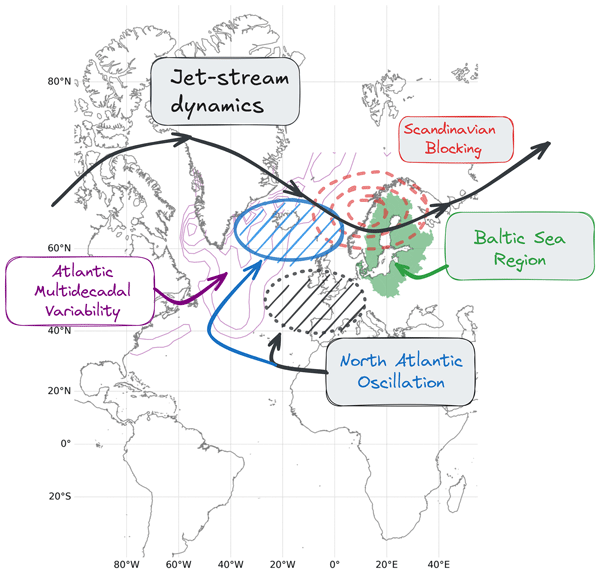
This review explains how weather patterns, guided by the polar jet stream, influence the Baltic Sea’s climate and ecosystem. It covers the North Atlantic Oscillation, blocking events and other processes and discusses how they affect temperature, rainfall, and storms from days to decades. These shifts then impact oxygen levels, productivity, and acidification in the Baltic Sea. Physical links are fairly well known, but biogeochemical pathways remain uncertain.
Jannick Fischer, Pieter Groenemeijer, Alois Holzer, Monika Feldmann, Katharina Schröer, Francesco Battaglioli, Lisa Schielicke, Tomáš Púčik, Bogdan Antonescu, Christoph Gatzen, and TIM Partners
Nat. Hazards Earth Syst. Sci., 25, 2629–2656, https://doi.org/10.5194/nhess-25-2629-2025, https://doi.org/10.5194/nhess-25-2629-2025, 2025
Short summary
Short summary
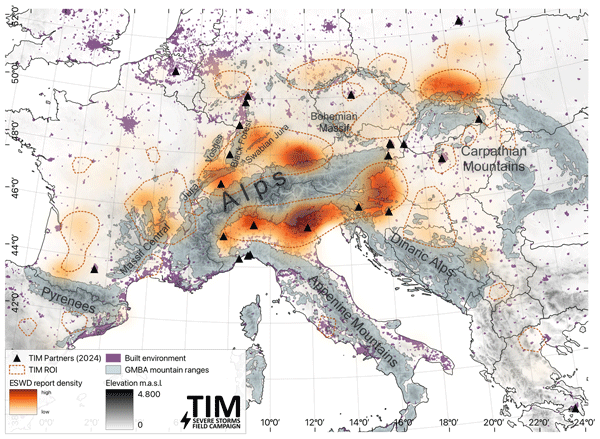
Strong thunderstorms have been studied mainly over flat terrain in the past. However, they are particularly frequent near European mountain ranges, so observations of such storms are needed. This article gives an overview of our existing knowledge on this topic and presents plans for a large European field campaign with the goals to fill the knowledge gaps, validate tools for thunderstorm warnings, and improve numerical weather prediction near mountains.
George Pacey, Stephan Pfahl, and Lisa Schielicke
Weather Clim. Dynam., 6, 695–713, https://doi.org/10.5194/wcd-6-695-2025, https://doi.org/10.5194/wcd-6-695-2025, 2025
Short summary
Short summary
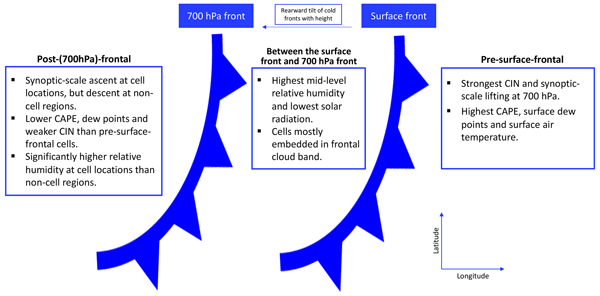
Cold fronts are often associated with areas of intense precipitation (cells) in the warm season, but the drivers and environments of cells at different locations relative to the front are not well-understood. We show that cells ahead of the surface front have the highest amount of environmental instability and moisture. Also, low-level lifting is maximised ahead of the surface front and upper-level lifting is particularly important for cell initiation behind the front.
Lisa Schielicke, Yidan Li, Jerome Schyns, Aaron Sperschneider, Jose Pablo Solano Marchini, and Christoph Peter Gatzen
Weather Clim. Dynam., 5, 703–710, https://doi.org/10.5194/wcd-5-703-2024, https://doi.org/10.5194/wcd-5-703-2024, 2024
Short summary
Short summary
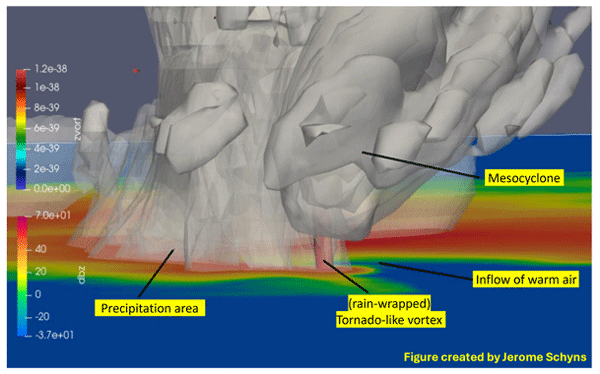
We present course contents and results of a 2-week educational block course with a focus on Cloud Model 1 (CM1) and 3D visualization. Through hands-on experience, students gained skills in setting up and customizing the model and visualizing its output in 3D. The research aimed to bridge the gap between classroom learning and practical applications, fostering a deeper understanding of convective processes and preparing students for future careers in the field.
George Pacey, Stephan Pfahl, Lisa Schielicke, and Kathrin Wapler
Nat. Hazards Earth Syst. Sci., 23, 3703–3721, https://doi.org/10.5194/nhess-23-3703-2023, https://doi.org/10.5194/nhess-23-3703-2023, 2023
Short summary
Short summary
Cold fronts are often associated with areas of intense precipitation (cells) and sometimes with hazards such as flooding, hail and lightning. We find that cold-frontal cell days are associated with higher cell frequency and cells are typically more intense. We also show both spatially and temporally where cells are most frequent depending on their cell-front distance. These results are an important step towards a deeper understanding of cold-frontal storm climatology and improved forecasting.
Lisa Schielicke and Stephan Pfahl
Weather Clim. Dynam., 3, 1439–1459, https://doi.org/10.5194/wcd-3-1439-2022, https://doi.org/10.5194/wcd-3-1439-2022, 2022
Short summary
Short summary
Projected future heatwaves in many European regions will be even warmer than the mean increase in summer temperature suggests. To identify the underlying thermodynamic and dynamic processes, we compare Lagrangian backward trajectories of airstreams associated with heatwaves in two time slices (1991–2000 and 2091–2100) in a large single-model ensemble (CEMS-LE). We find stronger future descent associated with adiabatic warming in some regions and increased future diabatic heating in most regions.
Carola Detring, Annette Müller, Lisa Schielicke, Peter Névir, and Henning W. Rust
Weather Clim. Dynam., 2, 927–952, https://doi.org/10.5194/wcd-2-927-2021, https://doi.org/10.5194/wcd-2-927-2021, 2021
Short summary
Short summary
Stationary, long-lasting blocked weather patterns can lead to extreme conditions. Within this study the temporal evolution of the occurrence probability is analyzed, and the onset, decay and transition probabilities of blocking within the past 30 years are modeled. Using Markov models combined with logistic regression, we found large changes in summer, where the probability of transitions to so-called Omega blocks increases strongly, while the unblocked state becomes less probable.
Cited articles
Albanesi, S., Olivetti, C., and Petrongolo, B.: Families, Labor Markets, and Policy, in: Handbook of the Economics of the Family, edited by: Lundberg, S. and Voena, A., 1, 255–326, https://doi.org/10.1016/bs.hefam.2023.01.004, 2023. a
Association for Supporting Qualitative Research ASQ: QCAmap 2020, https://qualitative-content-analysis.org/en/software-2/qcamap-2020-2/ (last access: 22 December 2024), 2020. a
Baker, M.: Motherhood, employment and the “child penalty”, Women's Stud. Int. Forum, 33, 215–224, https://doi.org/10.1016/j.wsif.2010.01.004, 2010. a, b
Blickenstaff, J. C.: Women and Science Careers: Leaky Pipeline or Gender Filter?, Gend. Educ., 17, 369–386, https://doi.org/10.1080/09540250500145072, 2005. a
Bos, A. L., Sweet-Cushman, J., and Schneider, M. C.: Family-friendly academic conferences: a missing link to fix the “leaky pipeline”?, Polit. Groups Identities, 7, 748–758, https://doi.org/10.1080/21565503.2017.1403936, 2019. a, b
Brandt, G., Briedis, K., and Schwabe, U.: Promovieren mit Kind, Welche Rolle spielen Promotionskontexte für eine erfolgreiche Vereinbarkeit von familialen und beruflichen Anforderungen in der Promotionsphase?, Beitr. Hochschulforschung, 43, 8–31, https://www.bzh.bayern.de/fileadmin/user_upload/Publikationen/Beitraege_zur_Hochschulforschung/2021/2021-3-Brandt-Briedis-Schwabe.pdf (last access: 3 August 2026), 2021. a
Bray, S., Bos, J. L., Sweet-Cushman, J., and Schneider, M.: Family-Friendly Conferences, https://www.insidehighered.com/advice/2018/02/07 (last access: 3 August 2026), 2018. a
Buber, I., Panova, R., and Dorbritz, J.: Fertility Intentions of Highly Educated Men and Women and the Rush Hour of Life, Institut für Demographie – VID, 1, 1–28, https://doi.org/10.1553/0x003d06ee, 2021. a, b
Bundeszentrale für politische Bildung (bpb): Kinderlosigkeit, Sozialbericht 2024, https://www.bpb.de/kurz-knapp/zahlen-und-fakten/sozialbericht-2024/553065/kinderlosigkeit/ (last access: 23 September 2025), 2024. a
Calisi, R. M.: Got milk, must conference, Science, 359, 838–838, https://doi.org/10.1126/science.359.6377.838, 2018. a
Callaghan, C.: “Publish or perish”: Family life and academic research productivity, SA J. Hum. Resour. Manag., 14, https://doi.org/10.4102/sajhrm.v14i1.727, 2016. a
Canadian Meteorological and Oceanographic Society (CMOS): Past and Future Congresses, https://www.cmos.ca/site/congress/congress_past (last access: 14 November 2025), 2024. a
Carter, L., Wolz, L., and Pallett, L. J.: Researcher parents are paying a high price for conference travel – here’s how to fix it, Nature, 630, 517–518, https://doi.org/10.1038/d41586-024-01571-x, 2024. a, b
Cattaneo, U., Pozzan, E., and Beghini, V.: A quantum leap for gender equality: for a better future of work for all, International Labour Organisation, ISBN 9789221329985, 2019. a
Cech, E. A. and Blair-Loy, M.: The Changing Career Trajectories of New Parents in STEM, Proc. Natl. Aca. Sci., 116, 4182–4187, https://doi.org/10.1073/pnas.1810862116, 2019. a, b
Ceci, S. J. and Williams, W. M.: Understanding current causes of women's underrepresentation in science, Proc. Natl. Aca. Sci., 108, 3157–3162, https://doi.org/10.1073/pnas.1014871108, 2011. a, b
Coombs, A.: Researchers Revolt against Weekend Conferences, Nature, 623, 1093–1094, https://doi.org/10.1038/d41586-023-03430-7, 2023. a
Correll, S. J., Benard, S., and Paik, I.: Getting a Job: Is There a Motherhood Penalty?, Am. J. Sociol., 112, 1297–1338, https://doi.org/10.1086/511799, 2007. a
Deutsche Forschungsgemeinschaft (DFG): Chancengleichheit in der Wissenschaft, im Förderhandeln und in der Geschäftsstelle der DFG – Stellungnahme des DFG-Vorstands zu den Anforderungen an die Gleichstellung im Rahmen von Horizon Europe, Stellungnahme / technical report, Deutsche Forschungsgemeinschaft (DFG), Bonn, Germany, https://www.dfg.de/resource/blob/357054/stellungnahme-chancengleichheit-horizon-europe.pdf, (last access: 31 October 2025), 2024. a
Ecklund, E. and Lincoln, A.: Scientists Want More Children, PloS one, 6, e22590, https://doi.org/10.1371/journal.pone.0022590, 2011. a
Empirio: empirio.ai, https://www.empirio.de (last access: 22 December 2024), 2024. a
Etheridge, M.: Agency and Cruel Optimism in the Care Obfuscations of UK-based Academic Mothers, High Educ., https://doi.org/10.1007/s10734-024-01373-0, 2025. a
European Commission, Eurostat: Fertility statistics – Statistics Explained, https://ec.europa.eu/eurostat/statistics-explained/SEPDF/cache/1273.pdf (last access: 22 December 2024), 2022. a
European University Institute: Age Comparisons: Average age when achieving position/degree, https://www.eui.eu/ProgrammesAndFellowships/AcademicCareersObservatory/CareerComparisons/AgeComparisons (last access: 31 October 2025), 2018. a
Feeney, M. K. and Stritch, J. M.: Family-Friendly Policies, Gender, and Work–Life Balance in the Public Sector, Rev. Public Pers. Adm., 39, 422–448, https://doi.org/10.1177/0734371X17733789, 2019. a, b
Gaio Santos, G. and Cabral-Cardoso, C.: Work-family Culture in Academia: A Gendered View of Work-family Conflict and Coping Strategies, Gend. Manag., 23, 442–457, https://doi.org/10.1108/17542410810897553, 2008. a
Gather Town: Gather Town – Virtual Spaces, https://www.gather.town/, accessed: 13 August 2026), 2026. a
Gibson, H.: Accessibility at EGU: Parenting at the General Assembly? Yes to the creche!, geoLog, https://blogs.egu.eu/geolog/2020/02/19/ (last access: 14 August 2025), 2020. a
Gibson, H.: The new EGU colouring books!, geoLog, https://blogs.egu.eu/geolog/2024/04/12/the-new-egu-colouring-books/ (last access: 14 August 2025), 2024. a
Gottburgsen, A., Willige, J., and Sembritzki, T.: Vereinbarkeit von Wissenschaft und Familienaufgaben an Hamburger Hochschulen – Gesamtbericht, Deutsches Zentrum für Hochschul‐ und Wissenschaftsforschung GmbH, https://daten.transparenz.hamburg.de/Dataport.HmbTG.ZS.Webservice.GetRessource100/GetRessource100.svc/58da1252-b9f0-4271-9724-93063b437af7/Akte__E11153-04.pdf (last access: 3 August 2026), 2022. a
Goulden, M., Mason, M. A., and Frasch, K.: Keeping Women in the Science Pipeline, Ann. Am. Acad. Polit. Soc. Sci., 638, 141–162, https://doi.org/10.1177/0002716211416925, 2011. a
Gulland, A.: Men dominate conference Q&A sessions – including online ones, Nature, 612, https://doi.org/10.1038/d41586-022-04241-y, 2022. a
Hauss, K.: What are the social and scientific benefits of participating at academic conferences? Insights from a survey among doctoral students and postdocs in Germany, Res. Eval., 30, 1–12, https://doi.org/10.1093/reseval/rvaa018, 2020. a
Jarvis, S. N., Ebersole, C. R., Nguyen, C. Q., Zhu, M., and Kray, L. J.: Stepping Up to the Mic: Gender Gaps in Participation in Live Question-and-Answer Sessions at Academic Conferences, Psychol. Sci., 33, 1882–1893, https://doi.org/10.1177/09567976221094036, pMID: 36173741, 2022. a
Jean, V. A., Payne, S. C., and Thompson, R. J.: Women in STEM: Family-Related Challenges and Initiatives, pp. 291–311, Springer International Publishing, Cham, ISBN 978-3-319-08891-4, https://doi.org/10.1007/978-3-319-08891-4_15, 2015. a
Jesus-Rydin, C., Anand, P., Montanari, A., Hori, S. R., and Williams, B.: Promoting and supporting equality, diversity and inclusion in the geosciences, in: EGU General Assembly 2024, Session EOS3.1: Promoting and supporting equality, diversity and inclusion in the geosciences, Vienna, Austria, https://meetingorganizer.copernicus.org/EGU24/session/49299 (last access: 3 August 2026), 2024. a, b
Kerch, J., Steffen, R., Raab, G., Root, B., and Löer, K.: Surviving in Academia as a Parent, in: EGU General Assembly 2025, Session SC 2.1: Surviving in Academia as a Parent, Vienna, Austria, https://meetingorganizer.copernicus.org/EGU25/session/53319 (last access: 3 August 2026), 2025. a
Langin, K.: Are Conferences Providing Enough Child Care Support? We Decided to Find Out, Science, https://doi.org/10.1126/science.caredit.aaw3741, 2018. a, b
Lefebvre, A. and Bernhard, R.: Diversity at a Small Geoscience Conference, J. Geophys. Res.: Earth Surf., 129, https://doi.org/10.1029/2023JF007487, 2024. a
Liang, C. and Prior, T.: Hold my Baby: Improving Institutional Policies of Parenting and Field-based Research, geoLog, https://blogs.egu.eu/geolog/2025/04/14/ (last access: 14 August 2025), 2025. a
Mayring, P. and Fenzl, T.: Qualitative Inhaltsanalyse, 633–648, Springer Fachmedien Wiesbaden, Wiesbaden, ISBN 978-3-658-21308-4, https://doi.org/10.1007/978-3-658-21308-4_42, 2019. a, b, c
McCarver, V.: The Rhetoric of Choice and 21st-Century Feminism: Online Conversations About Work, Family, and Sarah Palin, Women Stuf. Commun., 34, 20–41, https://doi.org/10.1080/07491409.2011.566532, 2011. a
McHugh, M.: The Chi-square test of independence, Biochem. Med., 23, 143–9, https://doi.org/10.11613/BM.2013.018, 2013. a, b
MeteoXchange: MeteoXchange, https://www.meteoxchange.de/, last access: 14 November 2025. a
Morgan, A. C., Way, S. F., Hoefer, M. J. D., Larremore, D. B., Galesic, M., and Clauset, A.: The Unequal Impact of Parenthood in Academia, Sci. Adv., 7, eabd1996, https://doi.org/10.1126/sciadv.abd1996, 2021. a
National Center for Health Statistics: National Vital Statistics Reports, https://www.cdc.gov/nchs/data/nvsr/nvsr74/nvsr74-1.pdf (last access: 4 August 2025), 2025. a
Nature Editorial: Hybrid Conferences Should Be the Norm – Optimize Them so Everyone Benefits, Nature, 632, 229–229, https://doi.org/10.1038/d41586-024-02533-z, 2024. a
Nielsen, M. W., Alegria, S., Börjeson, L., Etzkowitz, H., Falk-Krzesinski, H. J., Joshi, A., Leahey, E., Smith-Doerr, L., Woolley, A. W., and Schiebinger, L.: Gender diversity leads to better science, Proc. Natl. Aca. Sci., 114, 1740–1742, https://doi.org/10.1073/pnas.1700616114, 2017. a
Päffgen, E.: Creating Family-Friendly Conferences in Geosciences: A New Study Needs Your Help!, geoLog, https://blogs.egu.eu/geolog/2024/06/18/ (last access: 14 August 2025), 2024a. a, b
Päffgen, E.: Conference Ranking: Family-Friendly Conferences in the Geosciences, https://www.ifgeo.uni-bonn.de/en/sections/meteorology/wg-climate-monitoring/family-friendly-conferences-in-the-geosciences/ranking (last access: 25 September 2025), 2024b. a
Pearson, K.: X. On the criterion that a given system of deviations from the probable in the case of a correlated system of variables is such that it can be reasonably supposed to have arisen from random sampling, Lond. Edinb. Dublin Philos. Mag. J. Sci., 50, 157–175, https://doi.org/10.1080/14786440009463897, 1900. a
Peters, C. N.: Children's Books for Research-Based Outreach and Science Communication Pedagogy, Geosci. Commun., 7, 81–90, https://doi.org/10.5194/gc-7-81-2024, 2024. a
Pohl, A., Werthmann, J., Cwik, J. C., Richter, J., Dawans, B. v., Pané-Farré, C. A., Renner, F., and Hunger-Schoppe, C.: Mit Kind zur Konferenz? Ein Positionspapier zur Erweiterung Familienfreundlicher Maßnahmen auf Fachgruppentagungen, Z. Klin. Psychol. Psychother., 51, 1–10, https://doi.org/10.1026/1616-3443/a000647, 2022. a, b, c, d
Saccarelli, C., Keenan, K., Shimron, E., Kasper, L., Keilholz, S., Wald, L., and Morris, E.: The Path to Parent-Inclusive Conferences, J. Am. Coll. Radiol., 18, https://doi.org/10.1016/j.jacr.2020.06.027, 2020. a, b, c
Santos, G. and Cabral-Cardoso, C.: Work-family culture in academia: A gendered view of Work-family conflict and coping strategies, Gend. Manag., 23, 442–457, https://doi.org/10.1108/17542410810897553, 2008. a, b, c
Sardelis, S., Oester, S., and Liboiron, M.: Ten Strategies to Reduce Gender Inequality at Scientific Conferences, Front. Mar. Sci., 4, https://doi.org/10.3389/fmars.2017.00231, 2017. a
Singh, R., Zhang, Y., Wan, M., and Fouad, N.: Why do women engineers leave the engineering profession? The roles of work-family conflict, occupational commitment, and perceived organizational support, Hum. Resour. Manag. J., 57, https://doi.org/10.1002/hrm.21900, 2018. a, b, c
Smith Taillie, L.: Being a Parent Is a Hidden Scientific Superpower – Here's Why, Nature, https://doi.org/10.1038/d41586-024-00776-4, 2024. a
Sonneveld, J., Yerkes, M., and Schoot, R.: Ph.D. Trajectories and Labour Market Mobility. A survey of recent doctoral recipients at four universities in the Netherlands, SSRN, https://ssrn.com/abstract=1919048 (last access: 3 August 2026), 2010. a
Staniscuaski, F., Machado, A. V., Soletti, R. C., Reichert, F., Zandonà, E., Mello-Carpes, P. B., Infanger, C., Ludwig, Z. M. C., and de Oliveira, L.: Bias against Parents in Science Hits Women Harder, Humanit. Soc. Sci. Commun., 10, 201, https://doi.org/10.1057/s41599-023-01722-x, 2023. a, b
Statistisches Bundesamt: Zahl der Woche, 21, 24, Mai 2022, https://www.destatis.de/DE/Presse/Pressemitteilungen/Zahl-der-Woche/2022/PD22_21_p002.html (last access: 22 December 2024), 2021. a
Steffen, R.: How to EGU22: Tips for attending the conference with kids, geoLog, https://blogs.egu.eu/geolog/2022/05/06/how-to-egu22-tips-for-attending-the-conference-with-kids/, (last access: 14 August 2025), 2022. a
Swann, N.: Scientist and Parent: Are we there yet?, eLife, 8, e49202, https://doi.org/10.7554/eLife.49202, 2019. a
The Geological Society of America: GSA Position Statement: Removing Gender Barriers to Career Progression in the Geosciences, https://www.geosociety.org/GSA/Science_Policy/Position_Statements/Current_Statements/gsa/positions/position26.aspx, (last access: 19 December 2024), 2023. a
Thoman, S. E., Stephens, A. K., and Robnett, R. D.: “Squeezing the Life Out of Each Day”: Emerging Adult Women’s Work-Family Expectations in STEM, Emerg. Adulthood, 10, 76–89, https://doi.org/10.1177/2167696821990910, 2022. a, b, c
Vieira do Nascimento, D., Roser-Chinchilla, J., and Mutize, T.: Women in higher education: has the female advantage put an end to gender inequalities?, United Nations Educational, Scientific and Cultural Organization, ISBN 978-980-7175-55-5, 2021. a
Ward, K. K. A. and Wolf-Wendel, L.: Academic Motherhood: Managing Complex Roles in Research Universities, Rev. High. Educ., 27, 233–257, 2004. a
Welde, K. D. and Laursen, S.: The Glass Obstacle Course: Informal and Formal Barriers For Women Ph.D. Students in STEM Fields, Int. J. Gender Sci. Technol., 3, 571–595, 2011. a
Windsor, L. C. and Crawford, K. F.: Best Practices for Normalizing Parents in the Academy: Higher- and Lower-Order Processes and Women and Parents' Success, PS: Polit. Sci. Polit., 53, 275–280, https://doi.org/10.1017/S1049096519001938, 2020. a
Editorial statement
This manuscript gives insight into barriers and difficulties faced by parents in academia wanting to participate in conferences, laying the foundation for dialogue between parents and conference organizers.
This manuscript gives insight into barriers and difficulties faced by parents in academia...
Short summary
Balancing academic careers and family responsibilities presents significant challenges, particularly for early-career researchers attending conferences. These events are essential for professional development but often create logistical difficulties for parents. Based on a survey of geoscientists, we show that parents require more support and non-parents largely approve of family-friendly measures. We provide practical guidelines to help conference organizers support researchers with families.
Balancing academic careers and family responsibilities presents significant challenges,...
Altmetrics
Final-revised paper
Preprint