
the Creative Commons Attribution 4.0 License.
the Creative Commons Attribution 4.0 License.
 | 27 Feb 2026
ClimarisQ: What can we learn from playing a game for climate education?
Davide Faranda
Lucas Taligrot
Pascal Yiou
Nada Caud
ClimarisQ is both a web and mobile game developed by the Institut Pierre-Simon Laplace to support climate change communication through interactive decision-making. This paper presents an exploratory evaluation of the game based on a post-play questionnaire completed by 77 users. Respondents rated ClimarisQ positively in terms of usability and scientific credibility. Self-reported outcomes indicate that the game supported reflection on the complexity, trade-offs, and uncertainty of climate-related decision-making, rather than the acquisition of factual knowledge, particularly among users with prior expertise. The respondent group was predominantly composed of educated and climate-aware adults, which limits generalization to other audiences. Beyond the questionnaire, the game has been tested in dozens of facilitated sessions with thousands of non-specialist participants, with consistently positive feedback. These results suggest that ClimarisQ can function as a complementary tool for climate education and outreach, especially when used in facilitated settings that encourage discussion and interpretation.
- Article
(941 KB) - Full-text XML
-
Supplement
(366 KB) - BibTeX
- EndNote


Climate change is a complex “wicked” problem with nonlinear interactions, long timeframes, and global scope (Levin et al., 2012). Human–climate interactions involve feedbacks, time lags, and cross-scale dynamics that make both impacts and solutions difficult to grasp (Steffen et al., 2007). Traditional information-based approaches often struggle to convert knowledge into sustained engagement, because awareness does not automatically translate into behavior change (Whitmarsh et al., 2021). Climate risks can also feel abstract or psychologically distant, especially for people who have not directly experienced impacts (Spence et al., 2011). This motivates the search for creative, interactive approaches that support deeper understanding, discussion, and commitment (Monroe et al., 2019). Games have increasingly been explored as one such approach, because they offer experiential learning environments where people can test choices, observe consequences, and learn by doing. Over the last decade, research on games for sustainability and climate education has expanded substantially (Ahmadov et al., 2024). Climate-related games now span board games, role-play, simulations, and digital formats, and address both mitigation and adaptation across audiences from students to policymakers (Reckien and Eisenack, 2013). Reviews highlight their proliferation and their potential to support dialogue, social learning, and systems-oriented reasoning about climate challenges (Reckien and Eisenack, 2013; Flood et al., 2018). Well-designed games can also provide a “safe-to-fail” space where players explore trade-offs and uncertainty without being judged, which may strengthen understanding and willingness to engage with solutions (Flood et al., 2018; Rooney-Varga et al., 2018). A systematic review of 46 studies, for instance, found overwhelmingly positive outcomes for games on climate adaptation, including trust-building and enthusiasm for learning (Flood et al., 2018). This aligns with broader calls in climate education for participatory and affective approaches that go beyond one-way communication (Monroe et al., 2019).
ClimarisQ is both a web and mobile game developed as a scientific outreach project to engage players with climate-system complexity and the societal challenges of facing climate extremes. Players take on decision-making roles and negotiate how to limit greenhouse gas emissions and manage resources under increasing extreme weather risks. The game integrates scientific data (generated from both climate models and observations) and simulates feedback mechanisms among climate, the economy, and society. Its core design requires stakeholders to balance economic viability, social acceptance, and environmental outcomes, making trade-offs and time delays concrete (e.g., investments that reduce future disaster losses may strain budgets or public approval in the short term). Extreme events are represented as uncertain in timing and location while their statistical risk shifts with the climate state, reinforcing the probabilistic nature of attribution and risk under climate change. The game is also intended to support discussion of ethical questions such as justice, responsibility, and decision-making under uncertainty, especially when facilitated by teachers, scientists or outreach officers in group settings.
This kind of interactive exploration aligns with calls to strengthen climate education by emphasizing interconnected physical and social dynamics (Ballew et al., 2019). Higher systems thinking ability is associated with greater recognition of climate change and support for mitigation (Ballew et al., 2019), and simulation-based learning environments can help players experience feedback loops and delays directly. For example, the Grim FATE simulation reported improvements in students' understanding of climate dynamics and feedback (Waddington and Fennewald, 2018). More broadly, evaluations of established climate games show measurable benefits: World Climate has been implemented widely and is associated with increases in knowledge and intent to act (Rooney-Varga et al., 2018), and KEEP COOL has been linked to shifts in responsibility and optimism about cooperation among students (Meya and Eisenack, 2018). Games can also reduce the psychological distance of abstract threats (van Beek et al., 2022) and support active, social learning processes that outperform one-way communication in changing attitudes and behaviors (Whitmarsh et al., 2021; Rumore et al., 2016).
Beyond cognitive outcomes, climate engagement has important affective and social dimensions (Moser, 2017). Ethical climate communication must balance concern with efficacy: overly dire messages can induce fatalism (O'Neill and Nicholson-Cole, 2009), whereas solution-oriented framing can foster agency and “constructive hope” linked to greater support for climate action (Marlon et al., 2019). This is particularly relevant for youth, among whom climate anxiety is widespread (Hickman et al., 2021). Games can acknowledge risk while maintaining player agency through experimentation, iteration, and visible consequences, but they must also avoid trivializing the stakes. This balance – engagement without distortion – has been observed in other educational game contexts (Asplund et al., 2019). Related work also shows that games can help stakeholders grapple with probabilistic concepts and policy responses to extremes, as in CAULDRON for extreme-event attribution (Parker et al., 2016), and that simulations can strengthen cooperation and insight into collective-action dilemmas (Sterman et al., 2015; Rumore et al., 2016; Flood et al., 2018). Games can further contribute to climate literacy by making interconnections accessible. Indeed, by using an online platform, ClimarisQ is designed to be broadly accessible and scalable, and it is made freely available to lower barriers to participation. In this article, we analyze ClimarisQ's educational potential using a post-play user survey, combining quantitative ratings with qualitative feedback. We situate these findings within the landscape of climate communication tools, and we discuss implications for the design and use of games in climate education.
ClimarisQ is a turn-based digital game in which players assume the role of a public decision-maker managing climate policy over time under increasing exposure to extreme weather events. The game objective is to maintain system stability by preventing any of three coupled parameters – ecology, money, and popularity – from reaching zero. These parameters represent environmental sustainability, economic capacity, and social acceptance, and evolve in response to player decisions. At each turn, players are presented with policy proposals from different advisory domains and must decide whether to implement them. The game ends when one parameter reaches zero. The parameters are simplified abstractions intended to make trade-offs explicit rather than to represent detailed socio-economic dynamics. Actions that improve environmental outcomes may involve economic costs or social resistance, while politically popular or low-cost measures may increase long-term climate risk. Feedback is provided through changes in the parameters and short in-game news items describing societal or environmental consequences, without indicating optimal choices. The learning goals of the game differ from its game objectives. ClimarisQ is not designed to transmit factual knowledge or assess decision-making performance, but to expose players to feedbacks, delays, and uncertainty inherent in climate governance. The climate state is summarized by atmospheric CO2 concentration, displayed through a color-coded gauge that controls the probabilistic occurrence of extreme events such as heatwaves, floods, or droughts. Event timing is uncertain, while occurrence becomes more likely as cumulative emissions increase.
The game can be played individually or in facilitated settings, where decisions may be discussed collectively prior to implementation. In these contexts, the popularity and financial parameters act as proxies for social response and political feasibility. ClimarisQ avoids references to specific countries or governance systems and uses a generalized representation to support use across different settings. This abstraction involves simplifications that could be addressed in future localized or scenario-specific versions.
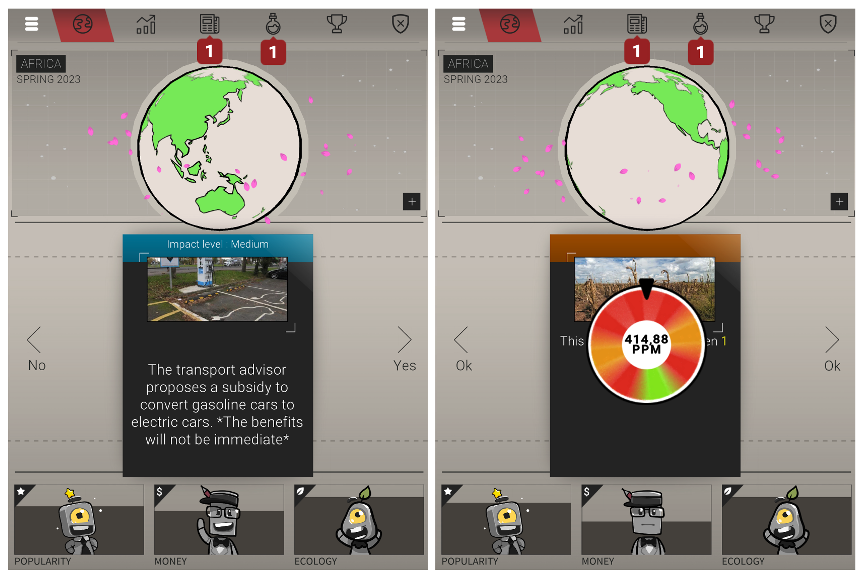
Figure 1Screenshots from ClimarisQ illustrating core gameplay elements. The left panel shows a policy decision proposed by an advisor, whose acceptance or rejection affects three parameters – ecology, money, and popularity. The right panel displays the current atmospheric CO2 concentration, which modulates the frequency of extreme weather events, linking cumulative emissions to climate risk within the game.
2.1 Game Deployment and Audience
ClimarisQ was launched publicly in mid-2022 as a free game on the Google Play Store, Apple App Store, and a dedicated website for desktop play. The game was conceived as a general climate communication and education tool, intended for use across a range of contexts, including higher education, secondary education, public outreach, and informal learning. It was designed to support both facilitated use (e.g. classrooms, workshops) and individual self-directed play, with the level of depth depending on the context of use. While the game's online availability and scientific grounding initially led to greater visibility within academic and science-adjacent communities, it has also been extensively facilitated in outreach settings, including science festivals involving hundreds of primary and middle school pupils with no specific scientific background. Dissemination took place through outreach events (e.g. Fête de la Science, Forum Météo-Climat, Trieste Next), online climate-related forums, social media, and via the European H2020 project XAIDA, in which some of the authors are involved. As a result, although the game can be used in secondary education when facilitated, the first pool of voluntary users – and thus survey respondents – was largely composed of adults with prior exposure to climate-related topics. The authors of this article are also the designers and developers of ClimarisQ. The evaluation presented here constitutes a formative and exploratory assessment, aimed at documenting user experience and perceived educational value in order to inform further development, rather than providing an external validation.
An online questionnaire was administered approximately 6–12 months after launch. Participation was voluntary and anonymous, with no incentives offered. The call for participation was disseminated through the same channels used to promote the game. The survey was available in English and in French, which correspond to the game's primary international languages. The game is also available in other languages such as Italian, Spanish, German, Romanian and Arabic. Respondents were not required to document gameplay duration or completion; the survey therefore reflects self-reported experiences among users who chose to respond.
2.2 Questionnaire Design
The questionnaire (see Supplement) combined quantitative and qualitative items and was structured into four parts. First, demographic and background information was collected, including age, self-identified profile (e.g. student, educator, researcher), highest level of education, field of work or study, country of residence, and how respondents discovered the game. Second, user experience was assessed using 5-point Likert-scale questions (1 = very poor, 5 = excellent) covering ergonomics, scientific content, clarity of in-game questions, perceived difficulty, and visual aesthetics. Third, perceived educational impact was explored through yes/no questions asking whether respondents felt they had learned something new and whether the game might influence their everyday life, each followed by an open-ended comment inviting further explanation. These items were intended to capture perceived learning, reflection, and awareness rather than objectively measured knowledge or behavioral change. Finally, respondents were asked whether they would recommend the game to others, with an open-ended question allowing them to justify their response.
2.3 Data Analysis
Responses were collected between June and December 2022 and anonymized prior to analysis. No personally identifying information was collected; demographic variables were categorical. Quantitative analyses were descriptive, consisting of means and distributions for Likert-scale items and frequency counts for demographic variables. Given the modest sample size (N=77) and exploratory scope, no inferential statistical testing was performed, in line with the guidelines provided by Wilks (2016). Where informative, broad subgroup comparisons (e.g. students versus researchers/educators) were explored cautiously, acknowledging uneven group sizes and the ordinal nature of the data. Qualitative responses were analyzed using an inductive coding approach. Two authors independently reviewed all free-text responses, identified recurring themes, and resolved differences through discussion. This process was used to summarize user perspectives rather than to conduct a formal thematic analysis. Representative quotations were selected to illustrate dominant or contrasting views and are reported in the Results section. Very brief or ambiguous responses were not over-interpreted. Quantitative and qualitative findings were examined together to assess consistency between numerical ratings and respondents' explanations (e.g. perceived difficulty levels).
2.4 Limitations
This study has several limitations. The sample size and uneven subgroup sizes limited robust subgroup comparisons (e.g., novice vs. expert), which should be addressed in future classroom-based evaluations. The respondent group represents a self-selected sample and is not representative of all ClimarisQ users or of the general population. Recruitment channels and voluntary participation likely favored individuals already interested in climate issues or engaged with academic or educational networks, resulting in a sample skewed toward adults with relatively high levels of education. Consequently, the findings should not be interpreted as representative of the game's impact on less climate-literate or younger audiences. In addition, the evaluation relies exclusively on self-reported perceptions, without pre-test measures, control groups, or validated instruments for assessing learning outcomes. References to “learning” in this study therefore reflect perceived learning or reflection rather than objectively measured knowledge gains or behavioral change. Finally, respondents were not asked to document gameplay duration or whether the game was played individually or in a facilitated setting, which limits interpretation of variability in responses. Despite these limitations, the survey provides useful exploratory insights into how ClimarisQ is experienced by its early user base and how its educational and communicative value is perceived. The results should be interpreted as formative evidence intended to inform future development of ClimarisQ and other games with similar topics and more rigorous evaluation efforts.
3.1 Respondent Profile
A total of 77 individuals responded to the questionnaire (Fig. 2). Respondents ranged in age from 8 to 56 years (mean ≈ 30 years; median in the late twenties). Most respondents were adults. Based on self-identification, a substantial fraction reported profiles consistent with higher education or academia (e.g. university students, PhD candidates, postdoctoral researchers), while only a small number identified as secondary school students or school teachers.
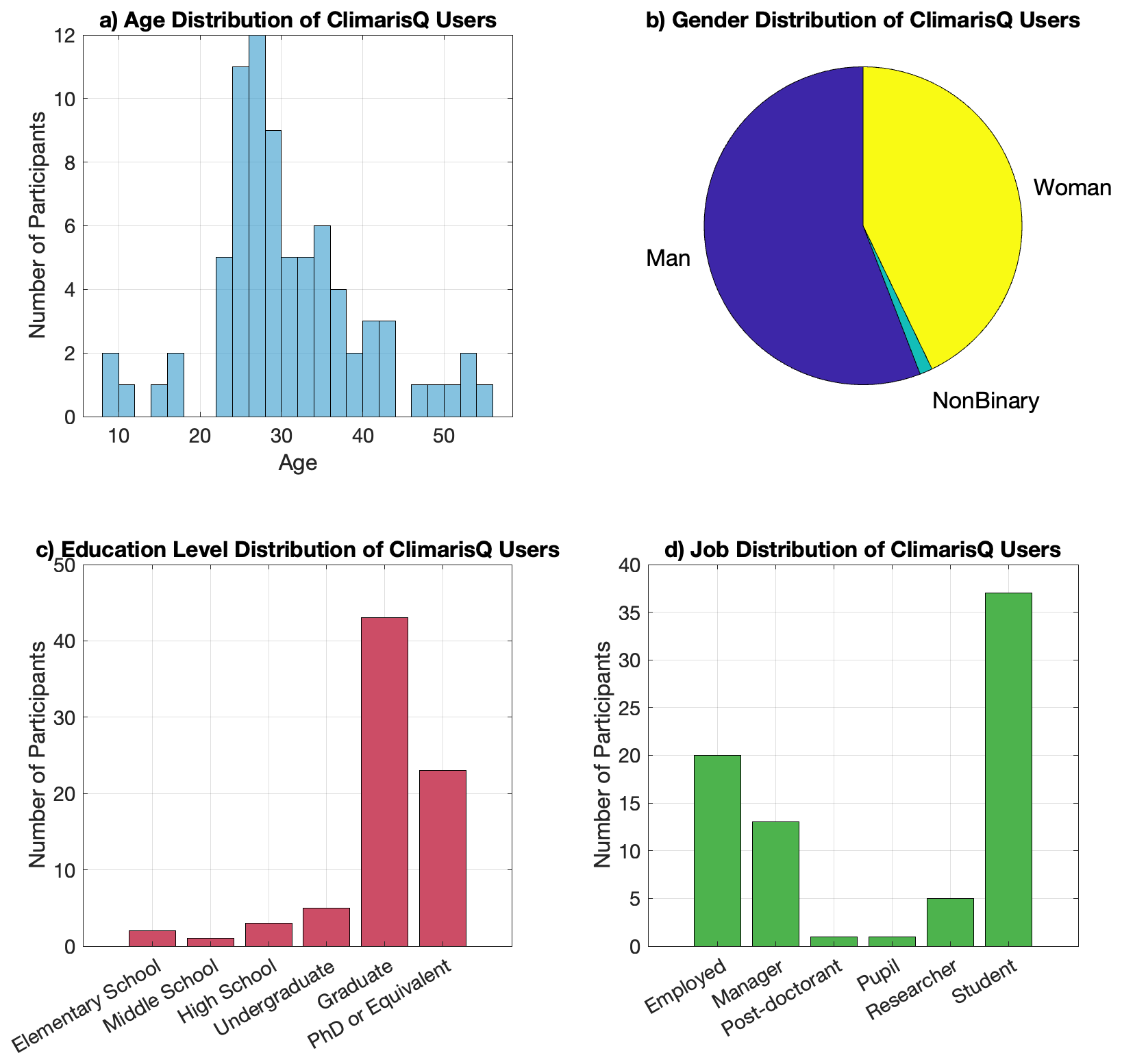
Figure 2Demographic distribution of ClimarisQ users. (a) Age distribution of participants, showing the most common age range around 25–35 years. (b) Gender distribution, with the majority identifying as male, followed by female and non-binary participants. (c) Education level distribution, with a portion of users holding graduate or equivalent qualifications. (d) Job distribution, indicating that most participants are students, with a smaller representation from researchers, employed individuals, and other categories. These distributions provide insight into the profile of the game's user base.
Respondents were generally highly educated, with many indicating graduate-level training (Master's or PhD or equivalent). Participants were geographically diverse, spanning multiple continents (Fig. 3). Countries reported included France and other European countries (e.g. Germany, Italy, Romania, the Netherlands, Belgium), as well as the USA, India, China, Tunisia, Mexico, Brazil, and Egypt, among others. Discovery of the game was most commonly reported through academic or professional networks and online climate-related communities, with additional mentions of social media, workshops or events, and project-related communication (including XAIDA). Fewer respondents reported discovering the game through App store browsing or formal school-based channels.
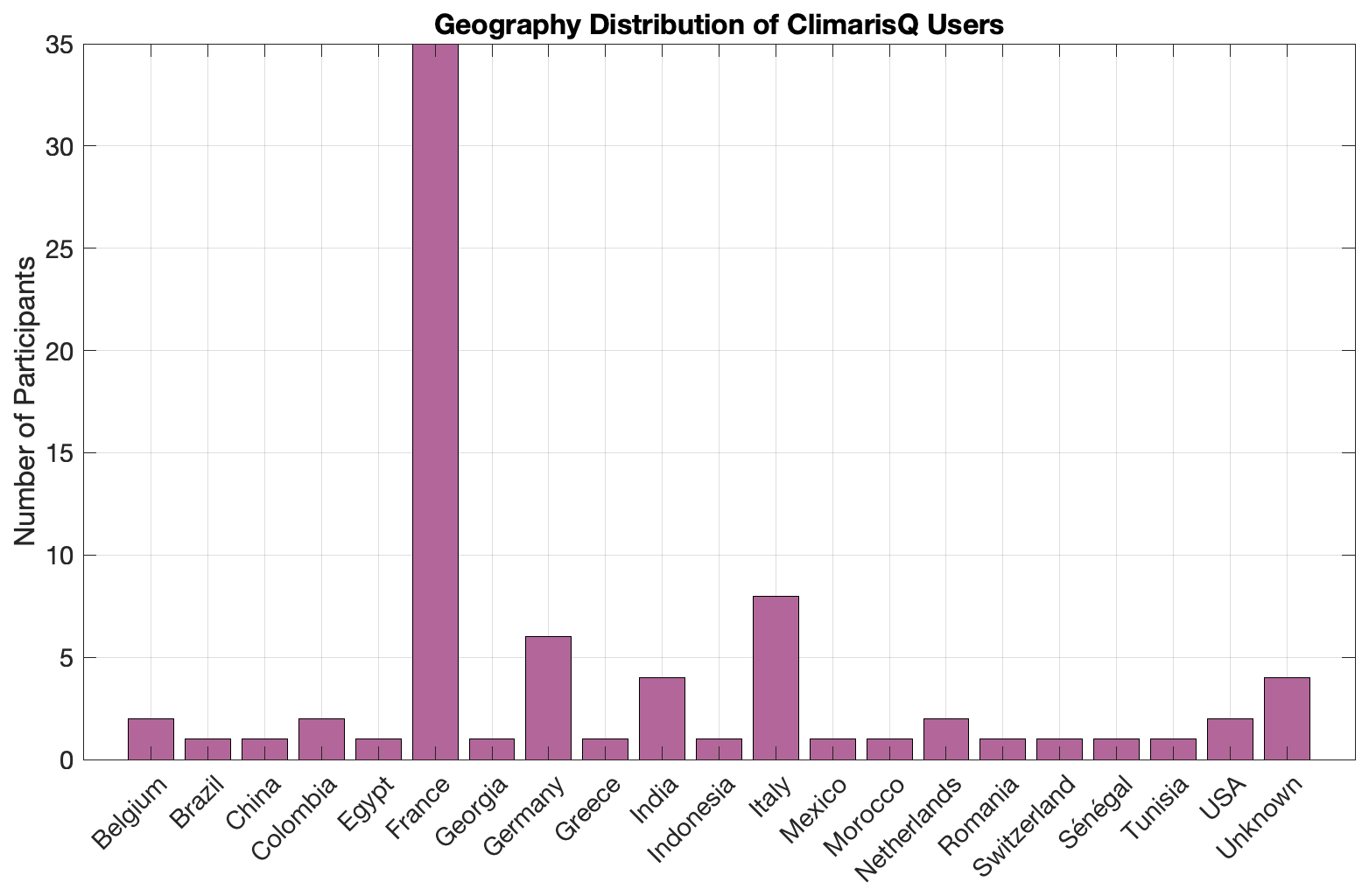
Figure 3Geography distribution of ClimarisQ users. The chart shows a concentration of participants from France, followed by Italy, Egypt, and Germany, with smaller contributions from other countries. Some entries are labeled as Unknown, indicating incomplete geographical data.
3.2 User Experience Ratings
Participants rated five aspects of ClimarisQ on a 1–5 Likert scale (Fig. 4). Overall evaluations were positive across all categories, with particularly high ratings for ergonomics and scientific content. Ergonomics received a high mean score (), with most respondents rating it 4 or 5. Comments indicated that the interface was generally intuitive and that the game could be played without major technical barriers, although a few users mentioned a short adaptation period, particularly on mobile devices. Scientific content was the highest-rated aspect (mean ). Respondents frequently emphasized the credibility of the information presented and appreciated the link to real climate data and scenarios. Several comments noted that the content was scientifically sound without being oversimplified, which was viewed positively, especially by respondents with academic backgrounds. Clarity of the in-game questions and decision elements was also rated favorably (mean ). Most respondents reported that the situations and choices were understandable and coherent, enabling them to grasp the implications of different options. A small number of respondents found some elements unclear, but this did not substantially affect the overall assessment. Perceived difficulty showed greater variability than other aspects, with a mean rating of approximately . Some respondents found the game challenging or even frustrating, particularly when attempting to maintain all indicators at high levels, while others considered it manageable after several plays. This dispersion likely reflects differences in prior knowledge and expectations, as well as the game's design choice to emphasize constrained trade-offs rather than easy success. Aesthetics and visual design were rated highly (mean ). Respondents generally appreciated the visual style and characters, noting that the graphics contributed positively to engagement without trivializing the subject matter. Gender differences in participants' evaluations of ClimarisQ were assessed using non-parametric methods appropriate for ordinal and binary data. For ergonomics, question clarity, difficulty, and aesthetics, no significant differences were observed between men and women, with identical median ratings (median = 4), non-significant (p>0.7) Wilcoxon rank-sum tests (Mann and Whitney, 1947), and negligible effect sizes (Cliff's δ≈0). A significant difference emerged for the evaluation of scientific content, with women assigning higher ratings than men (median = 5 vs. 4; p=0.024), corresponding to a small-to-moderate effect size (Cliff's 0.277).
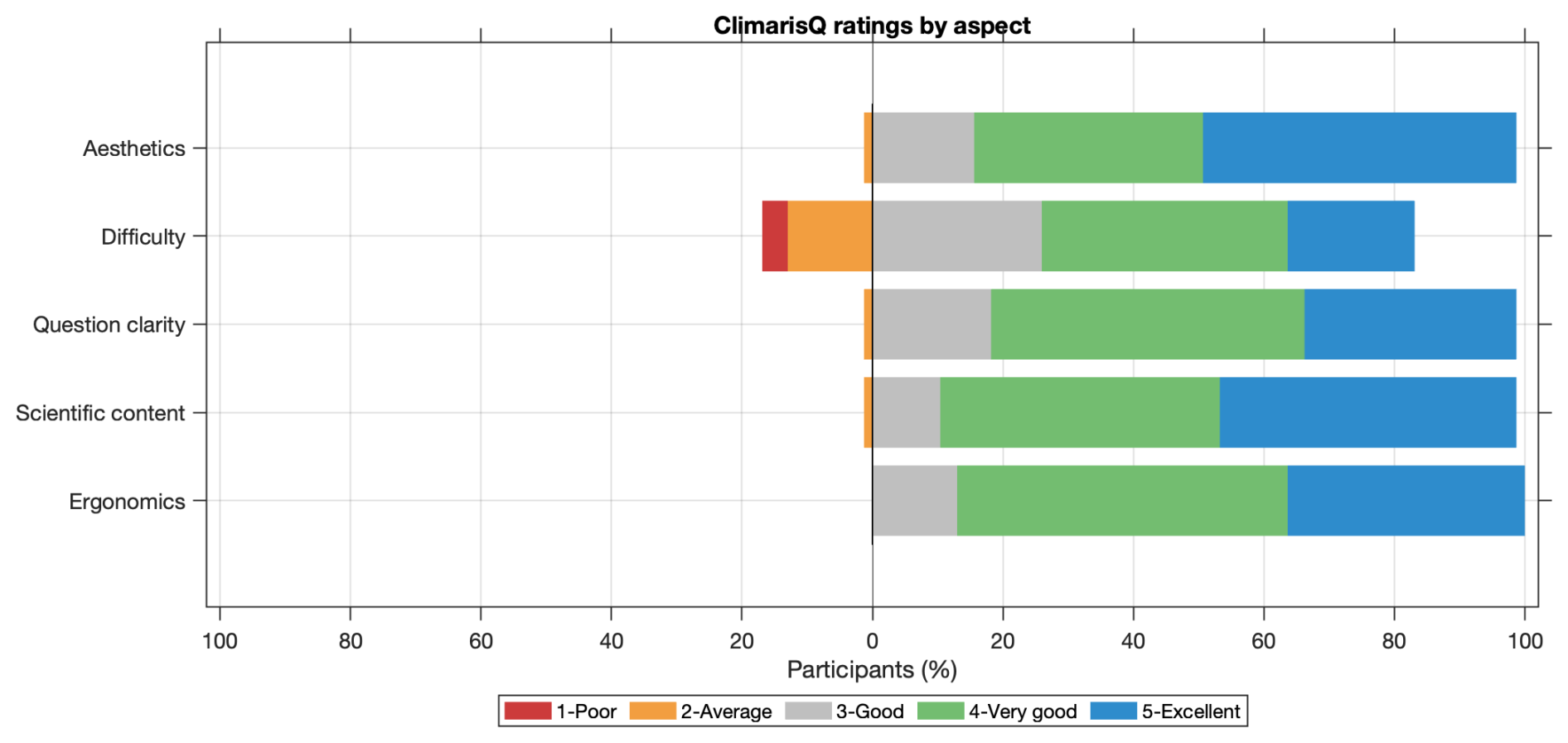
Figure 4Distribution of participant ratings for ClimarisQ game aspects shown as a diverging Likert plot. Ratings are reported on a five-point Likert scale ranging from 1 (Poor) to 5 (Excellent) for Ergonomics, Scientific Content, Question Clarity, Difficulty, and Aesthetics. Negative and positive responses are displayed on opposite sides of the central axis, with the neutral category centered.
3.3 Educational Outcomes: Knowledge and Awareness
The questionnaire explored perceived educational effects by asking whether respondents felt they had learned something new and whether playing the game might influence their everyday life (Fig. 5a). These questions were intended to capture self-reported learning, awareness, and reflection rather than objectively measured knowledge or behavioral change. A majority of respondents reported that the game did not substantially change their everyday life, while a minority indicated some form of impact. When impacts were reported, they most often concerned increased awareness, reflection, or willingness to discuss climate issues, rather than concrete changes in behaviour. This pattern is consistent with the profile of the sample, which included many respondents who already reported high familiarity with climate-related topics. Responses to the question “Did you learn something new by playing ClimarisQ?” were similarly mixed. Many respondents stated that they did not acquire new factual knowledge, often noting that they were already familiar with the scientific aspects of climate change. However, even among these respondents, several emphasized that the game helped them better appreciate the complexity of climate decision-making, particularly the need to balance environmental, economic, and social constraints. Among respondents who reported learning something new, the most frequently mentioned themes concerned trade-offs and constraints in climate action. Several noted a clearer understanding of how ecological objectives can conflict with financial resources or public acceptance, and how no single decision leads to an optimal outcome. Others mentioned increased awareness of uncertainty and variability, including the role of chance in the occurrence of extreme events despite prudent decision-making. A smaller number of responses referred to increased personal awareness, such as being more attentive to the cumulative effects of everyday actions or the urgency associated with climate risks. These statements suggest an affective or reflective form of learning, rather than the acquisition of new scientific facts, which is important because reflective learning may be longer lasting, especially as facts change over time (Kolb, 1984).
The results indicate that ClimarisQ primarily supported reflection, perspective-taking, and awareness of complexity, particularly for respondents with prior knowledge of climate issues. Perceived learning was therefore more qualitative and contextual than factual, aligning with the game's emphasis on decision-making under constraints rather than information transmission.
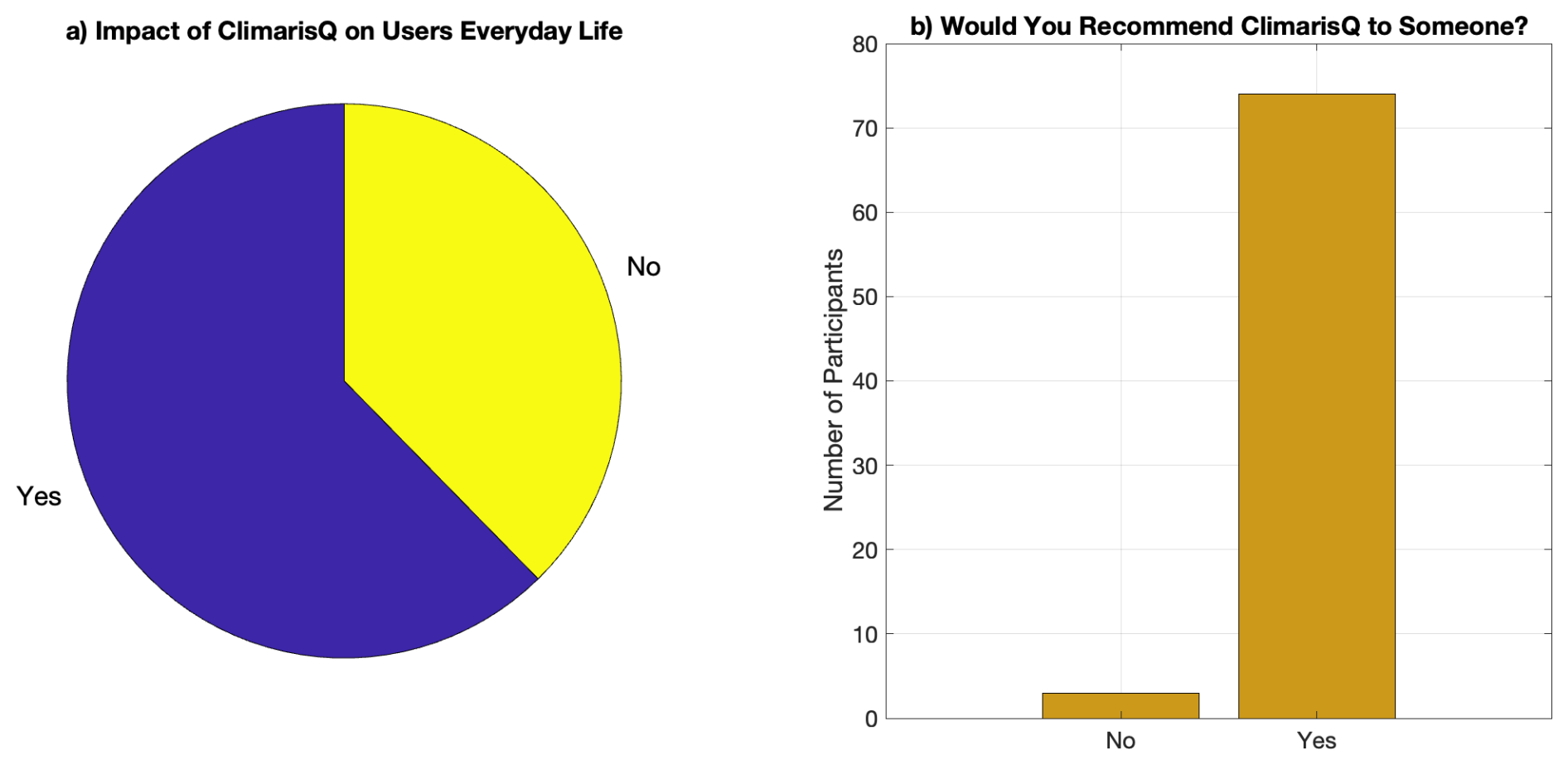
Figure 5User responses to the Impact and Recommendation questions in ClimarisQ. (a) The pie chart illustrates the impact of ClimarisQ on users' everyday lives, with the majority of participants reporting a positive influence (Yes) and a smaller portion indicating no impact (No). (b) The bar chart shows that a vast majority of participants would recommend ClimarisQ to others, with only a few indicating otherwise.
3.4 Willingness to Recommend and User Feedback
Most respondents indicated that they would recommend ClimarisQ to others (Fig. 5b), although many provided only brief or non-elaborated answers. Where explanations were given, several recurring themes emerged. A common reason for recommending the game was its ability to engage players while conveying the complexity of climate-related decision-making. Respondents frequently noted that the game made abstract issues more concrete and helped illustrate why climate action involves difficult trade-offs rather than straightforward solutions. Several comments emphasized that the game provided a useful basis for discussion, particularly in educational or outreach contexts.
Another recurring theme concerned the game's educational utility. Some respondents explicitly described ClimarisQ as a valuable tool for introducing climate issues to students or non-specialist audiences, even when they themselves did not feel they had learned new information. This suggests that more knowledgeable users viewed the game primarily as a communication or teaching support rather than as a source of new content for their own learning. A smaller number of respondents did not recommend the game or expressed reservations, often without detailed explanation. From the available comments, these reservations appeared to relate mainly to perceived difficulty, limited replayability, or a mismatch between the respondent's expectations and the game's design. Several respondents suggested that additional scenarios, adjustable difficulty levels, or clearer introductory guidance could improve the experience, particularly for non-specialist players.
Overall, the feedback indicates that ClimarisQ was widely perceived as engaging and educational, with strong potential for use in communication and teaching settings. The willingness to recommend the game reflects positive reception, while the critical comments point to areas for refinement rather than fundamental shortcomings. No gender differences were detected for the perceived impact of the game on everyday life or for willingness to recommend ClimarisQ, as assessed using Fisher's exact tests on the corresponding binary response variables, with comparable response proportions across groups (Fisher, 1922).
This study presents an exploratory evaluation of ClimarisQ based on user perceptions collected through a post-play questionnaire. The results indicate that the game was generally perceived as accessible, scientifically credible, and capable of supporting reflection on climate-related decision-making, particularly among respondents with prior familiarity with climate issues. Reported educational effects were primarily qualitative. Many respondents indicated that the game did not substantially change their knowledge base, but helped them reflect on the complexity of climate action, including trade-offs between environmental objectives, economic constraints, and social acceptance. This suggests that the game's contribution lies less in transmitting new information and more in situating known concepts within an interactive decision-making context. Such outcomes are consistent with the intended design of the game, which emphasizes experiential engagement rather than instruction.
The game mechanics appear to have supported this form of reflection by making constraints, feedbacks, and uncertainty explicit through simplified indicators and stochastic events. Respondents frequently referred to the difficulty of maintaining all system indicators simultaneously, and to the role of chance in outcomes. These observations suggest that players engaged with the game as a representation of constrained decision-making rather than as a problem with a single optimal solution. The respondent profiles indicate that ClimarisQ was primarily used by adults with relatively high educational attainment, including students and early-career researchers. Several respondents explicitly framed the game as a tool they would recommend for educational or outreach purposes, even when they did not report personal learning gains. This suggests that the perceived value of the game may differ across audiences, functioning as a reflective or illustrative tool for knowledgeable users and as an introductory resource for less familiar audiences. The findings therefore support the use of ClimarisQ as a complementary activity within facilitated educational settings rather than as a standalone instructional intervention. In practice, ClimarisQ is rarely used as a standalone activity when presented by the authors or collaborating institutions. Game sessions are systematically followed by facilitated debriefing discussions, during which participants collectively reflect on their decisions, trade-offs, and outcomes, and relate them to real-world climate governance challenges. These debriefings typically address uncertainty, feedbacks, ethical considerations, and the limits of individual versus collective action. Beyond the game mechanics themselves, its educational potential also depends on facilitation practices. In our experience, learning is often supported through ongoing dialogue during gameplay, with scientific explanations and discussions of socio-economic impacts introduced progressively at each decision point rather than confined to a final debriefing. Alternative facilitation formats, such as organizing participants into small groups representing institutional actors who must deliberate internally and appoint a spokesperson to justify collective choices, further illustrate the game's capacity to foster discussion, argumentation, and collective reasoning. Future developments could support wider and more autonomous use through structured in-game or post-game facilitation tools. Differences in perceived difficulty reflect variation in prior knowledge and expectations, with some participants finding the game challenging and others more accessible after repeated play. This highlights the importance of contextualization and facilitation, particularly for mixed audiences. While structured discussions may support interpretation, the educational value of the game also relies on human facilitation, which cannot be fully replaced by additional in-game features. Training scientists, educators, and mediators to facilitate the game therefore represents an important complementary pathway for its use in climate education.
Several limitations constrain the interpretation of these results. The study relies on a small, self-selected sample and on self-reported perceptions rather than objective measures of learning or behaviour. The respondent group does not reflect the full range of potential users, particularly younger or less climate-literate audiences. Consequently, the findings should be interpreted as indicative of perceived engagement and reflection rather than as evidence of learning effectiveness or behavioral impact. Within these limits, the results suggest that ClimarisQ can support reflection and discussion around climate-related decision-making when used as part of a broader educational or communication process. Future evaluations would benefit from targeted studies in classroom settings, the use of validated assessment tools, and designs that distinguish between cognitive, affective, and reflective outcomes.
This study presented an exploratory evaluation of ClimarisQ, a game designed to support climate education and communication through interactive decision-making. Based on a post-play questionnaire, the results indicate that the game was perceived as accessible, scientifically credible, and engaging by a predominantly adult and climate-aware audience. The educational effects observed were primarily reflective rather than informational. Many respondents reported that the game did not substantially increase their factual knowledge, but helped them better appreciate the complexity of climate-related decision-making, including trade-offs between environmental objectives, economic constraints, and social acceptance. This pattern is consistent with findings from other climate-related games, which suggest that such tools often reinforce understanding of systemic interactions and urgency rather than transmit new information, especially among already knowledgeable users (Rooney-Varga et al., 2018; van Beek et al., 2022). In this sense, ClimarisQ functioned more as an experiential and illustrative tool than as a conventional instructional resource.
Engagement emerged as a central perceived strength of the game. Respondents frequently indicated that the interactive format helped sustain attention and encouraged discussion, echoing prior work showing that game-based approaches can enhance engagement and dialogue around complex environmental issues compared to static forms of instruction (Flood et al., 2018; Rumore et al., 2016). Several participants stated that they would recommend the game to students or peers, suggesting that its perceived value extends beyond individual use to educational and outreach contexts. At the same time, the results underline that games such as ClimarisQ are not standalone solutions for climate education. Previous research emphasizes the importance of embedding gameplay within facilitated settings that include discussion or debriefing in order to support interpretation and learning (Flood et al., 2018; Rumore et al., 2016). Variation in perceived difficulty among respondents further highlights the need for contextualization and adaptation to different audiences, as also observed in other climate game evaluations (Parker et al., 2016).
The present evaluation has several limitations. The respondent group was small, self-selected, and predominantly composed of highly educated and climate-aware adults, which limits the generalizability of the results, particularly to younger or less climate-literate audiences. Learning outcomes were assessed through self-reported perceptions rather than objective measures, and behavioral changes were not evaluated. The findings should therefore be interpreted as indicative of perceived engagement and reflective value, rather than as evidence of learning effectiveness or impact on action. Similar methodological limitations have been reported in the literature on game-based climate education, which highlights the need for more systematic and comparable evaluation approaches (Ahmadov et al., 2024). Within these constraints, the study suggests that ClimarisQ may function as a complementary tool within broader climate education and communication strategies, primarily supporting reflection, discussion, and the understanding of complexity rather than the transmission of factual knowledge. Future work should focus on classroom-based studies, the use of validated evaluation instruments, and the inclusion of structured debriefing to better assess contributions to learning and dialogue across diverse audiences, in line with prior recommendations (Meya and Eisenack, 2018; Kwok, 2019).
The source code for the ClimarisQ game is not publicly available due to ongoing development and maintenance by the project team. However, researchers interested in the underlying algorithms and models used in the game design are encouraged to contact the corresponding author for more information or collaboration opportunities.
The data supporting the findings of this study are available upon reasonable request. This includes anonymized survey responses used for evaluating the game. Aggregated results and example datasets are available in the Supplement or can be provided by the authors upon request.
The supplement related to this article is available online at https://doi.org/10.5194/gc-9-115-2026-supplement.
DF devised the study and performed the analysis. All authors contributed to writing and reviewing the article.
The authors are the developers of ClimarisQ and report on an evaluation of their own game. The game is freely available and the authors have no commercial interests related to its distribution.
This study involved the voluntary and anonymous collection of survey data from users of the ClimarisQ educational game. No personal or sensitive information was collected, and all participants provided informed consent before completing the questionnaire. No identifiable or sensitive data were collected; therefore formal review was not sought. The research team adhered to the European Code of Conduct for Research Integrity, and all data have been anonymized and stored in compliance with GDPR regulations.
Publisher's note: Copernicus Publications remains neutral with regard to jurisdictional claims made in the text, published maps, institutional affiliations, or any other geographical representation in this paper. The authors bear the ultimate responsibility for providing appropriate place names. Views expressed in the text are those of the authors and do not necessarily reflect the views of the publisher.
This article is part of the special issue “Climate and ocean education and communication: practice, ethics, and urgency”. It is not associated with a conference.
ClimarisQ was developed within the framework of the CNRS – AMCSTI – ISC-PIF incubator on complex systems. The development of the game was carried out by Opal Games. The authors would like to warmly acknowledge the fundamental contributions of Marielle Verges, Anne Teyssèdre, and the Opal Games team (François Renou, Renaud Chanin, Philippe Caseiro). We also thank the following contributors: Tommaso Alberti, Véronique Arnaud, Pierre-Alain Auclair, Paul-Maxence Baraton, Heloise Bréeon, Erika Coppola, Andra Covaciu, Nathalie de Noblet, Clarisse Derobert-Masure, Laurent Desse, Victor Duflos, Soren Francois, Isabelle Genau, Mireia Ginesta, Anaelle Grosbois, Maxime Jacquot, Aurich Jeltsch-Thoemmes, Meriem Krouma, Céline Lipari, Alain Mazaud, Philippe Naveau, Bastien Perdriault, Marie Pinhas, Chloe Scragg, Catherine Senior, Emilie Smondack, Marjorie Tarjon, Soulivanh Thao, Natalia Vankovic, Robert Vautard, Elodie Vigner and Mathieu Vrac. We thank David Crookall, Elena Shliakhovchuk, Chloe Lucas, André Czauderna and Pimnutcha Promduangsri for their helpful review and suggestions, which significantly improved the manuscript.
The development of ClimarisQ received financial support from Université Paris-Saclay through La Diagonale Paris-Saclay. Additional support was provided by the Laboratoire des Sciences du Climat et de l’Environnement (LSCE), the Institut Pierre-Simon Laplace (IPSL), CNRS, CEA, UVSQ, OVSQ, Universcience, the Palais de la Découverte, the Cité des Sciences, the Institut de la Transition Environnementale (ITE) of Sorbonne University, and the London Mathematical Laboratory (LML). This work was also funded by the European Union’s Horizon 2020 research and innovation programme under grant agreement No. 101003469 (XAIDA), the ANR project TASE PowDev (Strategic Development of the Power Grids of the Future, grant no. ANR-22-PETA-0016), the ANR project Templex (ANR-23-CE56-0002), and the ANR project TRACCS, Transformer la modélisation du climat pour les services climatiques (grant no. ANR-22-EXTR-0005).
This paper was edited by David Crookall and reviewed by Chloe Lucas, André Czauderna, and Pimnutcha Promduangsri.
Ahmadov, T., Karimov, A., Durst, S., Saarela, M., Gerstlberger, W., Wahl, M. F., and Kärkkäinen, T.: A two-phase systematic literature review on the use of serious games for sustainable environmental education, Interactive Learning Environments, 1–22, https://doi.org/10.1080/10494820.2024.2414429, 2024.
Asplund, T., Neset, T.-S., Käyhkö, J., Wiréhn, L., and Juhola, S.: Benefits and challenges of serious gaming – The case of “The Maladaptation Game”, Open Agriculture, 4, 107–117, https://doi.org/10.1515/opag-2019-0010, 2019.
Ballew, M. T., Goldberg, M. H., Rosenthal, S. A., Gustafson, A., and Leiserowitz, A.: Systems thinking as a pathway to global warming beliefs and attitudes through an ecological worldview, Proceedings of the National Academy of Sciences, 116, 8214–8219, https://doi.org/10.1073/pnas.1819310116, 2019.
Fisher, R. A.: On the interpretation of χ2 from contingency tables, and the calculation of P, Journal of the Royal Statistical Society, 85, 87–94, https://doi.org/10.2307/2340521, 1922.
Flood, S., Cradock-Henry, N. A., Blackett, P., and Edwards, P.: Adaptive and interactive climate futures: systematic review of “serious games” for engagement and decision-making, Environmental Research Letters, 13, 063005, https://doi.org/10.1088/1748-9326/aac1c6, 2018.
Hickman, C., Marks, E., Pihkala, P., Clayton, S., Lewandowski, R. E., Mayall, E. E., Wray, B., Mellor, C., and van Susteren, L.: Climate anxiety in children and young people and their beliefs about government responses to climate change: a global survey, The Lancet Planetary Health, 5, e863–e873, https://doi.org/10.1016/S2542-5196(21)00278-3, 2021.
Kolb, D. A.: Experiential learning: Experience as the source of learning and development, Prentice-Hall, Englewood Cliffs, NJ, ISBN 9780132952613, 1984.
Kwok, R.: Can climate change games boost public understanding?, Proceedings of the National Academy of Sciences, 116, 7602–7604, https://doi.org/10.1073/pnas.1903508116, 2019.
Levin, K., Cashore, B., Bernstein, S., and Auld, G.: Overcoming the tragedy of super wicked problems: constraining our future selves to address climate change, Policy Sciences, 45, 123–152, https://doi.org/10.1007/s11077-012-9151-0, 2012.
Mann, H. B. and Whitney, D. R.: On a test of whether one of two random variables is stochastically larger than the other, The Annals of Mathematical Statistics, 18, 50–60, https://doi.org/10.1214/aoms/1177730491, 1947.
Marlon, J. R., Bloodhart, B., Ballew, M. T., Rolfe-Redding, J., Roser-Renouf, C., Leiserowitz, A., and Maibach, E.: How hope and doubt affect climate change mobilization, Frontiers in Communication, 4, 20, https://doi.org/10.3389/fcomm.2019.00020, 2019.
Meya, J. N. and Eisenack, K.: Effectiveness of gaming for communicating and teaching climate change, Climatic Change, 149, 319–333, https://doi.org/10.1007/s10584-018-2254-7, 2018.
Monroe, M. C., Plate, R. R., Oxarart, A., Bowers, A. W., and Chaves, W. A.: Identifying effective climate change education strategies: a systematic review of the research, Environmental Education Research, 25, 791–812, https://doi.org/10.1080/13504622.2017.1360842, 2019.
Moser, S. C.: Communicating climate change adaptation and resilience, Oxford Research Encyclopedia of Climate Science, https://doi.org/10.1093/acrefore/9780190228620.013.436, 2017.
O'Neill, S. and Nicholson-Cole, S.: “Fear Won't Do It”: Promoting positive engagement with climate change through visual and iconic representations, Science Communication, 30, 355–379, https://doi.org/10.1177/1075547008329201, 2009.
Parker, H. R., Cornforth, R. J., Suarez, P., Allen, M. R., Boyd, E., James, R., Jones, R. G., Otto, F. E. L., and Walton, P.: Using a game to engage stakeholders in extreme event attribution science, International Journal of Disaster Risk Science, 7, 353–365, https://doi.org/10.1007/s13753-016-0105-6, 2016.
Reckien, D. and Eisenack, K.: Climate change gaming on board and screen: A review, Simulation and Gaming, 44, 253–271, https://doi.org/10.1177/1046878113480867, 2013.
Rooney-Varga, J. N., Sterman, J. D., Fracassi, E., Franck, T., Kapmeier, F., Kurker, V., Johnston, E., Jones, A. P., and Rath, K.: Combining role-play with interactive simulation to motivate informed climate action: Evidence from the World Climate simulation, PLOS ONE, 13, e0202877, https://doi.org/10.1371/journal.pone.0202877, 2018.
Rumore, D., Schenk, T., and Susskind, L.: Role-play simulations for climate change adaptation education and engagement, Nature Climate Change, 6, 745–750, https://doi.org/10.1038/nclimate3084, 2016.
Spence, A., Poortinga, W., Butler, C., and Pidgeon, N. F.: Perceptions of climate change and willingness to save energy related to flood experience, Nature Climate Change, 1, 46–49, https://doi.org/10.1038/nclimate1059, 2011.
Steffen, W., Crutzen, P. J., and McNeill, J. R.: The Anthropocene: Are Humans Now Overwhelming the Great Forces of Nature?, Ambio, 36, 614–621, http://www.jstor.org/stable/25547826 (last access: 18 February 2026), 2007.
Sterman, J. D., Franck, T., Fiddaman, T., Jones, A., McCauley, S., Rice, P., Sawin, E., Siegel, L., and Rooney-Varga, J. N.: World Climate: A role-play simulation of climate negotiations, Simulation and Gaming, 46, 348–382, 2015.
van Beek, L., Milkoreit, M., Prokopy, L. S., Reed, J., Vervoort, J., Wardekker, A., and Weiner, R.: The effects of serious gaming on risk perceptions of climate tipping points, Climatic Change, 170, 31, https://doi.org/10.1007/s10584-022-03318-x, 2022.
Waddington, D. I. and Fennewald, T.: Grim FATE: Learning about systems thinking in an in-depth climate change simulation, Simulation and Gaming, 49, 168–194, https://doi.org/10.1177/1046878117753498, 2018.
Whitmarsh, L., Poortinga, W., and Capstick, S.: Behaviour change to address climate change: Factors influencing uptake of policy interventions, Current Opinion in Psychology, 42, 76–81, https://doi.org/10.1016/j.copsyc.2021.04.002, 2021.
Wilks, D.: “The stippling shows statistically significant grid points”: How research results are routinely overstated and overinterpreted, and what to do about it, Bulletin of the American Meteorological Society, 97, 2263–2273, 2016.